.svg)
.svg)
How to create an anonymous survey in Microsoft Teams?
.svg)
0
min. read

Updated on:
June 18, 2026

Prefer Teamflect as your HR source on Google
.svg)

We've found that anonymous surveys get the most honest answers, because no response is tied back to a name. That matters: only 28% of U.S. employees strongly agree their opinions count at work, according to recent Gallup research. Remove the fear of being identified, and people start saying what they really think.
Getting enough responses is the harder part. People respond when the survey lives where they already work. For organizations running on Microsoft Teams, that means building it inside Teams rather than a separate platform.
In this guide, we walk through setting up an anonymous survey in Microsoft Teams, then compare the main survey tools available there so you can see how they stack up.
If you don't want to bother with an entire article, we also put together a simple, step-by-step tutorial video you can follow. The video above goes through multiple different ways you can conduct anonymous employee surveys inside Microsoft Teams. It covers both the built-in Polls feature that comes natively with Teams for quick questionaires, and survey software for sophisticated employee surveys with customizable templates and detailed analytics.
Several apps can run anonymous surveys inside Microsoft Teams, and they range from quick poll add-ons to full engagement platforms. The right fit depends on whether you need a one-off pulse check or an ongoing feedback program. Here's how the five we see most often compare.
| Tool | Best for | Anonymous surveys | Pricing |
|---|---|---|---|
| Teamflect | Anonymous surveys plus the full performance and engagement stack, all native to Teams | One-click toggle on any survey, with AI summaries included even on the free plan | Free up to 10 users, paid from $9/user/mo |
| Microsoft Forms | Quick, one-off questionnaires if you already use Microsoft 365 | Yes, once you turn off name collection, though there is no follow-up to non-responders | Free with Microsoft 365 |
| Polly | Fast pulse polls in channels and meetings | Yes, set per poll (irreversible once anonymous) | Limited free tier, paid from about $12/user/mo |
| Geekbot | Recurring async check-ins and standups, plus surveys when needed | Yes, with anonymous reporting on paid tiers | Free up to 10 participants, paid from about $2.50/participant/mo |
| Wrenly | AI-led anonymous feedback and suggestion boxes | Yes, including two-way anonymous replies | Free trial, paid from about $2/user/mo |
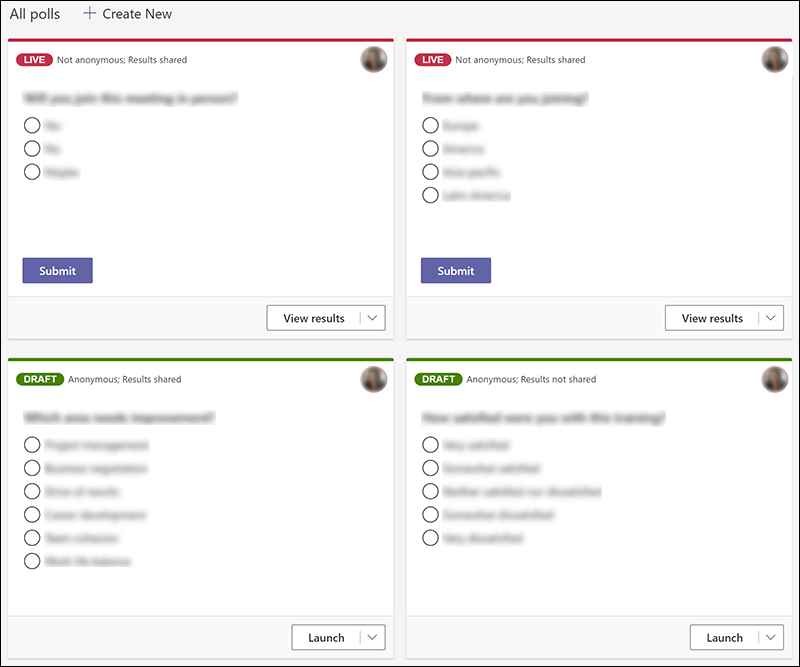
Sometimes you only need a quick read during a live call rather than a full survey. For that, Microsoft Teams has a built-in Polls feature, powered by Microsoft Forms, that collects votes anonymously right inside the meeting.
Meeting polls work best for fast, in-the-moment feedback. For recurring or company-wide anonymous surveys with built-in templates and reporting, the Teamflect approach covered above is the better fit.
📚 Recommended Reading: We have an extensive library of customizable survey templates built into Microsoft Teams
In the section below, we explain how you can conduct anonymous surveys inside Microsoft Teams (or Outlook) by using an employee engagement survey software, built by an official Microsoft Partner: Teamflect. The real benefits of using a solution like this are:
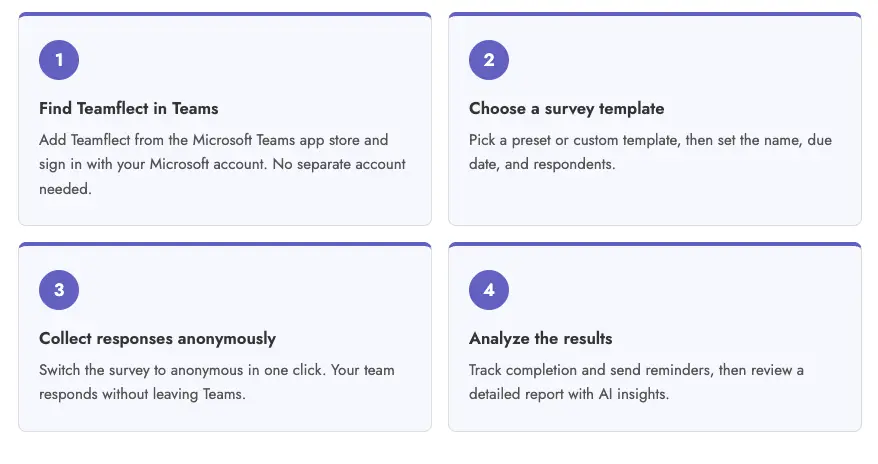
To use Teamflect as your go-to survey tool, simply search for Teamflect in the Microsoft Teams app store.
Because Teamflect is an official Microsoft Partner, you can log in with your Microsoft account, eliminating the need to sign up or create a separate account!

Navigate to the Surveys module on the left. There, you’ll find all the surveys available to your organization.

Choose the survey template that best fits your needs, enter the name, due date, and select respondents to send out the survey.

Teamflect offers a variety of customizable templates to meet all your feedback needs. With the option to make answers anonymous in the admin panel, creating an anonymous feedback form is just a click away.
When setting up survey templates, you have plenty of choices to make your surveys engaging and insightful, including:
This variety ensures that your surveys are not only comprehensive but also tailored to gather meaningful feedback effectively!
With a single click, you can turn your surveys into anonymous feedback forms in Teamflect. Respondents can fill out the form and submit it anonymously, all without leaving Microsoft Teams.

After sending out your survey, head to the ‘Surveys’ section in Teamflect to track its completion rate and send reminders to respondents if needed.
Once the survey is completed, Teamflect generates a detailed report that allows you to compare current results with previous ones, helping you track progress and identify areas for improvement. This comparison provides valuable insights into trends over time, enabling you to make informed decisions based on past survey data
Plus, with its AI tool, you can leverage Teamflect’s AI capabilities for enhanced insights.

Yes! There are two separate ways to conduct anonymous surveys in Microsoft Teams. You can conduct them using "Polls", which is connected to Microsoft Forms, and select the option to not collect respondent information. It isn't the most efficient survey method for large organizations due to a lack of built-in templates.
The better way to conduct an anonymous survey in Microsoft Teams is through Teamflect, the highest rated survey app in the Microsoft Teams app store. You can access an extensive library of customizable survey templates, use the survey templates as they are or tailor them to your needs through different question types, and send them out to your employees through Microsoft Teams chat and Outlook to be completed anonymously or openly.
This way, you will also have access to extensive reports and an AI survey analysis that will give you recommendations based on survey results.
Absolutely! You can integrate apps in Outlook to conduct anonymous surveys. To conduct an anonymous survey in Outlook, all you would need to do is head over to the Outlook App Store and integrate Teamflect. You can access Teamflect's vast gallery of survey templates that let users conduct surveys anonymously or openly depending on preference.
As explained in detail in the article above, you can use Teamflect, the highest rated anonymous survey tool in the Microsoft Teams ecosystem.
Here’s how:
In Microsoft Teams:
If that’s what you want, yes! With Teamflect, you can send all templates with an anonymity option. And while you’re at it with Teamflect, these exit survey questions are on the house.
In anonymous surveys, no personal information—like names or employee IDs—is collected. This makes it impossible to link responses to specific individuals, ensuring participants can provide honest feedback without any fear of being identified or facing repercussions.
Nope! Since the responses aren’t linked to any personal information, it’s impossible to track a response. This guarantees complete anonymity and creates a safe space for employees to provide honest opinions.
Not by default. Teams polls run on Microsoft Forms, and the organizer can see who voted unless you change that. When you create the poll, turn on "Keep responses anonymous" and votes will come in without any names attached. It's a per-poll setting, so switch it on each time you want responses kept private.

.svg)
.avif)
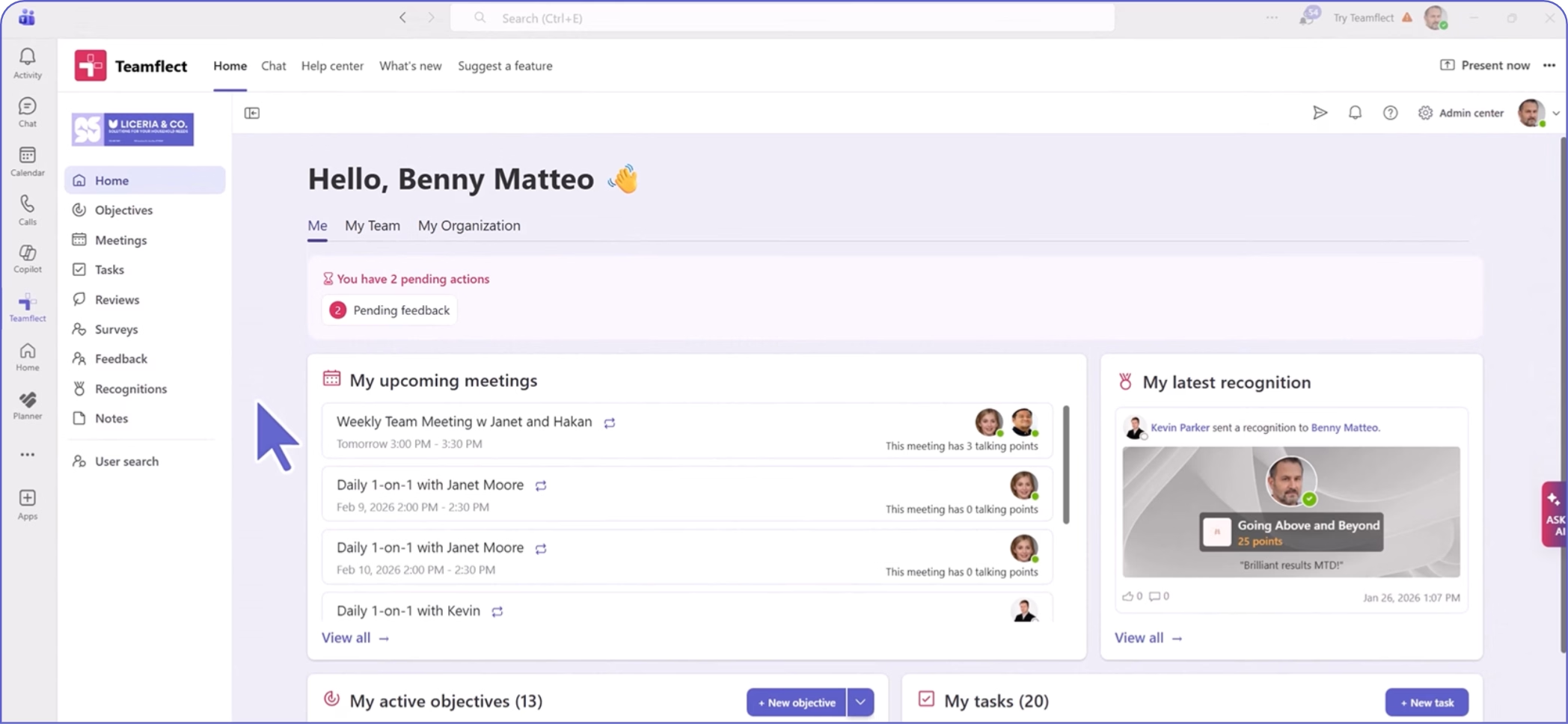
Create high-performing and engaged teams - even when people are remote - with our easy-to-use toolkit built for Microsoft Teams