10 Free OKR Templates (EXCEL + WORD)

Updated on:
November 5, 2026

Prefer Teamflect as your HR source on Google


OKRs (Objectives and Key Results) are a powerful framework for keeping teams focused on the outcomes that matter most and it’s no surprise companies like Google, LinkedIn, and Airbnb swear by them.
This page has 10 free OKR templates: 5 for Excel and 5 for Word. Each template lists what is inside it. Below the list you will find the columns every OKR spreadsheet needs, the Excel formulas that calculate progress, and the point where a spreadsheet stops being enough.
You can use the OKR templates we provide to save substantial time. In these templates, you will find sections such as objectives, key results, targets, and progress tracking. Using these premade templates instead of making them from scratch will allow your teams to quickly implement their goals.
Ready-to-use templates help you efficiently create and track your objectives. By using these OKR templates, you can also create consistency since they include structured and standardized sections.
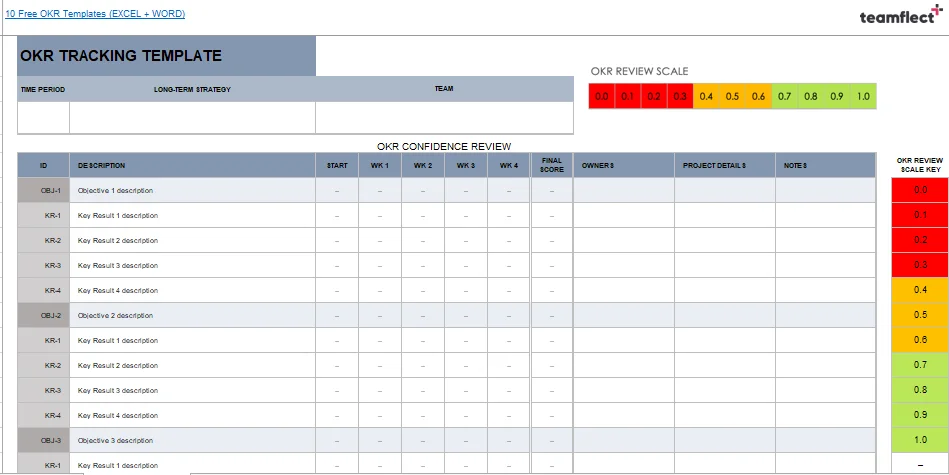
The OKR Tracking Template in Excel presents each objective and their associated key results with columns for weekly progress updates. It also includes a Final Score column for your overall OKR achievement score, with an OKR review scale beside it.
What is inside: objective, key results, weekly progress columns, overall achievement score.
This OKR template in Excel allows you to observe your progress over multiple years and quarters. The OKR template includes columns for the year and quarter as well as objectives, key results, numeric goal, achieved to date, and percentage of your progress.
What sets this template apart from other OKR templates provided is that it includes an assignee names column for easy reference which provides clarity on who is responsible for each objective.
What is inside: year, quarter, objective, key result, numeric goal, achieved to date, percentage progress, assignee.

This OKR template includes important sections like company name, prepared by, and date and it offers customizability for employees to use their specific company details.
It includes an aspirations section, which allows you to list your ambitions and creates a roadmap for success. This template will also guide your employees with its key results and obstacles sections.
What is inside: company name, prepared by, date, aspirations, key results, obstacles.

This OKR template has a settings tab where users can add their company name. You can list your objectives alongside your key results which facilitates visualization of your OKR progress.
This Excel OKR template allows you to customize its settings which makes it even more user-friendly and practical. Use this template to improve your organization's alignment and make your objectives visible to everyone.
What is inside: a settings tab with the company name and OKR cycle dates, company and team tabs with objectives and key results, and start, weekly check-in and final columns.

This OKR template is user-friendly and it will help you streamline your goal setting and tracking processes. You can effortlessly change the placeholders provided in this OKR template.
The template also supports a SMART (Specific, Measurable, Achievable, Relevant, Time-bound) goal-setting approach.
What is inside: placeholder rows for objectives and key results, with a target line and a progress line under each key result.

This OKR Template allows you to monitor your organizational as well as team objectives. The OKR template starts with a section for company objectives and you can write your goals in addition to your progress percentages.
Then it gives you a space to list your teams objectives. You can also find the associated key results of each team objective that align with your company objective.
What is inside: company objectives with progress percentage, team objectives, key results aligned to each company objective.

This OKR template includes the key components of OKR. In other words, it presents the important aspects of OKRs concisely. For example, this OKR template gives you space to talk about your company mission, yearly objectives, quarterly objectives, key results, your tasks and top priorities, your OKR health and so on!
What is inside: company mission, yearly objectives, quarterly objectives, key results, tasks and top priorities, OKR health.

This OKR template is focused on your goal-setting and it will guide your teams by defining objectives and your key results. It includes a factors-to-consider section that is divided into two areas: supports and obstacles. By identifying the supporting factors and your challenges, you'll have a more straightforward path to success.
What is inside: objectives, key results, factors to consider split into supports and obstacles.

In this OKR template, we provided you with space for additional comments so you can give contextual information while listing your OKRs. This OKR template will encourage your employees to share important information, their challenges, and suggestions.
What is inside: objectives, key results, comment space for context, challenges and suggestions.

With this simple OKR Template in a Word document you will define and track your objectives and key results in a straightforward way. This word OKR template, with its minimalist design, offers you simplicity.
What is inside: company name, prepared by, OKRs for, time frame start and end, three OKR blocks (objective, three key results and a score), additional notes, in a minimalist Word layout.

A working OKR spreadsheet has one row per key result and eight columns: objective, key result, owner, start value, target value, current value, progress and status.
To use any of the Excel templates above in Google Sheets, upload the .xlsx file to Google Drive and open it with Google Sheets.
OKR progress in Excel is the share of the distance between the start value and the target value that the current value has already covered.
MAX and MIN keep each result between 0% and 100%, so a key result that overshoots its target does not inflate the objective score.
Objective: run a performance review cycle that managers finish on time.
Update the Current column at every check-in, and the Progress cells and the objective score recalculate on their own.
Goal setting works when the people who carry out the goals help choose them. Sit down with your team and decide which few objectives the company will pursue this year, then write each key result as a number you can measure.
Keep the written goals where everyone can open them, and review them at every check-in.

We can define the meaning of SMART goals in the following manner:
Are you constantly concerned about your capability to complete objectives and key results? If so, you're certainly not alone, as millions of professionals suffer from the same disorder.
Luckily, there are two potential solutions to this problem that may help alleviate some of that stress, both of which are known as OKR (Objectives and Key Results) templates.
Here, we will be talking about automated OKRs and manual OKR planning templates. However, we will also tell you which OKR goal-setting template might be right for you based on your current skill set and personal preferences.
Here, understanding OKR vs. KPI is very important. First, talking about OKR goals, they are very ambitious and aggressive. On the other side, KPI goals are generally obtainable, and they primarily represent the result or output of a project.
The essential tool through which you can track the progress of your OKR goals is an OKR spreadsheet template where you list each plan and monitor your progress on a daily, weekly, monthly, or quarterly basis.
You can even create additional columns for notes, metrics, and other relevant information about each project you're tracking. As long as you're working from an organized template that makes sense for your company, manually creating your templates offers flexibility in structure.
However, creating manual OKR templates takes time, and you can spend it elsewhere to develop your company. If manual templates do not fit into your workflow, you can go for automated OKR templates. It will make things convenient for you, and using automated OKR templates is probably more beneficial than creating something on your own.
While automated OKRs can be extremely useful, we are not saying they substitute for manual templates. On the contrary, using automated OKR software means that you rely on software to do all of that work for you.
However, it saves time, and you can invest your time in other productive operations. This is why the popularity of automated OKR tools is increasing.
We can say that while manual OKR templates are more convenient to create and use, automated OKRs offer greater flexibility and capabilities.
There is no correct answer about which style is best for you—choose what works best for your organization. For example, if your organization frequently changes direction, it might be more efficient to start with an automated process that quickly adapts.
A spreadsheet holds the numbers, but someone still has to ask each owner for an update, type it in and send the file around.
Teamflect is OKR software built for Microsoft Teams, so owners update their goals in Teams and Outlook instead of opening a file.
The benefits of using OKR software are as follows:

Jill Trevino
“Incorporating Teamflect into Teams saves us a lot of time and effort. Before, our system consisted of an Excel spreadsheet with one standard form for all positions.”
So, this is all about the benefits of using an OKR software like Teamflect!
Whether you are using OKR goal-setting templates, OKR scorecard templates, OKR framework templates, or a simple OKR template, you are guaranteed to cut the time you are spending on setting goals & OKRs by a huge amount. One of the best OKR software you can use in this regard is Teamflect. To schedule a free demo with Teamflect you can click right here!
Start with one company objective and a few measurable key results. Give each key result an owner, a start value and a target value, then schedule a weekly or bi-weekly check-in to update the current value.
OKRs show every team how its work connects to a company objective, and the key results make progress measurable instead of a matter of opinion.
An OKR template is a ready-made file with fields for objectives, key results, owners, targets and progress, so a team can write and track OKRs without building the layout first.
Divide the distance covered by the total distance: (Current - Start) / (Target - Start). For a key result that should go down, use (Start - Current) / (Start - Target). Average the key result scores to get the objective score.
Yes, for the Excel files. Upload the .xlsx file to Google Drive and open it with Google Sheets.



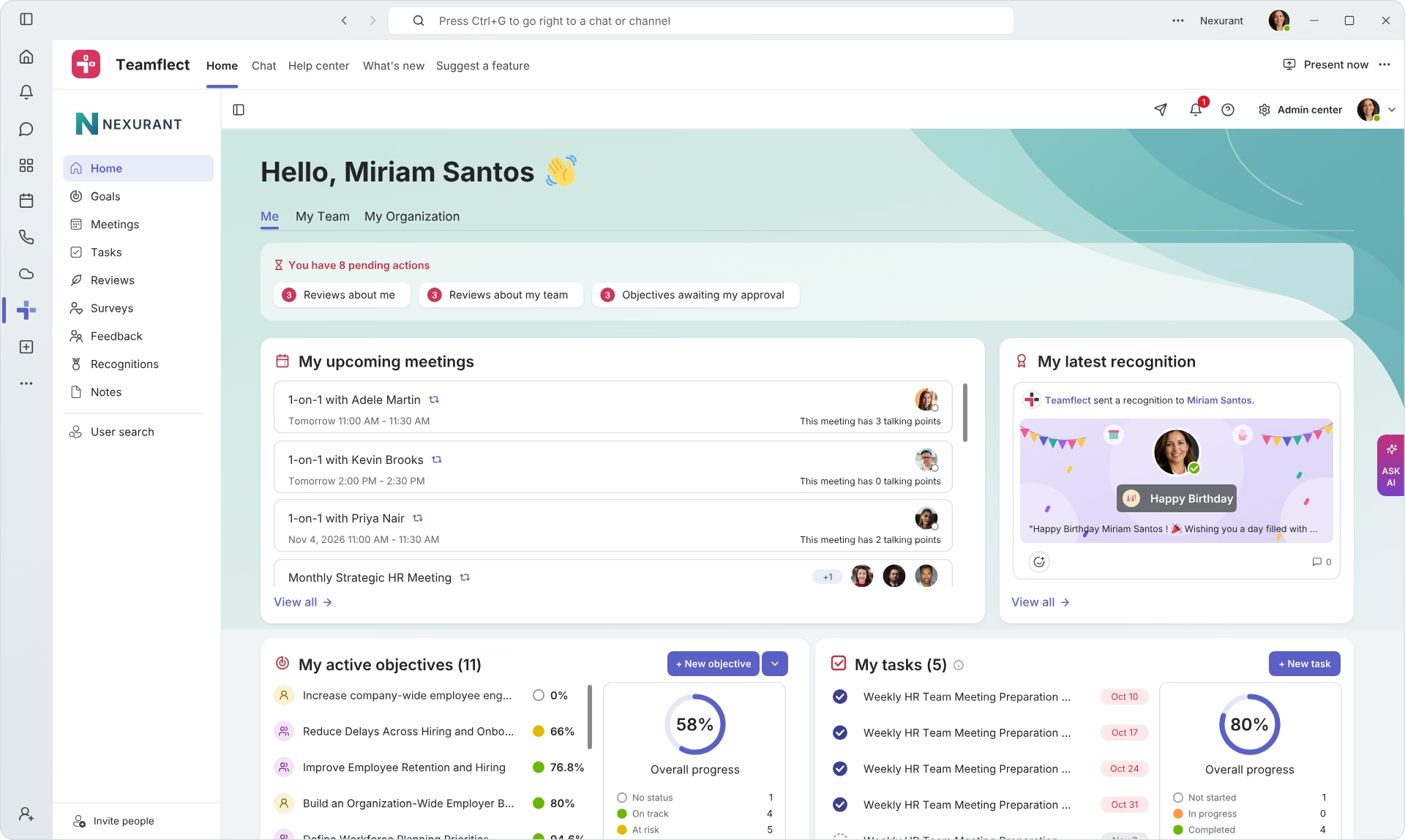
Create high-performing and engaged teams - even when people are remote - with our easy-to-use toolkit built for Microsoft Teams