.svg)
.svg)
10 Employee Feedback Templates and a Free AI Feedback Generator

Updated on:
March 11, 2026

Prefer Teamflect as your HR source on Google
.svg)

A template gives you the shape of feedback, but it cannot know what actually happened. Use the ten employee feedback templates below when you want a proven structure. Or tell the free AI feedback generator what happened and get a short message you can send, with the replies to prepare for. It works for praise and for problems.
Regular feedback is essential for a healthy workplace culture. When employees receive structured feedback from their managers, they understand what they are doing well and have a clear picture of where to improve.
Employee feedback templates are also valuable for managers and organizations. With regular feedback, managers can identify areas where employees need support and tailor their approach to help individuals achieve their goals — improving retention, productivity, and overall results.
According to Gallup, managers who deliver frequent, meaningful feedback see significantly higher team engagement — with employees who receive regular direction and recognition reporting stronger performance outcomes and lower turnover intent.
In addition to improving performance, feedback helps foster a culture of open communication and trust within an organization.
When employees feel heard and valued, they are more likely to share their thoughts and ideas with their colleagues and managers, creating a more open and collaborative workplace.
Ultimately, the case for regular employee feedback is clear. It is critical for employees, managers, and organizations to grow, improve, and achieve their goals.
Below are ten employee feedback templates that give employees the structure they need to succeed.
Manual feedback processes are time-consuming and prone to inconsistency. 360 feedback software can help streamline the feedback process and surface actionable insights to improve employee performance and organizational outcomes.
The right feedback software saves time, increases consistency, improves communication, and makes it easier to track progress across teams.
With a feedback platform, you can create and distribute employee feedback templates, monitor completion, and generate reports to identify performance trends and areas for improvement.
Teamflect is an all-in-one performance management platform built for Microsoft Teams. With customizable templates, automated reminders, real-time feedback, and data analytics, it keeps the entire feedback process inside the tools your team already uses.
With Teamflect, you can create and manage feedback loops for individuals, teams, and entire organizations in one central platform.

Using Teamflect, managers can create employee feedback templates for all types of feedback, including peer feedback, 360-degree feedback, and self-assessment. Automated reminders ensure that all feedback is submitted on time, and progress is trackable in real-time.
Teamflect's data analytics feature allows teams to generate Power BI reports and analyze performance trends across the organization, making it easier to identify areas for improvement and track progress over time.
Key capabilities include:
The behavioral feedback template focuses on specific behaviors observed in team members and provides feedback on how those behaviors affected their performance.
By focusing on behaviors rather than personality traits or generalizations, this template keeps feedback objective and actionable.
When using the behavioral feedback template, start by describing the specific behavior observed — be concrete and avoid generalizations. Next, explain how that behavior impacted performance, either positively or negatively. Finally, provide suggestions on how the team member can continue to improve.
Focusing on behaviors and giving actionable, timely feedback helps employees understand exactly what they need to do differently — and what to keep doing well.
The performance feedback template is a pre-designed form for assessing employee performance over a specific period, typically annually or bi-annually.
It includes questions that address specific areas such as job responsibilities, goals, and achievements.
One of the core benefits of a performance review form is its structured, objective approach to evaluation. Performance feedback forms also encourage goal-setting and development planning — opening a direct conversation about an employee's aspirations and the steps needed to reach them.
The employee developmental feedback template is designed to help managers give constructive feedback that encourages growth. It focuses on identifying areas where team members can improve and provides suggestions and resources to help them get there.
Developmental feedback is typically given regularly — during performance reviews or scheduled check-ins — but can also be triggered by specific development needs as they arise.
When feedback focuses on growth, team members feel invested in, and their motivation and job satisfaction tend to follow. Developmental feedback also builds trust between managers and their teams, creating an environment where creativity and collaboration can take hold.
The 360-degree feedback template involves feedback from multiple sources — team members, managers, peers, and sometimes customers or clients. This comprehensive approach provides a well-rounded view of performance, strengths, and areas for improvement.
The holistic view it creates can surface strengths, weaknesses, and blind spots that a single perspective would miss. It also promotes self-awareness and personal growth — seeing yourself through multiple lenses can prompt meaningful shifts in behavior and decision-making.
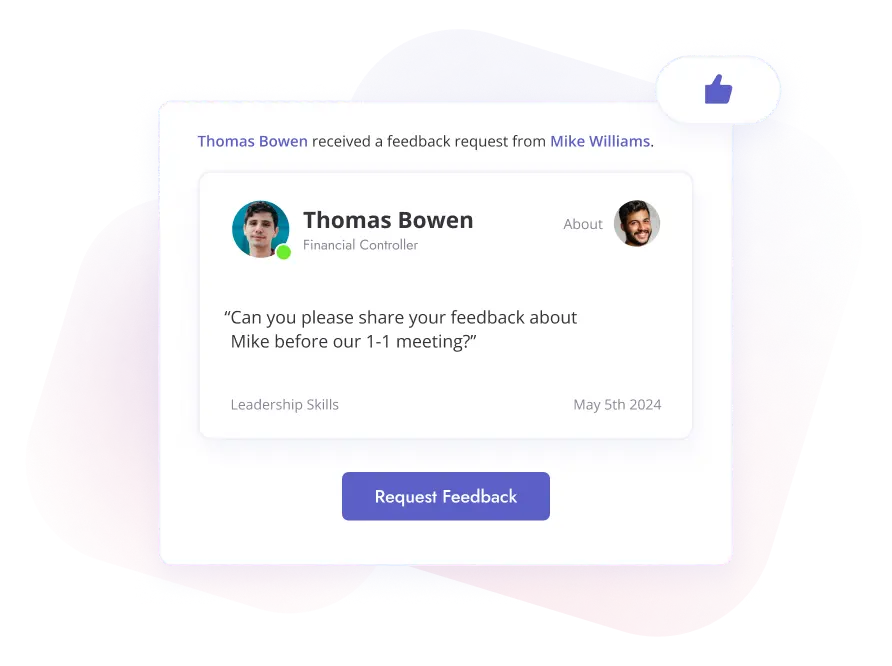
The leadership skills feedback template gives employees and managers a clear picture of how their leadership is perceived by others. Importantly, leadership skills apply to anyone — not just those in formal leadership roles.
This template helps team members develop leadership capabilities regardless of their position, while giving them insight into how they are perceived by colleagues — a foundation for self-awareness and professional growth.
The peer feedback template gathers input from a team member's colleagues, providing a perspective on performance and behavior that managers often cannot see on their own.
Peer feedback helps identify blind spots and development areas that may not surface in a manager review. It also builds a culture of open communication and trust — when peers regularly share honest feedback, collaboration and teamwork tend to strengthen across the team.
The exit interview template collects feedback from departing employees — one of the most candid sources of insight an organization can access.
Because departing employees have less reason to filter their responses, this template often surfaces issues with management, culture, compensation, or processes that current employees may not raise directly. That feedback can drive meaningful improvements across the organization.
The goal oriented feedback template focuses feedback on the progress toward specific objectives, making it a strong tool for performance management and development conversations.
To use it effectively, identify the specific goals you want to assess — such as sales targets, customer satisfaction, or team collaboration. Ask the employee to reflect on their progress relative to those goals, what they have learned, and what actions they plan to take next.
When feedback is tied to specific goals, employees tend to stay more focused and engaged — and outcomes improve as a result.
Self-review is one of the most underused parts of a feedback cycle, yet it drives some of the strongest development outcomes. The self-assessment feedback template is designed for employees to assess their own performance and identify areas for growth.
The act of self-evaluation builds self-awareness and encourages employees to take ownership of their professional development — shifting the dynamic from feedback as something that happens to them, to something they actively participate in.
The project-based feedback template covers all key dimensions of project work: goals, milestones, timelines, budget, quality, communication, teamwork, leadership, and problem-solving.
It is designed for managers and team leaders who need to give structured feedback on both individual contributions and the team's collective performance — making it easier to identify where additional support is needed and where the team is performing well.
Knowing which type of employee feedback template to use is only half the equation. Understanding what a well-structured template contains is what separates feedback that drives change from feedback that gets filed and forgotten.
Most effective employee feedback templates share a common architecture. At minimum, they include a rating scale or scoring mechanism to assess specific performance dimensions, open-ended questions that invite behavioral observations, a section for strengths with concrete examples, a section for development areas with suggested actions, and a space for agreed next steps or follow-up dates. Templates designed for ongoing use — rather than annual reviews — tend to be shorter and more focused, covering one or two dimensions per conversation rather than everything at once.
Research from Gallup shows that employees who receive frequent, structured feedback are significantly more likely to be engaged at work than those who receive feedback only once a year. The structure matters as much as the frequency — vague feedback without a template to anchor it tends to create confusion rather than clarity.
A useful heuristic: a strong employee feedback template should answer three questions for the recipient. What did you do well, and why does it matter? Where do you need to grow, and what does that look like in practice? What will you and your manager do differently in the next 30 days? Templates that consistently answer those three questions — whether behavioral, developmental, or goal-oriented — tend to produce the most durable behavior change. For a deeper look at how feedback structure affects performance, this HBR piece on the feedback fallacy is a useful read to share with your management team.
For HR teams ready to move beyond generic forms, Teamflect's feedback module allows managers to customize templates around specific competencies, auto-schedule recurring feedback cycles, and track progress without leaving Microsoft Teams. See how teams using Teamflect have built consistent feedback habits that improved review completion rates and manager confidence: Read Case Studies
Feedback templates save time. Using pre-designed structures ensures all necessary areas are covered without having to start from scratch each cycle — freeing managers to focus on the quality of their feedback rather than its format.
Templates also drive consistency. When all employees receive feedback through the same structure, evaluations become more objective and bias is easier to identify and reduce. That consistency is critical for building a workplace where employees trust the process and respect its outcomes.
Finally, feedback templates provide a shared framework for both managers and employees. For managers, they organize the conversation and ensure nothing important is missed. For employees, they clarify expectations and provide a roadmap for growth and development.
Employee feedback is an essential driver of performance, communication, and organizational success. Without it, employees lack the clarity to improve — which leads to disengagement and turnover over time.
Feedback templates and feedback software make the process more consistent, more efficient, and more impactful. With customizable templates and real-time tracking, feedback becomes easier to manage at scale.
By building employee feedback templates into your performance management strategy, you can create a culture of continuous feedback, engagement, and collaboration that compounds over time.
Schedule a demo with Teamflect to see how structured feedback can work for your organization — with a platform built specifically for Microsoft Teams.

.svg)
.avif)
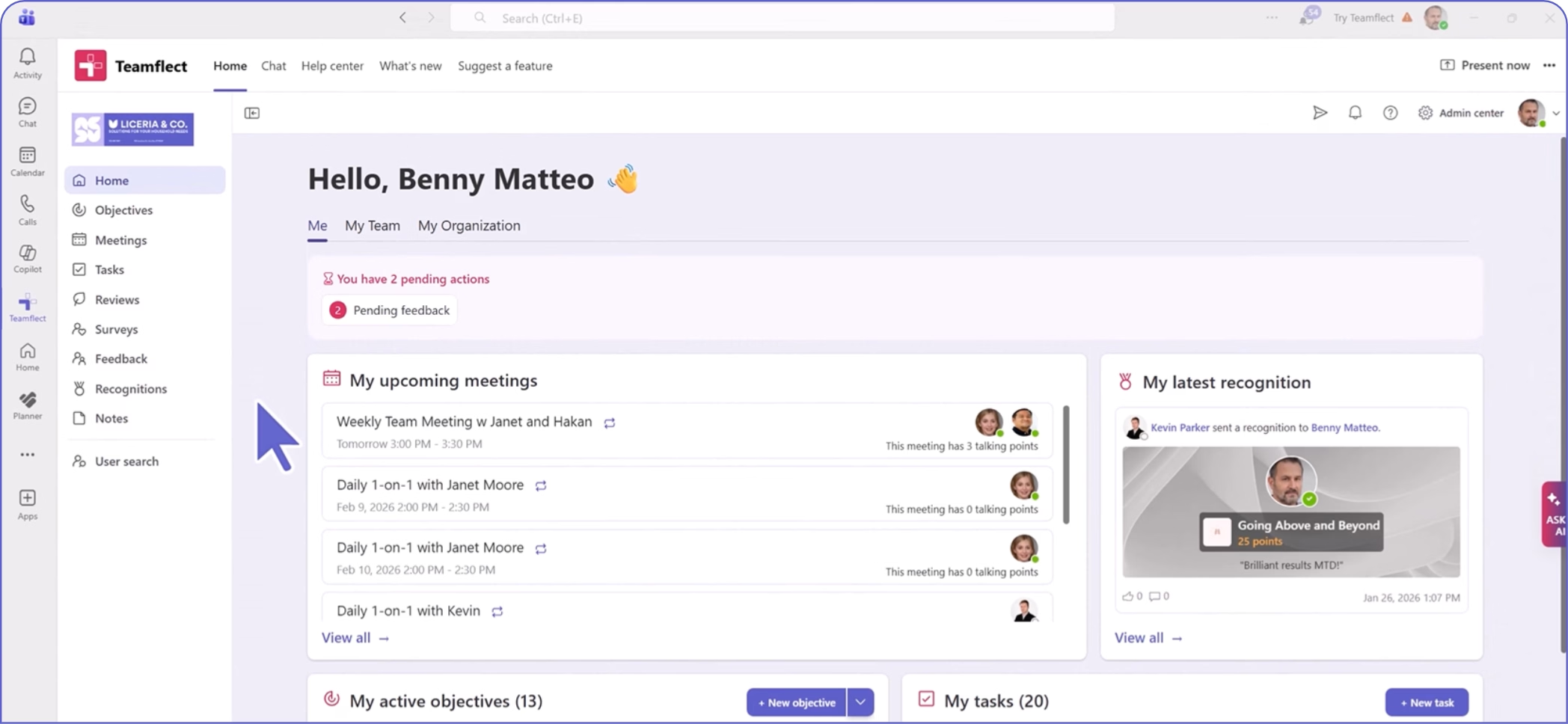
Create high-performing and engaged teams - even when people are remote - with our easy-to-use toolkit built for Microsoft Teams