.svg)
.svg)
Fillable PDF Performance Review Templates: 10 Free Forms and a Generator for Your Own

Updated on:
October 23, 2026

Prefer Teamflect as your HR source on Google
.svg)

PDF performance review templates are one of the oldest and longest enduring performance review formats. While the most industries are moving away from them for more digital and customizable solutions, we know that they are still quite widely used. To make sure the organizations still using them are at the very least using the best possible versions available, we created 10 of the best PDF performance review templates anyone can find on the internet in 2026.
Need a different format? We also have a Word performance review template and an Excel performance review template.
Our HR department and management experts collaborated with our designers to design 10 editable PDF templates for a wide range of performance review scenarios that you can download for absolutely free.
Best for: Year-end evaluations where you need both a narrative record and a goal-by-goal account of what was achieved.
What we like:
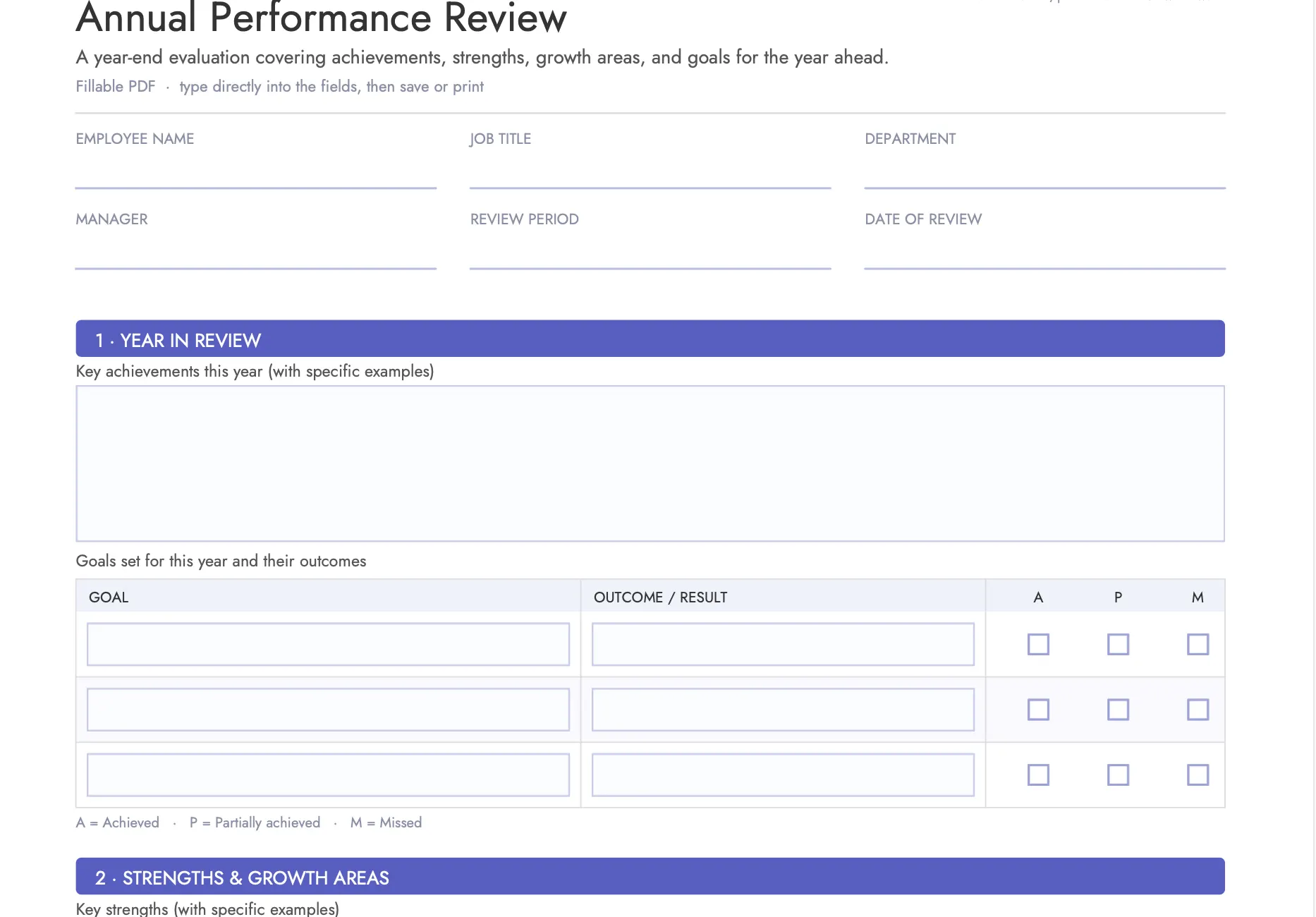
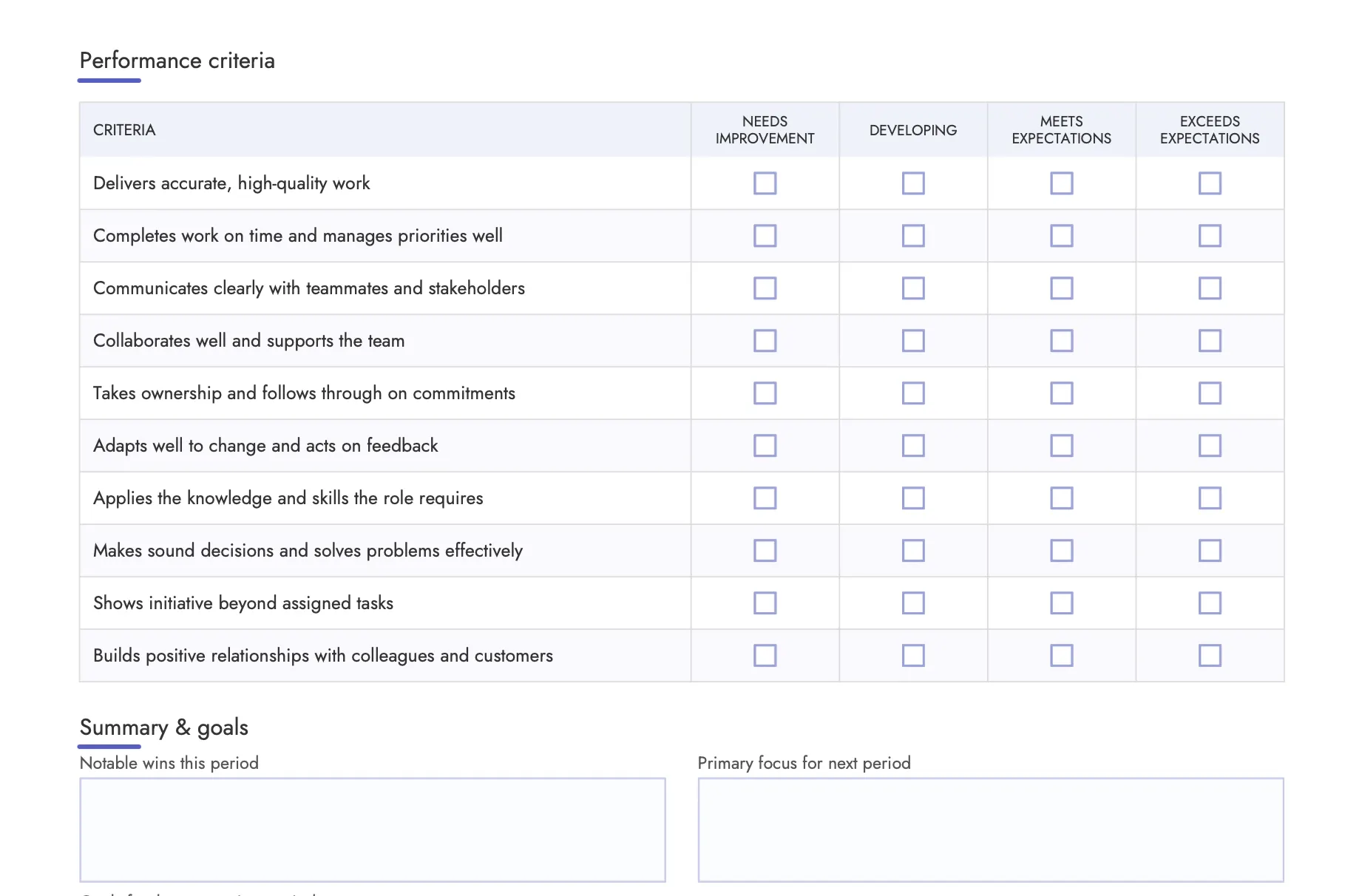
Switching from open-ended performance review questions to a checklist: ten behavior-based criteria on a four-point scale, with wins, focus, and goals, all on a single page.
Best for: Fast general-purpose reviews, or any cycle where a longer form means the review stops happening.
What we like:
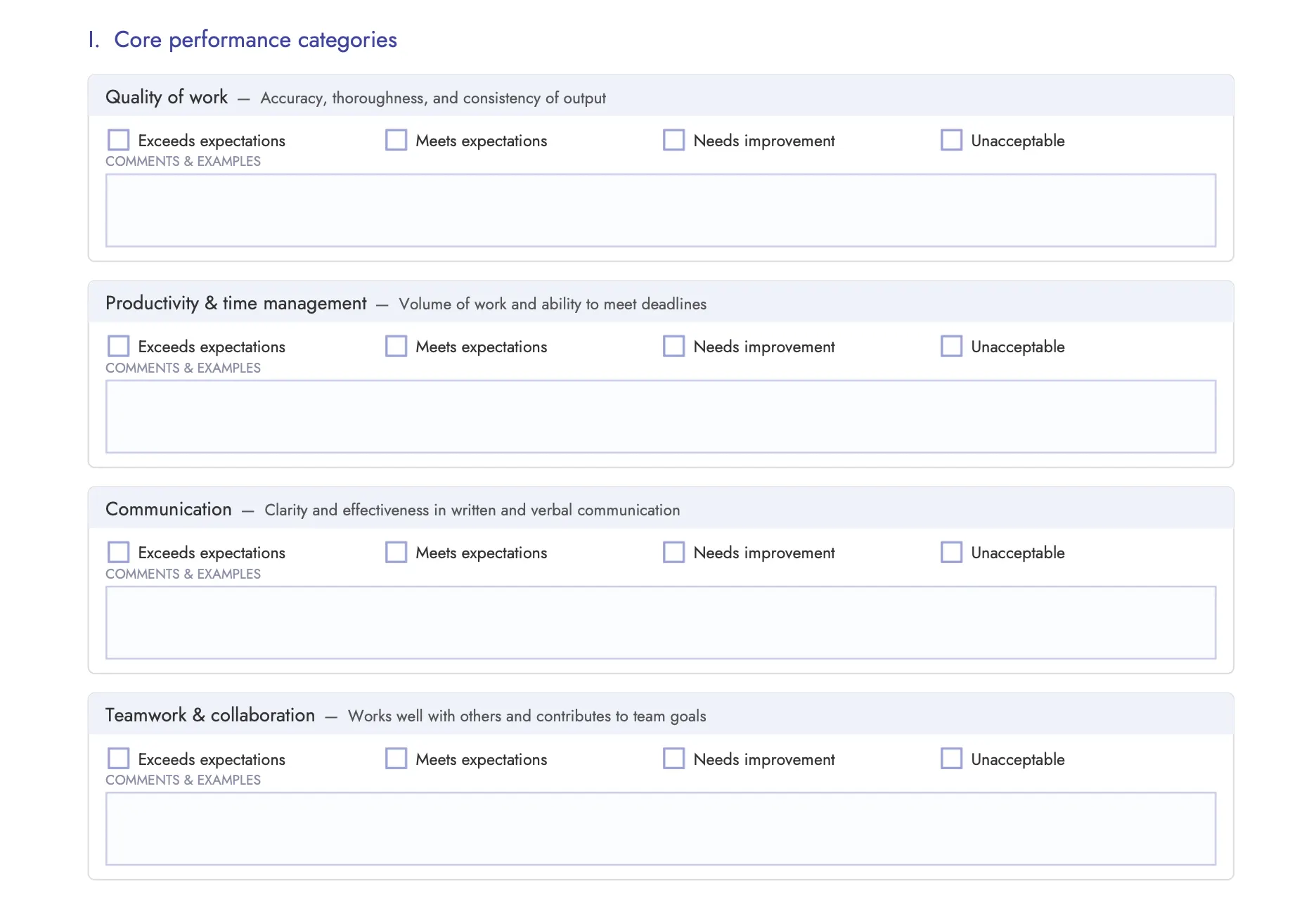
Six core performance categories where every rating must be backed by written comments and examples, plus two blank job-specific criteria you define for the role being reviewed.
Best for: Structured evaluations where ratings need an evidence trail, including reviews that feed into HR records.
What we like:
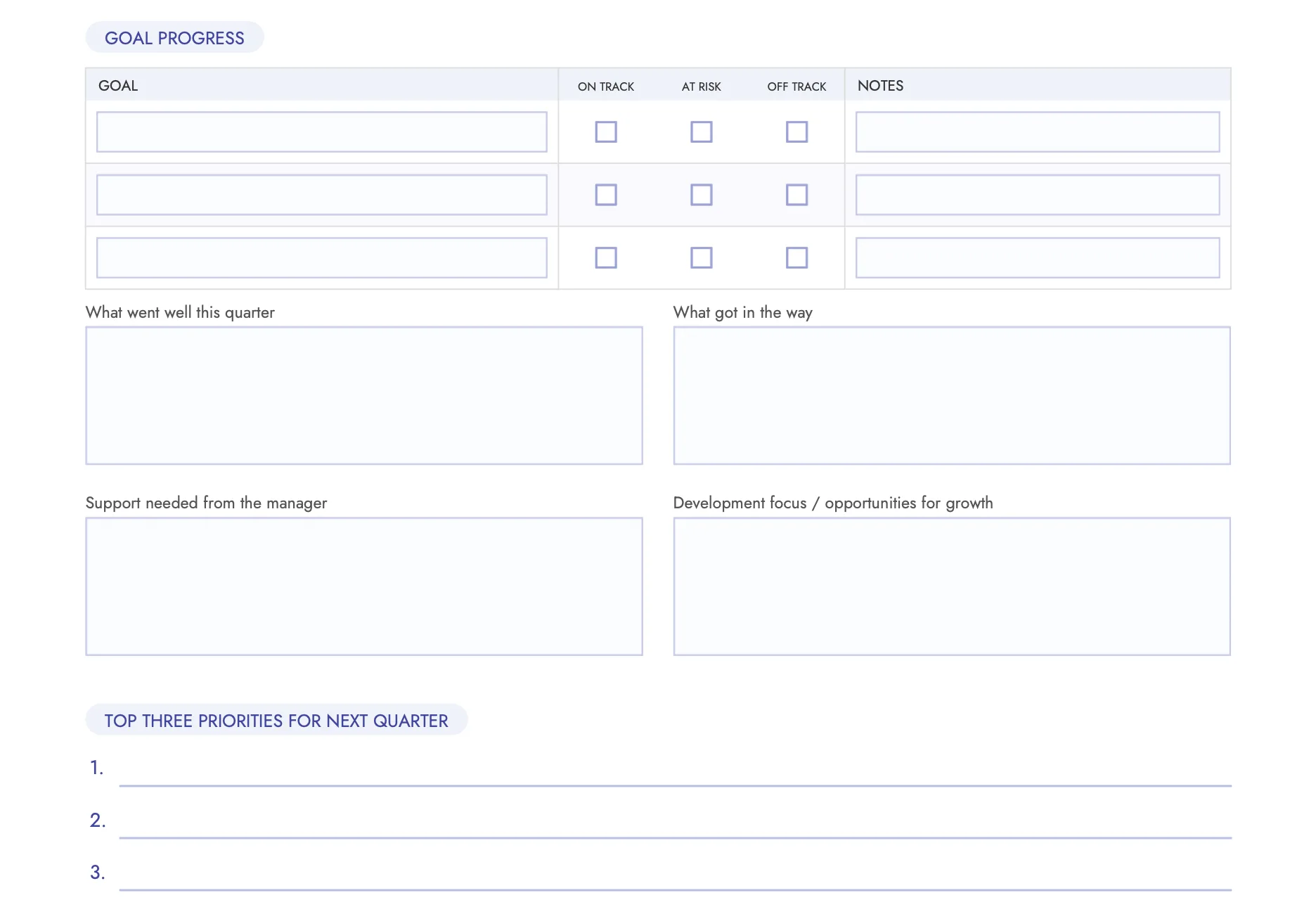
A one-pager built for frequency: goal status, what went well, what got in the way, and three priorities for the next quarter. If you are still settling on aperformance review frequency, this is the template that makes shorter cycles sustainable.
Best for: Monthly or quarterly check-ins between formal reviews, when the goal is course correction rather than evaluation.
What we like:
The most complete template in the set: an employee self-assessment, fourteen competencies rated on an anchored 1-5 scale, and an N/A option for employees too new to evaluate fairly.
Best for: Organizations that want scores they can compare across people and cycles without losing the written evidence behind them.
What we like:
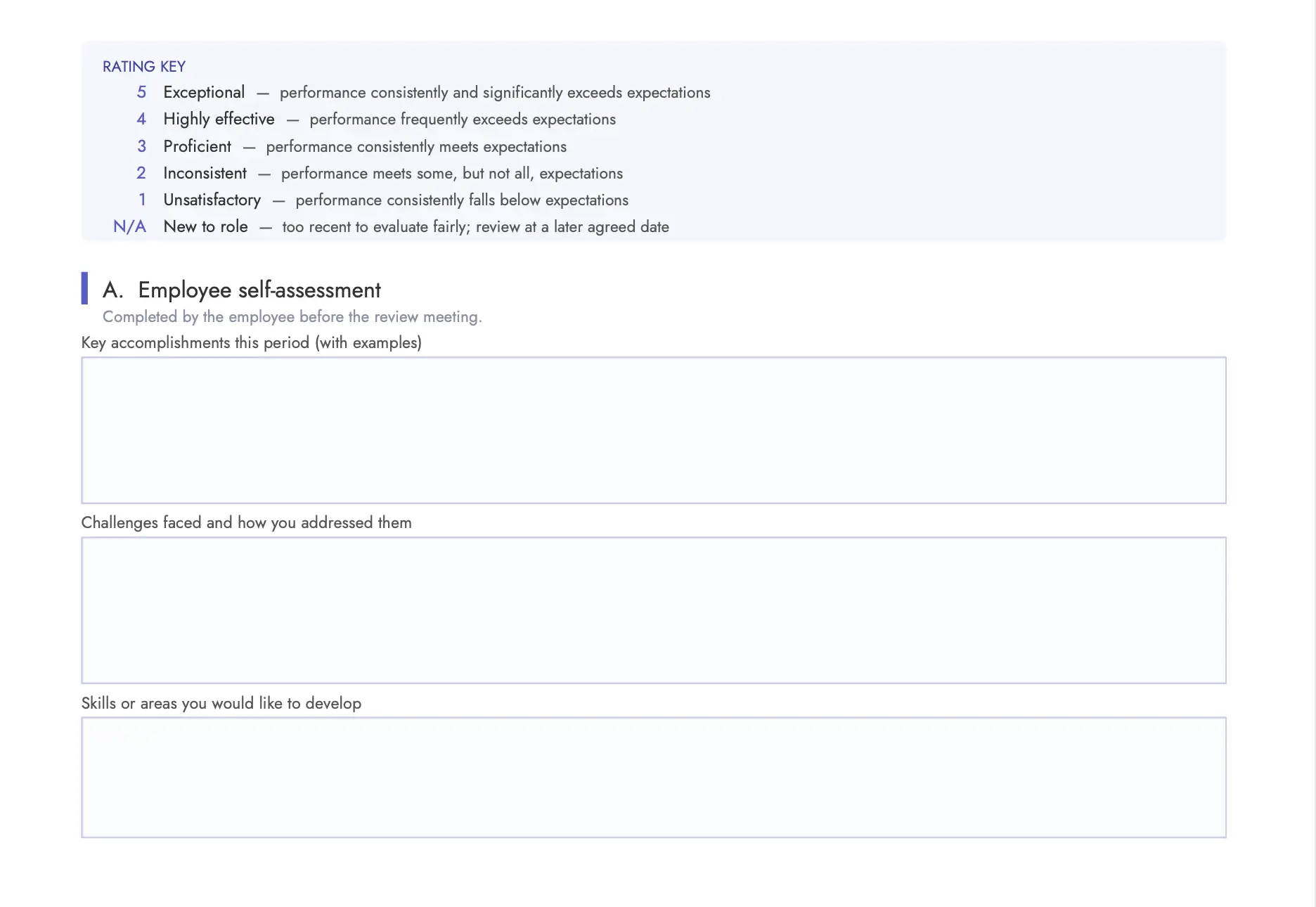
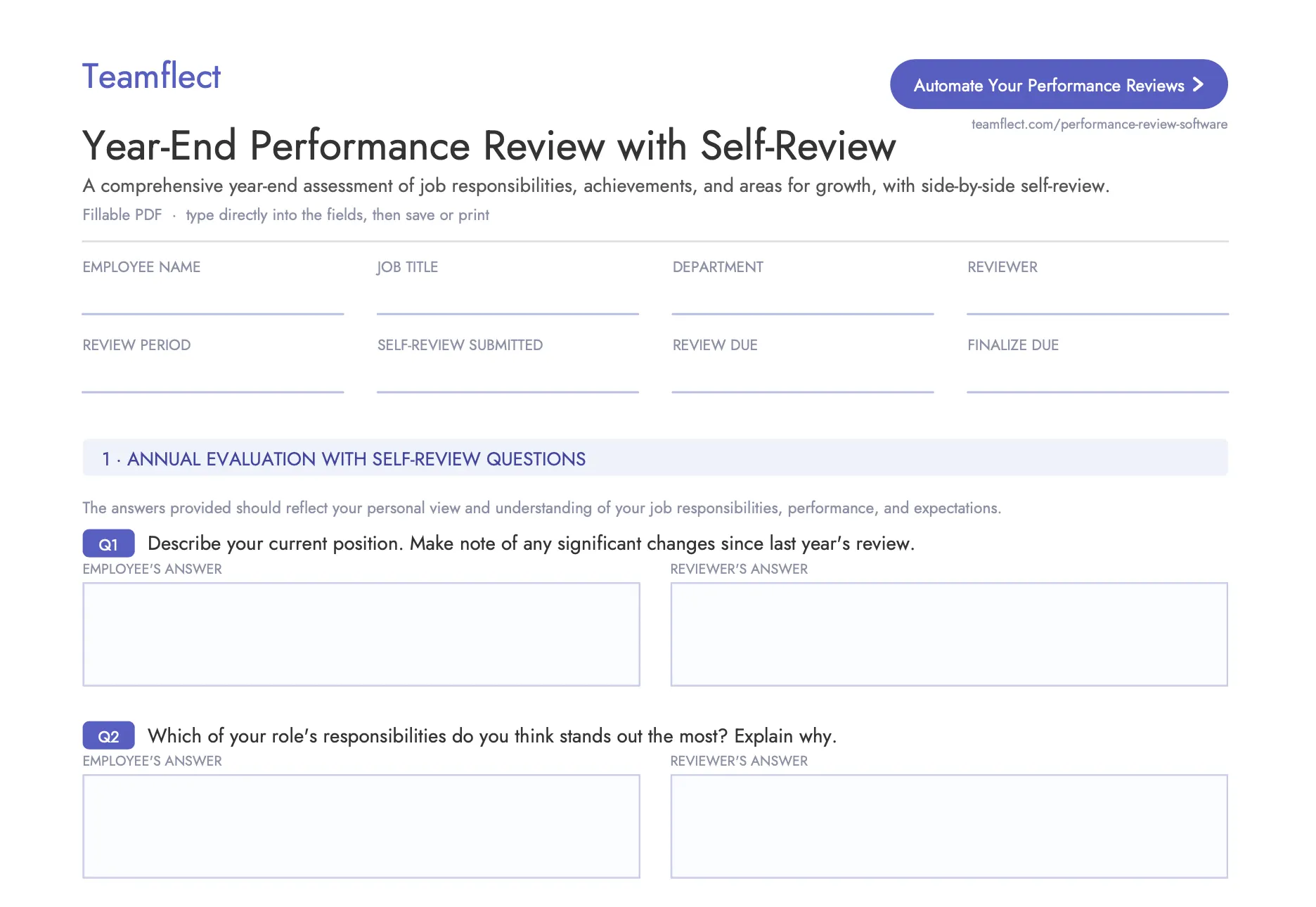
This is the heaviest review of the year, so the template carries four sections: an annual self-review, a core values assessment, goal-oriented questions, and company culture questions. The employee and the reviewer answer every question side by side in the same fillable PDF.
Best for: Organizations running one comprehensive annual cycle where the employee's voice carries the same weight as the manager's.
What we like:
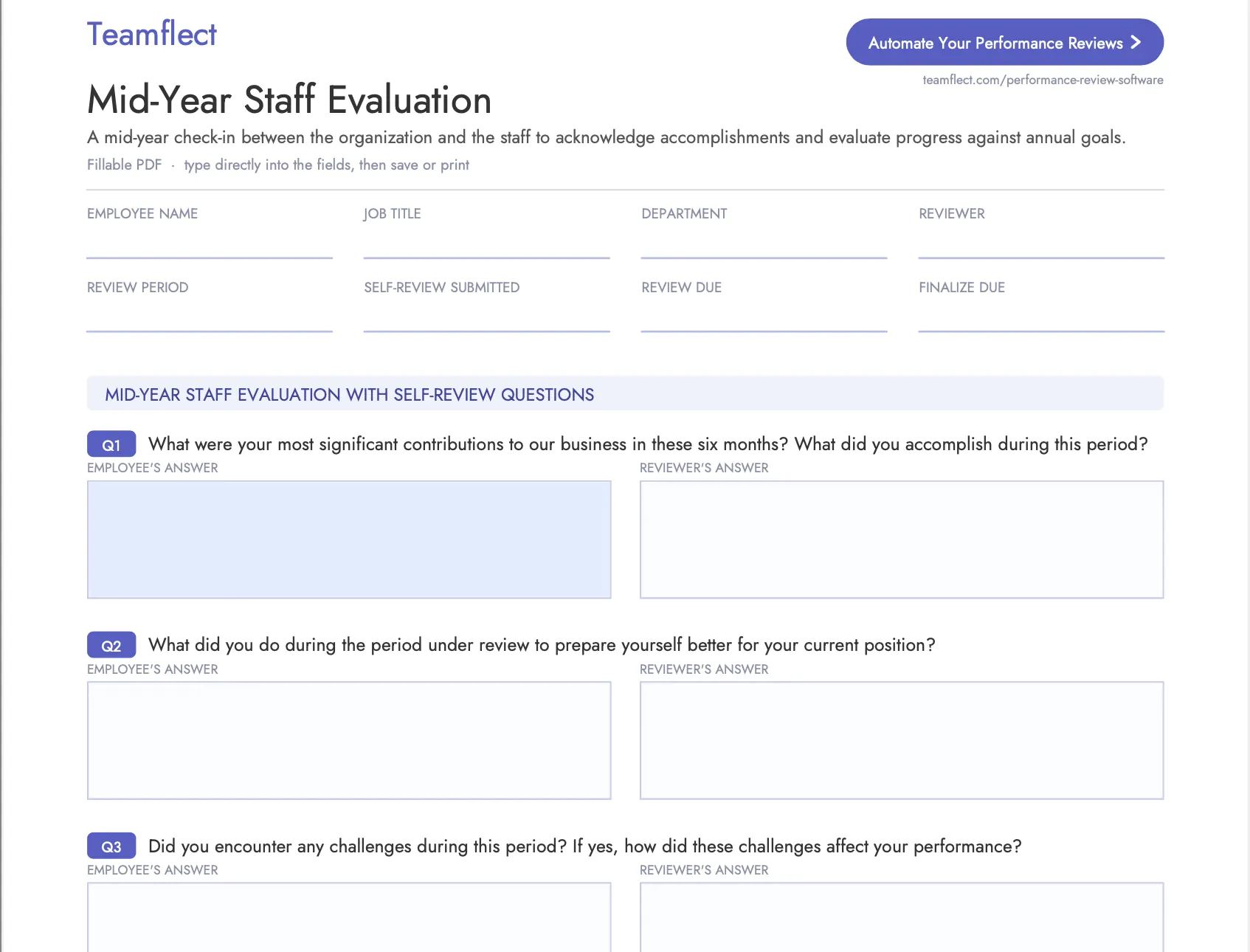
A five-question checkpoint at the halfway mark covering contributions, preparation, challenges, team comfort, and development priorities. It is deliberately light, designed to course-correct against annual goals rather than re-litigate them.
Best for: Mid-year check-ins between two annual reviews, when you need honest progress read without the weight of a full evaluation.
What we like:
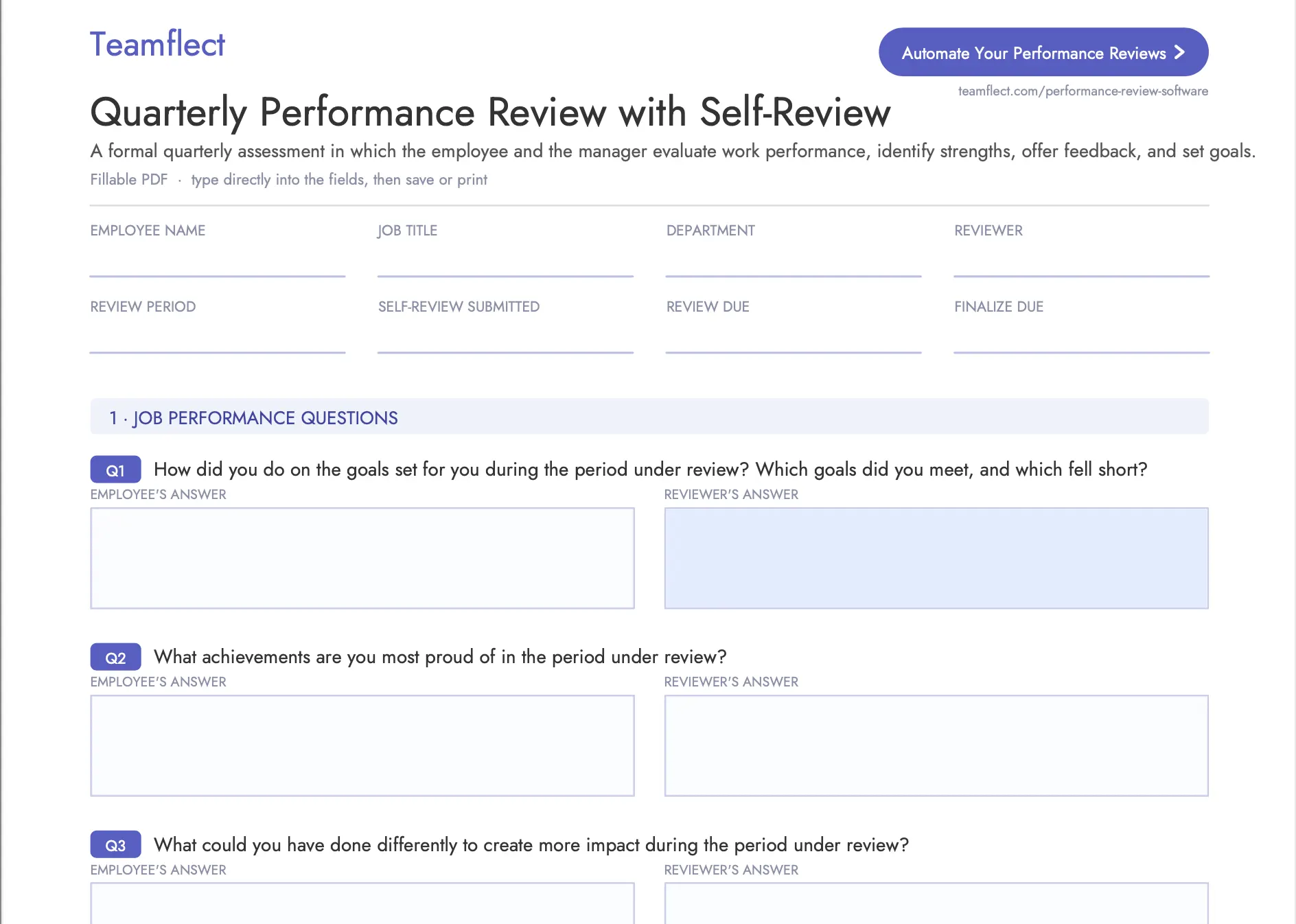
Where the quarterly check-in earlier in this list takes ten minutes, this template runs a complete review cycle: five job performance questions and three goal-oriented questions, each answered by both the employee and the reviewer.
Best for: Teams that review on a quarterly cadence and want self-review built into every cycle instead of saving it for year-end.
What we like:
Fifteen questions covering the full arc of a seasonal hire: role skills, work quality, teamwork, attendance, customer handling, and the decision every seasonal review exists to answer, whether to bring them back.
Best for: Retail, hospitality, and other seasonal operations that need a documented, defensible record before rehire decisions.
What we like:
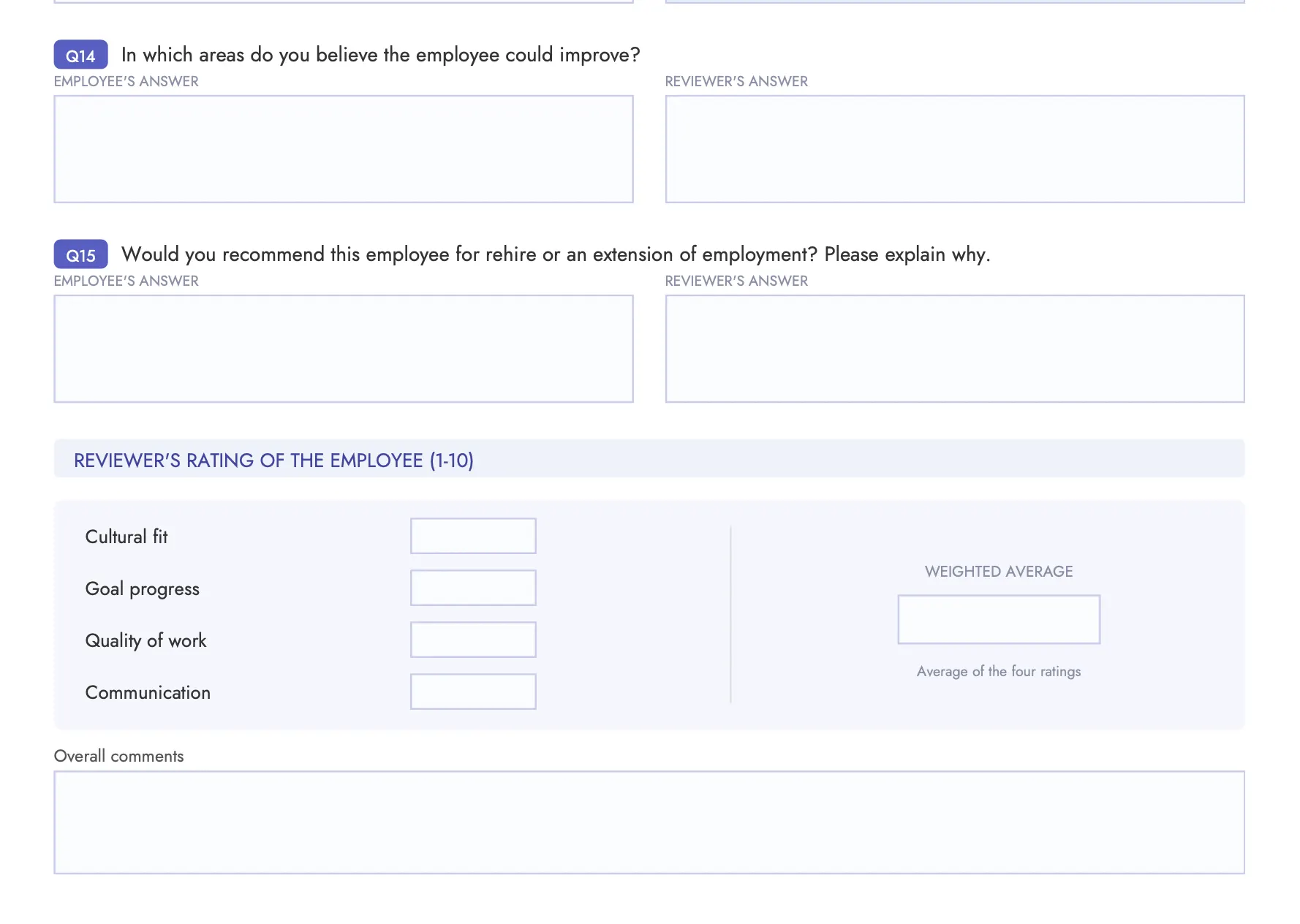
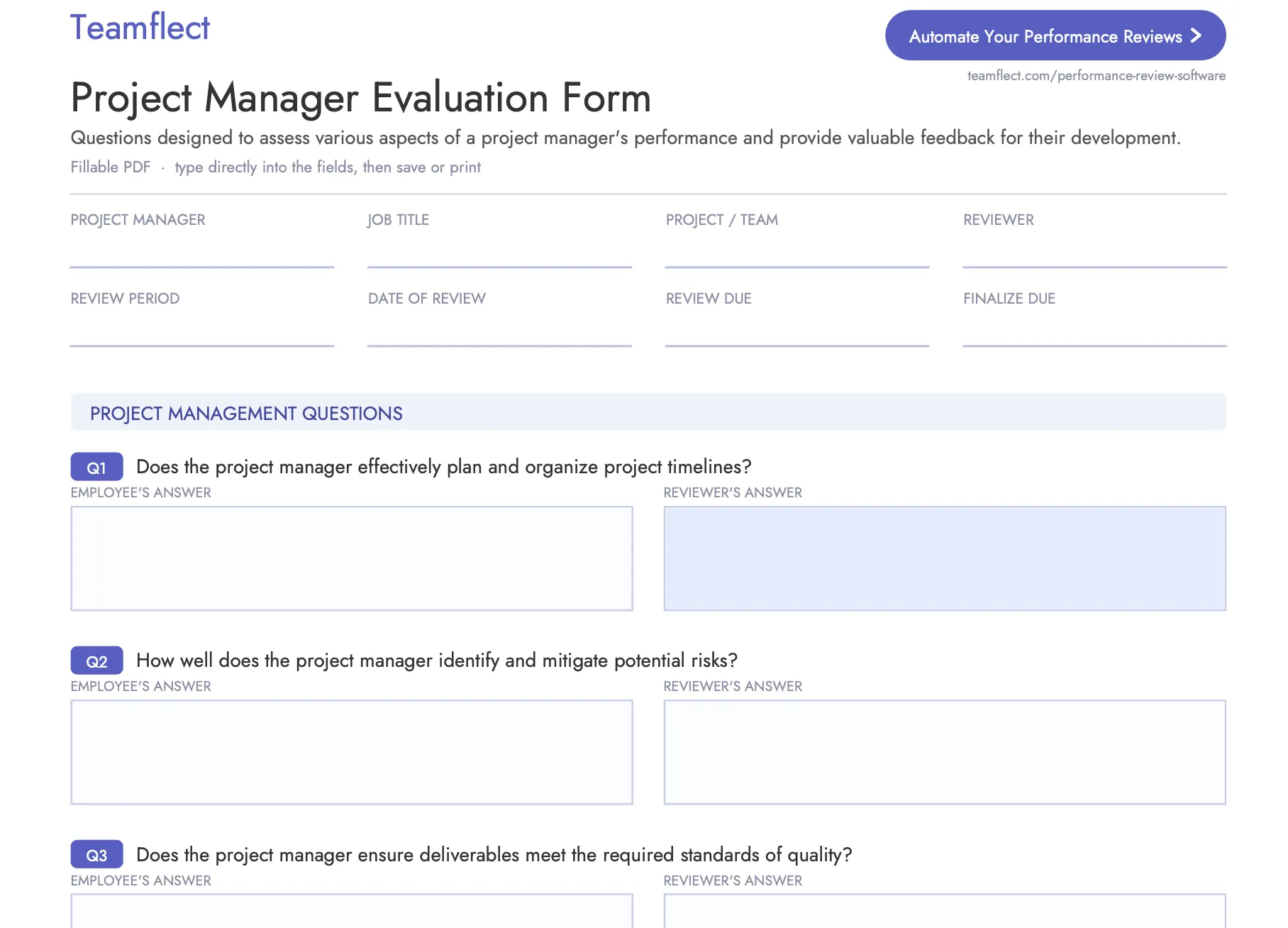
Fifteen questions across the competencies that define the role: planning, risk, quality, budgets, team leadership, conflict handling, and stakeholder communication. Both the project manager's self-assessment and the reviewer's evaluation live in the same document.
Best for: Evaluating project managers on delivery outcomes and people leadership, at project close or on a regular review cadence.
What we like:
An employee evaluation form scores a fixed set of competencies on one scale, while a performance review template adds goals, a self-review and a development plan around those scores.
If you only need to score competencies, start with our Employee Evaluation Form (template 3 above).
Utilizing a PDF performance review template will help you set a structured pace for your evaluations and give you a professional approach to review processes. Unlike editable formats, PDFs ensure consistency and security in order to maintain a polished and user-friendly layout. These are a couple of reasons why you should utilize PDF performance review templates:
Switching from PDF performance review templates to using performance review software is akin to switching from a flip phone that you are very used to using, to a high-end smartphone.
We know that you’re used to your flip phone. Emily, one of the Teamflect blog writers, still holds on to her Razr dearly.
That being said making the switch from PDF performance review templates to actual employee performance review software will make your life much easier. Here is why!
%2520(1).avif)
Performance review software such as Teamflect automates the review process, making it more efficient and accurate.
The software automates data collection, entry, and analysis, which eliminates manual errors, and saves managers time and effort.
Review cycles can also be scheduled at intervals of your choice and reminders set so that the process is completed on time and in a consistent manner, which can help to identify areas of improvement and opportunities for growth.
Unlike PDF performance review templates, you can actually integrate your performance review process into your communication software, be it Zoom orMicrosoft Teams, speeding things up immensely.
If you do have questions about the frequency of performance reviews, we strongly recommend you read our article on Performance Review Frequency.
.avif)
Performance review software allows managers to create and customize performance review templates according to the specific needs of their organization.
This means they can tailor the questions and layout to suit their particular goals and objectives. This allows managers to gain more accurate, relevant, and actionable insights into employee performance.
It also helps to ensure that the process is aligned with the company’s overall strategy, values and culture.
Customization features also allow managers to include different factors like behavioral competencies, goal-setting, multiple reviewers, and 360-degree feedback.
Teamflect’s extensive performance review template gallery is a great example of having a wide array of options that you can use right off the shelf or customize to your liking.
Whether you are using word performance review templates, or PDF performance review templates, you surely don’t have access to automated reports analyzing them!
The reports and insights provided by performance review software let managers identify trends, patterns, and areas for improvement in employee performance over time.
Reports and HR analytics can be generated on an individual and team level, which helps managers to identify strengths and weaknesses.
This information can be used to make data-driven decisions, such as identifying opportunities for training and development or recognizing high-performing employees.
Teamflect, for example, makes use of Power BI reports that provide their users with unparalleled data an insight into their operation.
Teamflect is free for up to 10 users, and paid plans start at $9 per user per month. Every paid plan includes an assigned Customer Success Manager.
Prices are for monthly billing, were checked on 15 October 2026, and are subject to change.

Charmaine Loratet
"Teamflect has been a really solid platform that's enabled us to do exactly what we need to do to allow our people to focus on what they do best every day."
A well-structured PDF performance review template can be a vital component for an effective review process, ensuring consistency and thoroughness in evaluating employee performance.
Whether you’re a manager, HR professional, or small business owner, incorporating these must-have sections in your performance review template can enhance the overall effectiveness of your performance appraisals.
While this goes without saying, employee information is what helps keep your performance review template PDF arranged and organized. Information like department, role, job description, and necessary competencies can all be included in your PDF employee review template.
Here, outline the key performance objectives that were set at the beginning of the review period. Discuss the employee’s achievements relative to these goals.
This particular section helps in assessing how well the employee has met or exceeded their objectives, offering a clear perspective on their contributions to the team or organization.
Identifying an employee’s strengths and areas for improvement is the reason performance reviews exist. Highlight the skills, competencies, and behaviors where the employee excels, and provide constructive feedback on areas where there is scope for enhancement.
To add value and clarity to the review, include a section for specific examples that illustrate the employee’s performance.
While PDF review templates fail at this front, performance review software like Teamflect can help you integrate 360-degree feedback data into your performance appraisal templates with ease.
Encourage a two-way dialogue by including a section for employee feedback. This part should allow employees to share their perspectives, challenges, experiences, and aspirations.
It fosters a culture of open communication and collaboration, and it can provide managers with valuable insights into team dynamics and morale.
Setting goals for the next review period establishes clear expectations and motivates employees toward future achievements. The goals you set should follow the SMART goal-setting criteria, providing a clear roadmap for the employee’s continued development.
Conclude the template with a section for the reviewer’s final comments and an overall assessment of the employee’s performance.
If you’re using a digital review template inside a performance review software like Teamflect, you have the option to take both shared and private notes about the performance review and deliver your overall assessment.
This sample shows how a manager can fill in the core sections of a performance review template with specific ratings and written examples.
Employee: Maria Lopez, Customer Success Specialist. Review period: January 1 to June 30, 2026. This is a sample for illustration only.
Strengths: Clear written communication and steady delivery.
Growth area: Taking the lead on ideas without being asked.
Goal for the next period: Propose and run one improvement to the onboarding process by December 31, 2026.
The numbers in the sample are invented for illustration.
These are the questions people ask most often before they download and use a PDF review form.
Yes. All 10 templates are free to download as PDF files. If you would rather send and complete reviews inside Microsoft Teams, the performance review template gallery lists 18 customizable templates.
Yes. Open the file in a PDF reader, click a field and type. You can also print the template and fill it in by hand.
Open the PDF in Adobe Acrobat, choose All tools, then Protect a PDF, then Protect with password, and set a password to view or to edit the file. The free Acrobat Reader can fill in fields but cannot add a password.
An evaluation form scores competencies on one scale. A performance review template also covers goals, self-review and next steps.

.svg)
.avif)
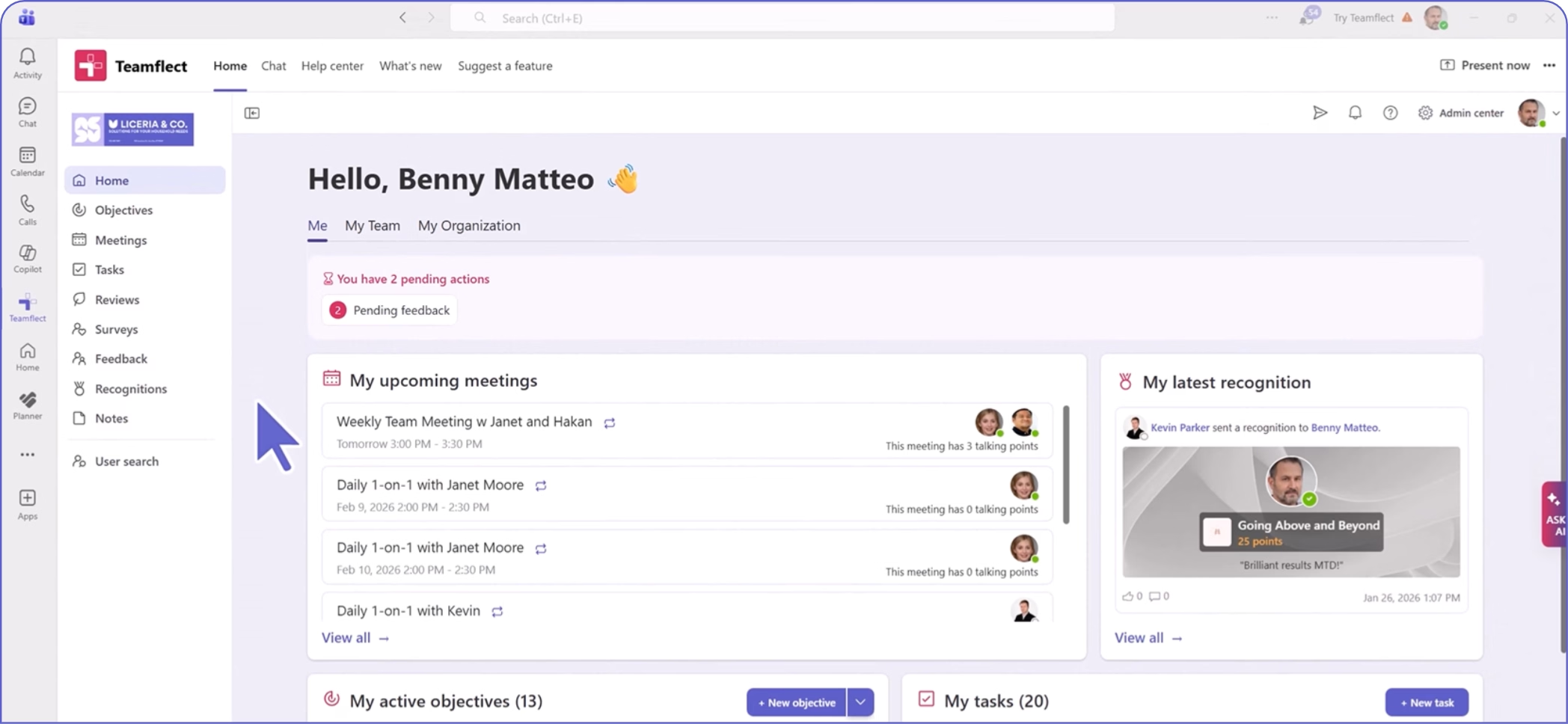
Create high-performing and engaged teams - even when people are remote - with our easy-to-use toolkit built for Microsoft Teams