.svg)
.svg)
4 Day Work Week: Everything You Need to Know in 2026
.svg)
0
min. read

Updated on:
September 14, 2026

Prefer Teamflect as your HR source on Google
.svg)

Everything you need to know about the 4-day workweek: the models, the evidence, pros and cons, which companies use it, and how to run a pilot that holds.
A few years ago, mention a four-day workweek, and people assumed you were talking about summer Fridays or an unusual experiment by a tiny Scandinavian startup. That view is now officially out of date.
With a major peer-reviewed study tracking 141 organizations published in Nature Human Behaviour and the Thirty-Two-Hour Workweek Act making noise in the US Congress, shortened schedules have quickly become a serious operational topic for enterprise leadership.
Much of the coverage gets caught up in extremes, either hyping four-day weeks as an all-in-one fix for burnout or warning they'll trash productivity. Neither view gives People Ops leaders much actionable insight.
This guide looks past the hype to examine what the evidence actually shows: how these models operate in practice, where organizations struggle, and how to build a pilot that succeeds long-term.
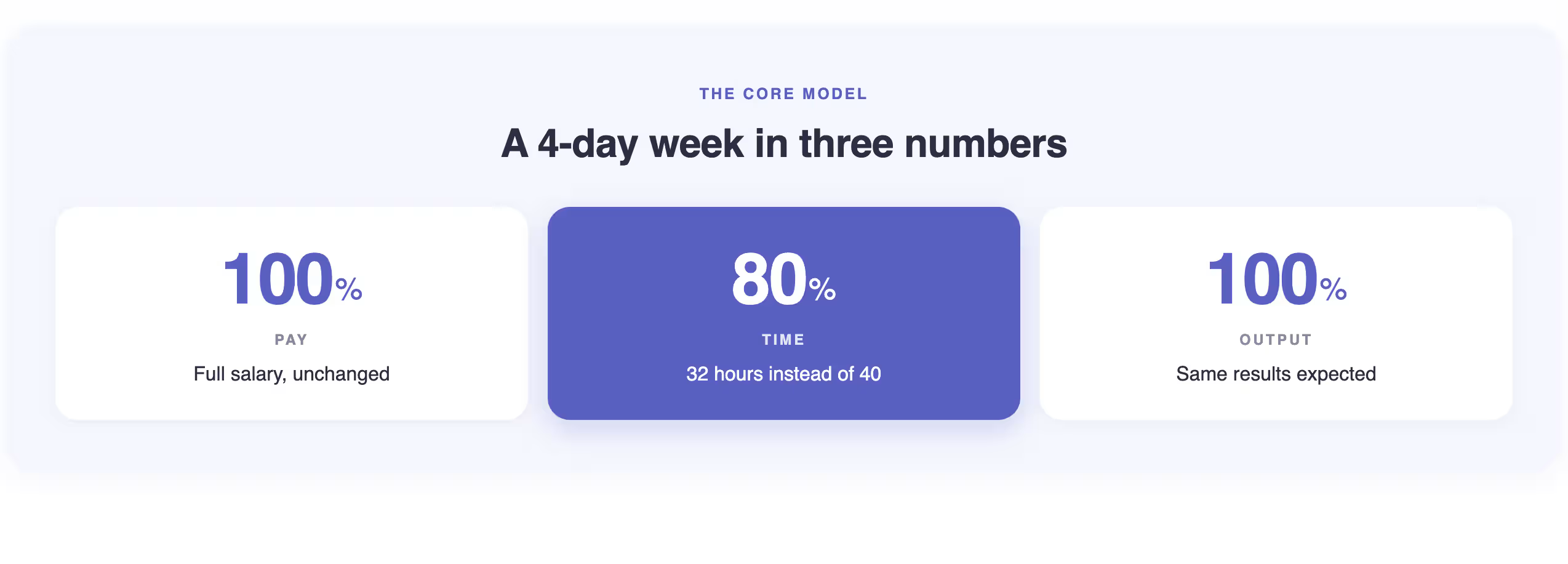
In a four-day workweek, employees get a full salary for 32 hours of work instead of 40, with no drop in expected output. In practice, companies set this up in three main ways.
The table below breaks down how primary shortened workweek models compare in practice:
100-80-100: Workers who accomplish their targets get their full pay for a 32-hour week. This only works if you stop tracking internet presence and focus only on output. They do this by deprioritizing lower-priority activity, streamlining approvals, and cutting superfluous syncs.
Workdays extend to 10 hours; total hours stay the same. Teams could get Friday off, but they'd face more daily fatigue with no meaningful reduction in workload.
Three-day weekends seem nice but it's hard to stay sharp over a 10-hour shift. Studies reveal that people are actually more productive and healthier when total hours drop to 32, not when they’re squeezed into lengthier workdays.
Other flexible working models allow businesses to trial shorter hours or longer weekends before adopting a 32-hour schedule. Rotating flex days off and seasonal summer hours to meet specific operational needs. 9/80 schedules.
The format you choose for scheduling will be dictated by your client coverage needs, size of your team and your day-to-day operating needs.
Rigorous multi-company studies show that four-day workweeks improve employee retention, lower stress, and maintain overall business output when supported by operational redesign. However, research also shows clear boundaries: success requires deliberate workflow changes, not just policy announcements.
Fan, Schor, Kelly and Gu’s landmark study, published in Nature Human Behavior in July 2025, analyzed 2,896 employees across 141 organizations in six countries against 12 control companies. The data indicated statistically significant reductions in employee burnout, improved mental and physical health outcomes, and sustained organization-level revenue.
The companies involved maintained baseline output by reducing operational friction per day, not by reducing total output. Organizations routinely meet five-day targets in compressed, 32-hour windows by cutting out low-value admin tasks for employees.
Leaders must evaluate the clear limitations of today’s academic research on shortened workweeks before considering implementation. Most published studies skew heavily toward white-collar knowledge workers and involve largely self-selected organizations already motivated to improve workplace culture.
Identifying these research gaps helps People Ops teams build real pilots, rather than assuming productivity gains from automation.
Shorter workweeks offer clear strategic benefits for attracting and retaining talent and improving focus, but they also bring operational risks around scheduling, client response, and the intensity of work on any given day. This mutual understanding will help leadership teams plan effective mitigation plans.
Organizations adopting a 32-hour workweek gain considerable benefits in talent acquisition, employee retention, and daily focus. Reducing required hours creates a strong incentive for top talent while forcing teams to eliminate operational waste.
Granting a four-day schedule is a key differentiator in competitive labor markets, helping mid-market firms win talent against larger enterprise compensation packages.
Three full days off a week give staff enough time to recover, reducing chronic workplace exhaustion. In multi-company trials, we see consistently declines in self-reported stress, lower sick leave, and fewer signs of severe employee burnout.
Managers need to decide whether to meet or accelerate decision-making when operating on a tight schedule. Organizations are improving business productivity via structured employee participation strategies, asynchronous updates and streamlined approval processes.
A reduced working week presents operational risks to be actively managed. Cutting the number of days you work without reducing the work can add stress to those days, create holes in client coverage and cause possible payroll compliance issues.
Unmanaged transition periods may cause to quiet fatigue, where employees secretly log hours on off days to keep up with unchanged workloads.
Industry structure determines how easily an organization can adopt a four-day model. Knowledge-based sectors can move seamlessly with asynchronous tools, while shift-based, clinical, and billable-hour industries face severe operational constraints.
Technology and Knowledge Work
Software engineering, product design, and corporate functions are shifting to 32-hour weeks with little disruption. These roles depend heavily on focus time, so outcome-based performance measures are easy to enforce.
Healthcare and Manufacturing
You can't just cut the operating hours of facilities that need a physical presence or need to keep machines running. Rather, manufacturing plants and clinical centers use staggered team shifts to keep operations running while giving individual workers longer time off.
Professional Services and Billed Hours
Law firms, agencies and consultancies run up against revenue walls with hourly billing models. Going to a four-day week means moving from hourly tracking to value-based pricing on projects.
The four-day workweek is being adopted worldwide, from multinational corporate pilots to national government pilots to new federal legislation. Looking at actual implementations, we can see how different regions and organizations manage schedule changes.
Major enterprises often run public trials, but uptake in long-term operations varies widely. Specific corporate case studies illustrate the difference between a temporary marketing pilot and a permanent policy change.
European and Asian governments have sponsored large-scale experiments on the macroeconomic impact of reduced working hours.
Current Status of U.S. Legislation
In the US, legislation is focused on the Thirty-Two-Hour Workweek Act, introduced by Senator Bernie Sanders and Rep. Mark Takano. The legislation would amend the Fair Labor Standards Act (FLSA) to reduce the federal standard workweek threshold from 40 hours to 32 hours over four years, and require employers to pay overtime for hours worked over 32 hours.
Though federal legislation remains a political fight, several U.S. states have introduced legislation exploring four-day workweeks, including proposals for state-employee pilots and tax incentives for private employers.
Review your current business process to eliminate redundant meetings, establish outcome based performance indicators and set realistic client coverage times for 4 day work weeks. Successful organizations run a structured pilot, usually three to six months, to test workload adjustments before making permanent schedule policy changes.
To change schedules successfully, you need to restructure your business workflows before you cut hours. Organizations need to reduce unnecessary recurring status syncs, shorten their approval chains, and improve their meeting cadence so that full performance fits within 32 weekly hours.
Choosing the right schedule format requires balancing business needs with industry constraints. Leadership teams have to decide what’s best for the company’s operational flow: a company-wide Friday shutdown, a staggered team schedule, or a 9/80 framework.
Pilot programs should run for three to six months to collect reliable performance data across quarters. Determining clear failure criteria beforehand ensures leadership can safely revert to a standard schedule if key operational targets are missed.
Explicit exit parameters protect the business while giving teams the structure needed to adapt.
With numerical indicators in place prior to trial launch, there is no ambiguity when the leadership considers making the schedule permanent. To get a complete picture of an organization’s performance, it needs to combine operational outputs with well-being tracking.
By regularly monitoring team sentiment through how to measure employee satisfaction, managers can identify bottlenecks in workload early.
Managing client expectations and maintaining internal equity among departments are critical operational obstacles during a pilot. Non-office or customer-facing teams may require custom shift arrangements to prevent feelings of unfair treatment compared to flexible corporate staff.
Cross-training employees ensures clear client support on off-days without forcing staff to monitor messages during their time off.
Moving to a shortened workweek changes frontline managers' daily responsibilities, shifting their focus from monitoring hours to managing team capacity and outcomes. Managers must protect communication channels, adjust evaluation methods, and streamline team syncs to maintain steady performance.
When a company removes eight hours from the weekly schedule, managers cannot simply compress existing meeting loads into four days. Reclaiming productive time requires trimming recurring syncs, enforcing clear agendas, and leaning on structured meeting agenda templates.
If you don’t cut down meeting hours, you blow up the percentage of time spent in syncs and don’t give staff enough focus time to get core tasks done.
Managers often cancel individual check-ins under time pressure, inadvertently shutting down critical feedback loops. Workload imbalances can be spotted and employee development supported when schedules are tight with regular 1-on-1s.
Following established guides for running effective one-on-one meetings helps ensure check-ins are structured and outcome-focused. Frequent, regular check-ins help to catch small operational delays before they become big bottlenecks for the project.
The notion that long hours in the office equate to high performance is challenged by compressed schedules. Managers must judge their staff solely on the quality of their deliverables, the percentage of projects they complete and the extent to which they achieve their goals.
By learning how to measure remote employee performance, leaders can establish objective criteria that reward impact, not seat time. With continuous performance management you can see the status of projects in real time and do not have to have regular status meetings.
To be able to be fully productive on a reduced schedule, there needs to be a structured way to track goals, check-ins need to be asynchronous, and performance visibility needs to be clear. When teams lose eight hours of overlapping office time each week, an all-in-one performance management platform like Teamflect in Microsoft Teams helps managers keep one-on-ones, feedback loops and OKR tracking aligned without adding meeting bloat.
Adopting a four-day workweek is ultimately an operational decision to redesign how work gets done across your organization. Instead of cutting eight hours from the week, successful companies eliminate useless meetings, track real outcomes, and give people uninterrupted deep-work time.
Evaluating your team's workflow readiness is the first step toward building a sustainable 32-hour model that protects productivity while improving talent retention.
A true four-day workweek under the 100-80-100 model maintains 100 percent of employee pay in exchange for full productivity delivered across 32 hours. Pay is reduced only under pro-rated part-time arrangements, which differ from standard 32-hour workweek pilots.
For IRS purposes, full-time work is defined as 30-40 hours per week for benefit eligibility under the US federal tax code. A 32-hour work week meets the requirements of a full-time position, so employees retain their full health insurance and retirement benefits.
A compressed schedule of 4 days at 10 hours each still keeps the total at 40 hours worked. But typical four-day work week proposals cut the total hours to 32 per week without lengthening the workday.
Countries including Iceland, Belgium, the United Kingdom, Spain and South Africa have backed national trials or legislation around four-day schedules. Belgium has a legal right to a four-day compressed week, trials in Iceland led to broad cuts in national labor contracts.
A 32-hour schedule keeps total operational output the same or slightly higher, according to research across companies, forcing teams to cut out wasteful meetings and low-value work. When employees have time to recover, then focus and hourly efficiency change, but total productivity does not.
Employees can make formal, flexible work requests outlining how they will deliver full output in 32 hours. Employees have a better chance of success with their proposals when they present clear coverage plans, measurable pilot timelines and objective metrics for measuring performance.

.svg)
.avif)
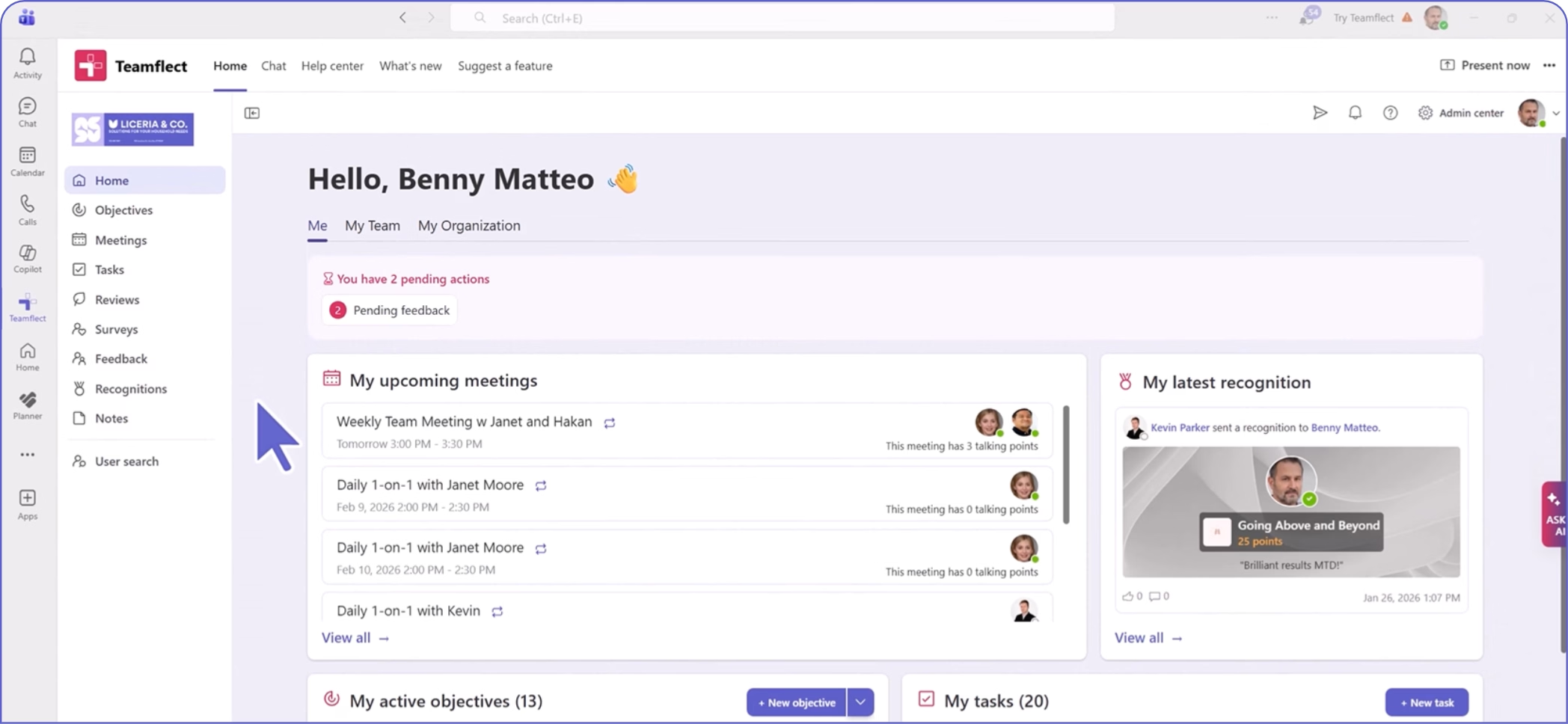
Create high-performing and engaged teams - even when people are remote - with our easy-to-use toolkit built for Microsoft Teams