Motivosity is an incredibly capable rewards & recognition platform, and it’s operating in a landscape where the share of senior leaders who view employee recognition as a major strategic priority has more than doubled—from 19% in 2022 to 42% in 2024.
However, it does leave a lot to be desired in the broader performance management and employee engagement categories, so if you’re searching for alternatives, this guide is for you.
Below, you’ll find an unbiased review of Motivosity, clear reasons why teams switch, and a detailed comparison of ten top competitors. We drew on real user reviews from G2, Capterra and Software Advice to capture strengths, weaknesses and pricing.
At the top of the list sits Teamflect, a Microsoft 365‑native platform that we’ll explore in depth.
An In-Depth Motivosity Review
Core Features
Peer‑to‑peer recognition: Employees give recognition using monthly budgets and digital points that can be redeemed for gift cards or company swag.
Company‑wide feed: A public ThanksMatters feed lets colleagues celebrate wins; milestone celebrations are automated for birthdays and anniversaries.
Manager insights & personality profiles: Managers access dashboards for 1‑to‑1 check‑ins and receive personality insights to build more cohesive teams.
Custom rewards & community funds: Admins can set up custom awards, allocate budgets and enable community funds while integrating with Slack and Microsoft Teams.
Mobile & integrations: Integrates with HRIS tools and offers a mobile app, though reliability varies.
Pros & Cons
Pros
"I love Motivosity — it's easy to use and has many ways to give recognition."
Encourages peer appreciation through an engaging social feed with budgets for micro‑bonuses.
Manager insights and personality profiles deepen team relationships and enable coaching.
Broad integrations with Slack, Microsoft Teams and HRIS tools support recognition in the flow of work.
Cons
"Birthday announcements seldom work and I sometimes lose coaching data when cancelling recurring meetings."
Requires careful oversight of budgets and participation; some users find the interface busy and reporting limited.
Users report inconsistent reminders and occasional login resets, leading to frustration.
Pricing is custom and requires a minimum annual spend of around US$3,000, which can be steep for small teams.
Administration burdens: Monitoring budgets and ensuring participation consumes HR time.
Interface & reliability: Feedback cites a busy design and unreliable reminders.
Pricing: Minimum spend requirements and custom quotes make the platform expensive relative to alternatives.
Top 10 Motivosity Alternatives
1. Teamflect: Best Motivosity Alternative for Microsoft 365
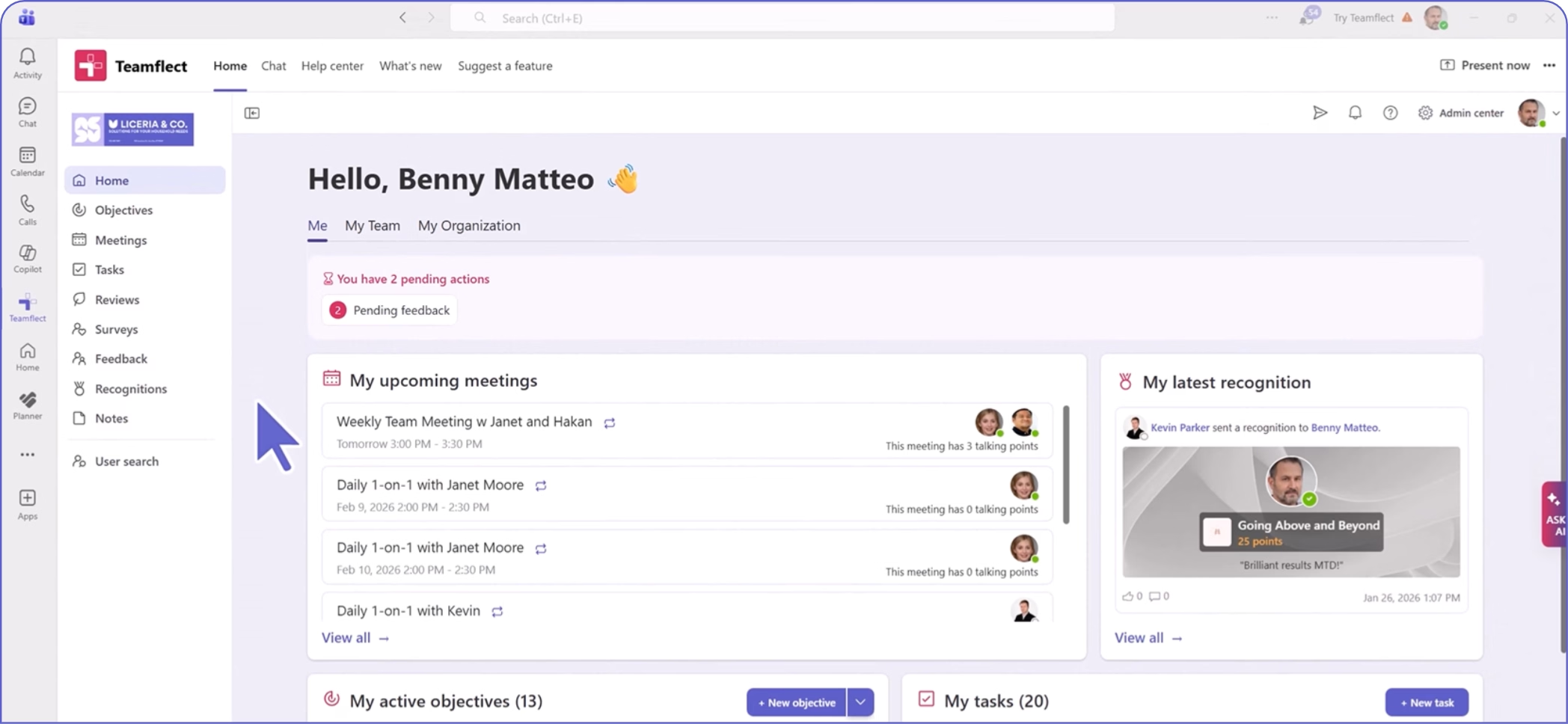
Teamflect is an all-in-one performance management and recognition platform built natively for Microsoft Teams and Outlook. Rather than operating as a standalone recognition tool, Teamflect embeds recognition into meetings, 1-on-1s, goals, and performance reviews, eliminating the need for separate logins or parallel systems.
As an all-in-one HR software, Teamflect's complete approach to performance management results in rewards & recognition feeling a lot more like a natural part of the employee experience, as opposed to a practice that has good intentions but feels forced.
What truly sets Teamflect apart as the best alternative to Motivosity that it makes the processes of employee recognition and performance management function seamlessly inside environments your teams work every day. Employees don't need to leave Microsoft Teams chat or their Outlook inbox to send a recognition to their colleagues.
Performance management, recognition and 1‑on‑1s sit in one place, giving managers richer analytics and saving HR time, and this matters because companies with strategic recognition programs see average turnover rates that are 23.4% lower than organizations without any recognition program at all.
Key Features
Deep Microsoft Teams and Outlook integration that lets employees recognize peers, run performance reviews and conduct 1‑on‑1s without leaving their collaboration tool.
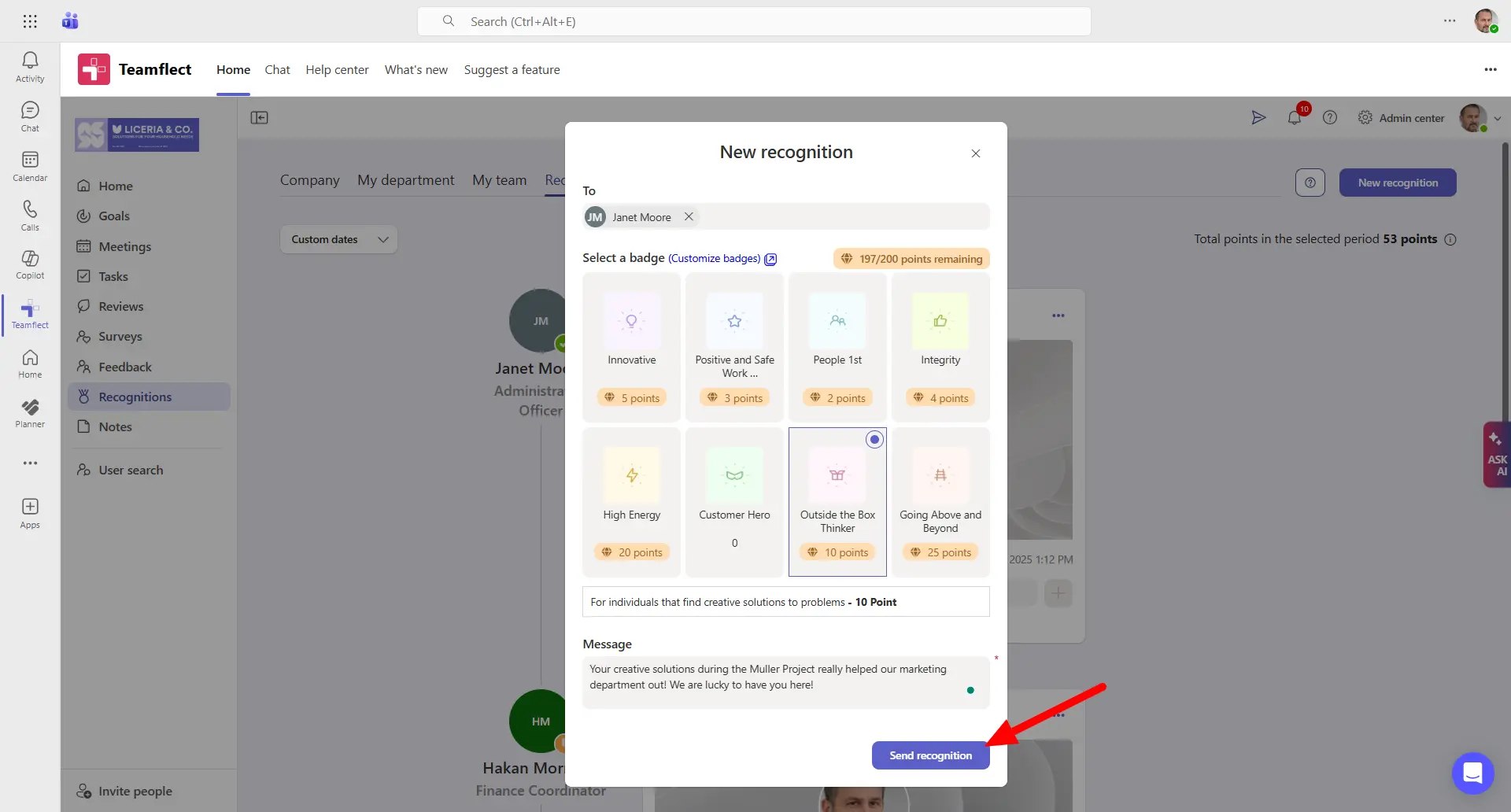
Customizable recognition badges, AI‑assisted feedback, engagement surveys and analytics dashboards.
Points based recognition integrated with custom rewards catalogs and leaderboards.
Integrated performance management, goals and OKRs, making recognition part of a broader people‑management platform.
Why Teams Switch from Motivosity to Teamflect
Teams built on Microsoft 365 appreciate Teamflect's native experience; there are no separate logins or tools to learn.
Performance management, recognition and 1‑on‑1s sit in one place, giving managers richer analytics and saving HR time.
The free plan and clear pricing remove budget anxieties common with Motivosity.
Pros
"One of the best Employee Engagement Apps + integrated to Teams" Capterra Review
Native to Microsoft Teams.
Connects recognition to goals, reviews and employee development, eliminating silos.
Quick implementation with a generous free plan and strong customer support.
Cons
Only limitation is that it requires a Microsoft 365 environment.
Pricing
Starter: Free for up to 10 users with full functionality
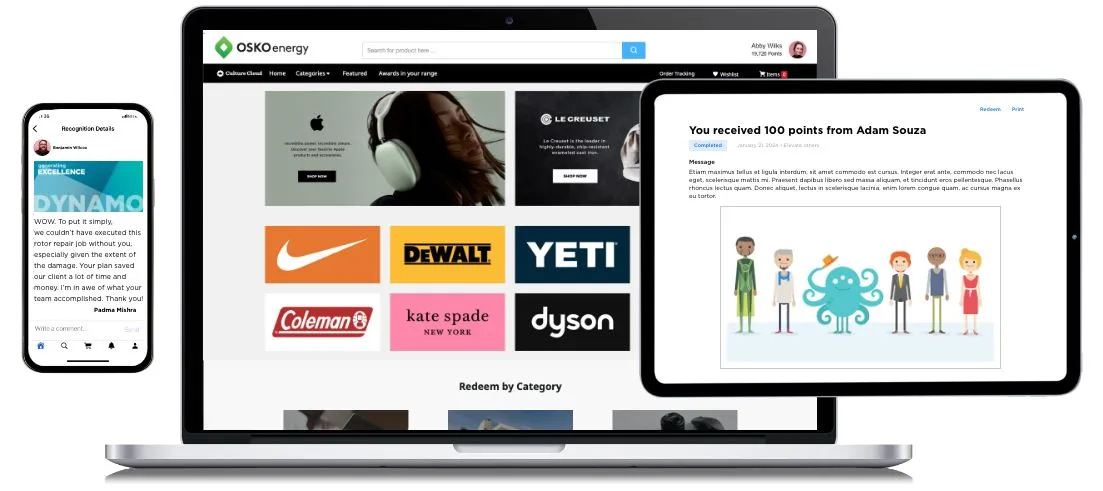
Vantage Circle is an enterprise-focused employee engagement platform best known for its global rewards catalog. It’s commonly used by multinational organizations that need region-specific reward redemption across countries.
Even with dedicated platforms, 75% of employees say they wish they felt more appreciated at work, according to Canva research cited by SHRM, which is why the breadth of a rewards catalog and the way recognition is delivered matter just as much as the features themselves.
Key Features
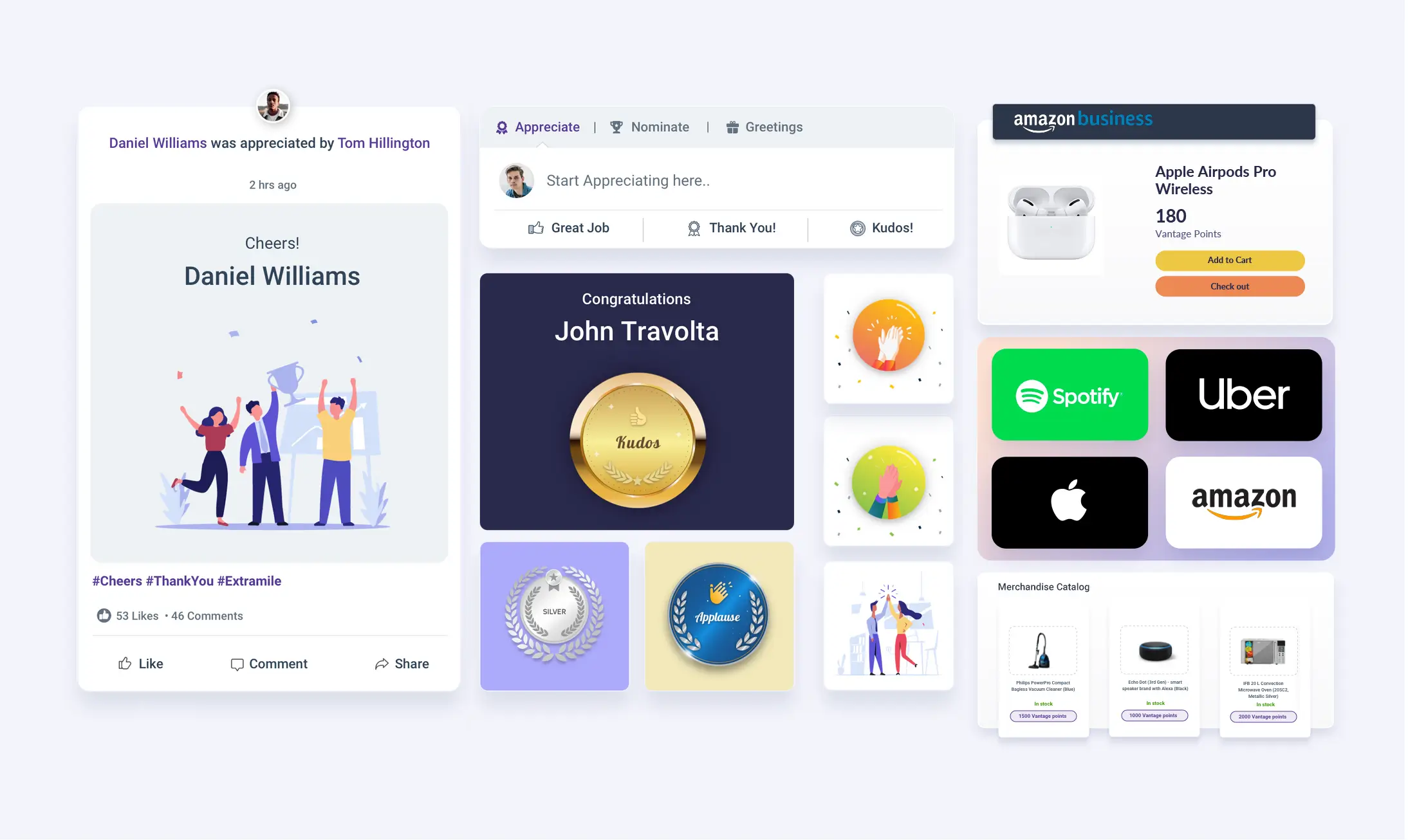
Global rewards marketplace spanning over 100 countries, allowing employees to redeem points for local gift cards and perks.
Points‑based peer and manager recognition with social feed and anniversary automation.
Wellness platform and pulse surveys integrated with analytics.
Why Teams Switch from Motivosity
Motivosity's rewards options are limited; Vantage Circle's global catalog gives employees meaningful choices across regions.
Built‑in wellness challenges and surveys offer engagement beyond recognition.
Enterprises appreciate consolidated analytics across multiple programmes.
Pros
"It is a great tool for peer-to-peer recognition. It also gives the end user flexibility to utilize the Vantage points as per their choice and flexibility." Capterra Review
Extensive international rewards catalog and points system.
Peer and manager recognition with social feed encourages transparency.
Wellness and engagement surveys enrich employee experience.
Cons
"While the customization options are extensive, they might require significant time and resources to implement effectively" Capterra Review
Some users desire more reward options and deeper reporting analytics.
Pricing is custom and may be high for small businesses.
Customer service has been criticized heavily.
Pricing
Custom. You must contact sales; plans vary based on company size and reward volume.
3. Nectar
Nectar is a lightweight recognition platform designed primarily for distributed and remote teams. It emphasizes simplicity, social recognition, and a straightforward rewards experience.
Key Features
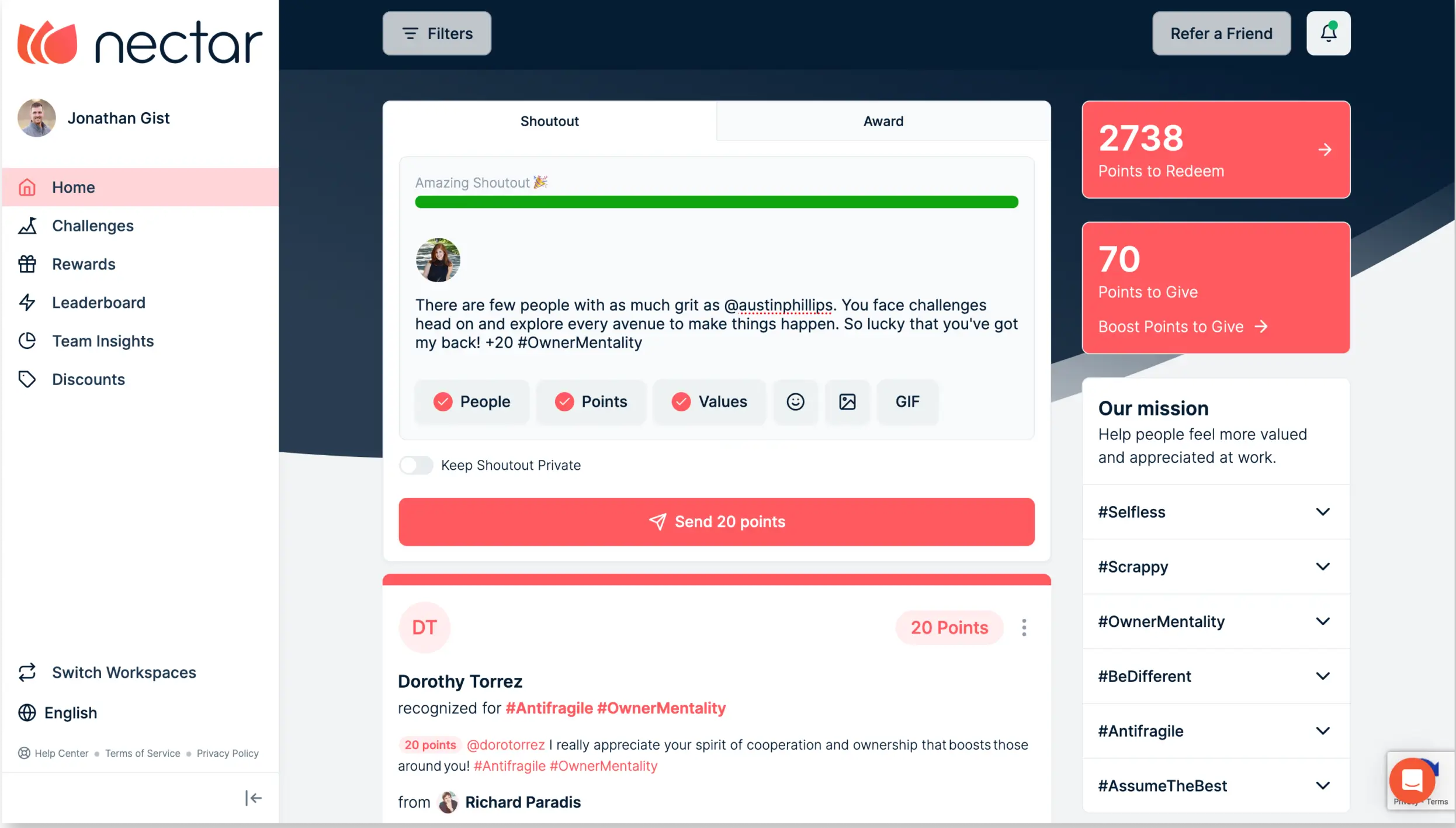
Simple points system with a social feed and custom badges.
Gift card redemption through a marketplace, plus automation for birthdays and anniversaries.
Manager dashboard and integrations with Slack, Microsoft Teams, Gusto and HRIS tools.
Pros
"I love Nectar. It creates a fun work atmosphere with the incentives and options for customizable incentives. I strive to be a good coworker not only for my team but for the nectar incentives as well." G2 Review
Engaging peer‑to‑peer recognition with custom badges and gift redemption.
Integrates with popular collaboration tools and HRIS platforms.
Automates celebrations for milestones and important dates.
Cons
"Reward options can feel limited depending on location, and sometimes the catalog doesn’t have enough variety. Also, few features feel basic and could be improved for better customization." G2 Review
Employees sometimes hoard points until month‑end, which can distort engagement.
Analytics and reporting are basic compared to enterprise platforms.
Pricing is still custom and may have a minimum annual contract.
Pricing
Custom, often starting at around US$4,000 per year for small teams. A free trial is available.
4. Reward Gateway
Reward Gateway (now part of Edenred) provides a unified recognition and rewards programme tailored for global enterprises. It offers unlimited reward choice, advanced analytics and deep integrations, making it suitable for organizations that require robust workflows and reporting.
Key Features
Provides a global rewards marketplace with gift cards, cashback, merchandise, and custom rewards that employees can redeem without markups.
Supports both scheduled and on-demand recognition programs for milestones, achievements, and everyday appreciation.
Offers engagement and recognition analytics dashboards that help HR teams measure participation and impact.
Pros
"Reward Gateway has transformed our engagement and benefits offering, with an easy-to-use platform that colleagues actively use and genuinely value and can track the benefits in real terms." G2 Review
Extensive global reward catalog with cash and non‑monetary options.
Robust analytics connect recognition to retention and business outcomes.
Flexible enterprise integrations and executive dashboards.
Cons
"The back end administration was slight more tricky to get used to but has improved." G2 Review
Customer support responsiveness can be inconsistent
Voucher fulfillment and refunds may be slow
Physical or postal reward options can feel outdated
Setup and configuration can be complex for new admins
Pricing
Fully custom; plans often require a lengthy contract. Demo available.
5. Guusto
Guusto focuses on simple, flexible and meaningful rewards that are easy to send and redeem. It’s ideal for organizations with deskless or frontline workers who need quick, digital recognition.
Key Features
Enables instant digital gifting via email or SMS without requiring recipients to create accounts.
Provides access to a global gift card and merchant network with flexible redemption options.
Includes budget controls and real-time spend tracking for administrators.
Delivers a mobile-friendly experience designed for frontline and deskless workers.
Pros
“The software offers a wide variety of rewards and has a user-friendly interface” Capterra Review
Simple, instant gift-based recognition via email or SMS
Strong fit for frontline and deskless workers
Budget controls and real-time spend tracking
Integrates with Slack and Microsoft Teams
Cons
“Sometimes the system experiences slow loading times, and the reporting features could be more robust” Capterra Review
Limited to gift-based rewards only
No physical reward fulfillment
Lacks deeper engagement analytics and culture insights
Customization options are fairly limited
Pricing
Custom. Contact Awardco for a quote; no publicly available free trial.
6. Bucketlist
Bucketlist provides a fully featured recognition and rewards platform that incorporates social feeds, milestones, goal‑based awards and comprehensive rewards.
Key Features
Supports peer-to-peer and manager recognition through a social feed with comments and reactions.
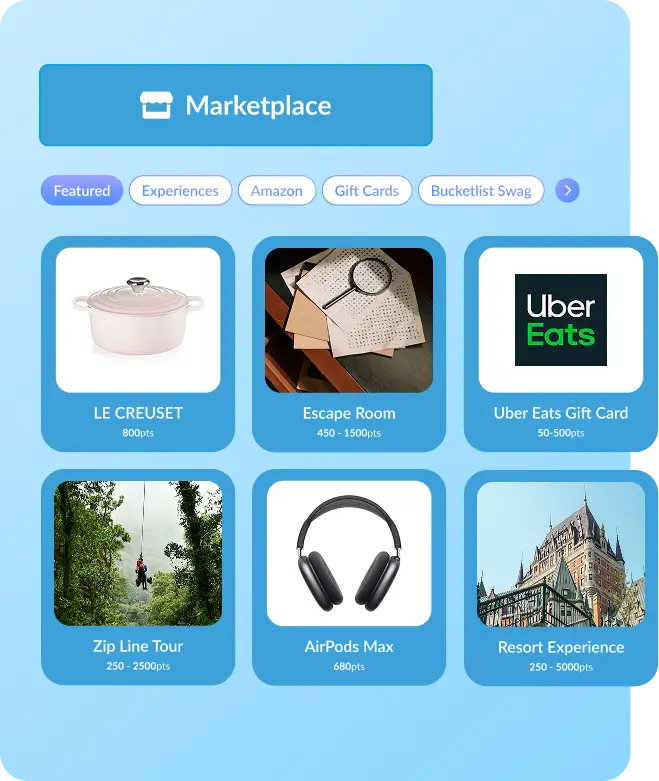
Offers a points-based rewards marketplace with gift cards, merchandise, experiences, and donations.
Automates service anniversaries, birthdays, and milestone recognition.
Allows administrators to configure custom approval flows, nominations, and recognition rules.
Pros
"Our company uses this tool extensively for daily recognition and appreciation. It's easy to give and receive points. The variety of options for redeeming points is excellent. Our employee engagement with the tool is high." Capterra Review
Engaging social feed with peer and manager recognition
Extensive rewards marketplace featuring gift cards, merchandise, and unique experiences
Automated milestone and service anniversary recognition
Flexible program configuration with approval workflows
Cons
"The tool is difficult for employees with limited or no access to email. The notification process about the points is a challenge." Capterra Review
Monthly point allocations can feel restrictive
Reward delivery may not be instant
Shipping costs can reduce perceived reward value
Pricing is custom and may be high for smaller teams
Pricing
Custom. Request a demo; there is no standard free plan.
7. Cooleaf
Cooleaf positions itself as a broader employee engagement solution rather than a pure recognition tool. Alongside recognition, it incorporates challenges, events, and surveys, making it appealing to organizations that want to drive participation and engagement through multiple programs in a single platform.
Key Features
Peer recognition with points, plus challenges, competitions and custom value badges.
Automated celebrations for milestones and a social feed for company‑wide recognition.
Reward marketplace and surveys with analytics.
Pros
"Cooleaf is a great source for employees to feel like their hard work actually does pay off. The rewards are awesome and there's a huge variety of things to earn using your Cooleaf points!" G2 Review
Gamified challenges and competitions build engagement.
Custom values badges and flexible reward marketplace.
Analytics and surveys provide insight into engagement.
Cons
"I find it clunky, when compared to other websites that I've used before. It takes two clicks to get on, not just one, the choices of how you recognize employees seems limited." G2 Review
Points issuance can be confusing and some find the interface complex.
Pricing is custom and may be high for small teams.
Limited third‑party integrations compared with other platforms.
Pricing
Custom. Contact Cooleaf for pricing; free trial available upon request.
8. Bonusly
Bonusly is a peer-recognition platform centered on frequent, low-friction micro-bonuses. It’s especially popular with small and growing teams that want recognition to feel casual, social, and continuous, without complex setup or long-term contracts.
Key Features
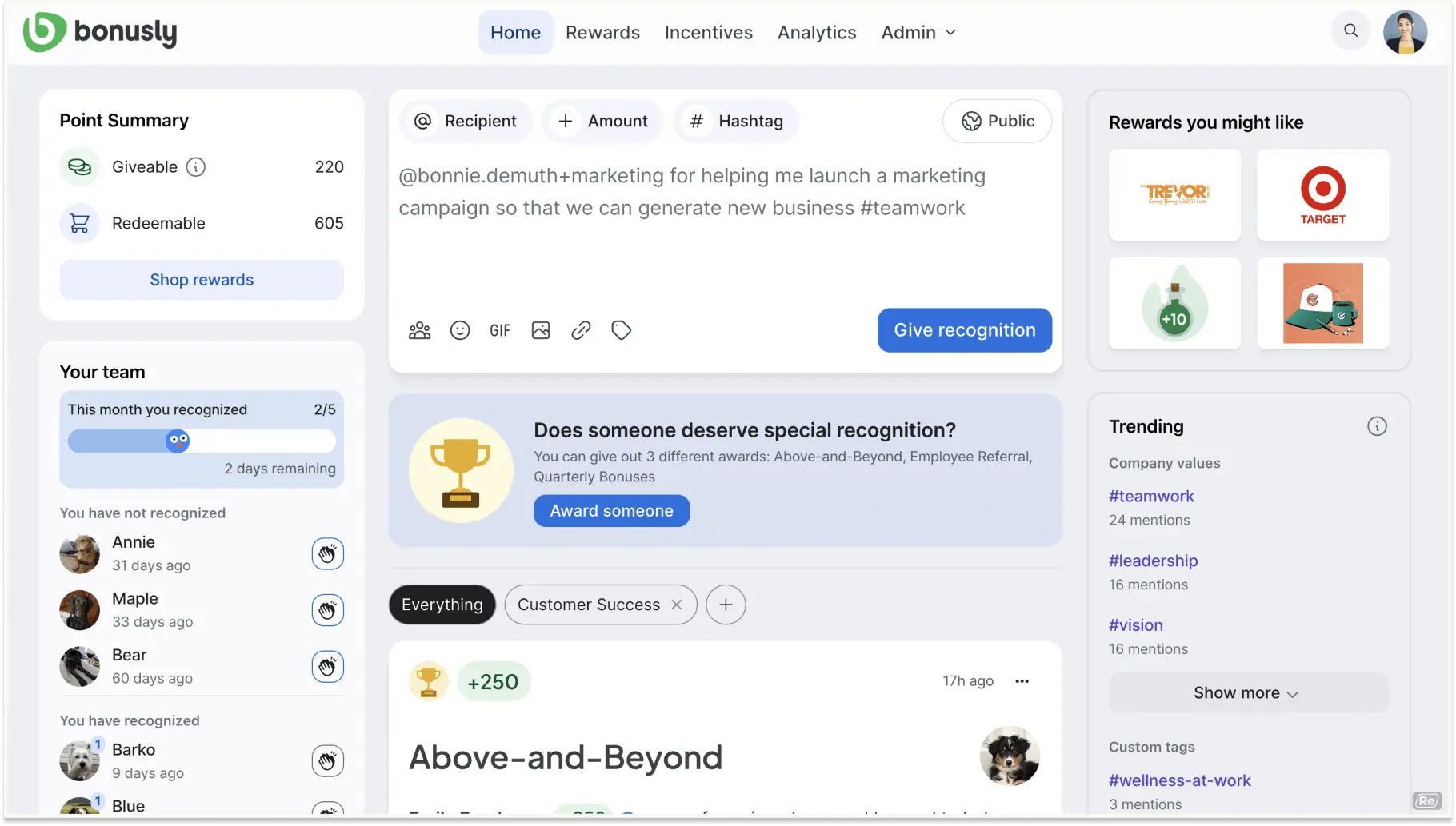
Peer recognition feed with micro‑bonuses that team members can convert into gift cards or charitable donations.
Automated celebrations of birthdays and work anniversaries, custom awards and robust analytics dashboard.
Integrations with Slack, Microsoft Teams and HRIS systems; mobile app support.
Pros
“I loved that you could give points to coworkers and also choose donations as rewards” Capterra Review
Simple and accessible recognition with micro‑bonuses and broad gift‑card selection.
Easy integration with Slack/Teams and strong analytics.
Frequent recognition fosters a positive culture in small and medium‑sized teams.
Cons
“The catalogue can be limited for companies outside the United States… The automated redemptions are fairly limited” Capterra Review
Tone may feel too casual for formal industries; some desire more customization.
The mobile app lacks some web functionality.
Gift‑card stock may be limited and employees can run out of points quickly.
Pricing
Plans start at around US$2 per user per month with a 14‑day free trial. Upgraded packages offer additional analytics and customization.
9. O.C. Tanner
O.C. Tanner is a long-established enterprise recognition platform designed for large, global organizations that want to tie employee recognition directly to values, performance, and long-term culture outcomes.
Key Features
Delivers values-based peer and manager recognition through a social feed with configurable award programs.
Provides an extensive global marketplace featuring merchandise, unique experiences, gift cards, and milestone awards.
Includes advanced analytics that connect recognition data to engagement, retention, and performance trends.
Supports service milestones, anniversaries, and leadership-driven recognition campaigns at scale.
Integrates with major HRIS platforms and collaboration tools for centralized people data.
Pros
"The platform was easy to navigate, and the redemption process was quick and straightforward." G2 Review
Strong focus on values, culture, and long-term employee engagement
Extensive global rewards and service anniversary capabilities
Mature analytics and reporting for enterprise HR teams
Proven scalability for very large organizations
Cons
"Because the platform is feature-rich, initial setup and onboarding can feel overwhelming for some companies—especially smaller ones or those without dedicated HR tech support." G2 Review
Complex implementation and configuration process
Premium pricing makes it unsuitable for small or mid-market teams
User experience can feel dated compared to newer tools
Less flexible for fast, informal peer recognition
Pricing Custom enterprise pricing only; requires a sales-led implementation and long-term contract, with demos available upon request.
10. Perkbox
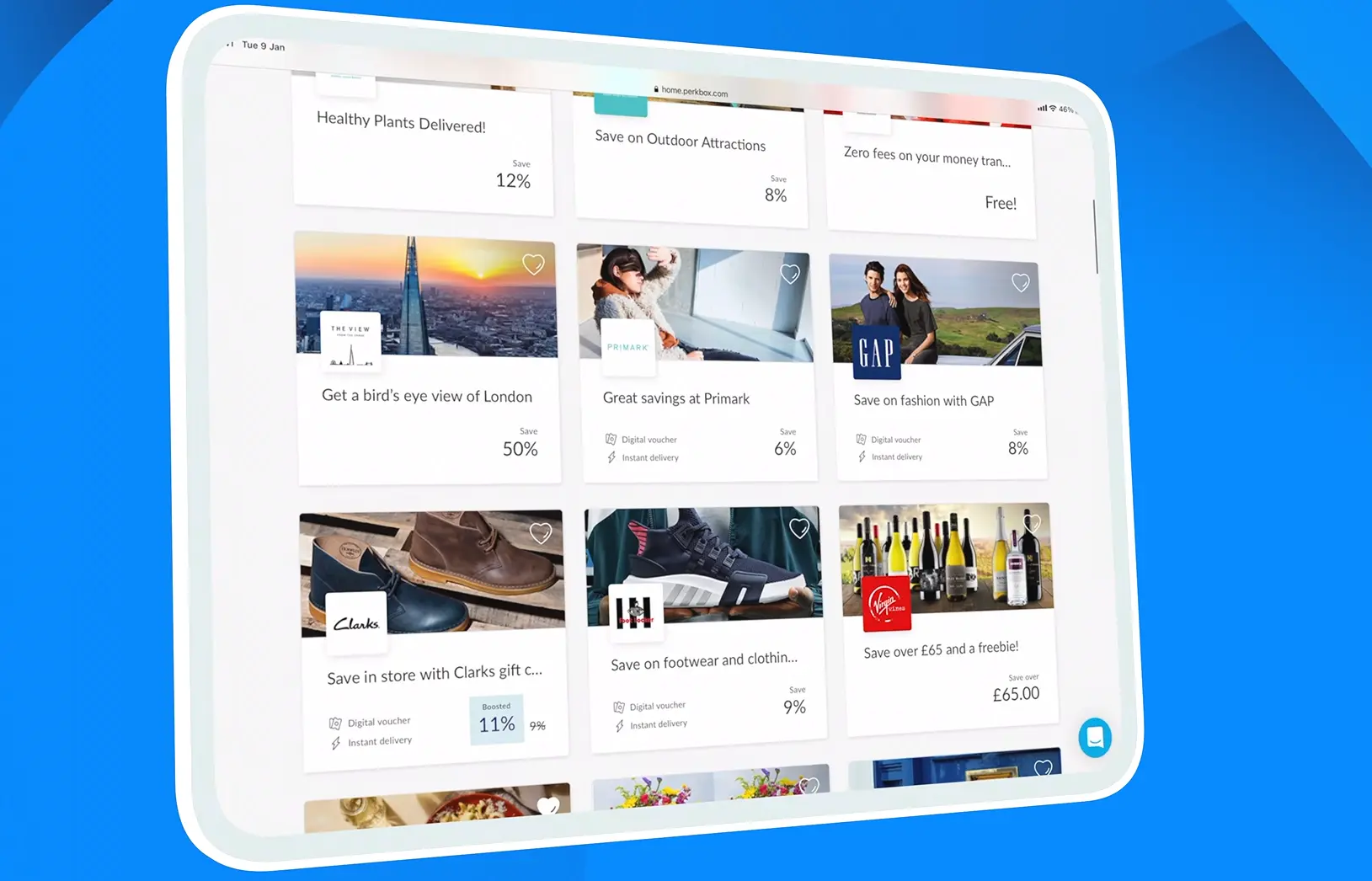
Perkbox is an employee recognition and benefits platform designed for mid-market and global teams that want to combine everyday perks with lightweight recognition. It’s commonly chosen by organizations that want recognition to sit alongside tangible employee benefits, rather than operating as a standalone rewards program.
Key Features
Provides peer-to-peer recognition with points that employees can redeem for gift cards, vouchers, and rewards.
Offers an always-on perks marketplace with discounts on retail, fitness, wellness, and lifestyle services.
Includes automated celebrations for birthdays, work anniversaries, and service milestones.
Delivers basic engagement analytics to track recognition activity and benefit usage.
Integrates with Microsoft Teams, Slack, and HR systems to support recognition within daily workflows.
Pros
"I love that Perkbox provides a platform where we can signal staff to receive wellbeing support, and it allows us to reward them for their hard work via monthly perks and the recognition tab, which is widely used by all our staff." G2 Review
Combines recognition with everyday employee benefits in a single platform
Strong value proposition for international and UK-based teams
Easy for employees to see immediate personal value, even without receiving recognition
Simple setup and relatively low adoption friction
Works well for companies prioritizing perks and morale over deep analytics
Cons
"I do feel there should be some form of points based reward functionality to link the celebration and the perks sections together" G2 Review
Recognition features are relatively lightweight compared to enterprise platforms
Analytics and reporting lack depth for strategic HR use cases
Limited customization for recognition workflows and branding
Less suitable for companies focused on performance-linked recognition programs
Pricing
Perkbox uses per-employee pricing with tiered plans based on features and regions. Pricing is not publicly listed and requires contacting sales; demos are available.
[fs-toc-omit] How to Choose the Right Motivosity Alternative
Selecting an employee‑recognition tool is more about finding the right cultural fit than looking for a set of features. Consider these factors:
Must‑have features: Define whether you need global rewards, peer‑to‑peer recognition, performance management integration or culture analytics.
Integration needs: Ensure the platform plugs into your existing systems such as Microsoft Teams, Slack, HRIS or Outlook. This will determine adoption and workflow efficiency.
Adoption & rollout risk: Look at user reviews around interface complexity and implementation time. Tools like Teamflect and Assembly emphasize rapid roll‑out, while Achievers and Workhuman require more onboarding.
[fs-toc-omit] How to Switch from Motivosity
Export your data: Before cancelling Motivosity, export recognition records, budgets and employee profiles. This ensures continuity and supports a clean migration.
Plan a timeline: Allow time for vendor selection, trial periods and stakeholder buy‑in. Enterprises often pilot an alternative with a small group before rolling out company‑wide.
Prepare your team: Provide training resources and internal communications explaining the switch. Highlight new features such as Microsoft Teams integration in Teamflect or micro‑bonuses in Bonusly to generate excitement.
Monitor adoption: Use the analytics dashboards in your new platform to track recognition rates and participation. Adjust budgets and training as necessary.
[fs-toc-omit] Frequently Asked Questions
[fs-toc-omit] Is Motivosity worth it?
Motivosity offers peer recognition, budgets and manager insights, but it requires manual oversight, has limited reporting and comes with a relatively high minimum spend. For organizations that need deeper analytics or tighter integration with Microsoft 365, the alternatives above may deliver better value.
[fs-toc-omit] What's the best free alternative to Motivosity?
For Microsoft 365 users, Teamflect is the standout free alternative: it offers a rich recognition and performance management suite with a free plan for up to 10 users. Smaller teams using other ecosystems might try Assembly's free trial or Nectar's introductory plans.
[fs-toc-omit] How quickly can we implement a new system?
Implementation time varies. Assembly and Teamflect are designed to launch quickly; users praise their easy setup. Enterprise‑grade tools like Achievers, Workhuman or Vantage Circle typically require several months for configuration and training.
We keep our content up to dateLast updated See all updatesHide updates
Updated Bucketlist and O.C. Tanner reward features
Added recognition stats to Teamflect and Vantage Circle
.svg)
.svg)


.svg)

.webp)
.webp)

.svg)
.avif)