.svg)
.svg)
Year-End Reviews: Best Practices, Sample End of The Year Review Questions + Free Template
.svg)
0
min. read

Updated on:
July 3, 2026

Prefer Teamflect as your HR source on Google
.svg)

A year-end review is a formal conversation where a manager and employee assess the year's performance and plan the next one. It typically covers accomplishments against goals, strengths, growth areas, and development priorities for the coming cycle. Reviews work best when both sides arrive with structure, evidence, and a clear agenda.
This guide covers how to prepare, sample questions to ask, and a free year-end review template you can download and customize. Use it to turn your next review cycle into decisions instead of paperwork.
A year end review is a structure evaluation format of an employee's performance over the last work year. It's a great opportunity to take time and reflect on accomplishments, challenges as well as any areas of improvement.
In that regard, these reviews typically involve discussions on goal achievements, skill development and feedback for further growth. A well conducted year end review hence helps align employees with company objectives and foster professional development.
Follow along as we go through the steps of how you can create a review template that is comprehensive enough for impactful insights for your employees.
Having a clear understanding of what you want to achieve with the review is a must. This simple piece of information will give you the direction you need in order to reach actionable feedback. Is it to assess overall performance for example? Or are you looking to identify growth areas,, or set future goals? Understanding your purpose with the review with clarity, will ensure that the review aligns with your overall objectives as an entity.
To be a comprehensive year-end review, your assessment should include the following key areas:
Gathering meaningful feedback happens only through meaningful questions. So, to ensure impactful results, you could try asking questions like;
These questions will bring valuable insights to the surface and help create a more meaningful assessment period. We will have more questions like this below our article as well!
Make sure to end the review with a section for setting clear, measurable professional goals for the year ahead. At the end of the day, no review cycle is static. The whole idea behind them is to create a space that is reflective enough so that you can evolve through your findings. In that sense, setting new objectives for the new year, will allow your employees to have a sense of direction and a clear roadmap for the future. You can also opt for designing performance improvement plans while you're at it as well!
Following these simple yet effective steps will allow you to prepare appropriately for year-end reviews and get the most out of the insights your workforce has to offer in order for you to prepare for the next year, setting yourself up for success!
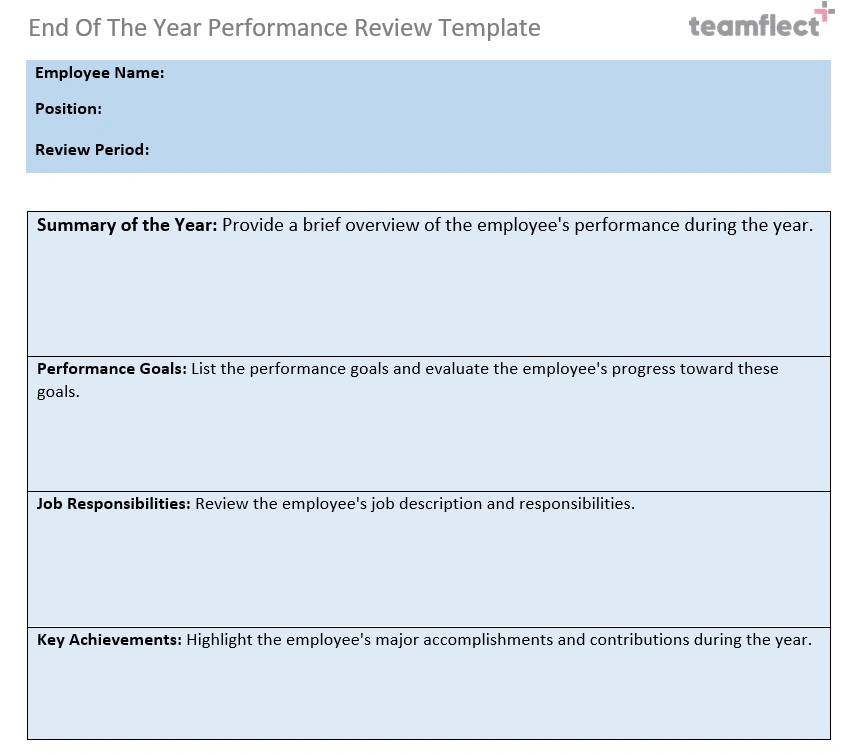
This year-end review template is provided in Word format, making it easy to edit and customize based on your team’s needs. The layout is simple and clearly structured, allowing both managers and employees to focus on the conversation rather than the format itself.
This template works best for:
The template includes dedicated sections to help guide a complete year-end evaluation, such as:
You can utilize this template in a variety of ways, as your team needs it and even customize it as necessary.
We also have examples of different year-end review questions you can choose from right in this article.
Using a structured year-end review template helps keep evaluations clear and consistent. This template allows you to save time, ensure important topics aren’t overlooked, and create space for more thoughtful feedback and goal-setting.
Most importantly, it supports constructive conversations that help employees understand where they stand and how they can grow in the year ahead.
By now we've already established why a year end review is so important but let's list of its benefits;
A year-end review is crucial for both employees and organizations as they help provide a structured opportunity to assess performance and set goals, fostering growth and development in the process.
They are the perfect time for performance reflection, goal alignment, constructive feedback, recognition and motivation ad well as invest time in career development while there is dedicated space to do so.
Gallup shows that employees who strongly agree they received meaningful feedback in the past week are nearly eight times more likely to be fully engaged at work, highlighting how powerful structured feedback conversations are for performance and retention.
Preparation decides whether an end of year review becomes a growth conversation or a formality. Research shows only 22% of employees strongly agree their performance review process is fair and transparent. Weak preparation is a major reason for that gap. Use the interactive checklist below to make sure both sides walk in ready.
The most reliable step is treating this as a shared checklist that both parties complete before the meeting. When both sides arrive prepared, the end of year review produces specific commitments rather than vague intentions.
Most teams still run end of year reviews through email attachments and shared documents. The result is version chaos, chased signatures, and reviews that land weeks late.
There is a faster way. Teamflect, the highest-rated employee appraisal tool in the Microsoft Teams ecosystem, runs the entire review cycle inside Teams. Sending out a company-wide annual review takes minutes, not days.
The video below shows the whole process in action: starting a review, customizing templates with goal data and 360-degree feedback, and completing evaluations on both sides. If your current process involves a single spreadsheet, watch what replaces it.
Teamflect allows users to automate review cycles at their desired frequencies. While we’ve shown you the manual way of starting a review cycle above, automating period-based performance reviews such as 30-60-90 day reviews or in this particular case, annual reviews is always the best possible practice.
Teamflect users have the option to create custom automation scenarios for any performance review template of their choice.
Automating period-based performance reviews both saves leaders a lot of time and effort, and reduces the risk of making any mistakes while conducting annual reviews.
You can start conducting your performance reviews inside Microsoft Teams by clicking the button below!
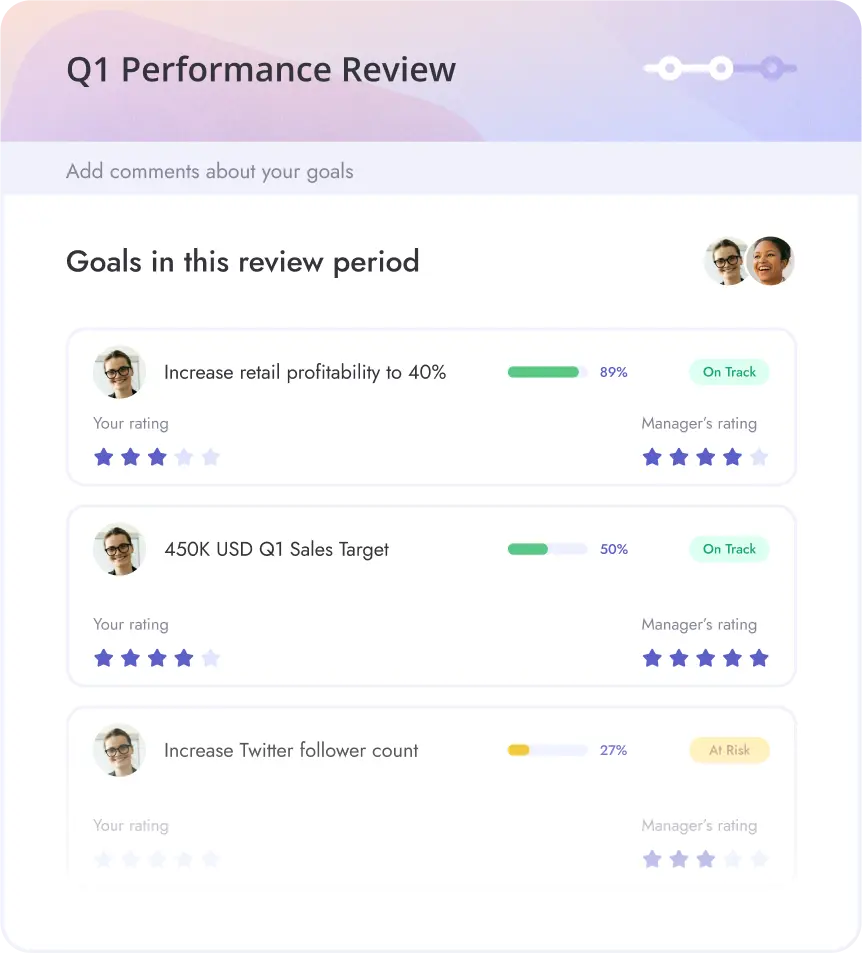
This section is dedicated to highlighting your proudest achievements over the past year. With such questions, you'll be able to understand your top successes, projects where you excelled, and how your work has positively impacted the team or organization as a whole.
In this part, the questions will assess the goals set at the start of the year and your progress toward them. It’s important to understand challenges you faced in order to plan ahead later on.
This section explores the steps you’ve taken to improve your skills and any plans for future growth. In order to support your continuous development and identify training opportunities, such questions will be a great aid.
Here, we focus on understanding the significant challenges you faced during the year and areas that might need improvement. These types of questions help provide better support and strategize for success.
Effective communication and teamwork are key to long-term success. This section reviews how well you collaborated with colleagues, any successes in teamwork, and challenges faced in relationships throughout the year.
This set of questions evaluate how you managed your workload and productivity. Sharing strategies that worked and areas for improvement helps in setting better practices for the future.
Feedback is crucial for continuous improvement and organizational growth. This section allows you to share your thoughts on the organization and identify areas where you need more support or feedback.
Work-life balance is the key that ties it all together. So, this section focuses on understanding current satisfaction levels and identifying ways to improve well-being within the company.
This section discusses your long-term aspirations and how your current role fits into them. These questions aim to understand career trajectories and provide necessary support for advancement along the way.
Looking ahead, this section will help set a roadmap for success in the coming year, outlining your expectations and how the company can support your goals.
A year end review should include key aspects of performance such as goal achievements and other key accomplishments within the year. In that regard, it should also include key challenges that were faced in the same period.
Within that period, it's important to consider the skills developed as well as how collaboration played a part in team efforts overall. A well constructed year-end review should also include space for feedback on growth areas and goal setting for the year ahead.
A structured year-end review gives both sides the same starting point: clear questions, documented goals, and honest feedback. The template in this guide handles the format, so the conversation can focus on performance and growth.
Start with the preparation checklist, pick the questions that fit your team, and set measurable goals for the year ahead. If your team already works in Microsoft Teams, Teamflect's performance review module keeps the entire cycle in one place, from self-assessment to final sign-off.
.avif)
.svg)
.avif)
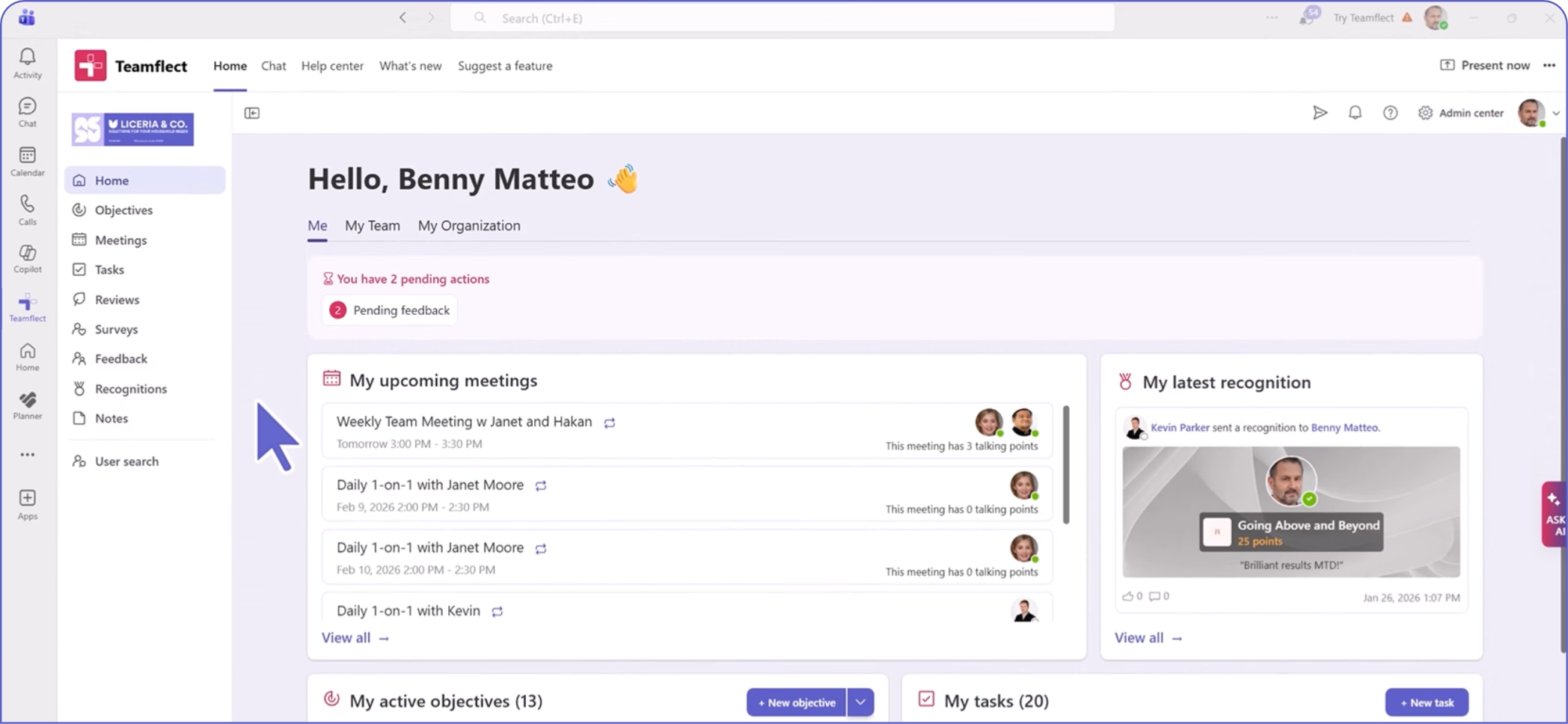
Create high-performing and engaged teams - even when people are remote - with our easy-to-use toolkit built for Microsoft Teams

_UsersMostLikelyToRecommend_Enterprise_Nps%201.svg)

.svg)
.svg)


.svg)
.svg)


.svg)

.svg)


%20THUMB.avif)
