.svg)
.svg)
Teamflect vs 15Five: Compare Features, Reviews, Pricing, and More!

Updated on:
January 7, 2026

Prefer Teamflect as your HR source on Google
.svg)

When comparing performance management platforms, most teams focus on three factors: feature depth, pricing transparency, and how well the tool fits into existing workflows. Both Teamflect and 15Five offer weekly check-ins, goal tracking, and employee engagement features, but they take fundamentally different approaches to where and how performance management happens.
15Five has built a reputation for structured weekly check-ins and continuous feedback loops. The platform works well for teams that want a standalone tool focused on manager-employee communication. Teamflect, on the other hand, brings performance reviews, OKRs, and engagement surveys directly into Microsoft Teams and Outlook, eliminating the need to switch between applications.
This comparison breaks down the key differences between these two platforms. We'll cover features, pricing, integrations, and implementation requirements to help you determine which tool better fits your organization's needs.
For teams already committed to the Microsoft 365 ecosystem, Teamflect's native integration offers a significant advantage in adoption rates and daily usability.
| Feature | Teamflect | 15Five |
|---|---|---|
| Free | Yes (up to 10 users) | No |
| Free Trial | Yes | Yes |
| G2 Rating | 4.6/5 | 4.6/5 |
| Microsoft Teams Integration | ✅ Native | ❌ Limited |
| Performance Reviews | ✅ | ✅ |
| OKRs & Goals | ✅ | ✅ |
| Feedback & 1-on-1s | ✅ | ✅ |
| Recognition | ✅ | ✅ |
| Engagement Surveys | ✅ | ✅ |
| Career Development | ✅ | ❌ |
| AI Features | ✅ Teamflect Agent | ❌ Basic |
| Support | Dedicated CSM | Tiered Support |
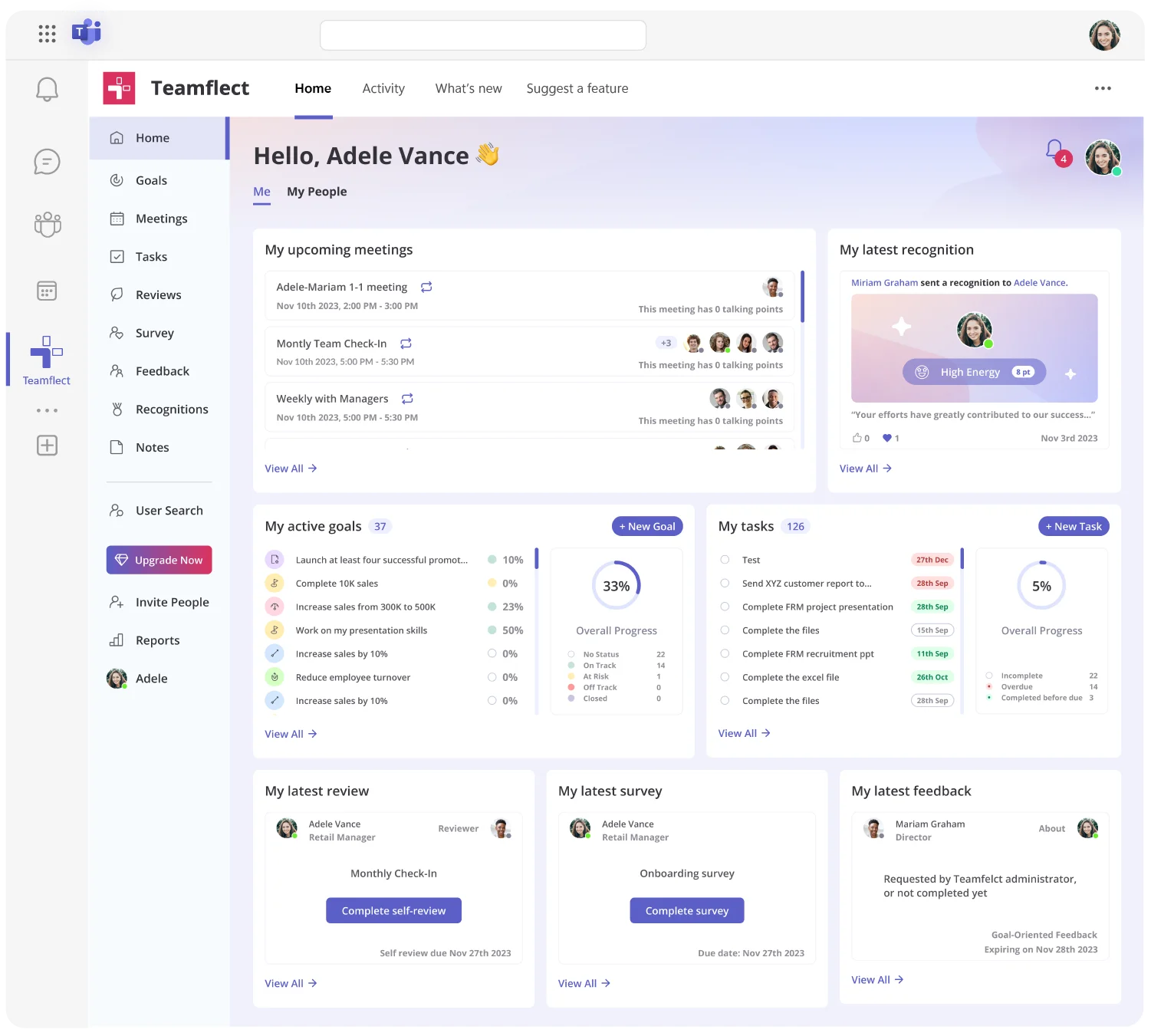
Teamflect is a comprehensive performance management and employee engagement platform designed specifically for Microsoft 365 organizations.
It functions as a native application within Microsoft Teams and Outlook, integrating essential HR functions, such as performance reviews, goal tracking, 360-degree feedback, and engagement surveys, directly into the daily workflow of your team.
This deep integration means managers and employees can complete critical tasks without ever having to switch applications, ensuring a smooth operational experience.
Key Features:
Pros & Cons:
Pros:
“It’s a well-integrated tool that fits seamlessly within Microsoft Teams, making it easy to give feedback, conduct 1-on-1s, and track goals without switching platforms.” - Software Advice Review
Cons:
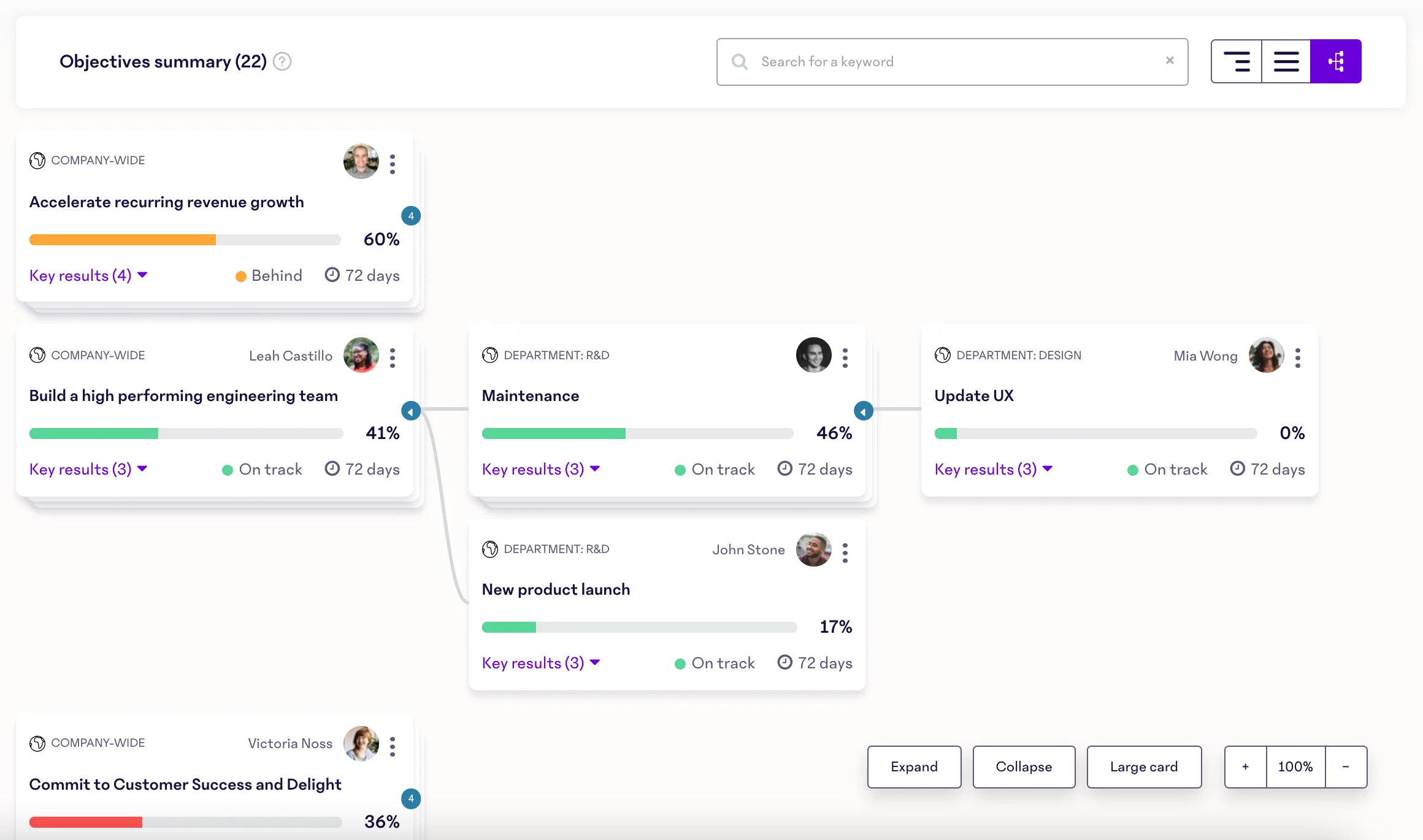
15Five is a platform dedicated to continuous performance management, built around features like weekly check-ins, OKR tracking, and peer recognition. It places a strong emphasis on consistent manager-employee communication by using structured weekly questions to maintain team alignment and engagement, making sure feedback loops are regular and productive.
Key Features:
Pros & Cons:
Pros:
"I like that I am able to connect with all members of the company I work for and receive and give high fives. I also love that it is a one-stop shop for manager check ins and reviews." - Software Advice Review
Cons:
“The 14-day trials feel limited, especially when trying to explore the platform thoroughly. A longer trial, at least a month, would give users more time to properly test its features and see how it fits their team structure and goals.” -G2 Review

Teamflect provides a straightforward and highly customizable performance review experience, leveraging its native integration with Microsoft Teams.
The platform allows for the easy execution of various review types, including annual, quarterly, and 360-degree feedback, which are all completed within the Teams environment. The process is supported by AI capabilities designed to assist managers and employees.
15Five emphasizes a continuous approach to performance reviews, building upon its foundation of weekly check-ins and regular feedback.
The platform's tools for performance management are highly rated for their customizability, allowing organizations to tailor forms and processes to their specific requirements. Its focus is on making the review process holistic by incorporating continuous feedback data.
The choice between the two platforms depends heavily on a company’s primary focus and technology stack. Both offer strong, modern review capabilities, but they excel in different areas.
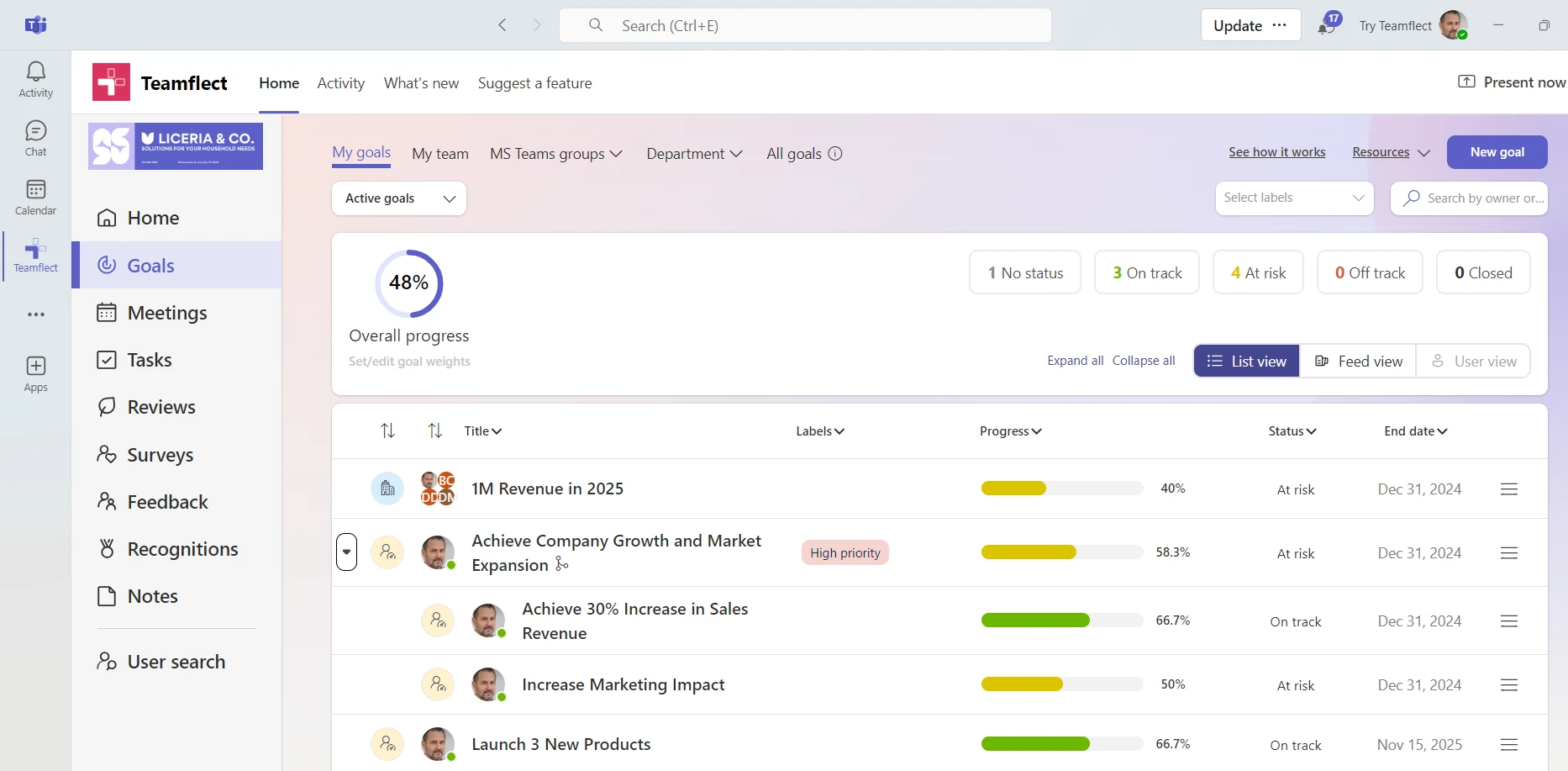
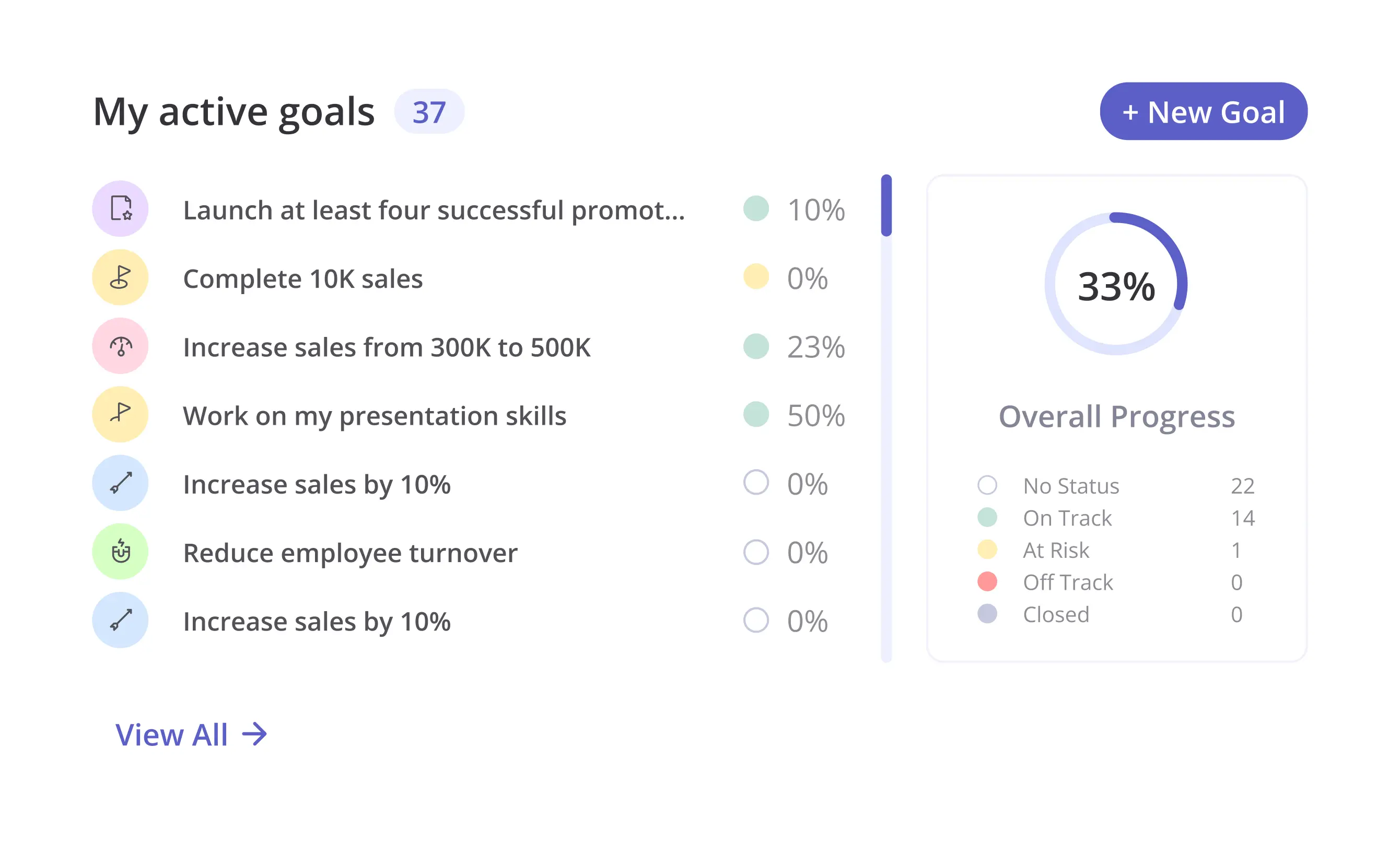
Teamflect's goal tracking tool is designed for deeply integrated goal management within Microsoft Teams. It allow teams to set, track, and update goals using adaptive cards directly in their familiar environment. The design prioritizes making goal evaluation a seamless part of the daily workflow rather than a standalone task.
15Five offers robust OKR tracking functionality with clear visual indicators and alignment tools. The process involves linking individual goals to company objectives, with progress tracking handled through the web dashboard. Updates are primarily made either through the structured weekly check-ins or by manually updating the dashboard.
For organizations operating within the Microsoft 365 framework, Teamflect holds a distinct advantage in this area. Its native integration and automated features promote better user compliance and more current data.
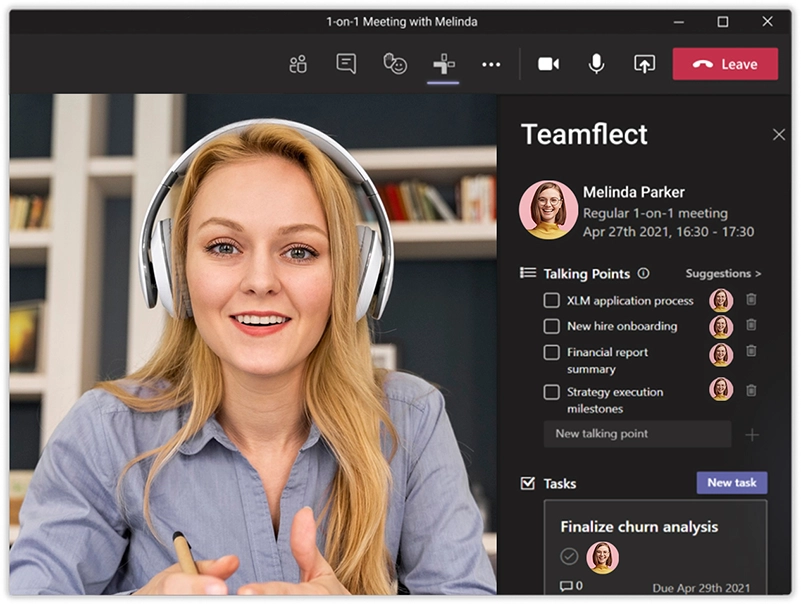
Teamflect provides 1-on-1 meeting management that is tightly integrated with the Microsoft Teams and Outlook environment. The system automatically prepares meeting agendas using recent performance data, feedback, and goal updates. This deep integration allows managers and employees to add private notes and track action items without having to leave the familiar Teams interface.
15Five structures continuous feedback around mandatory weekly check-ins, which use preset questions to gather information from employees. The platform also offers dedicated 1-on-1 meeting tools, including agenda templates and suggestions for talking points.
Managers review the weekly check-in responses before meetings, which helps them prepare discussion topics and move past simple status updates.
The superior platform depends on the organization's communication style and existing tech stack.

Teamflect handles recognition via the public channels and chat features in Microsoft Teams. Employees can give praise using badges that appear in public channels, which naturally boosts the visibility of achievements.
The recognition is directly tied to company values, and engagement surveys, including pulse checks, are deployed conveniently through Teams.
15Five's recognition system is called the High Fives program, which facilitates peer recognition via the platform's social feed. Employees can nominate colleagues for great work, and managers have the ability to amplify this praise across the organization.
This system promotes frequent appreciation, but employees must actively navigate to the separate 15Five platform to give or view recognition.
For maximum participation, the platform that makes recognition effortless will succeed.
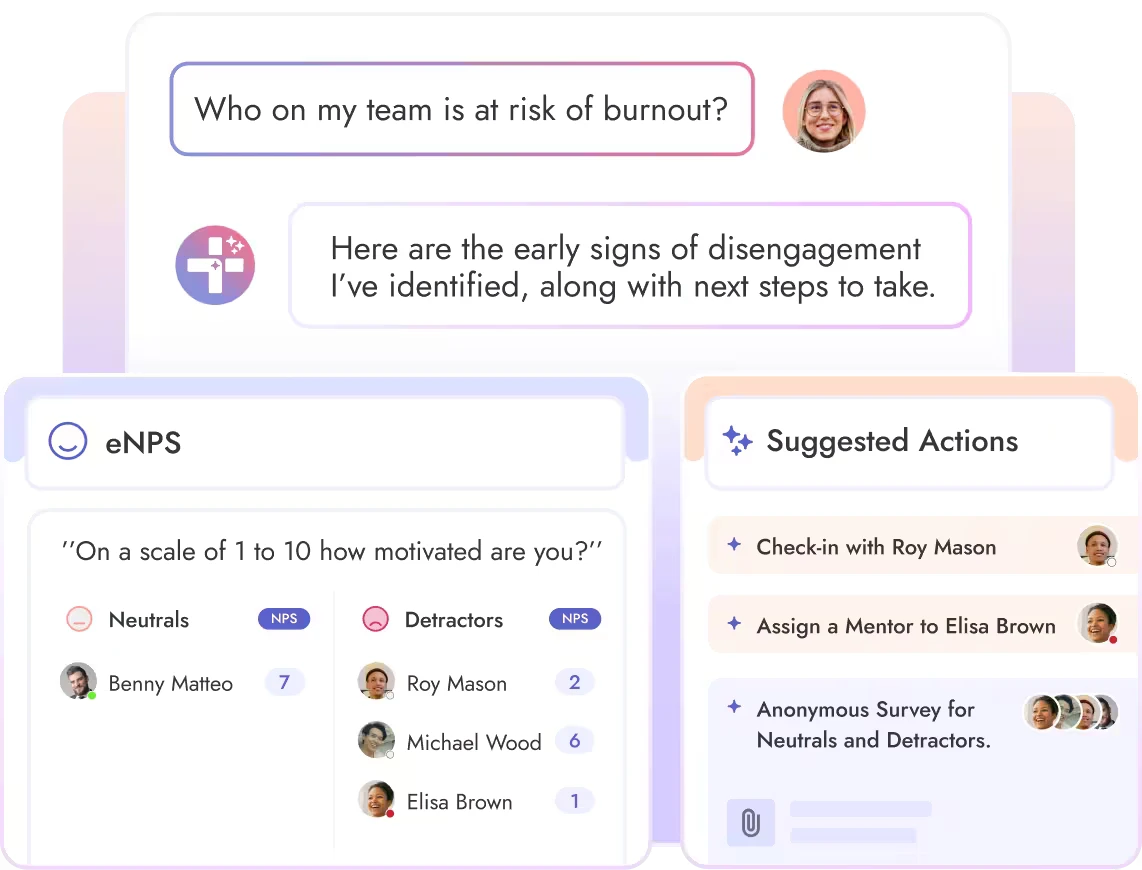
The Teamflect AI Agent acts as a comprehensive AI assistant for HR and performance management. It provides automated insights, coaching suggestions, and real-time answers concerning HR policies.
Teamflect’s AI is used to draft review comments using performance data, suggest personalized development goals, and identify trends in engagement survey responses, giving managers proactive recommendations.
15Five's AI functionality centers on manager coaching, primarily through its acquisition of Kona. This system provides managers with real-time, AI-powered coaching suggestions during virtual 1-on-1 meetings hosted on Zoom or Google Meet.
Outside this specific meeting assistance, the platform’s other AI features are less comprehensive than those offered by competitors.
Teamflect provides a wider application of artificial intelligence across the performance management system.
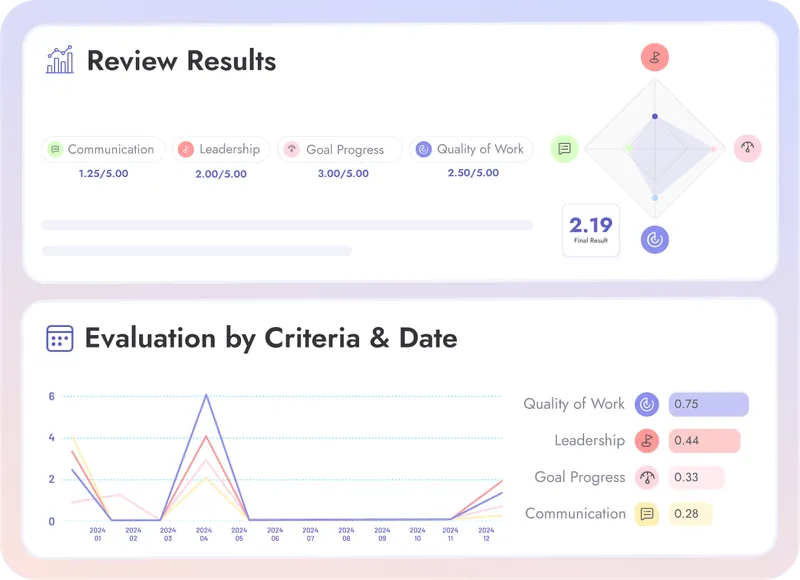
Teamflect is built for data-heavy organizations by providing a direct connection to Power BI for advanced analytics and custom reporting. HR teams can use pre-built dashboards to monitor performance trends, engagement scores, goal completion rates, and review cycle status.
The platform includes sophisticated features like talent mapping for identifying high performers and supporting succession planning.
15Five offers standard reporting dashboards that cover essential HR metrics, such as engagement scores, goal progress, and review completion rates. While these reports fulfill basic needs, they lack the customization and depth found in tools designed for strategic enterprise analytics.
Data export options are available but generally require manual processes rather than automated data feeds.
For organizations with strategic data requirements, Teamflect offers a more robust solution.
| Plan | Teamflect | 15Five |
|---|---|---|
| Free Tier | Up to 10 users with full functionality | Not available |
| Entry Level | $7/user/month (Essential plan, billed annually) | $4/user/month (Engage plan, billed annually) |
| Mid-Tier | $11/user/month (Professional plan, billed annually) | $11/user/month (Perform plan, billed annually) |
| Full Platform | Included in Professional | $16/user/month (Total Platform, billed annually) |
Teamflect offers a genuinely free plan for teams up to 10 users with no feature limitations. This makes it ideal for small teams testing performance management software before committing to paid plans. The Essential plan at $7/user/month includes all core features, while the Professional plan adds advanced analytics, custom workflows, and priority support.
Meanwhile, 15Five starts at $4/user/month for the Engage plan, which covers weekly check-ins and basic feedback features. Performance review capabilities require the $11/user/month Perform plan. Accessing the full platform with all features costs $16/user/month. For growing teams, these costs add up quickly, especially when multiple modules are needed.
For modern workplaces that rely on Microsoft Teams as their central hub for communication and collaboration, switching to Teamflect transforms performance management from a burdensome, administrative task into a truly native, intuitive activity. The reasons for this are as follows:
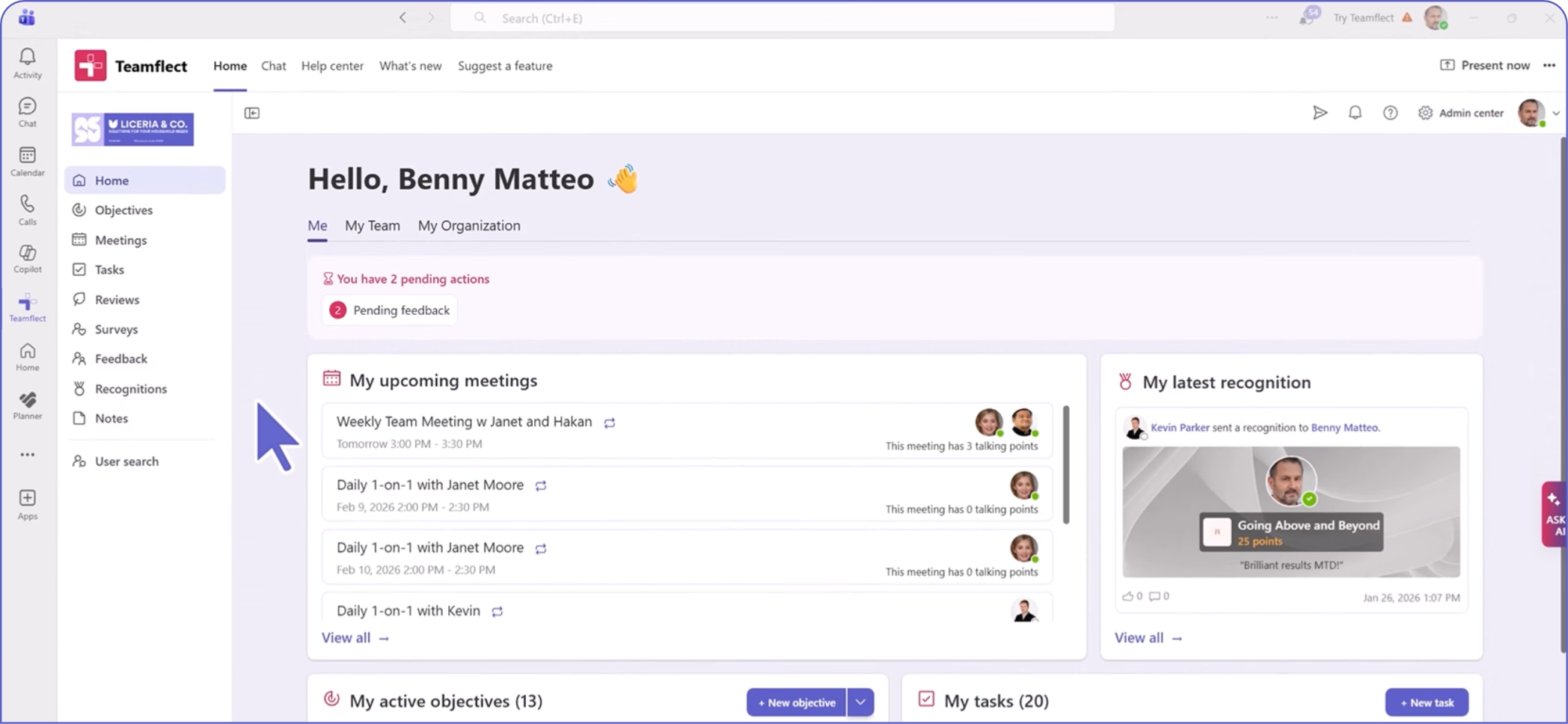
Teamflect's deepest strength is its complete operational presence within the Microsoft suite. Unlike standalone tools, Teamflect operates entirely inside Teams and Outlook, effectively eliminating the need for employees to maintain a separate login or continually switch context.
The implementation process for Teamflect is significantly quicker and less complex, making it highly attractive to IT and HR departments. Since the software utilizes existing Microsoft 365 permissions and organizational structures, it is ready to deploy much faster than external apps..
Teamflect is a unified platform that addresses a broad spectrum of talent management needs, allowing organizations to consolidate their HR technology stack. In contrast, 15Five primarily focuses on continuous check-ins and feedback, requiring organizations to purchase or manage other tools for specialized functions.
Teamflect offers a more cost-effective path to full functionality. While 15Five’s complete feature set requires an organization to purchase the higher-priced Total Platform plan, Teamflect includes all of its core capabilities in its lower-tier Professional plan.
Teamflect’s AI capabilities are more pervasive across the entire talent lifecycle, offering proactive support that reduces administrative overhead for HR and managers. The AI functions as an always-available assistant, going beyond meeting-based coaching.
Teamflect includes specialized features aimed at long-term employee progression and talent management that 15Five does not offer. This functionality is crucial for organizations focused on retention and building internal talent pipelines.
Both Teamflect and 15Five deliver solid performance management capabilities, but they approach implementation and user experience from fundamentally different directions.
Determining the right platform for your organization depends on your company's existing technology stack, budget, and desired approach to continuous communication. Understanding where your team spends most of its time working is the single most important factor in making a successful choice. Before deciding, run through HR platform demo questions to cover the key questions on features, integrations, implementation, and overall fit.
15Five is a highly effective option for organizations seeking a simple, dedicated tool centered on consistent, structured feedback. Its focus on mandatory weekly check-ins works best in environments where managers prioritize establishing a rigid, routine cadence for communication.
Teamflect is the clear choice for organizations fully committed to the Microsoft 365 ecosystem. Its native integration is designed to dismantle adoption barriers by embedding performance management directly into the daily applications employees already use, making it feel like an organic part of the workflow.
The ultimate decision often comes down to a simple question: Where does your team do its work?
Choosing between Teamflectand 15Five depends on your organization's technology stack, budget, and performance management priorities. While 15Five offers a focused solution for weekly check-ins, Teamflect delivers a more comprehensive platform with native Microsoft Teams integration, AI-powered insights, and career development features.
For Microsoft 365 organizations, Teamflect's embedded approach creates higher adoption rates, reduces administrative burden, and provides better value across the entire performance management lifecycle. The free plan for up to 10 users lets teams test the platform with no commitment.
The primary difference lies in integration depth and platform approach.
Teamflect operates natively within Microsoft Teams and Outlook, making performance management part of daily workflow without requiring separate logins. 15Five functions as a standalone web application focused on weekly check-ins and structured feedback.
Teamflect also includes career development and succession planning features that 15Five lacks.
Teamflect offers better value for comprehensive features. The free plan supports up to 10 users with full functionality, while 15Five has no free tier. For paid plans, Teamflect's Professional plan at $11/user/month includes all features.
15Five requires the $16/user/month Total Platform plan for equivalent capabilities. Organizations with 50+ employees typically save more annually when they choose Teamflect over 15Five.
Teamflect provides dedicated migration support for teams switching from 15Five. The process starts with exporting your check-in history, goals, and performance review data from 15Five in CSV format.
Teamflect's customer success team helps map this data to the appropriate fields and imports everything into your new environment. Most migrations complete within one to two weeks, including team training and setup. The timing works best when scheduled between review cycles to avoid disrupting active evaluations.
The difference is less about features and more about workflow. Teamflect brings OKRs directly into Microsoft Teams, so goal updates, check-ins, and alignment happen where conversations and collaboration already take place.
With 15Five, teams typically manage OKRs in a separate system and rely on integrations to connect that data back to Microsoft tools. For organizations aiming to reduce tool sprawl and keep performance processes close to everyday work in Teams, this can be an important consideration.
Yes, but through a Microsoft Teams–native experience. Teamflect enables real-time feedback and check-ins directly inside Teams, using native messages and prompts rather than a separate chat interface. This allows feedback to happen within everyday workflows without switching tools.

.svg)
.avif)
Create high-performing and engaged teams - even when people are remote - with our easy-to-use toolkit built for Microsoft Teams