.svg)
.svg)
How To Conduct Employee NPS Surveys Inside Microsoft Teams

Updated on:
July 3, 2026

Prefer Teamflect as your HR source on Google
.svg)

A net promoter score is a metric for measuring customer or employee loyalty and satisfaction levels by simply asking them the question:
And in this video guide we are answering “Can you conduct NPS surveys in Microsoft Teams ?”
Let’s take a look at how you can analyze the net promoter score survey results. When you’re conducting an NPS survey among your employees or customers, you’re asking them to rate on a scale of 0-10, their likeliness of recommending your product or company to their friends:
Those who rate between 0 and 6 are your detractors, and those rating between 7 and 8 are your passives. The 9 and 10s are your promoters.
To calculate your net promoter score, all you have to do is subtract the percentage of detractors from the percentage of promoters.
So if you have 20 % promoters and 60 % detractors, your net promoter score is a negative 40. But what do these numbers mean? Anywhere above a zero, which corresponds to anywhere in the positive region is good. Anywhere above 50 is excellent, and anywhere north of 70 is world-class.
So without further ado, let’s dive right into Microsoft Teams and show you how you can use Teamflect to conduct employee NPS surveys inside Microsoft Teams.

To download the best survey /performance management tool in the Microsoft Teams ecosystem, all you have to do is head over to the Teams App Store and download Teamflect.

Once the surveys have been sent out, you can always send your responders reminders to complete the survey.

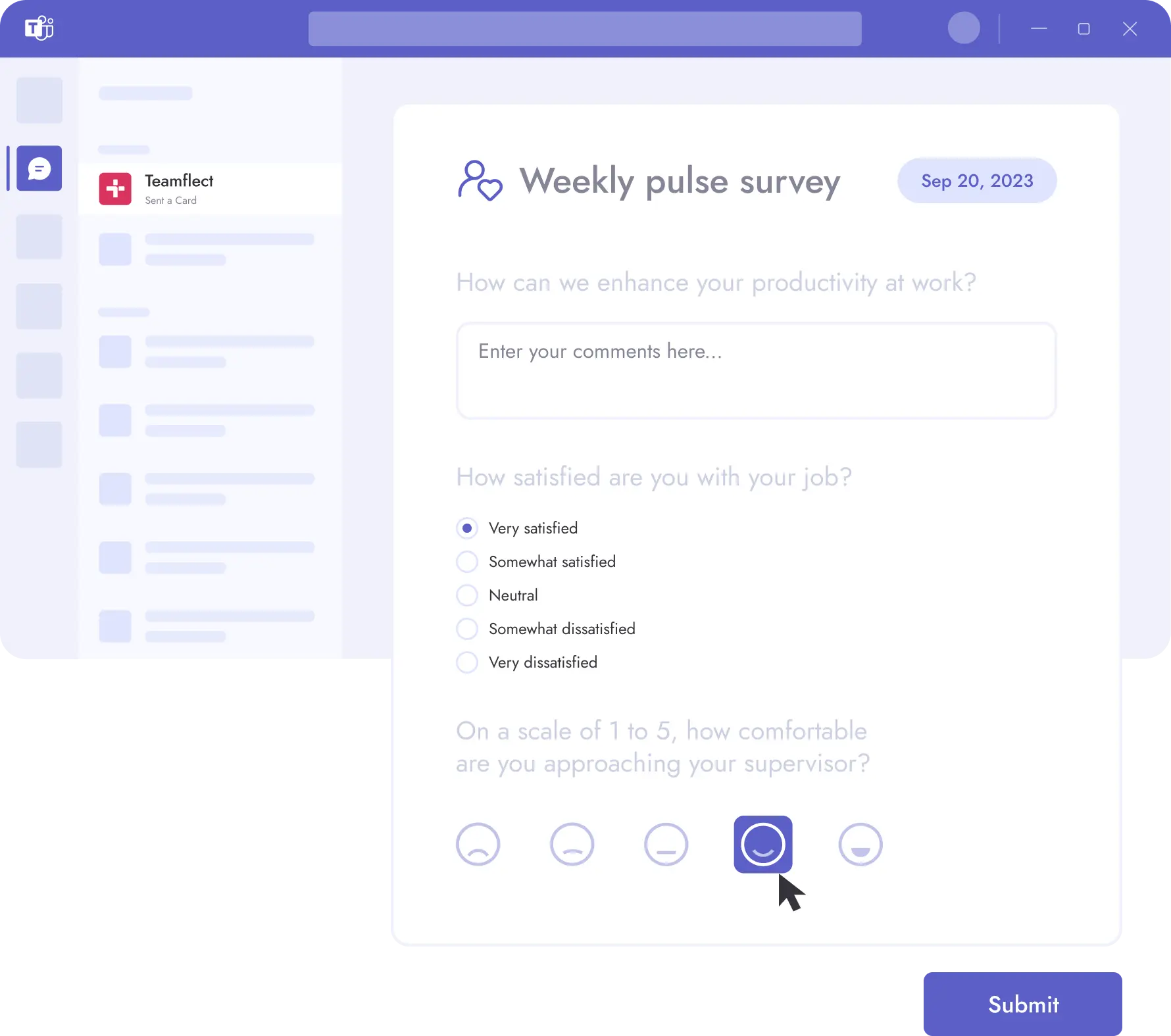
Your employees will receive the survey you sent out as an adaptive card inside Microsoft Teams chat. All they have to do is enter the survey and fill it out with their answers in only a few clicks.
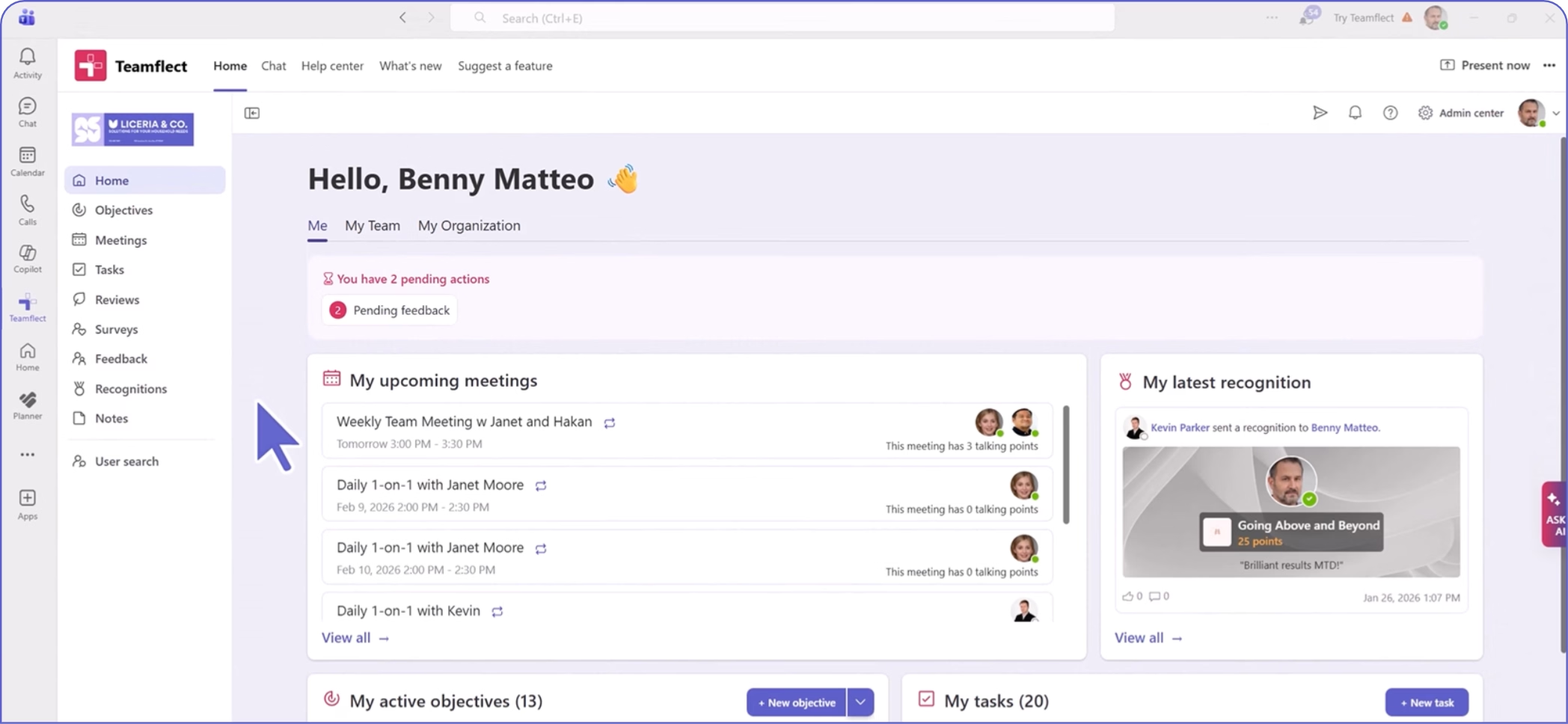
As a manager, all your employee survey results can be viewed easily inside Teamflect’s “Surveys” module.
You can view everyone’s results in bulk or click on individual responders to view their responses individually.

You can also generate a report with AI while conducting NPS surveys inside Microsoft Teams with Teamflect. This is going to be a detailed summary of your survey’s results with analysis. You also have the option to compare this survey results with past surveys.

Gallup’s 2026 global workplace reporting found that low engagement cost the world economy approximately 10 trillion dollars in lost productivity in 2025, or 9 percent of global GDP.
Beyond the initial calculation, eNPS serves as a vital diagnostic tool for organizational health. It allows leaders to move beyond guesswork and make data-driven decisions about culture.
Quarterly for the full eNPS survey, monthly for a short pulse check. Quarterly for the full eNPS survey, monthly for a short pulse check. Global engagement fell for a second consecutive year in 2025, to 20 percent. When the baseline itself is moving, an annual snapshot cannot tell you whether your organization is drifting with it.
The cadence only holds if it follows a structure. We call it the 90-Day Listening Loop:
Prove is the step most teams drop, and it is the one that keeps the loop alive. Prior research by Gallup finds employees who strongly agree they receive valuable feedback are five times as likely to be engaged and 48 percent less likely to be watching for other jobs. The mechanism runs both ways: people invest where their input visibly matters, and withdraw where it does not. When people answer a survey and nothing changes, they stop answering. Your next score comes from fewer, more polarized voices. That is how eNPS programs quietly die.
And proving does not require a big announcement. A two-line Teams post works: "You told us meeting load was the top friction point. Fridays are now meeting-free before noon." The format matters less than the causal link. People need to see "you told us" followed by a change.
Ask every vendor these five questions in the live demo, and judge what they show you, not what they say:
| Ask the vendor | What you are really testing |
|---|---|
| "Where does my employee actually answer this?" | Native integration. If the answer involves a browser link, expect response rates to fall. |
| "Can I see who has not responded, without seeing what anyone said?" | Whether anonymity is architecture or an afterthought. |
| "Set up a recurring quarterly eNPS right now, in front of me." | Automation. Under a minute is the bar. |
| "Show me this quarter against last quarter." | Trend reporting, the entire reason to measure eNPS repeatedly. |
| "What happens to 200 open-text answers?" | Whether analysis is AI-assisted or a manual Excel export. |
Employee NPS measures how likely your people are to recommend your organization as a place to work. The score comes from one question, which makes it easy to run and easy to repeat.
Repetition is where the value sits. A single survey gives you a number. A quarterly cadence with visible follow-up gives you a trend you can act on.
Running NPS surveys inside Microsoft Teams removes the biggest barrier to that consistency: employees answer where they already work, so response rates hold up cycle after cycle. Teamflect handles the scheduling, reminders, and promoter-detractor analysis within Teams.
If you want to see how that works in practice, you can try Teamflect below.

.svg)
.avif)
A net promoter score is a metric for measuring customer or employee loyalty and satisfaction levels by simply asking them the question:
And in this video guide we are answering “Can you conduct NPS surveys in Microsoft Teams ?”
Let’s take a look at how you can analyze the net promoter score survey results. When you’re conducting an NPS survey among your employees or customers, you’re asking them to rate on a scale of 0-10, their likeliness of recommending your product or company to their friends:
Those who rate between 0 and 6 are your detractors, and those rating between 7 and 8 are your passives. The 9 and 10s are your promoters.
To calculate your net promoter score, all you have to do is subtract the percentage of detractors from the percentage of promoters.
So if you have 20 % promoters and 60 % detractors, your net promoter score is a negative 40. But what do these numbers mean? Anywhere above a zero, which corresponds to anywhere in the positive region is good. Anywhere above 50 is excellent, and anywhere north of 70 is world-class.
So without further ado, let’s dive right into Microsoft Teams and show you how you can use Teamflect to conduct employee NPS surveys inside Microsoft Teams.
To download the best survey /performance management tool in the Microsoft Teams ecosystem, all you have to do is head over to the Teams App Store and download Teamflect.
Once the surveys have been sent out, you can always send your responders reminders to complete the survey.
Your employees will receive the survey you sent out as an adaptive card inside Microsoft Teams chat. All they have to do is enter the survey and fill it out with their answers in only a few clicks.
As a manager, all your employee survey results can be viewed easily inside Teamflect’s “Surveys” module.
You can view everyone’s results in bulk or click on individual responders to view their responses individually.
You can also generate a report with AI while conducting NPS surveys inside Microsoft Teams with Teamflect. This is going to be a detailed summary of your survey’s results with analysis. You also have the option to compare this survey results with past surveys.
Gallup’s 2026 global workplace reporting found that low engagement cost the world economy approximately 10 trillion dollars in lost productivity in 2025, or 9 percent of global GDP.
Beyond the initial calculation, eNPS serves as a vital diagnostic tool for organizational health. It allows leaders to move beyond guesswork and make data-driven decisions about culture.
Quarterly for the full eNPS survey, monthly for a short pulse check. Quarterly for the full eNPS survey, monthly for a short pulse check. Global engagement fell for a second consecutive year in 2025, to 20 percent. When the baseline itself is moving, an annual snapshot cannot tell you whether your organization is drifting with it.
The cadence only holds if it follows a structure. We call it the 90-Day Listening Loop:
Prove is the step most teams drop, and it is the one that keeps the loop alive. Prior research by Gallup finds employees who strongly agree they receive valuable feedback are five times as likely to be engaged and 48 percent less likely to be watching for other jobs. The mechanism runs both ways: people invest where their input visibly matters, and withdraw where it does not. When people answer a survey and nothing changes, they stop answering. Your next score comes from fewer, more polarized voices. That is how eNPS programs quietly die.
And proving does not require a big announcement. A two-line Teams post works: "You told us meeting load was the top friction point. Fridays are now meeting-free before noon." The format matters less than the causal link. People need to see "you told us" followed by a change.
Ask every vendor these five questions in the live demo, and judge what they show you, not what they say:
| Ask the vendor | What you are really testing |
|---|---|
| "Where does my employee actually answer this?" | Native integration. If the answer involves a browser link, expect response rates to fall. |
| "Can I see who has not responded, without seeing what anyone said?" | Whether anonymity is architecture or an afterthought. |
| "Set up a recurring quarterly eNPS right now, in front of me." | Automation. Under a minute is the bar. |
| "Show me this quarter against last quarter." | Trend reporting, the entire reason to measure eNPS repeatedly. |
| "What happens to 200 open-text answers?" | Whether analysis is AI-assisted or a manual Excel export. |
Employee NPS measures how likely your people are to recommend your organization as a place to work. The score comes from one question, which makes it easy to run and easy to repeat.
Repetition is where the value sits. A single survey gives you a number. A quarterly cadence with visible follow-up gives you a trend you can act on.
Running NPS surveys inside Microsoft Teams removes the biggest barrier to that consistency: employees answer where they already work, so response rates hold up cycle after cycle. Teamflect handles the scheduling, reminders, and promoter-detractor analysis within Teams.
If you want to see how that works in practice, you can try Teamflect below.
A net promoter score is a metric for measuring customer or employee loyalty and satisfaction levels by simply asking them the question:
And in this video guide we are answering “Can you conduct NPS surveys in Microsoft Teams ?”
Let’s take a look at how you can analyze the net promoter score survey results. When you’re conducting an NPS survey among your employees or customers, you’re asking them to rate on a scale of 0-10, their likeliness of recommending your product or company to their friends:
Those who rate between 0 and 6 are your detractors, and those rating between 7 and 8 are your passives. The 9 and 10s are your promoters.
To calculate your net promoter score, all you have to do is subtract the percentage of detractors from the percentage of promoters.
So if you have 20 % promoters and 60 % detractors, your net promoter score is a negative 40. But what do these numbers mean? Anywhere above a zero, which corresponds to anywhere in the positive region is good. Anywhere above 50 is excellent, and anywhere north of 70 is world-class.
So without further ado, let’s dive right into Microsoft Teams and show you how you can use Teamflect to conduct employee NPS surveys inside Microsoft Teams.
To download the best survey /performance management tool in the Microsoft Teams ecosystem, all you have to do is head over to the Teams App Store and download Teamflect.
Once the surveys have been sent out, you can always send your responders reminders to complete the survey.
Your employees will receive the survey you sent out as an adaptive card inside Microsoft Teams chat. All they have to do is enter the survey and fill it out with their answers in only a few clicks.
As a manager, all your employee survey results can be viewed easily inside Teamflect’s “Surveys” module.
You can view everyone’s results in bulk or click on individual responders to view their responses individually.
You can also generate a report with AI while conducting NPS surveys inside Microsoft Teams with Teamflect. This is going to be a detailed summary of your survey’s results with analysis. You also have the option to compare this survey results with past surveys.
Gallup’s 2026 global workplace reporting found that low engagement cost the world economy approximately 10 trillion dollars in lost productivity in 2025, or 9 percent of global GDP.
Beyond the initial calculation, eNPS serves as a vital diagnostic tool for organizational health. It allows leaders to move beyond guesswork and make data-driven decisions about culture.
Quarterly for the full eNPS survey, monthly for a short pulse check. Quarterly for the full eNPS survey, monthly for a short pulse check. Global engagement fell for a second consecutive year in 2025, to 20 percent. When the baseline itself is moving, an annual snapshot cannot tell you whether your organization is drifting with it.
The cadence only holds if it follows a structure. We call it the 90-Day Listening Loop:
Prove is the step most teams drop, and it is the one that keeps the loop alive. Prior research by Gallup finds employees who strongly agree they receive valuable feedback are five times as likely to be engaged and 48 percent less likely to be watching for other jobs. The mechanism runs both ways: people invest where their input visibly matters, and withdraw where it does not. When people answer a survey and nothing changes, they stop answering. Your next score comes from fewer, more polarized voices. That is how eNPS programs quietly die.
And proving does not require a big announcement. A two-line Teams post works: "You told us meeting load was the top friction point. Fridays are now meeting-free before noon." The format matters less than the causal link. People need to see "you told us" followed by a change.
Ask every vendor these five questions in the live demo, and judge what they show you, not what they say:
| Ask the vendor | What you are really testing |
|---|---|
| "Where does my employee actually answer this?" | Native integration. If the answer involves a browser link, expect response rates to fall. |
| "Can I see who has not responded, without seeing what anyone said?" | Whether anonymity is architecture or an afterthought. |
| "Set up a recurring quarterly eNPS right now, in front of me." | Automation. Under a minute is the bar. |
| "Show me this quarter against last quarter." | Trend reporting, the entire reason to measure eNPS repeatedly. |
| "What happens to 200 open-text answers?" | Whether analysis is AI-assisted or a manual Excel export. |
Employee NPS measures how likely your people are to recommend your organization as a place to work. The score comes from one question, which makes it easy to run and easy to repeat.
Repetition is where the value sits. A single survey gives you a number. A quarterly cadence with visible follow-up gives you a trend you can act on.
Running NPS surveys inside Microsoft Teams removes the biggest barrier to that consistency: employees answer where they already work, so response rates hold up cycle after cycle. Teamflect handles the scheduling, reminders, and promoter-detractor analysis within Teams.
If you want to see how that works in practice, you can try Teamflect below.
Create high-performing and engaged teams - even when people are remote - with our easy-to-use toolkit built for Microsoft Teams