.svg)
.svg)
8 FREE Employee Development Plan Templates and Examples!

Updated on:
March 27, 2026

Prefer Teamflect as your HR source on Google
.svg)

Many HR benchmarks estimate that replacing an employee can cost from one-half up to two times that employee's annual salary, once you factor in recruiting, onboarding, and lost productivity. One important stepping stone to achieving retention is employee development plans. Without the prospect of growth, you will not be able to attract or keep team members engaged. In managing your team, considering career advancement is a must, not just for your team's sake but also for your organization's.
An employee development plan template is a structured framework that organizations use in order to outline and monitor the progress of an employee's growth plan as a professional. Its purpose is to serve as a roadmap for both the employees and their managers to align personal and professional development goals as well as the organization's objectives.
Normally, an EDP includes the following: employee information, current skills assessment, development goals, training and resources allocation, an action plan, a timeline and performance metrics to monitor progression.
Employee development plans can feel a lot like abandoned New Year resolutions after a while. To make sure you don't run into that issue, you need to use an employee performance management solution that lets you create development plans inside your main communication platform. For Microsoft Teams users, that option is Teamflect!
You can try Teamflect for absolutely free and without having to sign up, inside Microsoft Teams. No time or feature limitations whatsoever.
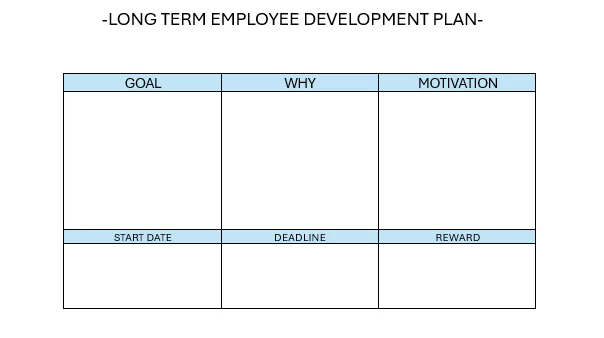
With this free employee development template, you won't have to work your way through a complicated and distracting design. What we love about this one is its simplicity and it's where its power lies.
This allows the individual completing the template to have complete freedom in how they wish to map out their development plans.
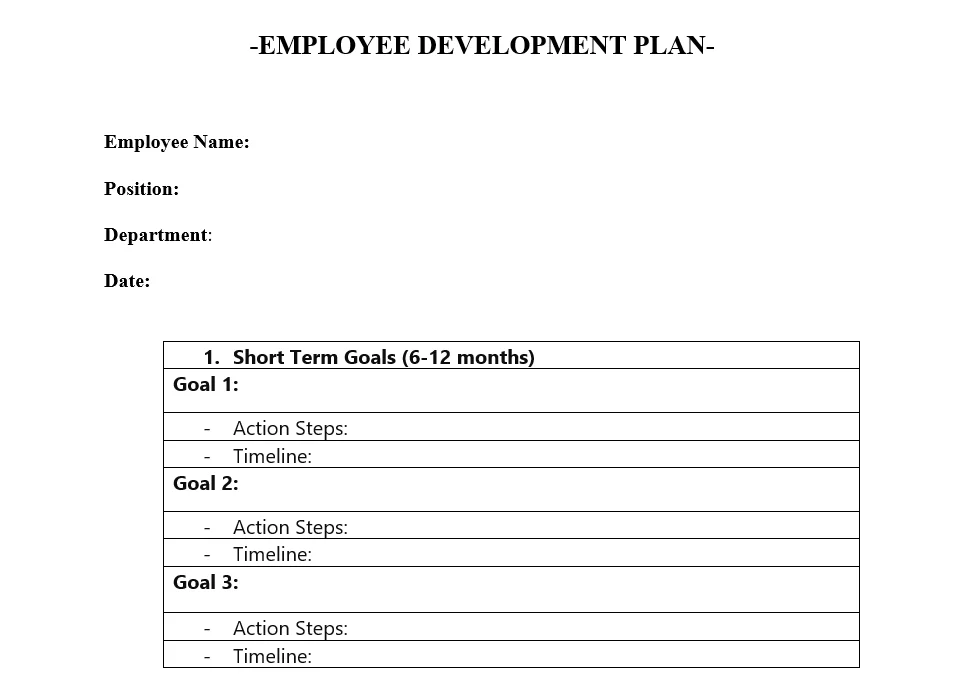
Another version of the employee development template is where you have a little more detail to push you into more introspection regarding your goals and be a bit more specific when it comes to your plan for the future.
Details like resources, time frames, and progress tracking can be found in this template to give yourself a well-thought-out employee development plan.
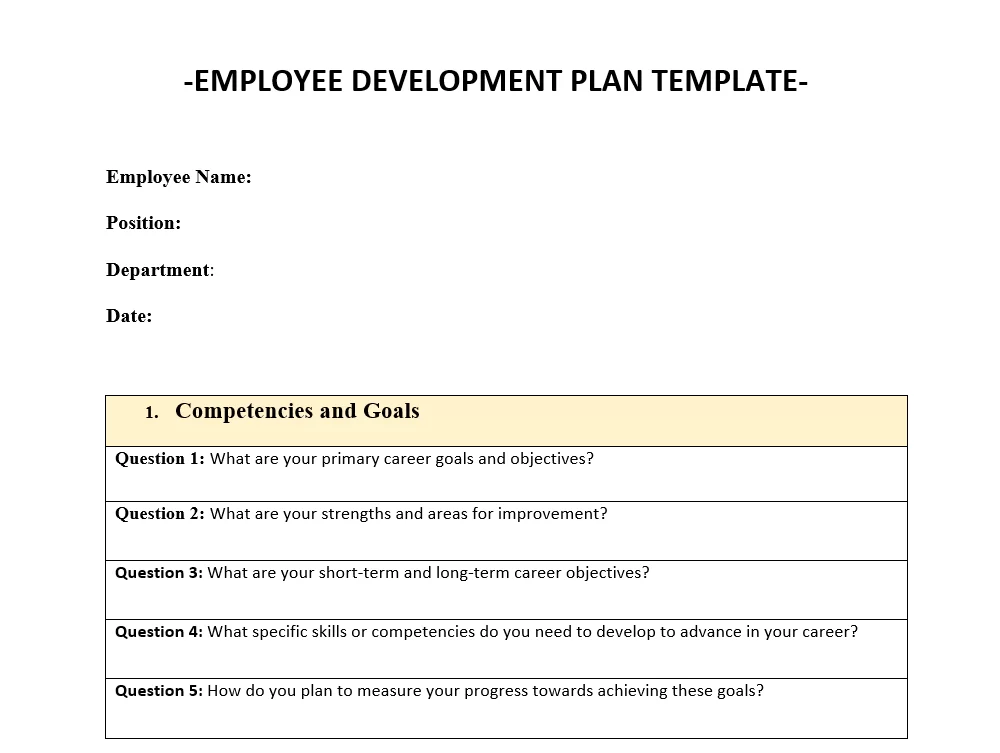
This one may not look too fancy but this free employee development plan template will hit all the right notes. This template contains everything you need in an employee development plan for no cost at all.
We particularly like their use of tasks, target ideas, and most importantly, the 90-day check-in section. For more on phased planning, see our guide to 30-60-90 day plans.
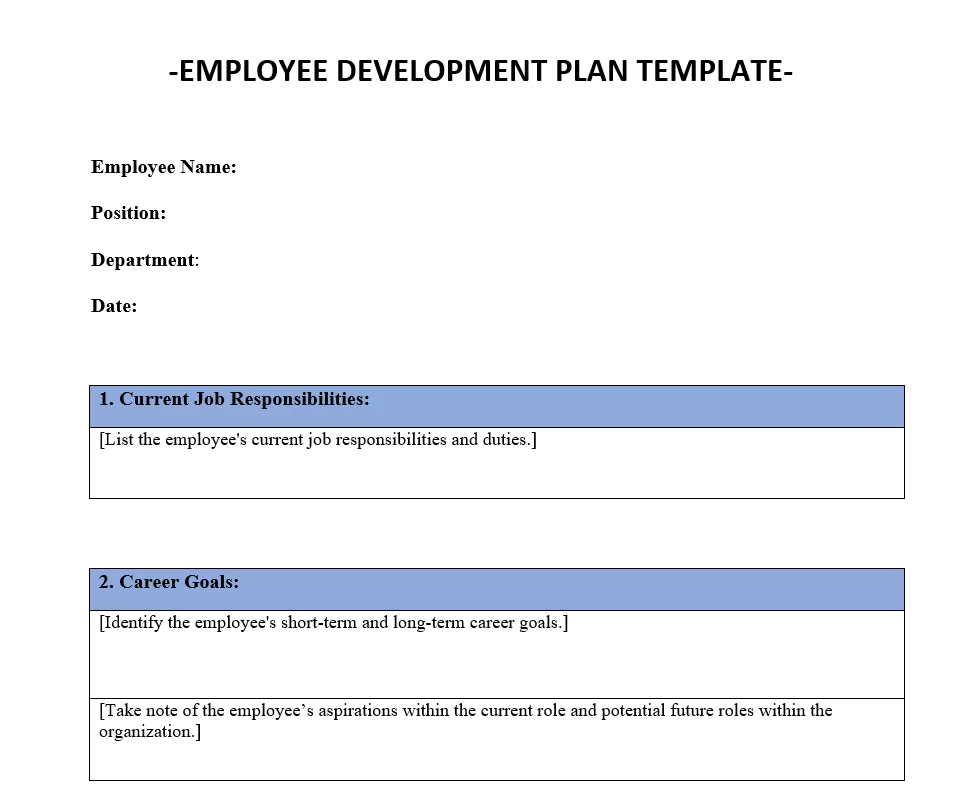
Another format in which you get everything you need is an employee development template. You'll see everything from career aspirations to current responsibilities, review periods, mentoring, and more. If you want a well-thought-out plan on all levels, this one's for you.
While the free employee development plan templates we listed above are all very effective and well-designed, they all bring a more generalist approach to employee growth and development.
That is why we wanted to create some templates/roadmaps of our own for more particular and specific situations that may arise in your workplace. So when it comes to specific situations, let's answer the question: What are examples of development plans?
An individual development plan template is more focused than a general employee development plan. Where a standard EDP maps out broad growth goals, an effective individual development plan template zeroes in on a single employee's career trajectory, skill gaps, and development actions over a defined time period. According to a 2025 Gallup study of nearly 16,000 U.S. workers, one in four employees report that their organization offers no real opportunities for advancement, a gap that structured IDPs are specifically designed to close.
The strongest individual development plan templates share five core components. First, an employee profile section that captures current role, tenure, and relevant background. Second, a skills inventory that honestly documents existing strengths alongside gaps the employee and manager have identified together. Third, clearly defined development goals, written in specific and measurable terms rather than vague aspirations. Fourth, a concrete action plan that names the actual learning activities, mentoring relationships, or stretch assignments that will drive progress. Fifth, success metrics and a review schedule so both the manager and employee can track whether the plan is working.
SHRM's guidance on IDPs emphasizes that the plan should be treated as a collaborative partnership between the employee and their manager rather than a top-down assignment. When employees co-create their individual development plan template, they are more likely to follow through on the actions it prescribes. For Microsoft Teams users, Teamflect's individual development plan tool brings this process directly into the workflows your team already uses every day, removing the friction that causes most plans to stall after the first check-in.
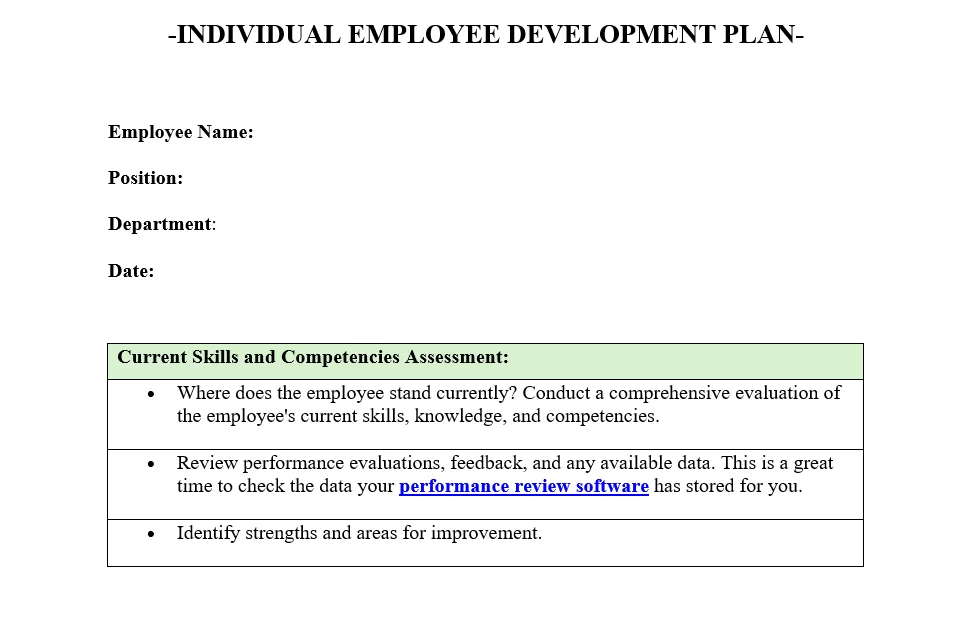
An IDP is more than just an employee development plan. It is a collaborative effort between an employee and their manager in order to improve the skillset, knowledge, and performance of a particular employee.
This template will offer you a simple roadmap to follow when creating an individual development plan for an employee.
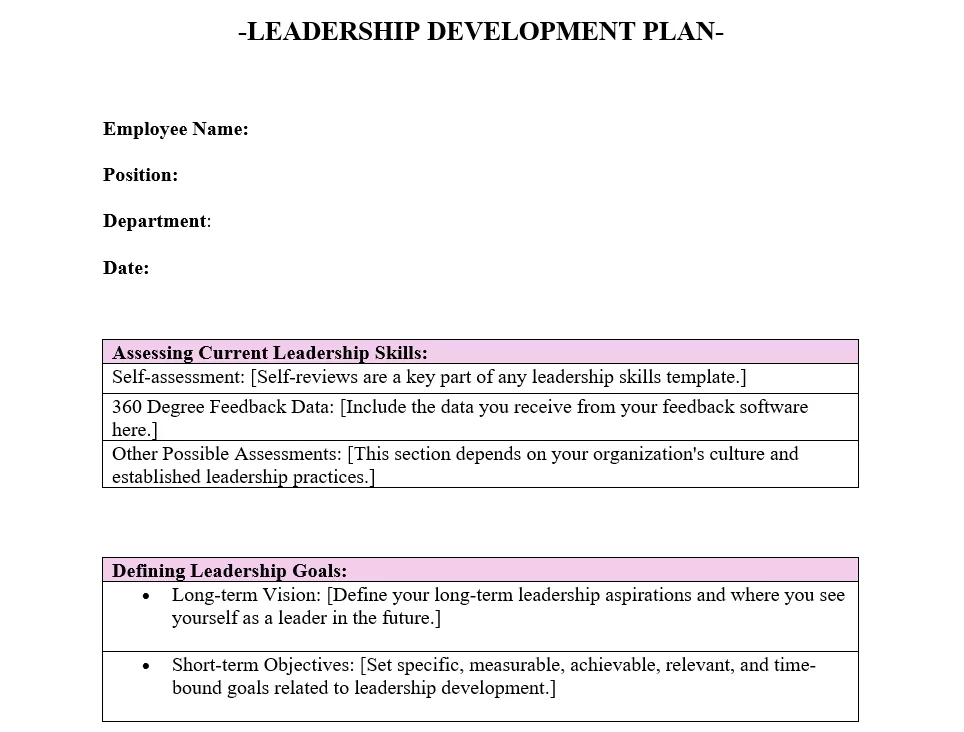
Any great leader knows the importance of giving the necessary chance to upcoming potential leaders in their organization which is exactly why this template is essential. A development plan catered to leaders in the making!
What this plan does best is help managers identify key areas of improvement in their direct reports' leadership skills and build on them!
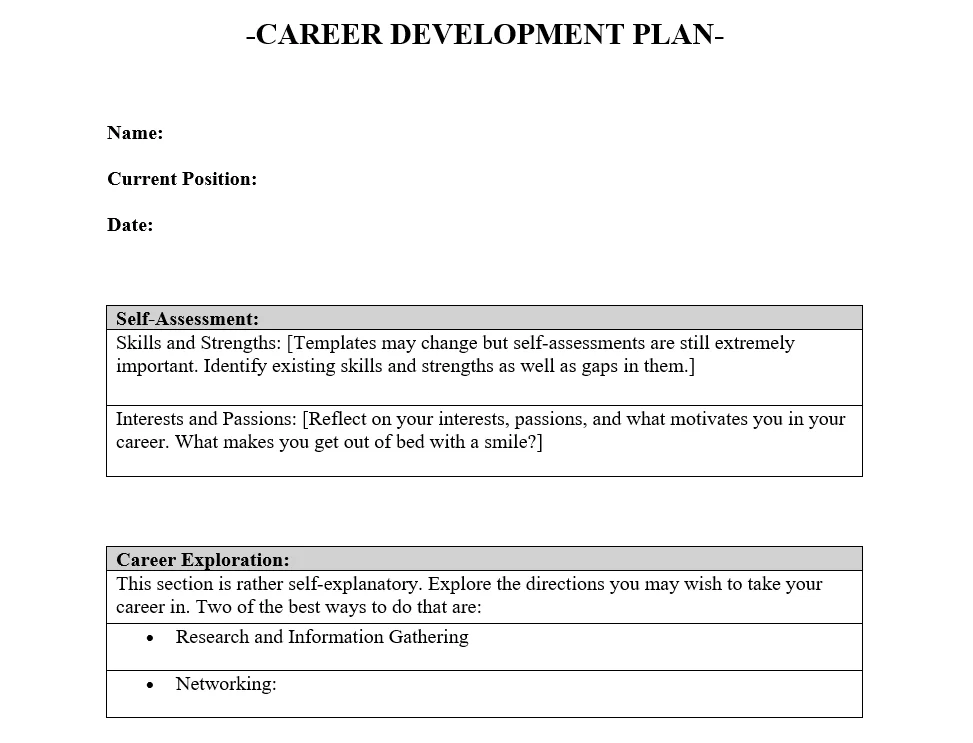
We always assume that career development plans must be for the managers, but that is not a prerequisite. So this one is designed for individuals to be able to map out the next steps for themselves.
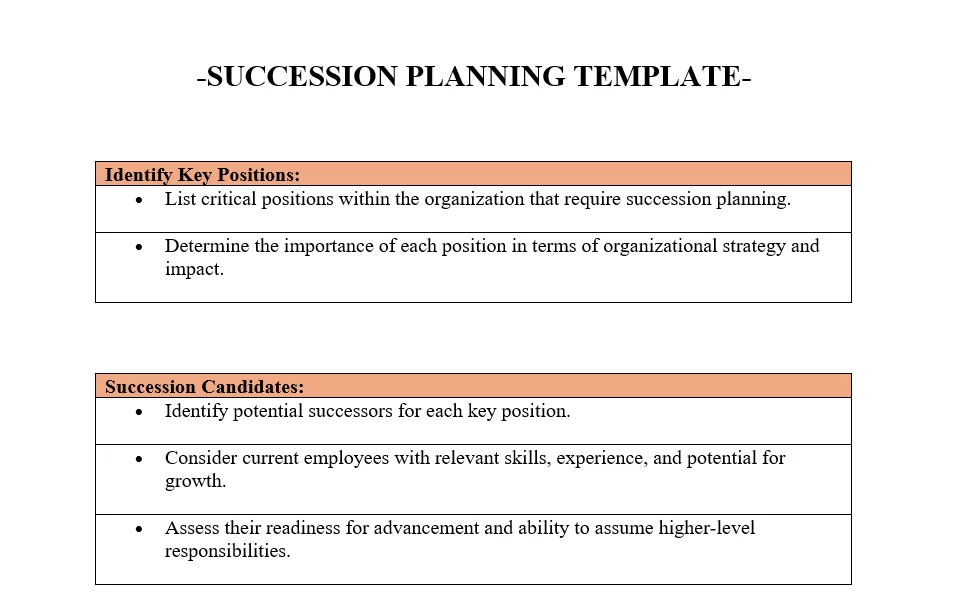
Succession planning is essential wherever you are. To ensure a smooth exchange you'll need to plan ahead, and this template will help you do exactly that.
An effective employee development plan is personalized, aligning each individual's growth with their role, career aspirations, and organizational needs. Below you will find some employee development plan examples we've curated for you. While they aren't as detailed as the development plan templates we've listed above, we believe they can give you an idea on how you can tailor employee development plans to fit different individuals.
Goal: Equip the new hire with essential skills and knowledge for success in their role, achieving proficiency and confidence within the first 90 days.
Objectives:
Actions:
Success Metrics:
This development plan is aimed to help new employees integrate quickly and establish a solid foundation for further development.
Goal: Develop key leadership and management skills in preparation for a future promotion to a supervisory role.
Objectives:
Actions:
Success Metrics:
This particular development plan equips mid-level employees with the leadership skills they need to confidently step into managerial roles, supporting both their career progression and organizational needs.
Goal: Transition an experienced individual contributor into a strategic, high-level advisory role, aligning their expertise with broader organizational goals.
Objectives:
Actions:
Strategy Contribution: Present findings and propose innovative strategies during leadership meetings, providing input that influences company direction.
Success Metrics:
This employee development plan example is designed to allow experienced employees to leverage their expertise at a strategic level, adding value to the organization's high-level goals while satisfying their own career ambitions for growth.
Employee growth and development isn't an event. It isn't an occasion. It is an ongoing process that always has to be on the agenda.
That is why you need to implement a performance management tool that has a tight focus on employee development. While there are many great performance management applications out there, the best option for Microsoft Teams users is…
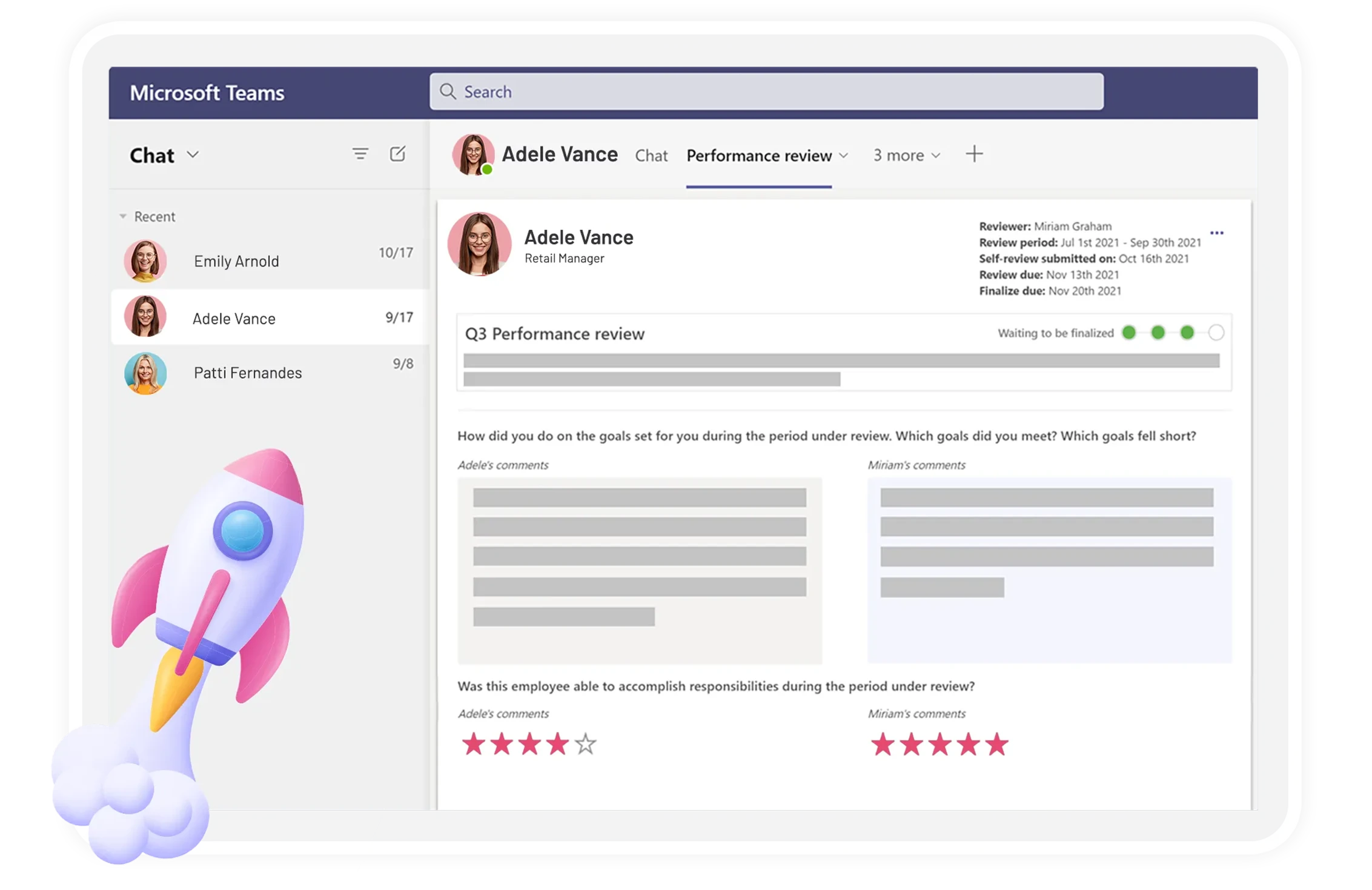
Teamflect is an all-in-one performance review software designed with complete Microsoft 365 integration in mind.
It is also one of the best individual development plan tool available in Microsoft Teams app store. Teamflect's feedback templates alongside its performance review templates all come with employee development plans attached to them, helping users build their employees up for success! See how MedQuest built their performance empowerment process from the ground up using Teamflect.
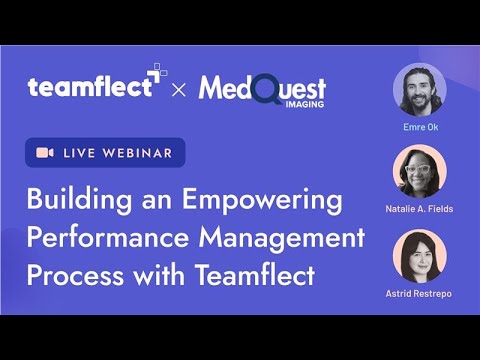
Knowing what goes into an individual development plan template is one thing. Watching a real HR team rebuild their entire performance process from the ground up across a distributed workforce of 1,000+ frontline healthcare employees is another.
We sat down with Natalie Fields, Director of People Experience at MedQuest, and Senior HRIS Analyst Astrid Restrepo to hear the full story: the philosophy behind moving away from traditional reviews, how they rolled out what they now call the "Performance Empowerment Process," and the outcomes they've seen since making the switch.
You can watch the full webinar on YouTube 👇
Creating an employee development plan template is an important responsibility for leaders who seek to retain their employees effectively. As with any aspect of performance management, a well-defined employee development plan template is essential.
Embrace the growth journey, and with Teamflect, make employee development an integral part of your organizational agenda!

.svg)
.avif)
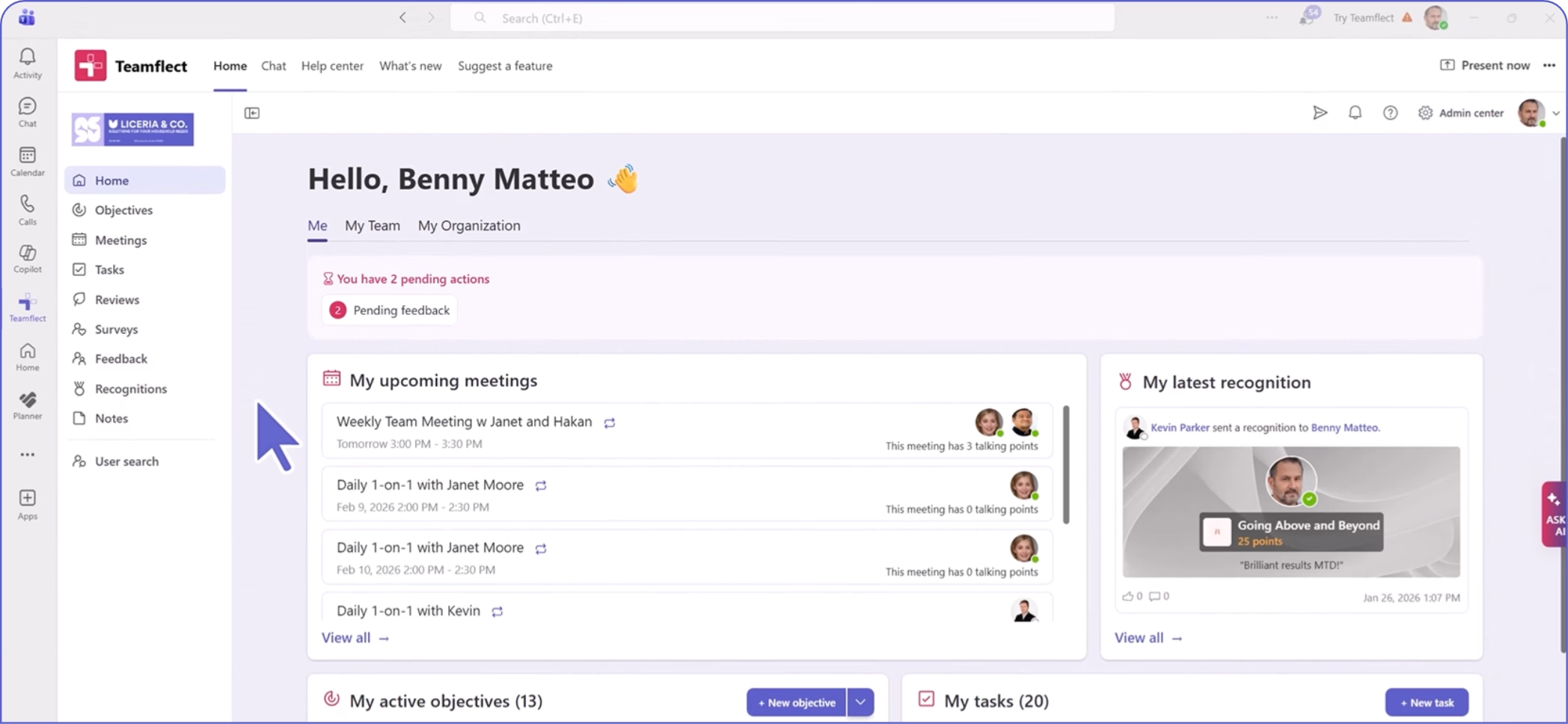
Create high-performing and engaged teams - even when people are remote - with our easy-to-use toolkit built for Microsoft Teams