.svg)
.svg)
How to Write Marketing OKRs: Templates and Examples

Updated on:
March 6, 2026


Prefer Teamflect as your HR source on Google
.svg)

Effective marketing management often relies on data-driven performance metrics. In fact, 88% of marketing leaders conduct team performance reviews at least once a quarter. Most of these professionals agree that the best strategy for boosting output is establishing clear, top-down goals and objectives.
Marketing OKRs provide a structured method to link your team’s quarterly efforts to the results that truly impact the business. Instead of focusing on a checklist of chores, this framework centers on the actual change you intend to create in the market.
A well-crafted objective is a qualitative, directional goal. It should be short, punchy, and ambitious enough to move the team, but clear enough that anyone in the company understands the intent.
Key results prove whether the objective was met. They are the measurable outcomes that tell you if you are moving in the right direction. To be effective, every KR must be quantifiable and time-bound.
Many marketing teams fall into the trap of confusing activity with progress. You can finish 100% of your planned tasks, such as writing white papers, attending trade shows, or posting to social media, and still fail to move the business forward.
Marketing OKRs force a mental shift:
To truly master this structure, you must understand a third, unofficial layer: Initiatives.
For example, if your Key Result is to "Increase conversion rates by 10%," your initiative might be "A/B testing the homepage hero section." By separating the metric (the KR) from the work (the initiative), your team remains flexible. If the A/B test fails, you change the initiative, but the goal remains the same.
Marketing is often perceived as a cost center rather than a revenue driver, partly because teams struggle to connect their work to business results. OKRs change that. They shift the conversation from "what did we produce" to "what did we achieve."
Writing effective OKRs for marketing is a step-by-step process. Each stage builds on the one before it, moving from business intent to measurable execution.
Before writing a single objective, identify what the business needs marketing to deliver. This is not the same as what marketing wants to do. Revenue growth, pipeline contribution, retention, and market share expansion are business outcomes. Rebranding, content calendars, and new campaigns are marketing activities.
Ask: "If marketing succeeds this quarter, what will be measurably different for the business?" The answer to that question is where your OKR should start.
An objective should be written in plain, action-oriented language that anyone in the company can understand. It should describe a meaningful shift, not a default state. Avoid phrases like "continue to" or "maintain." Those are not objectives; they are status quo descriptions.
A good objective is also time-bound by implication. "Establish marketing as a visible contributor to pipeline growth" is a reasonable quarterly objective. "Improve marketing" is not.
This is where most teams struggle. Key results should prove that the objective was achieved. They are not a list of deliverables or project milestones. A useful test: if the key result can be completed without the objective being achieved, it is probably a task.
Good key results share these characteristics:
Prefer leading indicators (metrics you can influence in-quarter, like demo requests or trial signups) over lagging indicators (like annual revenue) when writing quarterly key results.
Once the key results are defined, map the specific campaigns, projects, or tactics that will drive them. This is where strategy meets execution. Each initiative should have a clear owner and a documented link to the key result it supports.
This step also surfaces resourcing conflicts early. If three key results depend on the same content team, that tension becomes visible during planning rather than in week six of the quarter.
Quarterly OKRs work well for most marketing functions. Within the quarter, weekly or biweekly check-ins keep momentum up and give teams a regular opportunity to flag blockers before they compound.
Skipping check-ins is one of the most common reasons OKRs fail. A goal that is not reviewed regularly becomes a document, not a commitment.
Every OKR needs a single owner who is accountable for progress, even when multiple people contribute to the work. Shared ownership without a named lead tends to result in no one taking responsibility when things slow down.
This does not mean one person does all the work. It means one person is accountable for tracking progress, running check-ins, and escalating blockers.
OKRs are typically scored on a 0 to 1.0 scale, where 0.7 is often considered a strong result. A score of 1.0 may indicate the goal was not ambitious enough. Treat low scores as learning opportunities, not failures.
Teams that use OKR software purpose-built for their workflows, as is the case with Teamflect, see significantly higher adoption.
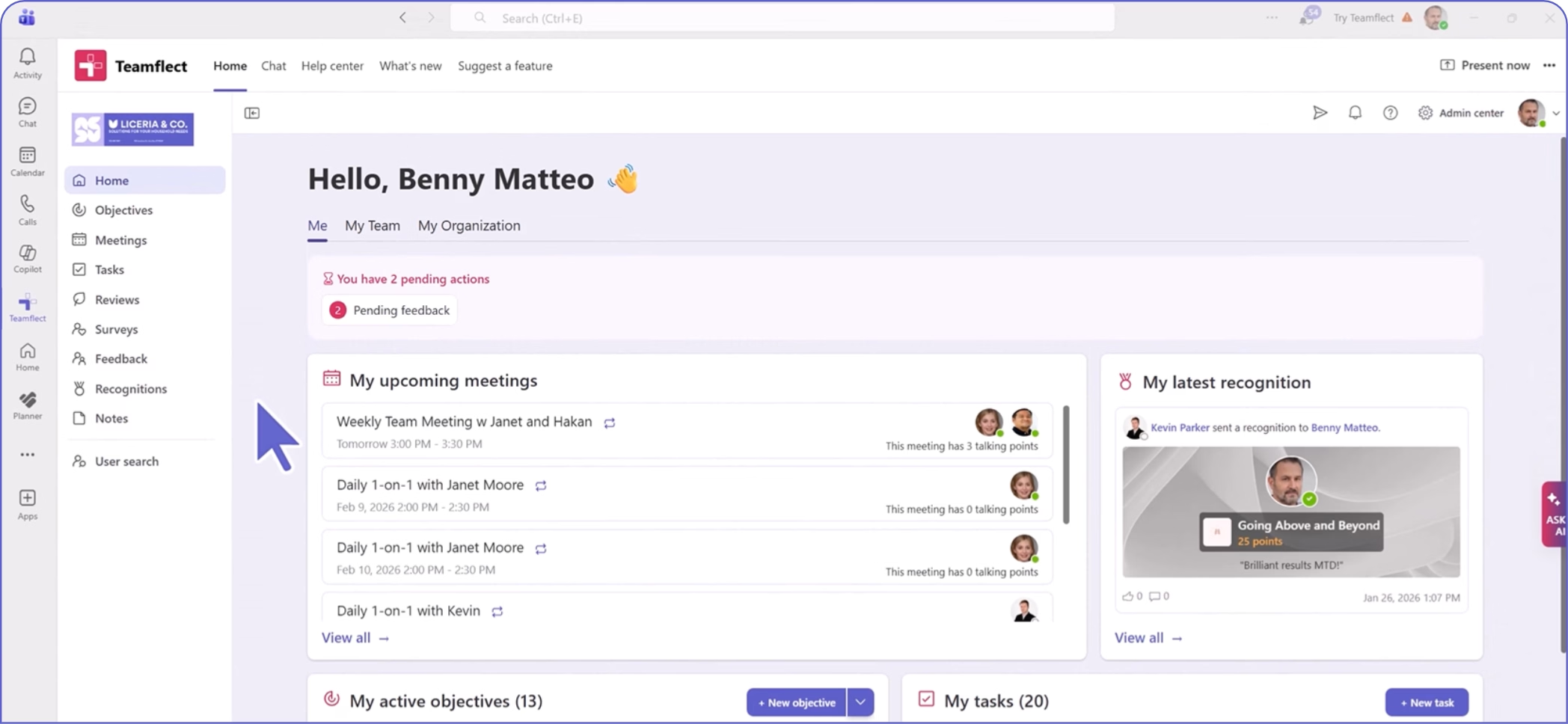
Teamflect's performance management software automates check-in reminders, tracks key result progress in real time, and keeps goals visible across the team without requiring anyone to leave Microsoft Teams. A consistent review process prevents OKRs from becoming static documents that are opened once at the start of the quarter and again at the end.
The following templates are built to be customized for your specific needs. Each version maintains a consistent core structure but is tailored to different levels of planning, from high-level quarterly shifts to specific campaign execution and individual accountability.
Use this structure for standard quarterly planning. Adapt the placeholders to fit your team's goals.
Objective: [Describe the meaningful shift your team wants to achieve this quarter]
Owner: [Name] Review cadence: Weekly check-ins, quarterly scoring
Use this template for a specific product launch, campaign, or go-to-market initiative with a defined time horizon.
Objective: [State the outcome this campaign is designed to achieve for the business]
Owner: [Campaign lead name] Review cadence: Weekly during campaign, scored at campaign close
Use this structure for individual marketers aligning their personal goals to team OKRs.
Objective: [State how this individual's work contributes to the team's quarterly objective]
Owner: [Individual's name] Review cadence: Biweekly 1:1s with manager
These practices apply regardless of team size, industry, or OKR maturity. Each one addresses a specific failure mode that tends to surface in marketing goal-setting.
An output is something your team produces: a white paper, a webinar, a paid campaign. An outcome is what changes as a result: pipeline influenced, demos booked, brand recognition in a target segment. OKRs should measure outcomes. Outputs can be tracked separately as the initiatives that drive them.
Fewer OKRs create sharper focus. When a team has eight or ten objectives, nothing is truly a priority. Three to five well-chosen OKRs per quarter are enough to drive meaningful progress without splitting attention across too many fronts.
"Improve lead quality" is not a key result. "Increase the percentage of marketing-qualified leads that convert to sales-accepted leads from 22% to 35% by the end of Q3" is. Precision removes ambiguity and makes progress easier to track.
Marketing OKRs should connect clearly to the objectives set at the company or executive level. If the company's goal is to expand into a new market segment, marketing OKRs should reflect the work needed to support that.
OKRs created in isolation often end up competing with company priorities rather than supporting them. Learning how to cascade OKRs ensures that your efforts stay aligned with the broader business strategy.
Regular reviews are what separate OKRs that drive behavior from OKRs that gather dust. Weekly or biweekly check-in meetings give teams the chance to report progress, surface blockers, and adjust tactics within the quarter. A 15-minute standing check-in is enough to keep everyone aligned.
Even well-intentioned teams run into the same OKR pitfalls. Knowing what to watch for makes it easier to course-correct before a mistake becomes a pattern.
Before: Key Result: "Launch the new demand generation campaign" After: Key Result: "Generate 500 marketing-qualified leads from the new demand generation campaign by end of Q2"
The first example is a task. It can be completed without the campaign performing at all. The second ties completion to a measurable outcome.
More than three to five objectives per quarter is a sign of unclear priorities, not strong ambition. With Gallup reporting that only 32% of U.S. employees are engaged, focus is vital. Modern leadership faces mounting hurdles, from remote work shifts to poor performance management. To combat this detachment, trim your list until every goal represents a target the team cannot afford to miss.
High counts of impressions or followers are easy to inflate but rarely impact revenue. Prioritize outcomes like marketing-qualified leads and pipeline contribution. This shift also requires data integrity.
Deloitte research shows only 70% of workers trust their organization’s data usage, compared to 93% of leaders. Since this trust is tenuous, your metrics must be transparent and meaningful to keep your team aligned.
Marketing OKRs written without input from leadership or adjacent functions often conflict with what the business actually needs. Involve your VP, CMO, or cross-functional leads in the planning stage to ensure alignment before the quarter starts, not after.
OKRs are stretch goals. Achieving 100% of every key result often means the targets were not ambitious enough. A score of 0.6 to 0.7 on a well-written OKR represents strong performance. Punishing teams for not hitting 1.0 every quarter discourages ambition and honest goal-setting.
According to Gallup, 74% of employees receive a performance review once a year or less. This gap creates a disconnect where goals are written and then ignored until the final week of the quarter.
Without regular check-ins, OKRs become static artifacts. Reviews are not optional; they are the mechanism that drives progress. Frequent feedback prevents stagnation and ensures your team stays aligned with evolving business needs.

One of the biggest barriers to OKR adoption is friction. When teams have to log into a separate platform to update their goals, check-in rates drop. Progress updates become end-of-quarter exercises rather than ongoing conversations.
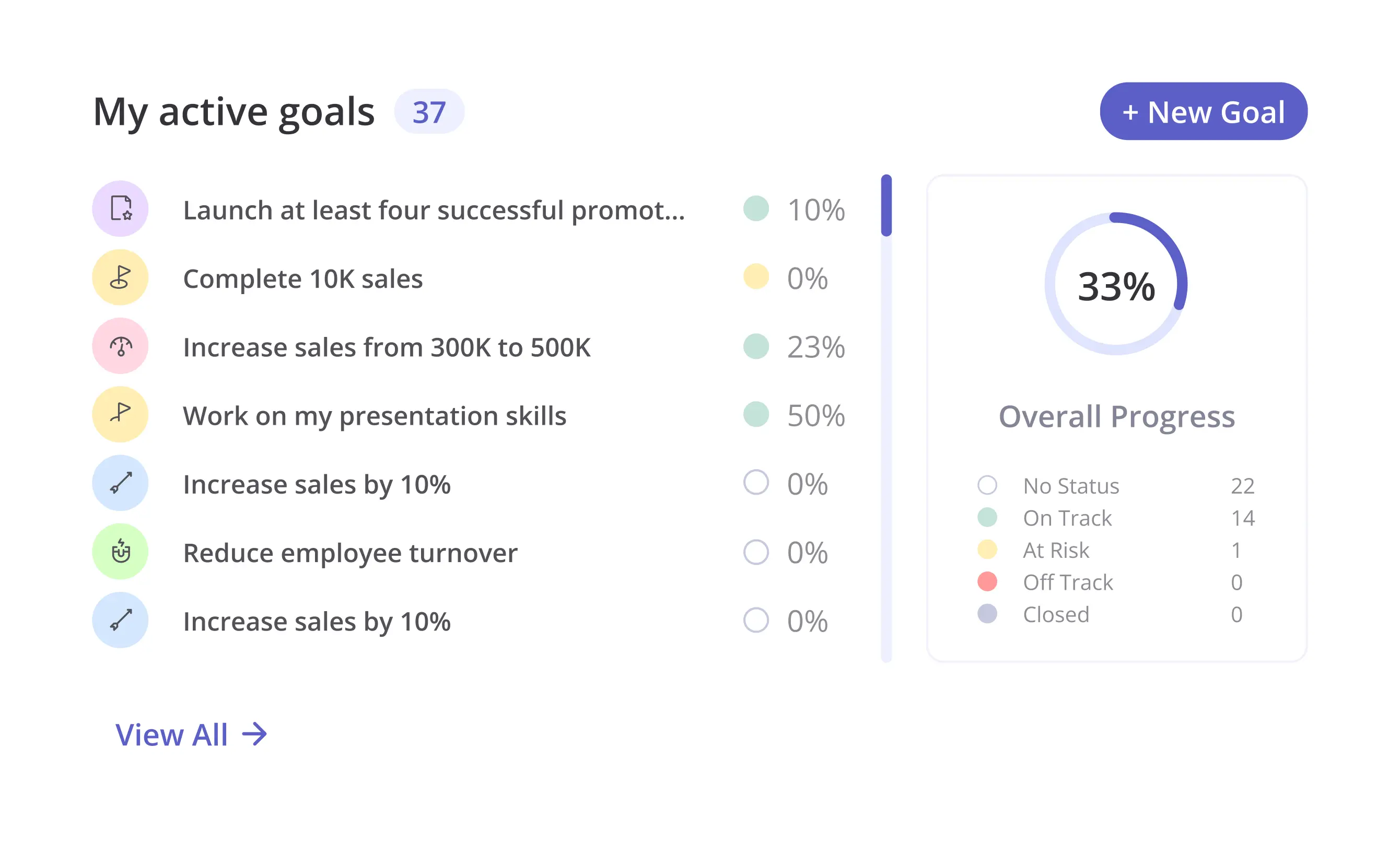
Teamflect's native Microsoft Teams integration brings OKR tracking directly into the tools your team already uses. Marketing managers can set objectives, assign key results, track progress, and run check-ins without leaving Microsoft Teams or Outlook.
Key capabilities for marketing teams:
Teamflect also functions as a broader employee engagement software platform, connecting goal progress to recognition, feedback, and development conversations. Marketing teams can manage OKRs, run performance reviews, and give peer feedback in one place, without switching tools.
For marketing leaders running teams on Microsoft 365, Teamflect is one of the leading OKR software in the Microsoft Teams App Store.
It depends on how your organization uses OKRs. Many teams treat OKRs as team-level goals and keep performance reviews separate to avoid incentivizing overly conservative goal-setting. If individuals know they will be evaluated on OKR scores, they tend to set easier targets. That said, OKR outcomes can inform performance conversations without being directly scored in a review. Teamflect supports both approaches and allows managers to configure how OKRs connect to performance cycles.
KPIs measure the ongoing health of a function. OKRs define what needs to change. A KPI might be monthly qualified lead volume. An OKR key result might be increasing that number by 30% in a specific quarter. KPIs are always on; OKRs are time-bound and focused on improvement or strategic shifts.
A score of 0.6 to 0.7 on a 1.0 scale is generally considered strong for well-written stretch goals. Consistent 1.0 scores suggest goals were not ambitious enough. Consistent scores of 0.2 or 0.3 suggest goals are unrealistic or under-resourced.
Start small. Introduce OKRs for one team or one function before rolling out org-wide. Make progress visible through shared dashboards. Tie check-ins to existing meeting rhythms rather than creating new ones. Using Teamflect, which brings Microsoft Teams integration to OKR management, removes the platform friction that typically tanks adoption in the early stages.
Yes. Teamflect's built-in AI agent can help marketing teams draft objectives, evaluate whether key results meet quality criteria, and suggest improvements based on common OKR writing errors. This is particularly useful for teams that are new to the framework or for managers reviewing OKRs across multiple direct reports. AI support speeds up the planning process without replacing the strategic thinking that good OKRs require.
.avif)
Create high-performing and engaged teams - even when people are remote - with our easy-to-use toolkit built for Microsoft Teams
.svg)


.webp)
