Organizations need performance frameworks that translate strategic objectives into measurable results. Two frameworks dominate this space: Objectives and Key Results (OKRs) and the Balanced Scorecard (BSC). Both approaches help companies track progress and align teams, but they take different paths to get there.
In one early study of Balanced Scorecard adopters, more than 40% of Fortune 1000 companies were reported to be experimenting with or using the framework to track strategy beyond financial results.
Understanding when to use OKRs, when to apply the Balanced Scorecard, or how to combine both frameworks can transform how your organization executes strategy. So, this guide breaks down the core differences, shows where each framework excels, and provides practical decision-making criteria for managers.
TL;DR — Quick Summary
Balanced Scorecard (BSC): A strategic planning framework that measures organizational performance across four perspectives—financial, customer, internal processes, and learning & growth—emphasizing balance and comprehensive measurement.
Objectives and Key Results (OKRs): An execution-focused framework where teams set ambitious objectives and track measurable key results, prioritizing speed, transparency, and outcomes.
Key Difference: BSC provides strategic clarity through multiple performance dimensions, while OKRs drive rapid execution through outcome-focused goals.
Best Use: BSC fits organizations needing governance and strategic balance; OKRs suit teams requiring execution agility and faster iteration cycles.
Implementation: Modern performance management platforms like Teamflect integrate both frameworks through Microsoft Teams, making implementation straightforward for organizations of any size.
OKRs vs Balanced Scorecard in Modern Organizations
Performance frameworks shape how organizations translate strategy into action. The Balanced Scorecard and OKRs represent two distinct approaches, each designed to solve different organizational challenges.
Modern organizations use both frameworks depending on their execution cadence and strategic needs:
The choice between balanced scorecards and OKRs often reflects organizational maturity, industry requirements, and leadership philosophy. Large enterprises frequently use BSC for strategic planning while applying OKRs for execution in specific divisions.
Balanced Scorecard
OKR
Best for environments where comprehensive measurement and strategic balance are the primary focus.
Suited for long-term planning cycles that require a stable, high-level overview.
Provides a structured approach to performance governance and organizational health.
Ideal for fast-paced environments requiring quarterly execution and rapid adjustments.
Focuses on transparent goal alignment to build a competitive advantage.
Prioritizes speed and agility over rigid organizational structure.
What is a Balanced Scorecard?
Definition: The Balanced Scorecard is a strategic planning and performance measurement framework that evaluates organizational performance through four interconnected perspectives.
The Balanced Scorecard, a strategic framework translates vision and strategy into a comprehensive set of performance measures.
The Four Perspectives:
Financial Perspective: Tracks traditional financial metrics such as revenue growth, profitability, return on investment, and cost efficiency. This perspective answers whether the organization creates value for shareholders.
Customer Perspective: Measures customer satisfaction, retention rates, market share, and brand perception. It addresses how customers view the organization and whether it delivers value to target markets.
Internal Process Perspective: Evaluates operational efficiency, quality metrics, cycle times, and process innovation. This perspective identifies which internal processes must excel to satisfy customers and achieve financial goals.
Learning and Growth Perspective: Assesses human capital, information systems, organizational culture, and innovation capacity. It examines whether the organization builds capabilities needed for long-term success.
These four perspectives connect through cause-and-effect relationships. Investments in learning and growth improve internal processes, which enhance customer satisfaction, ultimately driving financial performance. This interconnection distinguishes BSC from simple measurement dashboards.
What Are OKRs?
Objectives and Key Results combine qualitative objectives with quantitative key results to drive focused execution. The framework creates cross-functional alignment while encouraging ambitious goal-setting that stretches organizational capabilities.
Components of OKRs:
Objectives define where the organization wants to go. They should be:
Qualitative and inspirational
Time-bound, typically quarterly
Ambitious enough to require new thinking
Clear enough that teams understand the intent
Key Results measure progress toward objectives. They must be:
Quantitative and specific
Limited to three to five per objective
Outcome-focused rather than activity-based
Measurable with clear success criteria
A typical OKR might look like this:
Objective: Become the preferred platform for product teams.
Key Results:
Increase active users from 10,000 to 25,000.
Improve net promoter score from 45 to 70.
Reduce average onboarding time from 14 days to 3 days.
OKR methodology emphasizes setting stretch goals where achieving 60 to 70 percent represents success. This approach encourages innovation and risk-taking rather than conservative goal-setting. Organizations set OKRs at company, team, and sometimes individual levels, creating vertical and horizontal alignment.
Core Differences Between OKRs and Balanced Scorecards
The difference between Balanced Scorecards and OKRs extends beyond terminology. These frameworks embody different philosophies about measurement discipline, execution cadence, and organizational alignment.
Dimension
Balanced Scorecard
OKRs
Primary Purpose
Strategic planning and balanced measurement
Execution focus and outcome delivery
Time Horizon
Annual cycles with quarterly reviews
Quarterly cycles with continuous tracking
Measurement Approach
Four-perspective framework with multiple metrics
Objective plus three to five key results
Goal Ambition
Realistic targets expected to be met
Stretch goals where 70% achievement is success
Transparency Level
Typically private or limited visibility
Public across teams and organization
Alignment Method
Top-down through strategy mapping
Mix of top-down and bottom-up input
Success Criteria
Balance across all four perspectives
Progress on specific outcome metrics
Flexibility
More rigid once annual strategy is set
Adjustable based on quarterly learning
Indicator Types
Leading indicators and lagging indicators combined
Primarily outcome-based measures
Complexity
Higher due to multiple perspectives and relationships
Simpler structure with clear goal hierarchy
Governance Focus
Strong emphasis on comprehensive oversight
Lower governance, higher execution focus
Strategic vs Tactical
Strategic planning at the core
Tactical execution as primary driver
BSC emphasizes measurement discipline across multiple performance dimensions. It ensures organizations don't sacrifice long-term capability building for short-term financial gains. The framework's four perspectives force leaders to consider how today's decisions affect future organizational capacity.
Meanwhile, OKRs prioritize execution speed and outcome measurement. The framework assumes strategy is already clear and focuses on translating that strategy into quarterly deliverables. OKRs work best when leadership has already defined strategic direction and teams need a tool for rapid execution.
Another critical distinction lies in goal philosophy. BSC expects teams to meet their targets, treating shortfalls as performance gaps. OKRs deliberately set ambitious targets where partial achievement still represents meaningful progress. This difference affects risk-taking behavior and innovation culture.
How OKRs and Balanced Scorecard Measure Performance
Performance measurement approaches differ significantly between these frameworks. Understanding these differences helps managers select appropriate operational metrics and set realistic expectations.
Balanced Scorecards in Performance Evaluations
BSC measures performance across four distinct perspectives, ensuring organizations don't over-optimize one area at the expense of others. Each perspective includes multiple metrics that work together to paint a complete picture.
Financial metrics in BSC track traditional business results such as:
Revenue growth
Profit margins
Return on assets
Cash flow
These lagging indicators show whether past strategic decisions produced desired economic outcomes.
Customer metrics measure:
Market position
Satisfaction scores
Retention rates
Brand strength
Organizations track both quantitative measures such as net promoter scores and qualitative feedback through customer surveys and market research.
Internal process metrics evaluate:
Operational efficiency
Quality levels
Cycle times
Innovation rates
For example, a manufacturing company might track defect rates and production output, while a software firm measures deployment frequency and system uptime.
Learning and growth metrics assess:
Employee skills
Training completion
Engagement scores
Technology infrastructure
These foundational measures determine whether the organization builds capacity for sustained performance improvement.
OKR Measurement in Performance MANAGEMENT
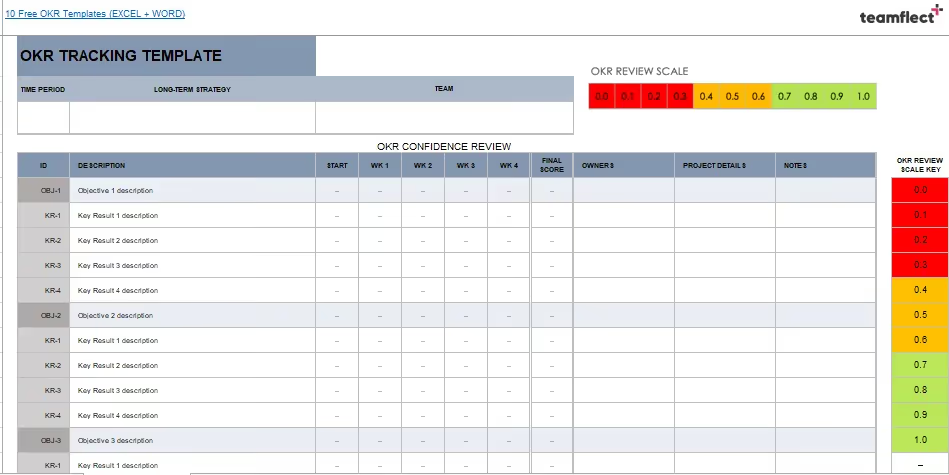
OKRs rely on key results that directly measure progress toward objectives. Each key result uses a numeric scale, typically 0.0 to 1.0, making achievement easy to track and communicate.
Outcome measurement is central to effective OKRs. Teams avoid activity-based metrics such as "conduct 20 customer interviews" in favor of outcome metrics such as "increase customer satisfaction score from 7.2 to 8.5." This focus keeps teams oriented toward impact rather than effort.
Most organizations grade OKRs at quarter-end using a simple scoring system:
0.0 to 0.3: Red, significant obstacles prevented progress
0.4 to 0.6: Yellow, some progress but fell short
0.7 to 1.0: Green, strong execution and meaningful achievement
The grading process includes reflection on what enabled success or caused shortfalls. Teams use these insights to set more effective OKRs in the next cycle. This learning loop builds organizational capacity over time.
Leading indicators play a critical role in OKR tracking. While final key results measure outcomes, teams monitor leading metrics weekly to assess whether they're on track. A sales team might track pipeline coverage and meeting quality as leading indicators for their revenue outcome key result.
The key difference: BSC uses multiple measurement types across different perspectives to ensure strategic balance. OKRs concentrate on fewer, outcome-oriented metrics that directly tie to quarterly execution priorities.
Alignment and Cascading: Where Each Framework Excels
Both frameworks create organizational alignment, but they achieve it through different mechanisms. Understanding these differences helps leaders design effective cascading processes.
Balanced Scorecards Alignment
The Balanced Scorecards create alignment through a rigorous top-down strategy mapping process. Leadership defines the overarching organizational strategy, which is then translated into objectives across the four primary perspectives. These high-level goals serve as the foundation that informs the objectives of business units, departments, and teams.
Cascading Objectives: Each organizational layer develops its own scorecard that directly supports the level above it.
Strategic Themes: These themes act as pillars that cut across perspectives and boundaries to ensure focus on critical priorities.
Strategic Consistency: The process emphasizes stability and long-term coherence.
Visual Dependency Management: Cross-functional relationships are managed through the strategy map.
OKR Alignment
OKRs create alignment through a mix of vertical direction and horizontal coordination, anchored by shared objectives and transparent goal-setting. While company-level OKRs set the overall trajectory, team-level OKRs define the specific contributions required to meet those goals, ensuring every part of the organization moves in sync.
Mixed Directional Input: The process combines top-down leadership with bottom-up expertise.
Horizontal Transparency: Because all OKRs are visible across the organization, teams can identify dependencies without silos.
Quarterly Cadence: Alignment occurs every three months, offering much faster adjustment periods than annual planning.
Shared Key Results: To drive cross-functional collaboration, multiple teams often share the same measurable key result.
Where Each Framework Excels
Modern organizations often choose their methodology based on the specific needs of their planning cycles and cultural goals.
The Balanced Scorecards provide a high-level view that ensures organizational health is monitored from every angle. It excels at:
Comprehensive Strategic Alignment: Creating a unified direction across complex organizations with multiple business units.
Balanced Measurement: Utilizing the four-perspective structure to ensure that financial targets do not overshadow customer satisfaction, internal efficiency, or employee growth.
Governance and Discipline: Providing large enterprises with a rigorous framework for long-term measurement and strategic oversight.
Meanwhile, OKRs provide a lightweight, high-velocity system designed to move the needle on specific priorities. It excels at:
Execution Alignment: Driving collective effort toward specific results in environments where speed and adaptability are critical.
Agile Coordination: Using quarterly cycles and transparent goal-setting to create tight focus without heavy process overhead.
Flexibility and Focus: Allowing technology companies and growth-stage organizations to pivot quickly while maintaining a clear execution focus.
OKRs vs Balanced Scorecards: Manager's Decision Table
Choosing between these frameworks requires understanding your organizational context. This decision table helps managers evaluate which framework fits specific situations.
Strong – comprehensive measurement across perspectives
Moderate – can track strategy but less comprehensive
Team autonomy and input
Weak – primarily top-down cascading
Strong – bottom-up input encouraged
Executive reporting and governance
Strong – structured reporting across all strategic dimensions
Moderate – clear progress tracking but less comprehensive
Innovation and experimentation
Weak – does not encourage stretch goals
Strong – rewards ambitious goal-setting
Complex organizations with multiple units
Strong – designed for organizational complexity
Moderate – works but requires careful alignment design
Regulatory or compliance-heavy industries
Strong – comprehensive documentation and governance
Weak – less formal structure
Startup or scale-up environments
Weak – too much structure for rapid change
Strong – built for speed and iteration
Cross-functional project execution
Moderate – strategy maps show dependencies
Strong – transparency drives collaboration
Capability building and learning
Strong – dedicated learning and growth perspective
Moderate – can include learning but not explicitly structured
Mature, stable operations
Strong – benefits from comprehensive measurement
Weak – quarterly cycles may create unnecessary churn
Results-oriented cultures
Moderate – balanced approach to results
Strong – explicitly outcome-focused
Additional Decision Factors:
Industry considerations: Financial services, healthcare, and manufacturing often prefer BSC's comprehensive approach. Technology, media, and professional services typically favor OKRs' execution speed.
Organizational maturity: Startups need OKR's simplicity and speed. Mid-stage companies benefit from adding BSC as they professionalize. Large enterprises often use both, applying BSC at the corporate level and OKRs for execution.
Strategic clarity: When strategy needs refinement, BSC's four-perspective framework helps leaders think comprehensively. When strategy is clear and execution is the challenge, OKRs drive better results.
Cultural fit: Organizations valuing stability, process, and governance gravitate toward BSC. Companies emphasizing innovation, risk-taking, and transparency prefer OKRs.
Resource availability: BSC implementation requires significant time for strategy mapping and metric development. OKRs can start with minimal overhead and scale up gradually.
The best choice isn't always binary. Many successful organizations use BSC for strategic planning and governance while implementing OKRs for quarterly execution. This hybrid approach provides strategic clarity with execution agility.
When to Use OKRs, Balanced Scorecards, or Both
Strategic frameworks should fit your organizational needs, not force your organization into a predetermined structure. Here's when each approach works best.
Use OKRs When:
Speed and iteration matter more than comprehensive measurement. Organizations facing rapid market changes need the ability to adjust goals quarterly. OKRs provide this flexibility without abandoning strategic focus.
Execution is your primary challenge. When strategy is clear but translating it into action creates bottlenecks, OKRs drive accountability for outcomes. The framework makes progress visible and forces teams to prioritize.
Transparency and collaboration need improvement. OKRs break down silos by making everyone's goals visible. Cross-functional projects benefit from shared key results that force coordination.
Innovation requires encouragement. The stretch goal philosophy of OKRs creates psychological safety for ambitious targets. Teams feel comfortable setting goals they might not fully achieve, driving innovation.
Top-down planning stifles frontline insights. OKRs incorporate bottom-up input, giving teams ownership over how they contribute to company objectives. This autonomy increases engagement and surfaces better execution ideas.
Use Balanced Scorecards When:
Strategic balance needs active management. Organizations risk over-focusing on short-term financial results without frameworks ensuring attention to customer, process, and capability building. BSC forces this balance.HBR highlighted that companies using the Balanced Scorecards as a management system were able to link long‑term strategic objectives to short‑term budgets and initiatives.
Governance and oversight are essential. Regulated industries, public sector organizations, and large enterprises require structured performance reporting. BSC provides the measurement discipline and documentation these environments demand.
Long-term capability building matters. The learning and growth perspective ensures organizations invest in future capacity, not just current performance. This long-term orientation suits mature organizations planning multi-year transformations.
Complex cause-and-effect relationships require understanding. Strategy maps clarify how actions in one area affect outcomes elsewhere. This systematic thinking helps leaders make better investment decisions.
Multiple stakeholder groups need different performance views. BSC's four perspectives naturally address different stakeholder concerns - shareholders care about financial perspective, customers focus on customer perspective, and so on.
Use Both Together When:
Strategic clarity and execution agility are both essential. Large organizations often need BSC for strategic planning while using OKRs to execute quarterly priorities. The BSC provides the strategic framework, and OKRs drive execution within that framework.
Different organizational levels have different needs. Corporate strategy might use BSC while business units and teams use OKRs for execution. This layered approach provides governance without sacrificing speed.
Organizational maturity varies across divisions. Established business units might use BSC while new ventures use OKRs. This flexibility allows each part of the organization to work in its most effective rhythm.
💡 Pro Tip
The hybrid approach works when organizations clearly define which framework applies where. Confusion arises when both frameworks compete for attention rather than serving complementary purposes.
Best Practices for Combining OKRs and Balanced Scorecards
Organizations increasingly recognize that BSC and OKRs serve complementary purposes. Combining these frameworks requires clear roles for each and intentional integration points.
Anchor Strategy with Balanced Scorecards
Use BSC as your strategic planning foundation. Develop a comprehensive Balanced Scorecard annually that defines strategic objectives across all four perspectives. Create strategy maps that show cause-and-effect relationships between objectives. These maps become the strategic blueprint that guides all execution decisions. When teams understand how their work connects to broader strategy, alignment improves.
Review BSC metrics quarterly at the leadership level. This ensures strategy remains relevant and metrics still align with organizational direction. Make annual strategy adjustments during your yearly planning cycle. HBR’s Balanced Scorecard research describes companies instituting monthly or quarterly strategy review meetings using scorecard data to test assumptions and refine strategic initiatives.
Execute Priorities Through OKRs
Translate your BSC strategic objectives into quarterly OKRs. Each quarter, leadership selects the most critical strategic priorities from the Balanced Scorecard and converts them into company-level OKRs.
For example, if your BSC includes a strategic objective to "improve customer retention," your Q2 OKR might be "Objective: Reduce customer churn in enterprise segment. Key Results: 1) Decrease monthly churn rate from 8% to 5%. 2) Increase customer health scores from 72 to 85. 3) Launch proactive success program covering top 100 accounts."
Allow teams to set supporting OKRs that contribute to company objectives. This bottom-up input ensures execution plans are realistic and incorporate frontline expertise. Teams understand their context better than distant leadership.
💬 Expert Opinion
Review OKR progress weekly or bi-weekly within teams and monthly at company level. This frequent tracking enables rapid course correction while maintaining strategic alignment to the BSC framework.
Create Clear Integration Points
Layer
Framework Used
Purpose
Review Cadence
Corporate Strategy
Balanced Scorecard
Long-term strategic direction and balance
Annual development, quarterly review
Annual Planning
Balanced Scorecard
Strategic objectives and annual targets
Annual
Quarterly Execution
OKRs
Priority execution and outcome delivery
Quarterly planning, weekly or bi-weekly tracking
Performance Review
Both
Strategic progress and quarterly results
Quarterly integrated review
When OKRs consistently fail to move BSC metrics, your execution priorities are misaligned with strategy. This signal indicates either poor OKR selection or strategic objectives that don't translate to actionable quarterly goals.
How to Implement OKRs: A Workshop With OKR Expert Hannes Albrecht
Choosing OKRs over a Balanced Scorecard is the easy decision. Implementing OKRs that actually change how your team works is where most rollouts stall. This on-demand OKR workshop tackles that gap directly.
OKR expert Hannes Albrecht, founder of the consultancy How to OKR, has spent more than a decade helping leadership teams implement OKRs. In the session he walks through writing objectives and key results that drive real strategic change, and the Teamflect team demonstrates the same method running inside Microsoft Teams.
Connect to Performance Management
Use BSC perspectives to structure competency expectations. The four perspectives guide what capabilities matter most in your organization. This creates consistency between strategic measurement and individual development.
Incorporate both BSC strategic progress and OKR execution results into performance conversations. This balanced view evaluates both what people achieved (OKR results) and how their work contributed to long-term strategic objectives (BSC perspectives).
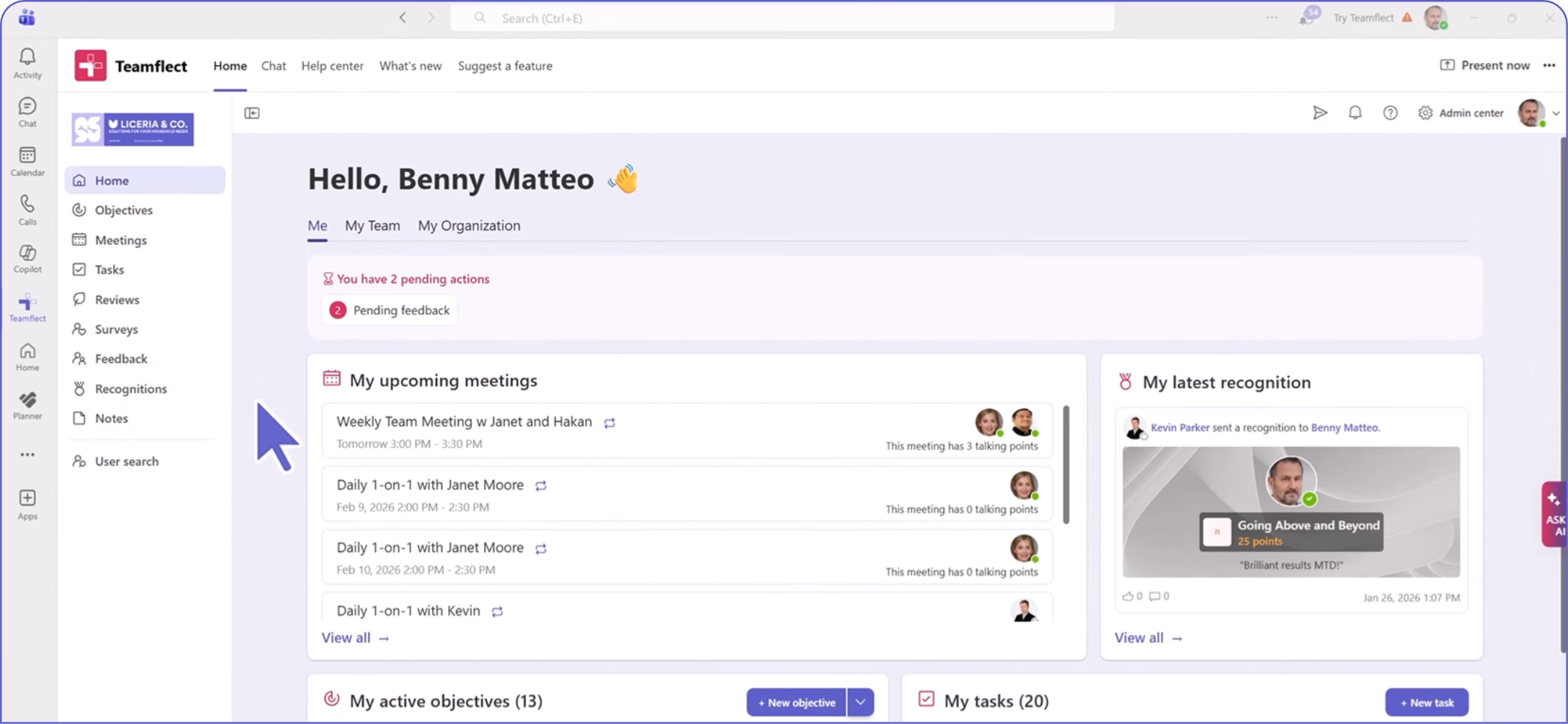
Modern performance management platforms handle this integration. OKR software built into tools like Teamflect tracks quarterly execution while maintaining visibility to longer-term strategic goals, giving managers complete context for performance discussions.
Explain why you use both frameworks and what role each plays. Without clear communication, organizations create confusion when some conversations focus on BSC metrics while others emphasize OKRs. Use consistent language.
If your BSC includes a "customer perspective," your OKRs should use similar terminology when addressing customer outcomes. Linguistic consistency reduces cognitive load.
Make both frameworks visible: Strategy maps and BSC dashboards should be easily accessible. OKRs should be transparent across relevant organizational levels. Visibility drives alignment and reduces the risk of conflicting priorities.
Free Balanced Scorecards + OKR Templates
Getting started with either framework requires clear templates that guide teams through the planning process. Don't worry, we have you covered! We put together multiple sets of OKR and other goal-setting templates.
Click the Download Button Below to Access a Wide Array of FREE OKR Templates
How Teamflect Supports OKRs and Strategic Performance Tracking
Teamflect Integrates Goals and Competencies into Performance Reviews
Modern performance frameworks require technology that simplifies goal tracking. Teamflect provides this infrastructure through native Microsoft integration, ensuring that strategic goals remain part of the daily workflow.
OKR Creation and Tracking
Seamless Goal Setting: Teams create and manage objectives directly within Microsoft Teams, removing the friction of adopting new software.
Progress Automation: Member updates to key results are aggregated instantly to show overall objective progress without manual status reports.
AI-Driven Insights: An AI agent analyzes progress patterns to surface execution bottlenecks and suggest historical data-backed adjustments.
Automated Goal Check-ins
Long-Term Connection: The platform links quarterly OKRs to annual strategic goals, ensuring short-term execution remains aligned with the broader vision.
Real-Time Dashboards: Leadership monitors progress across departments through live data visualizations to reallocate resources or adjust priorities mid-quarter.
Alignment Across Teams
Cross-Functional Visibility: Shared key results make dependencies explicit, allowing multiple teams to coordinate efforts through a single source of truth.
Conflict Identification: The system flags contradictory objectives or resource competition early, preventing alignment issues before they impact results.
Performance Reviews Connected to Goals
Data-Driven Assessments: Managers view OKR outcomes and competency data within the review interface, ensuring evaluations are based on concrete achievements rather than bias.
Integrated Frameworks: The platform supports both result-based tracking and behavioral competency models to evaluate both "what" was achieved and "how."
Ian Brown
Director of Campus Recreation and Wellness, Furman University
"Teamflect has propelled our department to stand out within our division of the institution. We've accomplished more than 50% of our strategic plan within one year. That's pretty crazy. We were able to facilitate that because we were using a tool like Teamflect."
Are OKRs a replacement for the Balanced Scorecards?
No, OKRs don't replace the Balanced Scorecard. They serve different purposes. BSC provides comprehensive strategic planning across multiple performance dimensions. OKRs drive focused quarterly execution of strategic priorities. Many organizations use BSC for long-term strategic clarity while implementing OKRs for short-term execution agility.
Can OKRs and Balanced Scorecards coexist in one organization?
Yes, they work well together when each framework has a clear role. Use BSC for annual strategic planning and comprehensive performance measurement. Use OKRs to execute quarterly priorities that advance BSC strategic objectives. The key is clear communication about when each framework applies and how they connect. Organizations that master this combination benefit from strategic balance and execution speed.
Which framework works better for scaling companies?
OKRs typically work better for scaling companies. The quarterly cycle allows rapid adjustment as the organization grows and market conditions shift. OKRs' transparency and bottom-up input scale more easily than BSC's comprehensive planning process. However, companies often add BSC elements as they mature and need more governance. The transition usually happens around 200 to 500 employees when strategic planning cycles formalize.
How often should OKRs vs Balanced Scorecards metrics be reviewed?
OKRs require monthly company reviews to enable course correction within the quarter. End-of-quarter grading sessions assess overall achievement and inform next quarter's planning. Balanced Scorecard metrics are typically reviewed quarterly for operational oversight and annually for strategic assessment. Leadership teams examine BSC dashboards monthly but make major strategic adjustments only during annual planning cycles.
Is Balanced Scorecards still relevant in agile organizations?
Yes, but its application shifts. Agile organizations use BSC for strategic planning and governance while implementing OKRs or other frameworks for execution. The BSC four-perspective structure remains valuable for ensuring strategic balance even in fast-moving companies. However, agile organizations typically review BSC metrics more frequently than traditional annual cycles and adjust strategy more readily when data indicates the need for change.
.svg)
.svg)


.svg)





.svg)
.avif)


.webp)
