.svg)
.svg)
Performance-Based Compensation: Models, Examples, and Best Practices

Updated on:
January 16, 2026

Prefer Teamflect as your HR source on Google
.svg)

Performance-based compensation has become a cornerstone of modern compensation strategy. Organizations across industries are moving away from purely fixed salary models toward systems that reward employees based on what they actually achieve.
This shift is increasingly tied to professional growth; for instance, when people feel their company actively supports their skill development, the risk of them leaving drops by nearly half (47%). The question isn't whether to implement performance-based pay anymore. The question is how to do it right.
Performance-based compensation is a pay structure where a portion of an employee's total earnings is directly tied to their individual performance, team results, or company-wide outcomes.
It’s a compensation model that differs fundamentally from traditional fixed salary approaches where employees receive the same paycheck regardless of output or achievement.
The key components that define this compensation structure include:
The core principle behind a performance-based compensation plan is straightforward. When employees know their effort directly impacts their earnings, they're more likely to align their work with organizational goals and push for better results.
A well-designed performance-based compensation system does more than just distribute paychecks differently. It fundamentally changes how employees approach their work and how organizations drive results.
When compensation is tied to specific outcomes, employees naturally focus on activities that drive results.
Instead of just showing up and going through the motions, they're working toward targets that actually move the needle for your organization. This alignment ensures that every employee understands how their daily work contributes to broader business objectives.
Performance-based compensation creates a direct line between individual contributions and rewards. Employees can't hide behind vague job descriptions. They know exactly what they're responsible for and what success looks like in measurable terms.
Top performers want to be recognized and rewarded for their contributions. A well-designed performance compensation system gives your best people a compelling reason to stay and continue excelling. Nothing kills motivation faster than watching high and low performers take home the same paycheck.
Not all employees contribute equally, and your compensation strategy should reflect that reality. Performance-based pay gives you a structured, defensible way to reward your stars while addressing underperformance through clear, objective criteria.
When the rules are clear from the start, employees understand exactly what they need to do to earn more. This transparency reduces feelings of favoritism and builds trust in your compensation philosophy and overall employee engagement.
Variable compensation gives organizations more flexibility during economic ups and downs. When business is booming, you can reward employees generously. During leaner times, your fixed costs remain more manageable without immediate layoffs or salary cuts.
The right performance-based compensation model for your organization depends on your industry, workforce composition, and business objectives. Different roles and business contexts call for different approaches to outcome-based rewards.
| Compensation Model | How It Works | Best For | Risks |
|---|---|---|---|
| Bonus-based pay | Employees earn bonuses for hitting specific goals or KPIs on top of their base salary | Knowledge workers, project-based roles, corporate positions | May encourage short-term thinking at the expense of long-term strategy |
| Commission-based | A significant portion of earnings comes from sales output or revenue generated | Sales teams, business development roles, account managers | Income volatility can create financial stress and high turnover |
| Merit-based pay | Annual or periodic raises based on performance ratings and evaluations | Corporate environments, government positions, traditional hierarchies | Vulnerable to rating bias and manager subjectivity |
| Profit sharing | Employees receive a share of company profits based on overall business performance | SMEs, startups, employee-owned companies | Individual employees have limited control over company-wide results |
| Tiered incentives | Reward levels increase as performance tiers are reached (bronze, silver, gold achievement levels) | Scalable organizations, sales organizations, multi-level teams | Can become overly complex and difficult to communicate |
| Stock options/equity | Employees receive company shares or the option to purchase shares at predetermined prices | Startups, high-growth companies, executive positions | Value depends on company performance and market conditions |
| Project-based bonuses | Specific bonuses tied to successful project completion or milestone achievement | Engineering teams, consulting firms, creative agencies | May encourage rushing to hit deadlines at the cost of quality |
The most effective performance-based compensation structure often combines multiple models. A sales representative might have a base salary (fixed), commission on sales (individual performance), and an annual bonus tied to team targets (collective outcomes). This hybrid approach balances stability with performance incentive alignment.
Performance-based compensation looks different across various roles and departments. What works for a sales team won't necessarily make sense for engineers or customer support specialists. Here's how compensation paid based on employee performance typically works for different positions:
| Role | Key Metrics | Compensation Model |
|---|---|---|
| Sales Representative | New business revenue, pipeline generation | Commission percentage + quarterly bonus for exceeding targets |
| Customer Success Manager | Customer retention rate, upsell revenue | Annual bonus tied to renewal rates and expansion revenue |
| Software Engineer | Project delivery, code quality, sprint completion | Milestone-based bonuses, annual merit increases |
| Marketing Manager | Lead generation, campaign ROI, brand awareness | Quarterly incentives based on qualified leads and conversion rates |
| Customer Support Specialist | CSAT score, resolution time, ticket volume | Quarterly incentive for maintaining high satisfaction ratings |
| Product Manager | Feature adoption, user engagement, product goals | Annual bonus tied to OKR achievement and product metrics |
| Operations Manager | Efficiency improvements, cost savings | Performance bonuses based on operational KPIs |
| HR Business Partner | Employee retention, time-to-hire, engagement scores | Annual merit increase based on people metrics |
| Finance Analyst | Forecast accuracy, reporting timeliness | Merit-based raises tied to performance reviews |
| Account Executive | New business revenue, account growth | Tiered commission structure with accelerators |
The key to effective role-based incentives is matching the compensation trigger to metrics that the employee can directly influence. An engineer shouldn't be penalized because the sales team missed their quota.
A customer support rep shouldn't be rewarded based on product features they didn't build. This principle of direct influence ensures compensation fairness and maintains employee motivation.
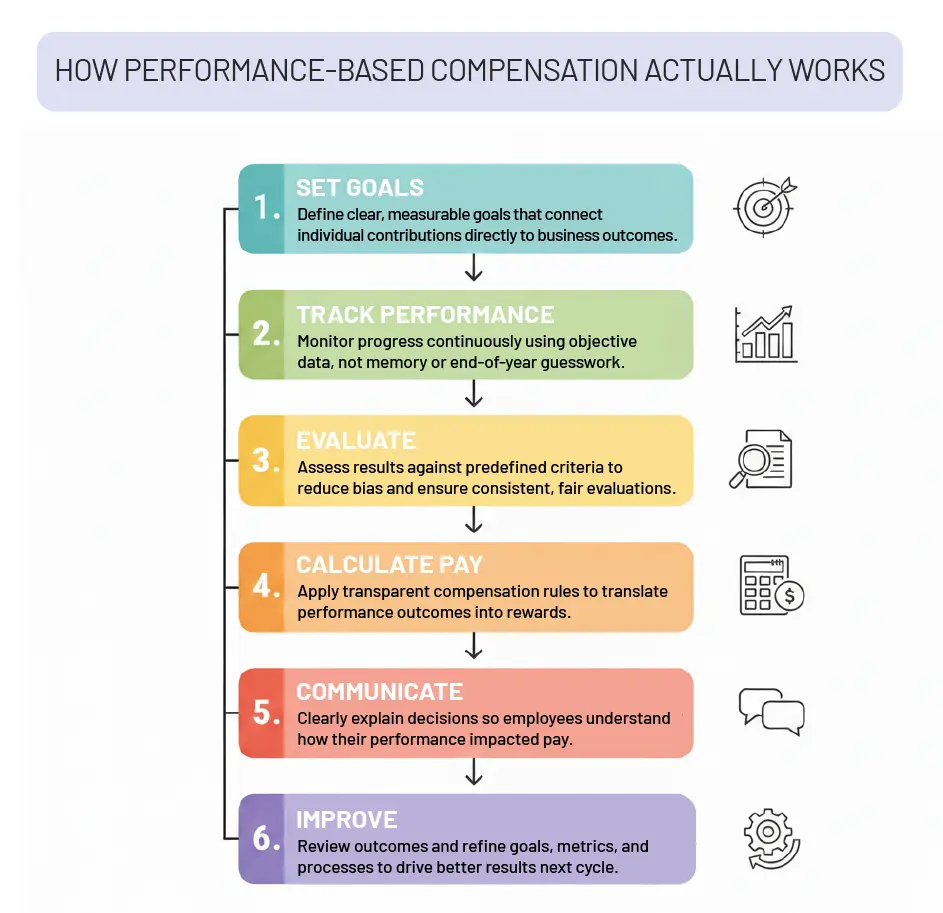
Understanding the theory behind performance-based pay is one thing. Implementing it successfully is another. The practical workflow that makes these systems function requires careful attention to each step.
Start by establishing clear, measurable objectives that align with both business priorities and individual roles. These could be revenue targets, project milestones, quality metrics, or customer satisfaction scores.
The criteria should be specific enough that there's no ambiguity about whether they've been met. Vague goals like "improve customer service" won't work. Specific targets like "achieve a 90% CSAT score" will.
Employees need to understand exactly how their performance translates into pay. Be transparent about the formula, bonus eligibility requirements, and payout schedule. Confusion or perceived unfairness at this stage will undermine the entire program before it even begins.
This is where many organizations struggle. You need reliable systems to monitor progress throughout the performance period, not just scramble to piece together data at review time. Modern performance management platforms can automate much of this tracking and provide real-time visibility into progress.
When the performance period ends, assessment should be based on facts, not feelings. Use the predefined metrics and criteria to determine achievement levels. Objective evaluation protects both the organization and the employee from performance review biases and subjective judgments.
Once performance is measured, the compensation outcome should follow automatically based on the rules you established upfront. If someone hit 120% of their quota, they should receive exactly what your plan promises for that achievement level. No surprises, no exceptions based on favoritism.
Provide clear documentation showing how the performance evaluation led to the compensation decision. This creates accountability and gives employees insight into what they need to do differently next cycle. Transparency at this stage builds trust in the entire system.
No performance-based compensation plan is perfect from day one. Gather feedback, analyze whether the system drove the right behaviors, and make adjustments for the next cycle. Market conditions change, business priorities shift, and what worked last year might not work this year.
This workflow only works when you have the infrastructure to support it. Spreadsheets and annual reviews won't cut it. You need real-time visibility into performance data and a system that connects goals to outcomes to compensation decisions.
Like any compensation strategy, performance-based pay comes with both advantages and potential pitfalls. Understanding both sides helps you design a system that maximizes the upside while minimizing the downsides.
| Benefit | Potential Risk | Mitigation Strategy |
|---|---|---|
| Increased employee motivation | Gaming the system or manipulating metrics | Use multiple balanced metrics and qualitative checks |
| Stronger goal alignment | Short-term thinking at the expense of long-term value | Include both short-term and long-term performance indicators |
| Pay fairness based on contribution | Bias in evaluation and subjective ratings | Implement transparent, data-driven performance tracking |
| Attracts high performers | Creates competitive rather than collaborative culture | Balance individual and team-based incentive structures |
| Flexible cost structure | Income uncertainty may increase turnover | Ensure base salary meets market standards |
| Reinforces desired behaviors | Employees focus only on measured activities | Regularly review metrics to ensure they reflect true priorities |
| Improved business performance | Unrealistic targets lead to burnout | Set challenging but achievable performance standards |
| Clear performance expectations | Complexity creates confusion | Keep compensation formulas simple and well-documented |
The key to maximizing benefits while minimizing risks is thoughtful design and consistent execution. A performance-based compensation plan that's poorly communicated or inconsistently applied can do more harm than a traditional salary structure. The difference between success and failure often comes down to how well you implement the system, not just how you design it on paper.
Building a performance-based pay system that actually works requires following proven principles. These best practices separate effective programs from well-intentioned failures.
Every performance metric should be quantifiable and directly connected to the employee's actual responsibilities. A software engineer's compensation shouldn't hinge on metrics they can't influence. Choose KPIs that employees can track themselves and understand how their daily work impacts the outcome.
Pure individual incentives can create toxic competition. Pure team incentives let low performers coast on others' work. The sweet spot is a mix that rewards both personal contribution and collaborative success. Consider a 70/30 or 60/40 split between individual and team metrics depending on the role.
If employees need a calculator and a PhD to figure out their potential earnings, your system is too complex. The compensation formula should be simple enough to explain in a single conversation. Transparency builds trust. Publish the criteria, the formula, and examples of how it works.
Balance quick wins with sustainable growth. Include metrics that measure quality, customer satisfaction, and strategic initiatives, not just short-term revenue or output. This prevents employees from hitting targets in ways that damage the business long-term.
Stretch goals are valuable, but unattainable targets destroy motivation. Use historical data and market benchmarks to set performance standards that challenge employees without setting them up for failure. If only 5% of your team can realistically hit the target, your plan needs adjustment.
Business priorities shift, markets change, and roles develop over time. What made sense last year might not work this year. Schedule annual reviews of your performance-based compensation structure to ensure it still drives the right behaviors and remains competitive.
Establish clear approval processes and oversight mechanisms. Who can modify targets mid-year? How are disputes resolved? What happens if metrics become irrelevant due to external factors? Answer these questions before problems arise.
Don't wait until the end of the year to tell someone they're off track. Regular check-ins, progress updates, and course corrections are essential. Employees should never be surprised by their performance-based pay outcome. Continuous feedback keeps everyone aligned and reduces anxiety about year-end results.
From the initial goal-setting conversation to the final compensation calculation, maintain clear records. This protects both the organization and the employee if questions arise about fairness or accuracy. Documentation also helps you identify patterns and improve the system over time.
Manual tracking of performance metrics is error-prone and time-consuming. Performance management software that integrates with your existing tools makes it easier to maintain objective records and provide real-time visibility into progress.
Even well-intentioned organizations make predictable mistakes when implementing performance-based pay. Understanding these pitfalls helps you avoid them from the start.
| Mistake | Impact | Better Approach |
|---|---|---|
| Vague or subjective performance criteria | Employees don't know what success looks like; creates distrust | Define clear, measurable metrics before the performance period begins |
| Overweighting variable compensation | Financial stress, burnout, excessive focus on short-term results | Maintain competitive base salary with reasonable variable component |
| Manual tracking and calculation | Errors, delays, inconsistent application, administrative burden | Implement automated performance tracking systems |
| Ignoring qualitative factors | Employees game metrics while damaging culture or quality | Balance quantitative metrics with behavioral and cultural assessments |
| Setting and forgetting targets | Metrics become irrelevant as business conditions change | Include provisions for mid-cycle adjustments under specific circumstances |
| Lack of manager training | Inconsistent application, bias, poor communication | Train managers thoroughly on evaluation standards and compensation philosophy |
| No consideration for external factors | Punishing employees for market conditions beyond their control | Build in adjustments for significant external impacts |
| Poor communication | Confusion, resentment, perception of unfairness | Communicate plan details clearly and repeatedly throughout the cycle |
| One-size-fits-all approach | Misaligned incentives across different roles and departments | Customize compensation models to fit different role types and career stages |
| Neglecting non-monetary recognition | Reduces intrinsic motivation, creates purely transactional relationships | Combine financial incentives with recognition software and cultural appreciation |
The biggest mistake is implementing a performance-based compensation system without the infrastructure to support it. If you can't track performance objectively, measure outcomes consistently, or communicate results transparently, you're not ready for pay-for-performance. Build the foundation first, then layer on the compensation structure.
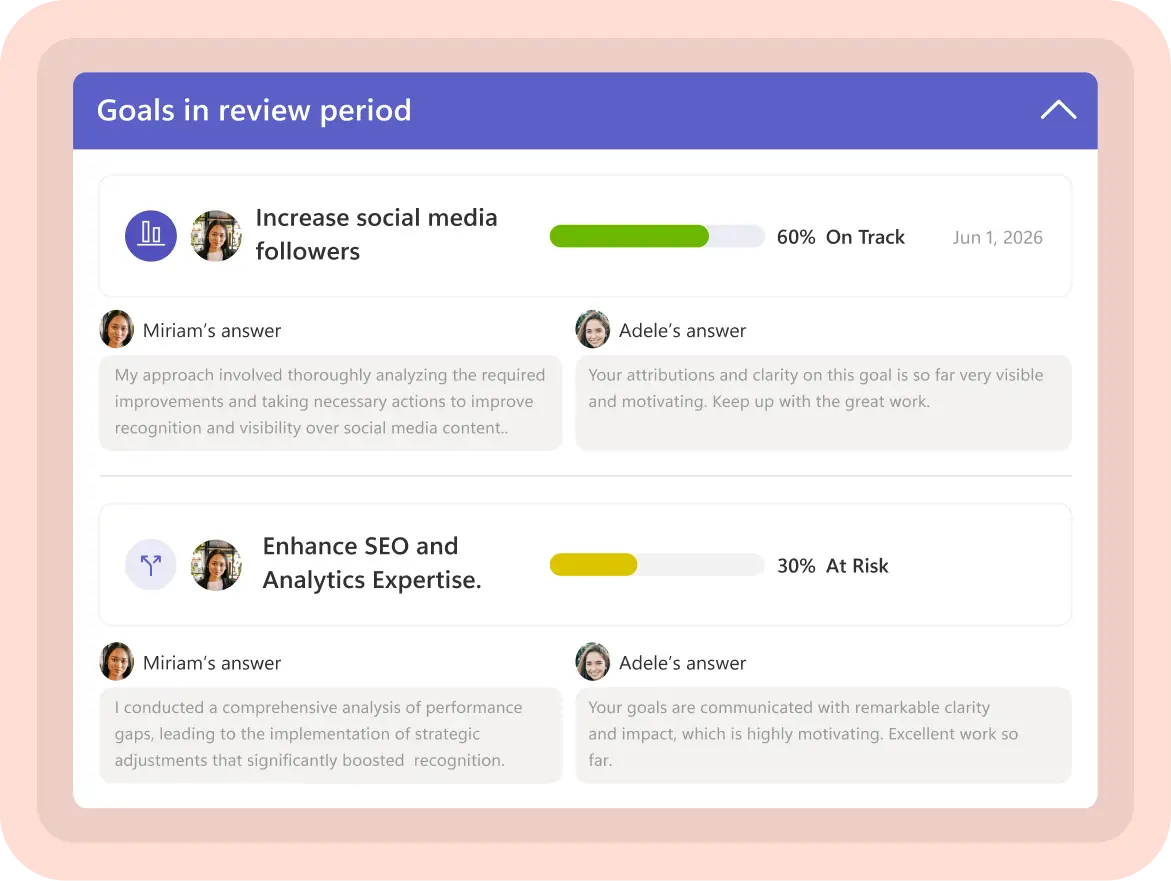
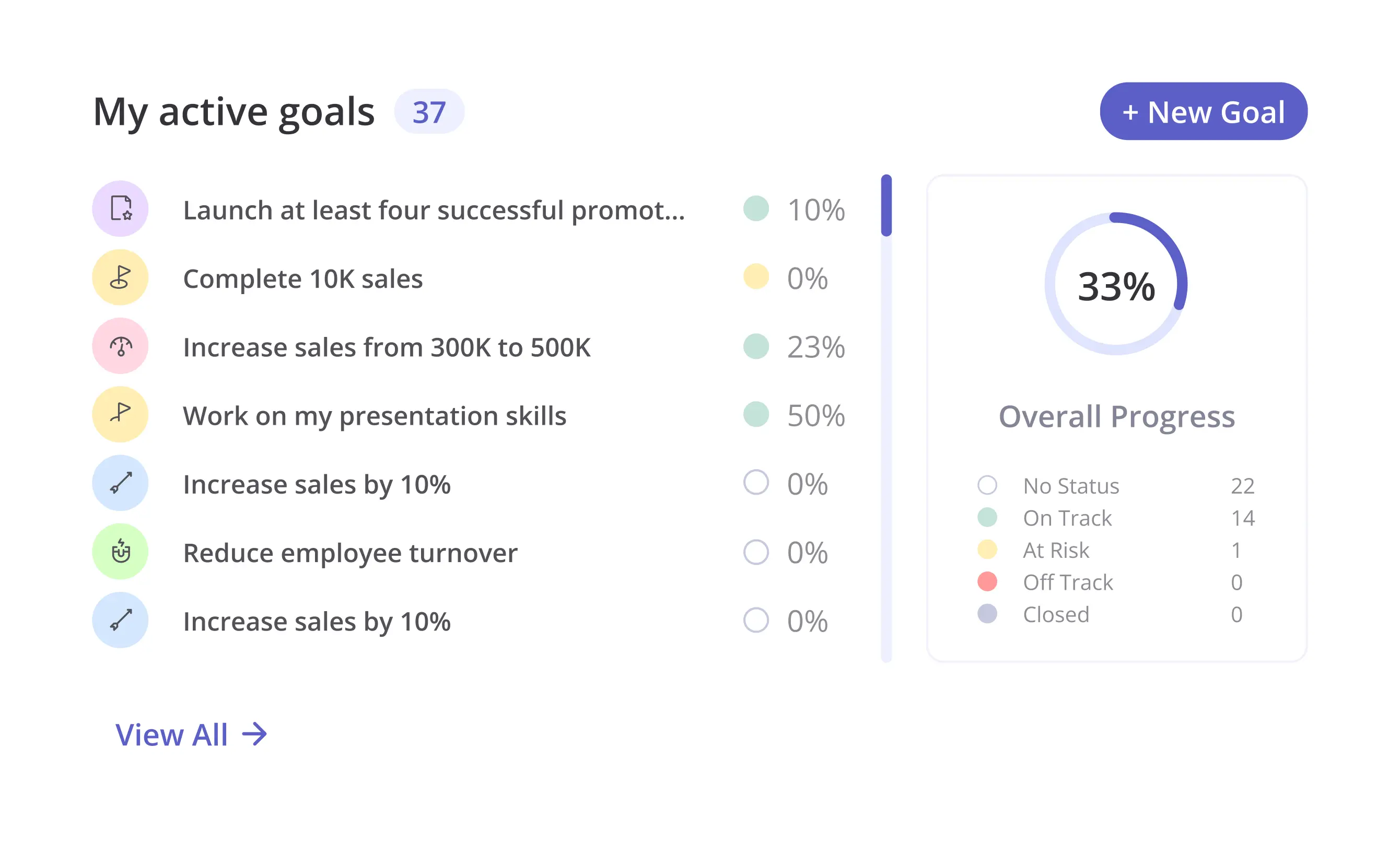
Here's the reality: performance-based compensation only works when you have accurate, objective data to base decisions on. Spreadsheets, gut feelings, and annual reviews won't cut it. You need a system that connects goals to performance to compensation outcomes in a way that's transparent and defensible.
The bottom line is simple. You can't build a fair, effective performance-based compensation plan without solid performance management infrastructure. Teamflect gives you that foundation right inside the tools your team already uses every day.
Performance-based pay is the broader compensation philosophy. It includes any pay structure where earnings are tied to results. Bonuses are one type of performance-based pay, but the category also includes commissions, merit increases, profit sharing, and tiered incentives. All bonuses are performance-based pay, but not all performance-based pay comes in the form of bonuses.
It can be, but fairness depends entirely on implementation. Performance-based compensation is fair when metrics are clear, achievable, and within the employee's control. It's fair when evaluation is objective and unbiased, and when the rules are transparent from the start. It becomes unfair when goals are unrealistic, metrics are subjective, or compensation decisions feel arbitrary. The system itself isn't inherently fair or unfair. The design and execution determine fairness.
The most effective approach is using objective, quantifiable metrics tracked consistently over time rather than relying on manager judgment alone. Combining multiple data sources like goal achievement, peer feedback, and behavioral indicators helps balance out individual bias.
Regular calibration sessions where managers compare ratings across teams can surface inconsistencies. Technology also helps by creating audit trails and making patterns of bias more visible. Training managers on common biases and how to recognize them is essential.
Most organizations review performance-based compensation annually, but the tracking and feedback should be continuous. Quarterly check-ins ensure employees aren't surprised by year-end outcomes.
The compensation plan itself should be evaluated at least once a year to confirm it still aligns with business priorities and market conditions. High-growth or rapidly changing organizations might need to revisit their approach even more frequently.
The best metrics are those that employees can directly influence and that align with business outcomes. For sales roles, revenue and quota attainment work well. For customer success, retention and expansion metrics make sense.
For engineers, project delivery and quality indicators are appropriate. The key is choosing 3 to 5 metrics that cover both what gets done (output) and how it gets done (quality, collaboration, values). Avoid metrics that are easily gamed or that encourage counterproductive behavior. When in doubt, test metrics on a small group first before rolling them out company-wide.

.svg)
.avif)
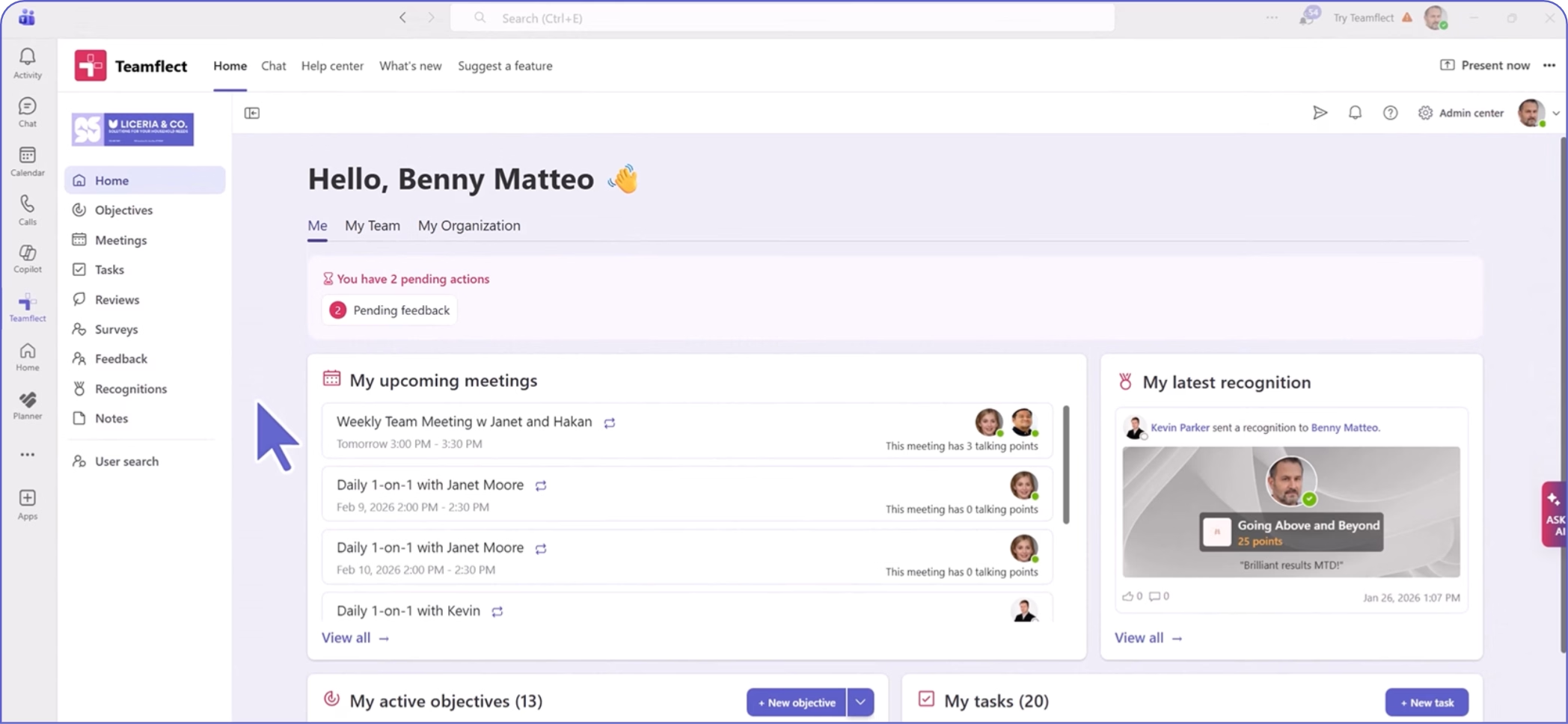
Create high-performing and engaged teams - even when people are remote - with our easy-to-use toolkit built for Microsoft Teams


.webp)
