.svg)
.svg)
How to Use AI for Smarter Goal Setting and Tracking

Updated on:
December 25, 2025

Prefer Teamflect as your HR source on Google
.svg)

For managers, setting clear and actionable goals has long been a challenge. That is why the rise of AI-powered goal setting is proving transformative. Corporate investment in AI is surging to boost productivity, and a recent study confirms the trend: 93% of Fortune 500 CHROs now use AI tools for business improvement. Using AI as an effective tool in the workplace can greatly reduce manager burnout, and increase productivity.
AI turns vague intentions into precise, measurable objectives, giving leaders unprecedented clarity and control over performance while still preserving the human touch.
Here’s how to use AI for goal management effectively.
Traditional goal setting eats up hours of manager time and often produces goals that are too vague to measure or too disconnected from company priorities. Here's what makes AI goal writing different:
AI tools fundamentally change the process from a time-intensive manual task to a rapid, data-driven activity, freeing up managers for more impactful coaching.
The strategic benefit of AI goal setting lies in its ability to ensure every individual objective contributes directly to the company's overall success and maintain fairness in the process.
AI for goal achievement isn't magic. It's a set of specific capabilities that make goal management faster and more effective. Here's what AI tools for task management and goal alignment actually do:
Type an idea (e.g., "increase customer satisfaction"), and AI generates a complete SMART goal draft with timeline, metrics, and success criteria. It uses data to recommend realistic targets.
AI suggests relevant metrics based on the employee's role (e.g., pipeline metrics for sales, response times for customer service), eliminating the blank page problem.
AI scores each goal for clarity and measurability, offering suggestions for improvement before finalization to ensure everyone understands the objective.
AI maps individual goals directly to team and company objectives, demonstrating how daily work supports strategic priorities.
By analyzing progress patterns, AI forecasts which goals are at risk (e.g., 20% complete halfway through the quarter) and flags them for immediate manager attention.
Color-coded dashboards replace spreadsheets, offering a quick visual of who is on track, enabling managers to make data-driven decisions.
When business priorities shift, AI suggests necessary updates to existing goals and recommends new metrics to match current needs.
📚 Recommended Reading: How to use AI effectively in performance reviews?
AI can dramatically improve how goals are written, tracked, and adjusted, but only if it’s embedded directly into day-to-day workflows. With Teamflect, AI supports goal setting inside Microsoft Teams, using real performance data rather than generic prompts or disconnected dashboards.
Here are three ways Teamflect applies AI to goal setting in a practical, manager-friendly way:

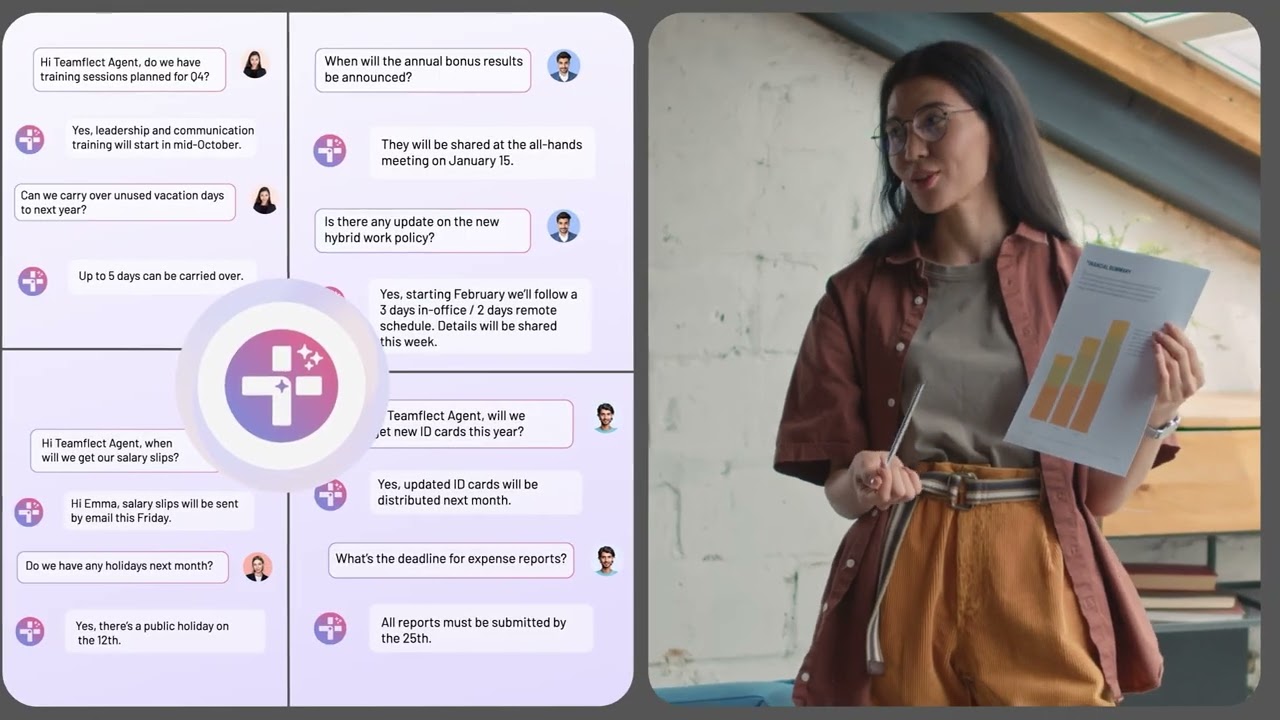
Instead of manually scanning progress bars or waiting until deadlines approach, managers can ask Teamflect Agent direct questions such as “Who on my team is at risk of missing their goals?”
The agent analyzes goal progress, due dates, completion patterns, and current status to surface which goals (and which employees) may need attention. This allows managers to intervene early with coaching, support, or reprioritization, rather than reacting after goals are already missed.
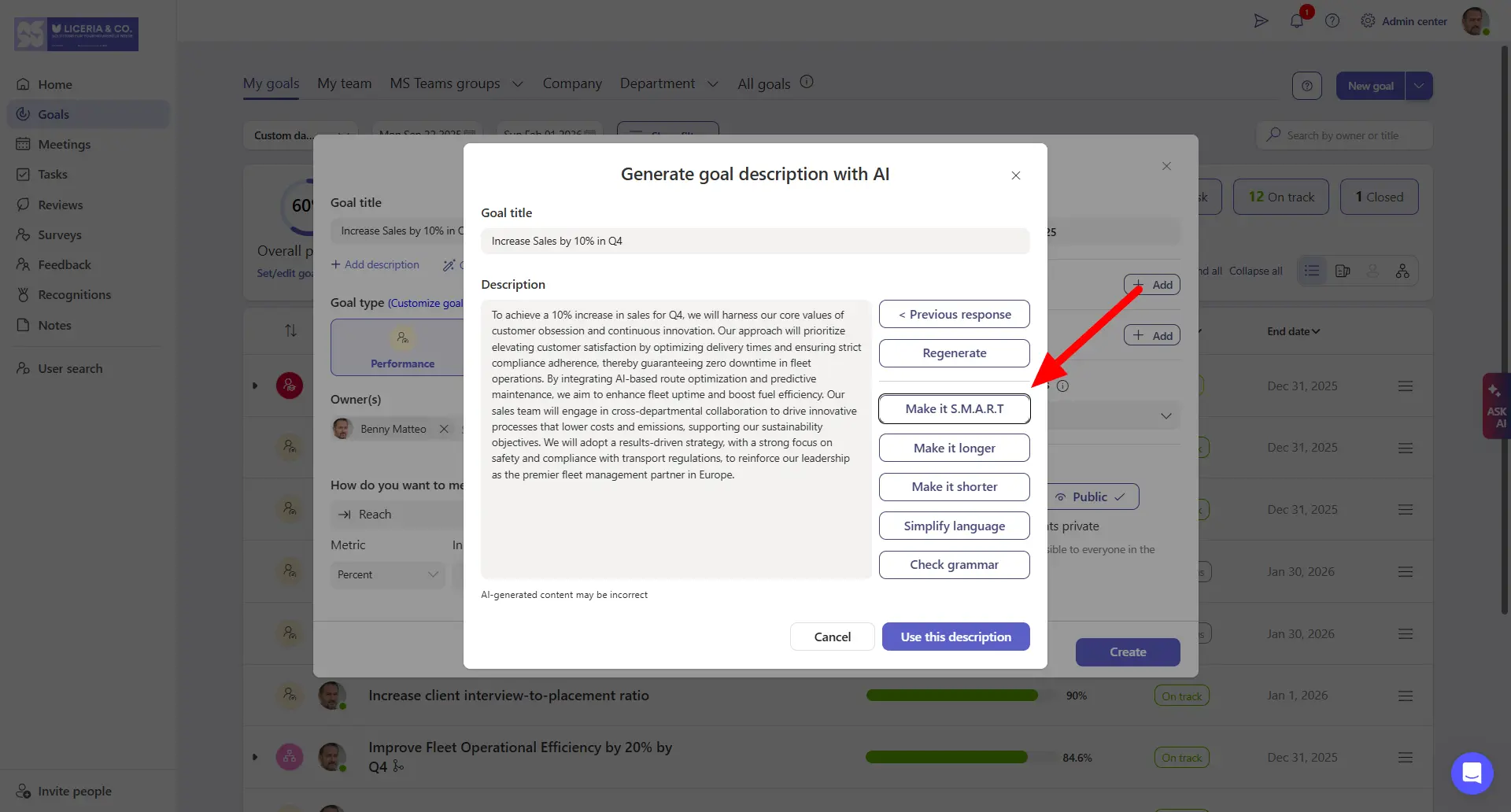
Vague goals are one of the most common reasons goal programs fail. Teamflect’s built-in AI helps managers and employees turn simple goal titles into clear, measurable, SMART goal descriptions directly within the goal-creation flow.
Users can:
This ensures goals are actionable and aligned from the start—without relying on templates or external writing tools.
Ended in observed strengths, gaps, and outcomes. These development goals can be reviewed, adjusted, and assigned immediately—creating a direct link between feedback, performance, and future growth.
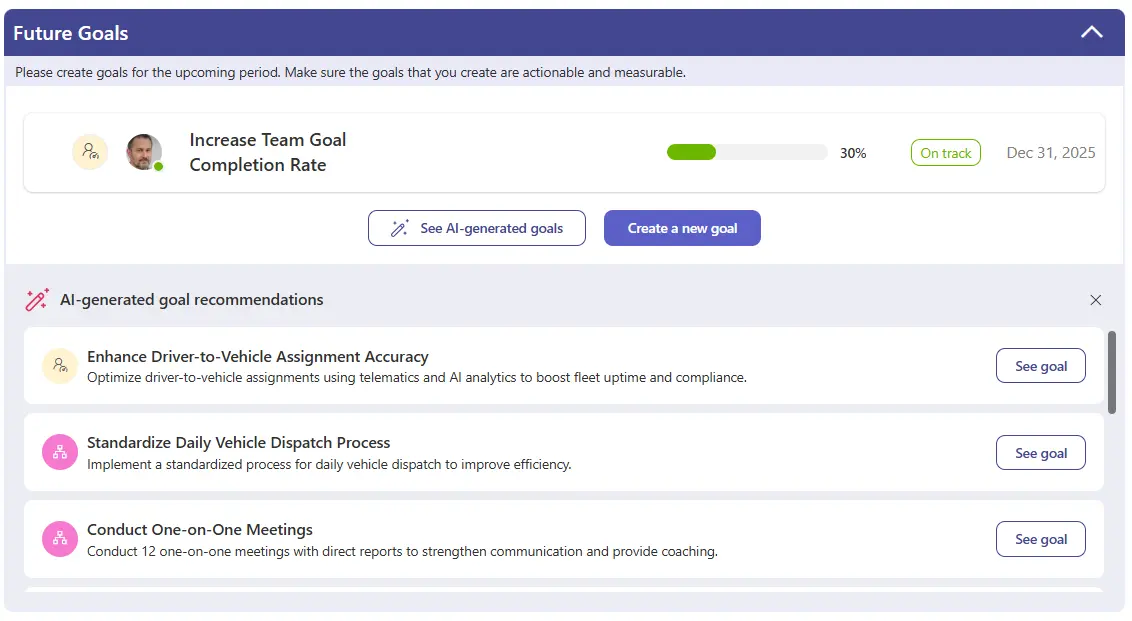
Goal setting becomes far more effective when it’s connected to actual performance insights. Teamflect uses AI to analyze performance review results, 360 feedback, and goal completion data to recommend relevant development goals.
Instead of generic objectives like “improve communication” or “develop leadership skills,” managers receive goal suggestions grounded in observed strengths, gaps, and outcomes. These development goals can be reviewed, adjusted, and assigned immediately, creating a direct link between feedback, performance, and future growth.
Not all AI goal-setting tools offer the same capabilities. Here's what actually matters for effective performance management, summarized in the table below.
| Feature | Why It Matters for Managers | AI Advantage |
|---|---|---|
| Automated goal suggestions | Removes guesswork and speeds up goal creation for entire teams | Generates structured, role-appropriate goals based on position, past performance, and industry benchmarks |
| Alignment engine | Ensures every team member's work connects to strategic priorities | Maps individual goals to team objectives and company OKRs automatically, showing contribution to bigger picture |
| Real-time tracking | Provides continuous visibility instead of waiting for quarterly reviews | Monitors progress daily, detects deviations early, and alerts managers to risks before deadlines |
| Predictive analytics | Helps managers act proactively rather than reactively | Forecasts goal completion likelihood, identifies at-risk objectives, and suggests interventions |
| Progress visualization | Eliminates manual status report compilation | Creates dashboards that show team progress at a glance with color-coded status indicators |
| Intelligent recommendations | Offers specific guidance instead of generic advice | Analyzes performance patterns and suggests concrete next actions based on similar successful goals |
| Dynamic goal adjustment | Keeps objectives relevant when priorities shift | Identifies outdated goals and recommends updates that match current business needs |
| Coaching cues | Helps managers have better one-on-ones | Surfaces conversation starters based on goal progress, recent achievements, and potential blockers |
| Performance insights | Turns data into actionable understanding | Highlights trends across teams, showing which goal types succeed most and where support is needed |
Teamflectbrings AI goal setting directly into your existing workflow, making it practical for managers who already have too much on their plate. Here's what the platform actually does:
Teamflect's AI-powered performance management platformturns goal creation from a chore into a quick, structured process. Set SMART goals in minutes, track progress in real time, and keep everything connected to your company's OKRs without leaving Microsoft Teams. Try Teamflect today.
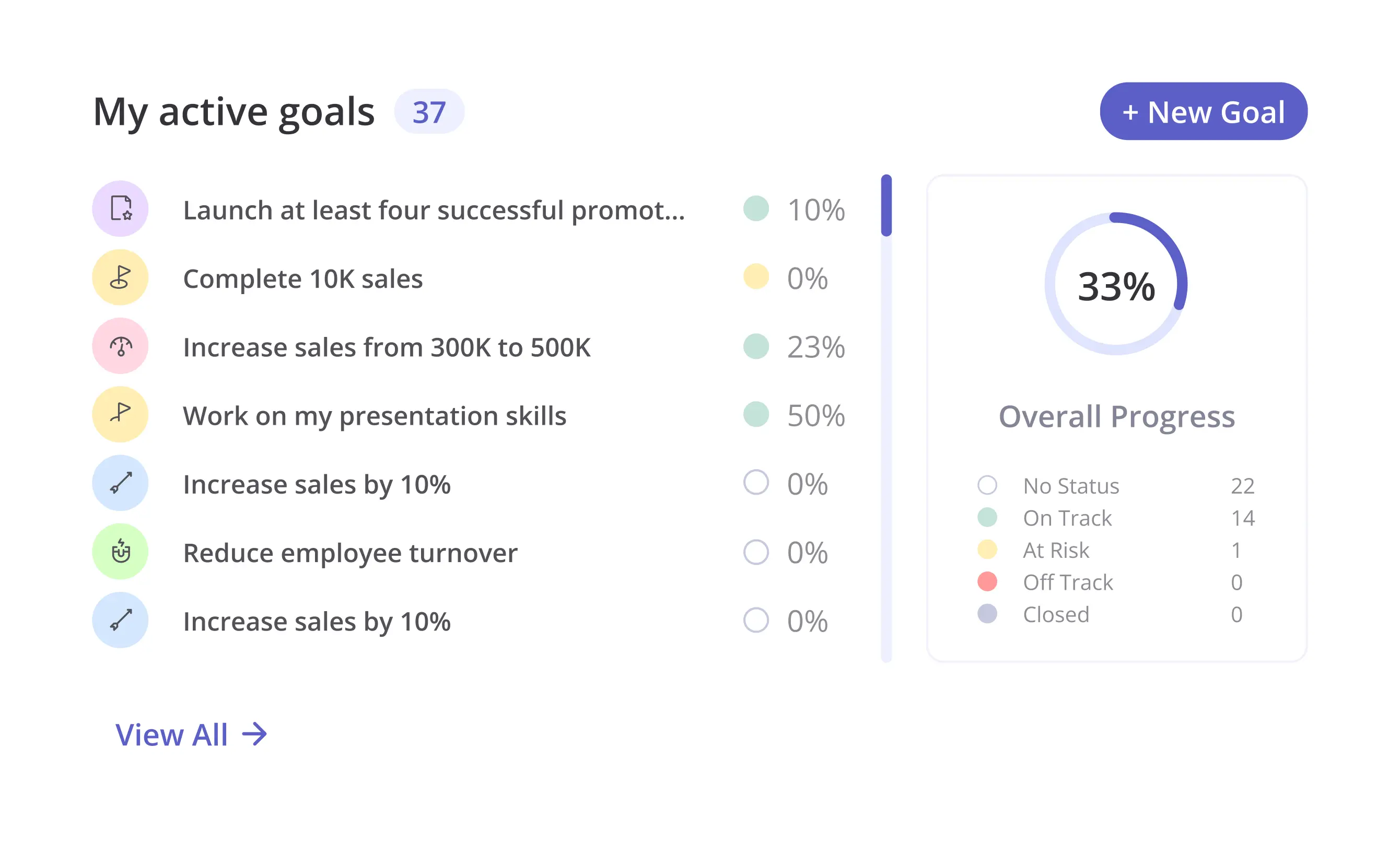
AI tools for goal setting only work well when used correctly. Here are the biggest pitfalls managers fall into:
AI-generated goals are starting points, not finished products. If you accept every suggestion without review, you'll end up with technically correct but contextually wrong objectives. Always add your knowledge of the employee's situation, team dynamics, and current workload.
AI for goals needs good information to work with. Typing "be better at job" produces generic results. Instead, specify the area: "improve project delivery timeliness" or "strengthen client relationship management." Clear inputs create useful goals.
When AI shows weak alignment between an individual goal and company objectives, that's a red flag worth investigating. Either the goal needs revision or you need to explicitly mark it as a developmental objective that serves future needs rather than current priorities.
Just because AI can quickly create 15 goals doesn't mean your team should have 15 goals. Focus beats volume. Three well-crafted, properly tracked goals drive more results than ten goals that get ignored after week two.
The system generates progress reports, flags risks, and suggests interventions. But none of that matters if managers don't act on it. Schedule weekly time to review AI-flagged concerns and reach out to team members who need support.
Predictive analytics shows probabilities, not certainties. If AI forecasts a 70% chance of goal failure, that's useful information to investigate further. It's not a final verdict. Talk to your employee, understand blockers, and adjust support accordingly.
AI doesn't understand office politics, personal circumstances, or team morale. Before finalizing goals, have a conversation. Make sure the employee believes the goal is fair, achievable, and worth pursuing. Buy-in matters more than algorithmic perfection.
No. AI for goal management is a tool, not a replacement for leadership judgment. AI generates structured drafts and suggests metrics, but managers must add context about team dynamics, individual circumstances, and strategic priorities. The human element matters in validating that goals are appropriate, achievable, and motivating for specific employees.
AI-driven goal setting software produces goals that are structurally sound and based on data-driven decisions. Accuracy depends on the input quality and the AI's training data. Goals generated by systems like Teamflect are typically 85-90% ready to use, requiring minor adjustments for specific contexts. The AI excels at format and metrics but needs human input for nuanced judgment.
Yes, when used correctly. AI applies consistent frameworks across all employees, reducing unconscious bias in objective setting. It suggests similar metrics for similar roles regardless of personal characteristics. However, AI isn't bias-proof. If training data contains historical biases, those can be reflected in recommendations. Managers should still review goals for fairness and adjust as needed.
AI goal-setting tools analyze multiple data sources: role descriptions, past performance signals, completed goals from similar positions, industry benchmarks, and company OKRs. Some systems also consider individual performance history, skill assessments, and development plans. Teamflect's AI agent, for example, specifically looks at your organization's goal patterns and success rates to make relevant suggestions.
AI can't understand office politics, personal motivations, or team morale. It doesn't know if someone is dealing with personal challenges or planning to leave. AI also struggles with highly creative or ambiguous roles where success is hard to quantify. The tool works best for roles with clear deliverables and measurable outcomes. Always supplement AI suggestions with personal knowledge of your team.
Reputable AI goal tracking platforms use enterprise-grade security and data isolation. Employee goal data is encrypted and accessible only to authorized users. AI models analyze patterns without exposing individual information. For platforms like Teamflect with Microsoft Teams integration, data handling follows Microsoft's security standards. Always review your tool's privacy policy and ensure it meets your organization's compliance requirements.

.svg)
.avif)
Create high-performing and engaged teams - even when people are remote - with our easy-to-use toolkit built for Microsoft Teams