.svg)
.svg)
Holacracy: What It Is, How It Works, and Whether It Actually Works

Updated on:
October 9, 2026

Prefer Teamflect as your HR source on Google
.svg)

Holacracy is a specific management system built on a written rulebook called the Holacracy Constitution. Authority moves from people into defined roles, and the structure changes through formal governance meetings rather than managerial decisions. It's not the same as “no managers” or a flat organization. Full adoption is a significant operating-model change, which is why it may work well for your small team and create real headaches if you try to scale it.
If your organization runs on titles and reporting lines, you are used to authority living in people. Holacracy moves it into roles instead. Brian Robertson developed the idea at Ternary Software in the early 2000s and co-founded HolacracyOne in 2007, publishing the first constitution in 2009. Since then the system has been updated; the current version is Holacracy Constitution 5.0, released in 2021.
That constitution is the whole point. Without it, your company is just trying to be less hierarchical. With it, you have a formal operating system with defined terms, structured meetings, and specific rules for how the structure can change. From the outside the two approaches can look the same, but they require very different things from the people inside.
The basic idea is that authority should live in roles rather than people. In practice, each role has an explicit purpose, defined accountabilities, and domains it controls. You can hold several roles at the same time, and a role can be restructured without disrupting you personally. Decisions within a role's domain don't need managerial sign-off, because the constitution grants the authority automatically.
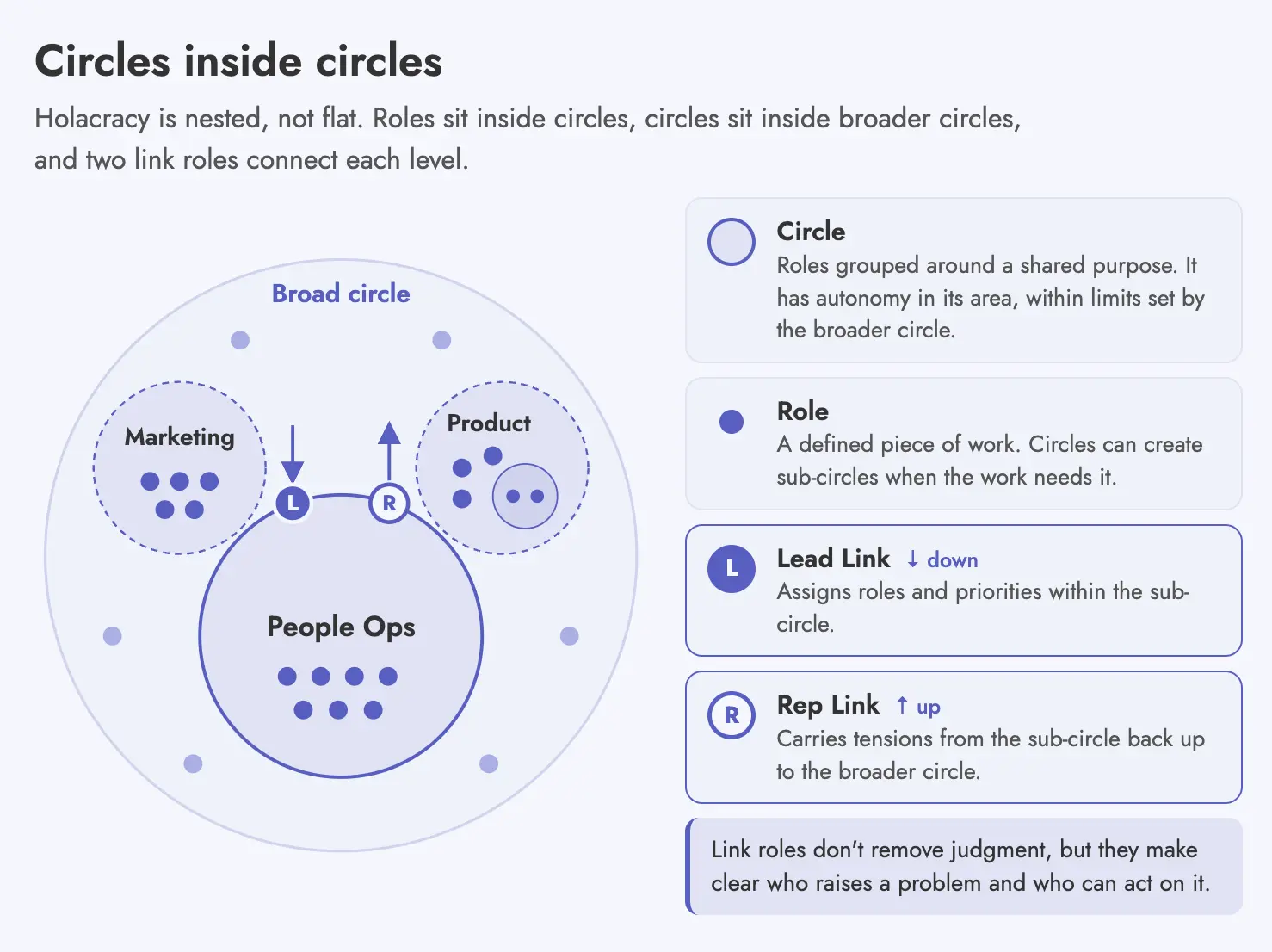
Roles sit inside circles, which your organization groups around a shared purpose. A circle can also create sub-circles when the work needs it, producing a nested structure rather than a flat one. Each circle has real autonomy within its area, but the wider circle still sets the limits of what it can do.
To connect those circles, Holacracy uses two link roles. A Lead Link assigns roles and priorities within a sub-circle; a Rep Link carries tensions back up to the broader circle. Neither one removes political judgment, but both formalize who is expected to raise a problem and who in your organization can act on it. If you currently use team goals to give groups a shared direction, you already understand the underlying logic. Holacracy just formalizes it further.
Holacracy splits your meetings into two types, and the separation matters. Governance meetings are for structure changes, where your roles, policies, and authority get updated when someone raises a tension, meaning a perceived gap between how things work now and how they could work better. Tactical meetings, by contrast, cover the actual work. Think status updates, blockers, and next actions.
Most teams mix these two things in the same meeting without realizing it. That is how you end up spending the first forty minutes of a status call debating who should own a decision. Keeping them separate does not solve the underlying problem, but it forces it into the open.
You may have heard Holacracy described as a flat structure, but it's not. Holacracy removes conventional managers and replaces them with a more documented hierarchy of circles, roles, link functions, and governance rules. If your organization adopts it, you will have more written structure than you have now, not less.
Sociocracy and Holacracy are often confused because both use circles and distribute authority. They are not the same thing, though. Holacracy is a specific, trademarked system built around a written constitution. Sociocracy, by contrast, is a broader family of governance approaches. Buurtzorg, the Dutch nursing organization frequently cited in self-management discussions, follows neither and should not be used as a Holacracy case study.
Holacracy had a brief moment of mainstream attention in the mid-2010s. If you looked into it then, you probably heard about Zappos and Medium. The actual results were more complicated than the headlines suggested.
Zappos rolled out Holacracy in 2015, and the transition was not smooth. About 14% of its 1,500 employees took a buyout rather than participate, which CBS MoneyWatch covered at the time. By 2020, Quartz reported that the company had been quietly walking the system back, bringing managers in and loosening the constitutional rules. Call it an evolved case rather than a success or failure.
Medium adopted Holacracy early and dropped it in 2016. The company's own exit statement described a persistent tax on effectiveness and connection. Medium said it wanted to keep the spirit of distributed authority, just not that particular system. That distinction is worth noting. Leaving Holacracy does not have to mean returning to conventional management.
Most organizations that have stuck with Holacracy are smaller, with knowledgeable participants, interdependent work, and founders genuinely willing to give up informal authority. If you are researching adoption for your own organization, ask for current references from companies at your size and stage rather than relying on stories from a decade ago.
The critics of Holacracy are not defending bad management. Rather, they are pointing to real costs that are easy to underestimate when you are reading about the system rather than actually running it in your organization.
Governance is not a one-time setup in Holacracy. Instead, your roles and authority are expected to evolve continuously, which means ongoing meetings, maintained records, and a facilitation process your whole team needs to learn. Medium described it as a persistent tax. That is accurate, and it compounds if your turnover is high or your work moves fast enough that governance is always chasing the situation.
Role-based authority can clarify what each person owns while making end-to-end accountability harder to see. When an outcome depends on several roles across multiple circles, everyone on your team may know their piece without anyone owning the result.
A conventional manager can obscure accountability problems too, but at least your team knows who to escalate to. In Holacracy, that escalation path has to be explicitly built into your governance structure, or it simply does not exist. That said, where cross-role ownership is murky in your organization, structured 360-degree feedback can help surface whether collaborators actually experience the accountability as clear.
Remove titles and you remove the scaffolding your organization uses to structure pay, promotions, and career development. Holacracy does not come with a replacement for any of that. Zappos tried skills-based badges during its transition, which shows how much design work this problem requires. Before you commit, you need a credible answer for how your people will understand their progression and how you will benchmark pay against the market.
New hires cannot pick up Holacracy by watching how things work. In practice, they need to learn the vocabulary, the meeting formats, and your governance process before they can participate meaningfully.
In a small, stable team, that is manageable. If your organization has regular turnover or a large frontline population, that training cost recurs at a pace that can outweigh the benefits. An employee engagement platform will not solve this, but it can support the communication that a transition this significant requires.
Yes, for some. No, for most. The honest answer depends on a few things. Are you willing to fully follow the constitution? Will your leaders genuinely give up informal override authority? And is your work complex and interdependent enough to justify the overhead?
Full adoption is not a process change. Think of it as a constitutional one. Your leaders will cede real discretion, and your employees will take on explicit responsibility in ways that are more exposed than a conventional job description.
That trade-off works well in small, mission-driven, collaborative teams. On the other hand, it tends to struggle when your headcount is high, your work is regulated, or your people need predictable career paths.
For most teams, partial adoption is the smarter starting point. The Holacracy Constitution separates several useful practices you can borrow and adapt individually. Rather than overhauling everything at once, test one specific friction point first. And whatever you borrow will still need to coexist with your existing enterprise HR software stack, covering permissions, reporting lines, and people data.
You don't need the full constitution to use Holacracy's best ideas. Here are four things you can try in your organization right now.
Reserve one recurring meeting for structural changes in your team, covering how roles are defined, who holds which decision rights, and what your working policies are. Keep your regular operating meetings for the actual work. When you mix the two, structural debates eat into execution time and your team never makes real progress on either.
For any recurring decision in your team, write down who makes the call and who needs to be told before it happens. You don't need a constitution for this, just a shared document. In fact, most teams have more hidden hierarchy than they realize, and this exercise surfaces it.
Once your decision rights are visible, goal alignment becomes much easier because you can test whether the decision owner is actually pointing at the right company priority.
Titles are often too broad to tell you what someone in your organization actually owns. Write down your critical roles separately from the org chart, especially where one person holds responsibilities that cross departmental lines. Doing so can clarify a lot of accountability without touching reporting lines or restructuring anything.
Instead of a standing agenda, ask your team to bring the specific gaps or blockers they need resolved. Then decide whether each one needs an operational response or a structural conversation, and save the structural ones for a separate meeting. Your regular meetings will get noticeably shorter and more useful.
Where cross-functional blockers keep recurring, a strategy execution platform can make ownership and progress visible without requiring a constitutional redesign.
Holacracy is a management system that replaces job titles and managers with defined roles and written governance rules. Authority sits in roles, not people, and a written constitution sets out exactly how decisions get made and how the structure can change.
No. A flat org just removes layers. Holacracy replaces them with a formal hierarchy of circles, roles, and governance rules. It actually has more documented structure than most conventional organizations, not less.
Not in its original form. Zappos rolled it out in 2015, but Quartz reported in 2020 that the company had been quietly walking the system back and bringing managers back in. It's better described as an evolved case than a working example.
The main ones are governance meeting overhead, the difficulty of replacing a compensation system built around titles, and the cost of training every new hire in a specialized vocabulary and process. The system also tends to struggle when leaders want to keep informal override authority.
Both use circles and distribute authority. Holacracy is a specific, trademarked system built on a written constitution. Sociocracy is a broader family of governance methods, usually centered on consent-based decision-making. The two are related but not interchangeable.
Smaller organizations tend to have more success with it. The governance, training, and coordination demands grow quickly as headcount rises, and the system becomes harder to sustain in large organizations with high turnover or complex functional boundaries.

.svg)
.avif)
Create high-performing and engaged teams - even when people are remote - with our easy-to-use toolkit built for Microsoft Teams