.svg)
.svg)
Goal Alignment: How to Align Employees With Company Goals

Updated on:
October 9, 2026

Prefer Teamflect as your HR source on Google
.svg)

Goal alignment means that organizational priorities, team commitments, and individual work point toward a shared outcome, even when people contribute in very different ways. In practical terms, employees should be able to explain how a decision they make this week supports a company priority. Leaders, in turn, should be able to explain why that work matters when resources or priorities conflict.
| Term | Field | Meaning | How it differs |
|---|---|---|---|
| Goal alignment | HR and performance management | Connecting individual, team, and company goals to a shared outcome | Focuses on line of sight from work to organizational priorities |
| Organizational alignment | Organizational design and strategy | Coordinating strategy, structure, incentives, processes, and behavior | Broader than goals because it includes how the organization operates |
| Goal congruence | Management accounting and control | Local decisions that also advance the organization's overall interests | Focuses on whether incentives and measures lead to the right decisions |
Goal setting is the act of defining a target. Alignment, by contrast, is the continuing connection between that target and a company outcome. As a result, a person can have a well-formatted goal and still be working on the wrong thing.
That distinction matters because specific, challenging goals improve performance under the right conditions. People need the ability, feedback, commitment, and resources to pursue them. Locke and Latham built this finding over 35 years of research into goal-setting theory.
At the same time, alignment does not require every goal to have one direct parent. Some work supports several priorities, and some roles exist to prevent failure rather than create a visible result. The test is whether the connection is explicit and defensible, not whether the chart looks perfectly linear.
Goal alignment usually breaks after leaders agree on strategy, not before. As priorities move through managers, functions, incentives, and local planning cycles, they can lose the context needed for sound decisions. Consequently, employees may stay busy while pursuing goals that reflect an earlier or incomplete reading of the company objective.
A company objective is necessarily broad. Directors first decide what it means for their functions; managers then turn that interpretation into work for teams and individuals. In other words, translation is work, not administration. When a director interprets the objective poorly, the teams below can be faithfully aligned to the wrong parent goal without anyone noticing.
Research by Donald Sull, Rebecca Homkes, and Charles Sull, published in HBR in 2015, drew on surveys of nearly 8,000 managers at more than 250 companies. The authors note that studies find two-thirds to three-quarters of large organizations struggle to implement their strategies.
One of the study's central findings is that execution depends on coordinated choices, not cascaded instructions. The authors also name a common myth: that communication equals understanding. That myth is one reason strategy fails in the middle of organizations.
Copying the language of a company objective into departmental or individual goals can create the appearance of alignment. Yet it does not tell a team what to change in its own work. "Improve customer retention" is not an actionable goal for legal, finance, support, product, or facilities. Each function must first turn that outcome into a contribution that fits its role, with a measure it can influence.
McKinsey’s 2024 performance survey of about 1,200 employees in 11 countries found that employees were most motivated by goals with a clear link to company objectives. The translation step is what creates that link. Skipping it and repeating company language as a substitute produces goals that look aligned but give no guidance on what to do differently.
Goals often become misaligned after a planning event, market change, acquisition, budget reduction, or leadership shift. Although the company objective changes, goals in team documents and individual reviews may remain untouched because updating them feels disruptive. A goal cycle therefore needs a stated rule for revising or retiring goals. Otherwise, employees are judged against work that no longer represents the organization's priority.
When the parent goal is not visible, employees have little to guide them when two requests compete for the same time. Gallup's Q12 survey uses "I know what is expected of me at work" as its first engagement item. According to Gallup’s Q2 2025 data, only 47% of U.S. employees strongly agreed with that statement.
That is not a direct measure of goal alignment, but it is a warning. When fewer than half of employees know what is expected of them, most of them are unlikely to see a clear link to company priorities.
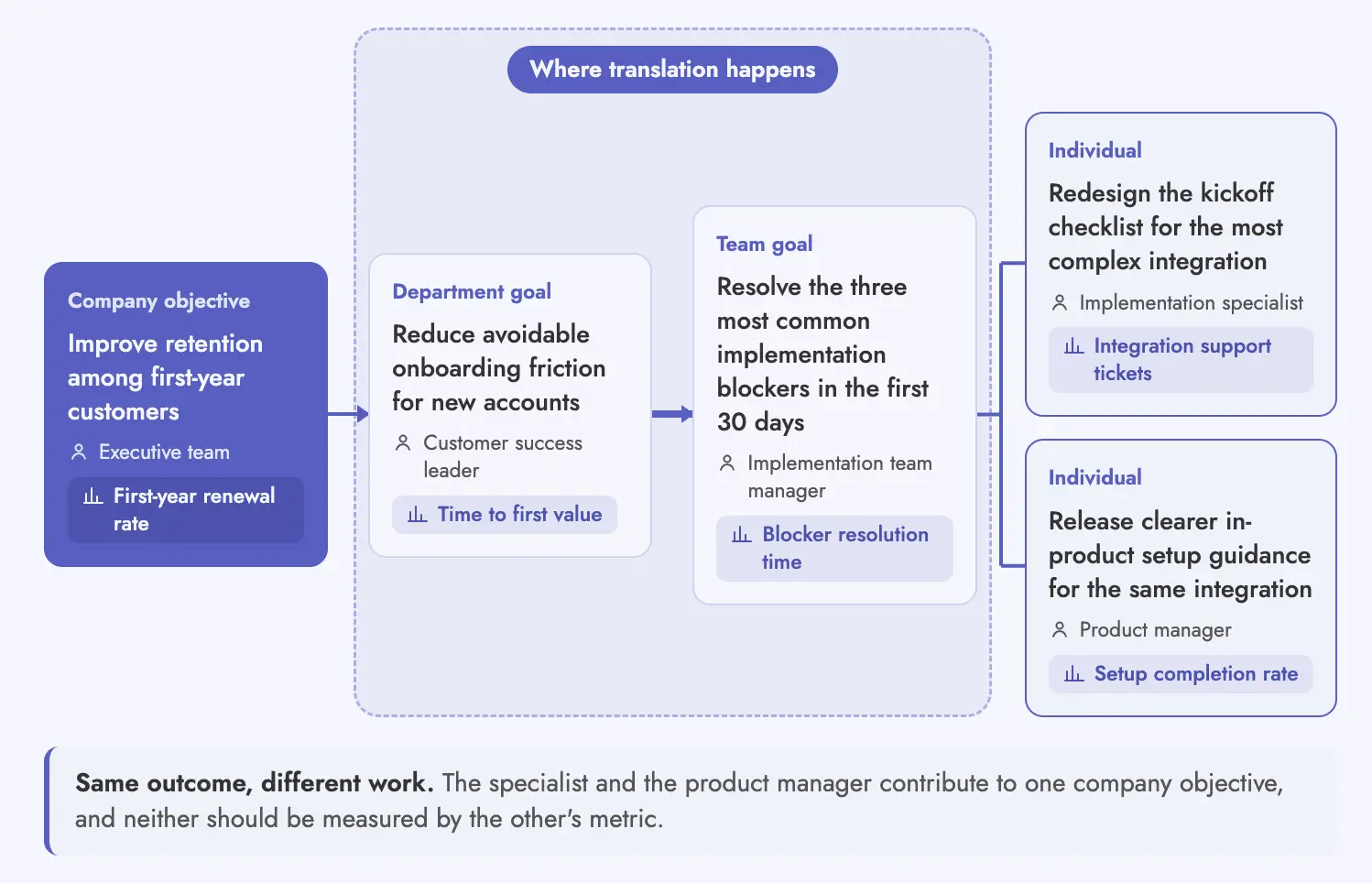
Goal alignment becomes visible when one company objective produces different, role-appropriate work across the organization. The example below follows a single objective from company level to two individual contributors in different functions. Although the goals do not repeat the same language, each one has a clear reason to exist.
| Level | Goal | Owner | How it is measured |
|---|---|---|---|
| Company objective | Improve retention among first-year customers | Executive team | First-year renewal rate and early churn rate |
| Department goal | Reduce avoidable onboarding friction for new accounts | Customer success leader | Time to first value and onboarding completion rate |
| Team goal | Resolve the three most common implementation blockers in the first 30 days | Implementation team manager | Blocker resolution time and repeat-support volume |
| Individual: implementation specialist | Redesign the kickoff checklist for accounts using the most complex integration | Implementation specialist | Checklist completion and integration-related support tickets in first 30 days |
| Individual: product manager | Release clearer in-product setup guidance for the same integration | Product manager | Setup completion rate and help-center exits from the integration flow |
The implementation specialist and product manager contribute to the same company outcome through different work. Neither person should be measured by the other's metric. Strong team goals make the shared contribution explicit, while the boundary between personal and team OKRs clarifies who owns each level of work.
Even so, the table hides the hard part. The department-to-team step requires judgment about where the real constraint sits, which work the team can influence, and what should be stopped. A clean cascade can make that translation look automatic. In practice, it is where alignment most often fails.
Start with clear company objectives, then translate them into role-relevant decisions, team commitments, and individual work. From there, make the parent goal visible and establish a review rhythm that lets goals change when the company's priorities change. The process works when it gives people enough direction to act without turning every decision into an approval exercise.
Start with a small number of company objectives that an employee can repeat without reopening a strategy deck. "Win the mid-market" is a direction, not yet an objective. Instead, state the intended outcome, the timeframe, and the measure that indicates progress. If leaders cannot explain what the organization will do differently, managers cannot translate it responsibly.
Before goals move down a level, ask each director and manager three questions: What part of this outcome can our function influence? What will we do differently? What will we stop or deprioritize? The answer should not be a smaller version of the executive goal. Rather, it should describe the function's contribution and the trade-off required to make it real.
Individual goals should come after the team has defined its contribution. Otherwise, managers can assign a collection of useful personal goals that do not add up to anything. A goal-setting template can make expectations consistent, while performance goals for employees give managers a more role-specific way to define success.
Employees should be able to see the relevant company, department, and team priority without asking their manager to explain it from memory. This matters most when work competes for time. When a person has two urgent requests, the parent goal helps them decide which one matters more. In Microsoft 365 environments, tracking goals in Microsoft Teams keeps those relationships close to the work itself.
Alignment is maintained through review, not created at the start of a quarter. Managers should revisit whether the parent objective still holds, whether the team's interpretation remains sound, and whether an individual goal should be changed or retired. Regular OKR check-ins create a practical point for revising work before a misaligned goal survives an entire cycle.
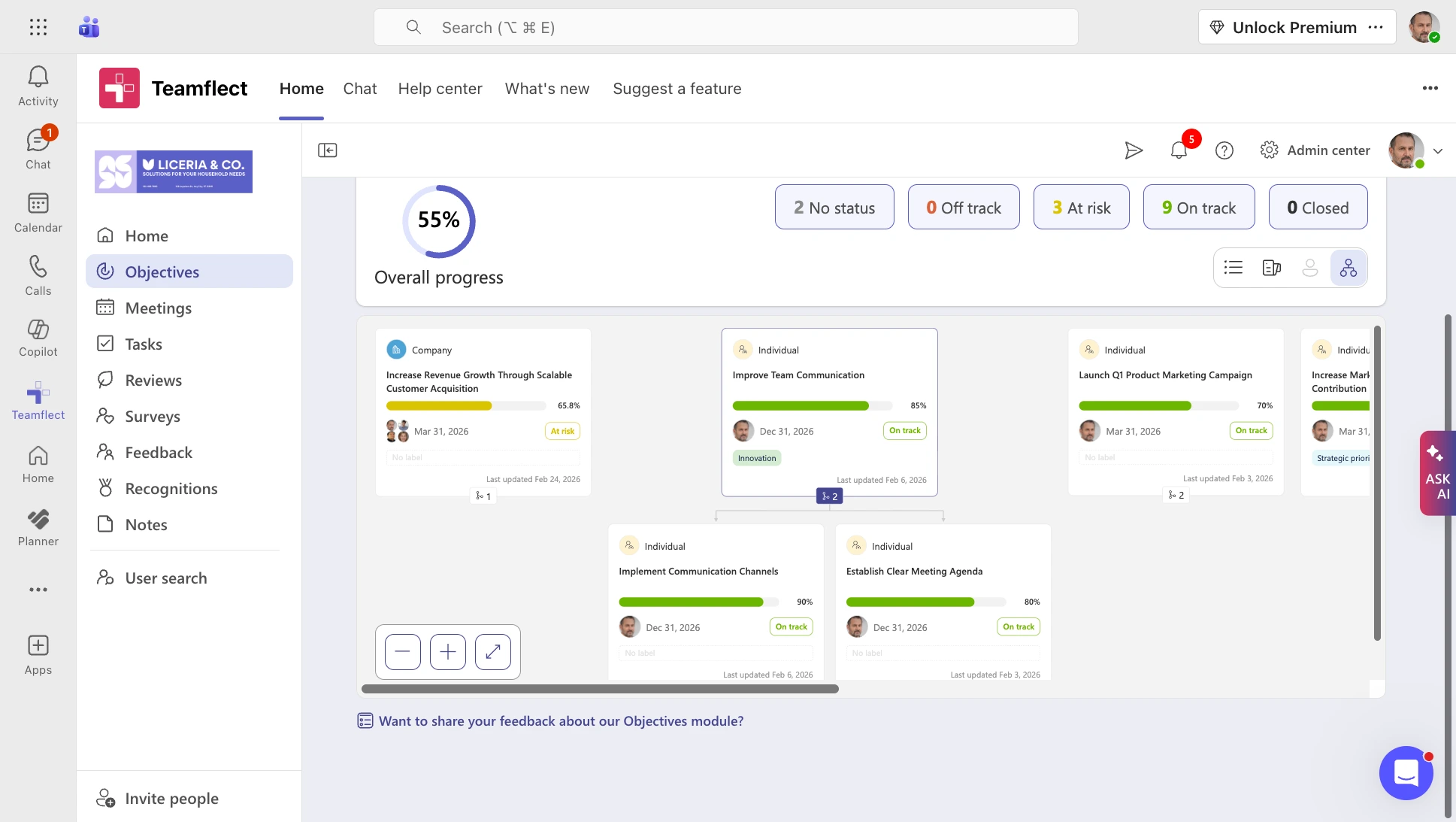
Teamflect handles the visibility side of goal alignment inside Microsoft Teams and Outlook. Every goal can link to a parent goal or break down into sub-goals. An employee who opens their own goal can then see the team and company priority behind it.
Automated check-ins arrive as cards in Teams chat, and goals can be shown inside ongoing Teams meetings. This keeps visibility and accountability high.
A framework can give goal alignment a common language, cadence, and record of ownership. However, it cannot perform the interpretive work for managers. Choose the lightest framework that helps the organization clarify outcomes, translate them across functions, and review progress without turning every employee into a project administrator.
OKRs fit organizations that need to connect ambitious outcomes with measurable results and revisit progress on a regular cadence. They can work particularly well when priorities change quickly. At the same time, they can create noise when every team writes too many of them. The practical choices involved in implementing OKRs therefore matter as much as the format itself.
SMART goals fit roles that need a clear, measurable commitment with a defined timeframe. They work well for stable responsibilities and performance expectations, and work best alongside a clear role description. Our guide on SMART goals in performance management covers how to apply them. Choosing between SMART goals and OKRs depends on whether the role needs a stable commitment or a more outcome-led operating rhythm.
Cascading goals can clarify ownership from company objectives to teams and individuals when the organization has a relatively clear hierarchy of outcomes. Still, the process can become mechanical. A useful cascade shows a translated contribution rather than a repeated slogan. That distinction is central to cascading OKRs across a larger organization.
Team goals fit work that depends on shared delivery rather than a collection of independent individual targets. They are especially useful when several roles contribute to the same service, release, customer outcome, or operational constraint. In those situations, the shared-accountability patterns in team goal examples can be a better fit than dividing one outcome into isolated personal targets.
Performance goals fit roles with defined responsibilities, service standards, capability expectations, or recurring outcomes. They should be linked to broader priorities where possible. Clear performance goals for employees preserve that role-specific accountability without forcing every function into an OKR structure.
Most organizations need both top-down direction and bottom-up input. Top-down alignment clarifies the outcomes the organization is choosing to prioritize. Bottom-up input tests whether those outcomes are feasible, identifies constraints leaders cannot see, and improves the translation into local work. The question is not which approach is universally better; it is which decisions belong at each level.
| Approach | Best for | Main risk |
|---|---|---|
| Top-down | Clarifying company priorities, investment choices, and non-negotiable outcomes | Goals are copied downward without enough local interpretation |
| Bottom-up | Identifying delivery constraints, role-specific contributions, and feasible measures | Teams optimize local work without a shared strategic direction |
| Both | Most cross-functional organizations with complex or changing priorities | Too many negotiation rounds unless decision rights are explicit |
A useful operating rule is that leadership owns the outcome, while teams own the explanation of how they can contribute. Managers can then test whether those local contributions add up, overlap, or create a conflict that needs a decision from above.
Not every role maps cleanly to revenue, customer growth, or a product metric. For legal, compliance, internal IT, facilities, support, and similar functions, alignment often means protecting an outcome or removing a constraint. Forcing a revenue-shaped goal onto those roles can create a worse goal than having none because it misstates what the function can control.
For example, a compliance leader may support a company objective of expanding into a regulated market. They can reduce approval-cycle risk and put the required controls in place before launch. An internal IT manager may support the same objective by ensuring new hires and new locations receive secure access within an agreed time.
A facilities lead may align by keeping a site opening on schedule and within safety requirements. These are not secondary contributions. They are conditions that make the company objective possible. Different types of goal setting give managers more appropriate options than applying a single revenue-shaped template to every function.
Goal alignment cannot be measured through completion rates alone. A team can finish every local target and still advance the wrong priority. Use quantitative signals to identify possible gaps. Then use qualitative evidence to determine whether employees and managers understand the connection between their work, their trade-offs, and the company outcome.
Look at four things: the share of active goals linked to a current company priority, goals with a named owner and measure, goals changed after a major strategy shift, and duplicate or conflicting goals across teams. These measures do not prove alignment; they show where to investigate. Consistent OKR tracking makes those links and changes visible over time.
Ask employees to explain the company priority in their own words and describe how their current work supports it. Then ask managers what they would deprioritize if resources tightened. Listen for vague repetitions of executive language, conflicting answers from adjacent teams, or goals that no one can connect to a current decision. Those signals often reveal misalignment more clearly than a dashboard with a high completion rate.
Goal alignment is the connection between an organization's priorities and the decisions, work, and measures owned by departments, teams, and individuals. It exists when employees can explain how their work contributes to a company outcome, not merely repeat a goal written at a higher level.
Goal alignment helps people make trade-offs when priorities compete. It gives managers a basis for allocating resources, clarifying what to stop, and reviewing progress. Without it, teams can complete well-written local goals that do not advance the organization's current priorities.
Goal setting defines a target. Goal alignment is the ongoing connection between that target and a larger organizational outcome. A goal can be specific, measurable, and well written and still be misaligned. This happens when it does not support the company priority or conflicts with another team's work.
Cascading goals move objectives down through organizational levels. Aligning goals is broader: it tests whether each level has correctly interpreted the intended outcome and can coordinate with related teams. Cascading can support alignment, but a copied-down goal may still be wrong for the role or function that receives it.
Goal misalignment commonly starts in one of four ways: strategy is translated poorly between levels, goals are copied without adaptation, priorities change without updates to local work, or managers cannot explain trade-offs. It also occurs when support, legal, compliance, facilities, and internal IT roles are forced into revenue-shaped goals that do not reflect their contribution.
Goal congruence is a management-accounting term. It describes a condition in which an individual's or unit's decisions in pursuit of local goals also advance the organization's overall goals. In practice, it is a useful test for whether incentives, measures, and individual targets point in the same direction.

.svg)
.avif)
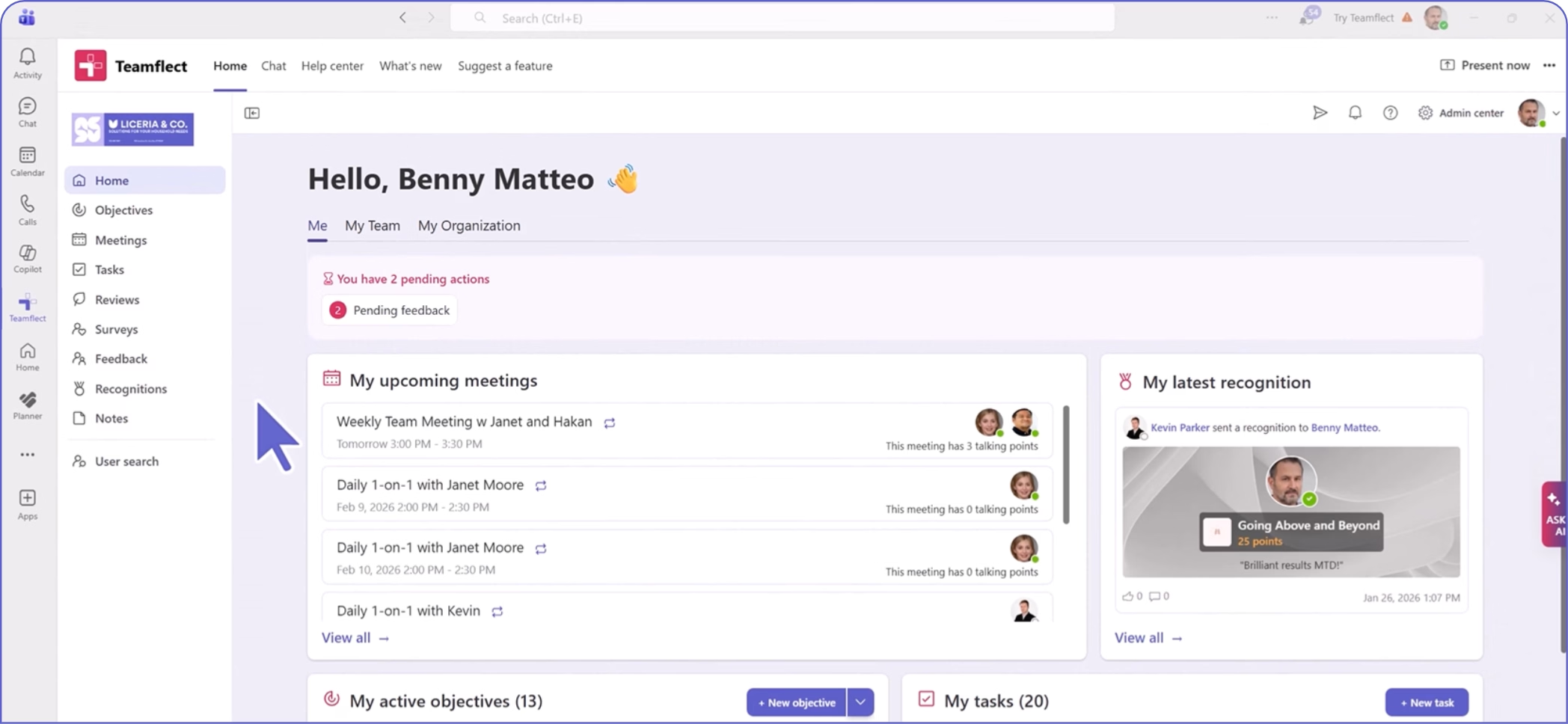
Create high-performing and engaged teams - even when people are remote - with our easy-to-use toolkit built for Microsoft Teams