.svg)
.svg)
Companies With the Best Performance Management Systems and Practices (2026 Examples)

Updated on:
July 24, 2026


Prefer Teamflect as your HR source on Google
.svg)

Ask most employees about performance reviews and you'll hear the same complaint: a form nobody enjoys, filled out once a year, forgotten by February. The companies with the best performance management systems figured that out a decade ago and moved on. When Deloitte audited its own process, it found the old annual model consumed close to 2 million hours a year, according to a 2015 Harvard Business Review account by Marcus Buckingham and Ashley Goodall. Adobe, Google, Microsoft, and Netflix reached the same conclusion and rebuilt their approach from the ground up.
This article breaks down what those companies actually do, from Adobe's continuous check-ins to the high-accountability ratings at Meta and Amazon, plus what a global enterprise like Securitas Europe changed when it made the switch. You'll see where AI fits now, backed by 2026 data, and leave with the specific moves you can copy whether you manage five people or five thousand. None of it needs a FAANG budget. It needs the right cadence and a tool that lives where your team already works.
Look past the brand names and these systems rhyme. Adobe, Google, Microsoft, and Deloitte built very different programs, but they all moved in the same direction after reaching the same conclusion: the annual review, on its own, was expensive and rarely changed behavior. Deloitte put a number on the waste, finding its old process consumed close to 2 million hours a year. The rebuilds that followed share four traits:
The differences that remain are real, and they map onto a spectrum of performance management models rather than one right answer. Some companies lean development-first, others accountability-first. What unites them is that none left the once-a-year review standing on its own.
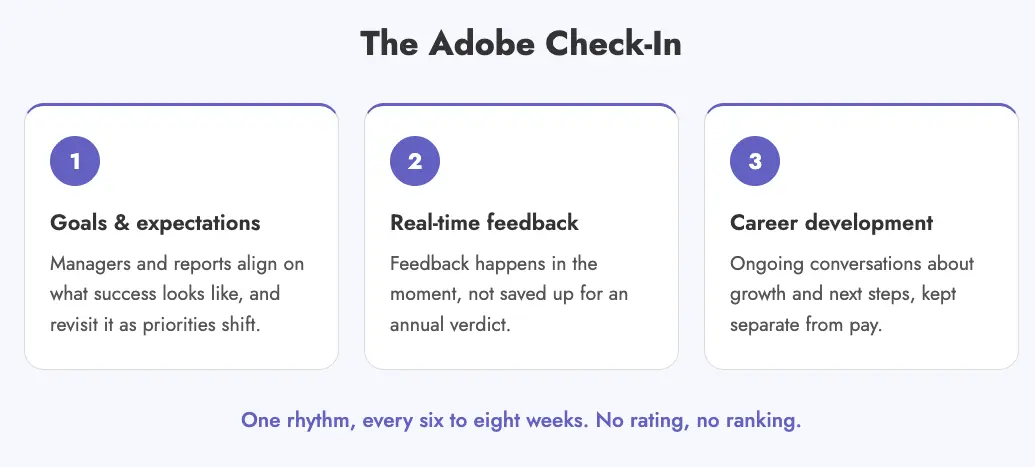
Adobe didn't tweak the annual review. It abolished it. In 2012 the company replaced the yearly evaluation with Check-in, a rhythm of ongoing conversations between managers and their reports, and nearly every system on this list owes something to that decision.
Check-in drops the numerical rating and the forced ranking entirely. Managers and employees meet regularly, at least every couple of months, around three areas: goals and expectations, feedback in the moment, and career development. Compensation decisions still happen, but they move to a separate annual Rewards Check-in, so the growth conversation never competes with the salary conversation.
The results held up. Since Adobe introduced Check-in in 2012, it has reported a roughly 30% drop in voluntary turnover and recovered the 80,000 manager hours the old cycle consumed each year. The attrition that used to spike every February, when employees read a disappointing rating and started updating their resumes, largely went away.
What you can borrow:
"We plan to abolish the annual performance review format."
- Donna Morris, then SVP of Global People Resources at Adobe, 2012
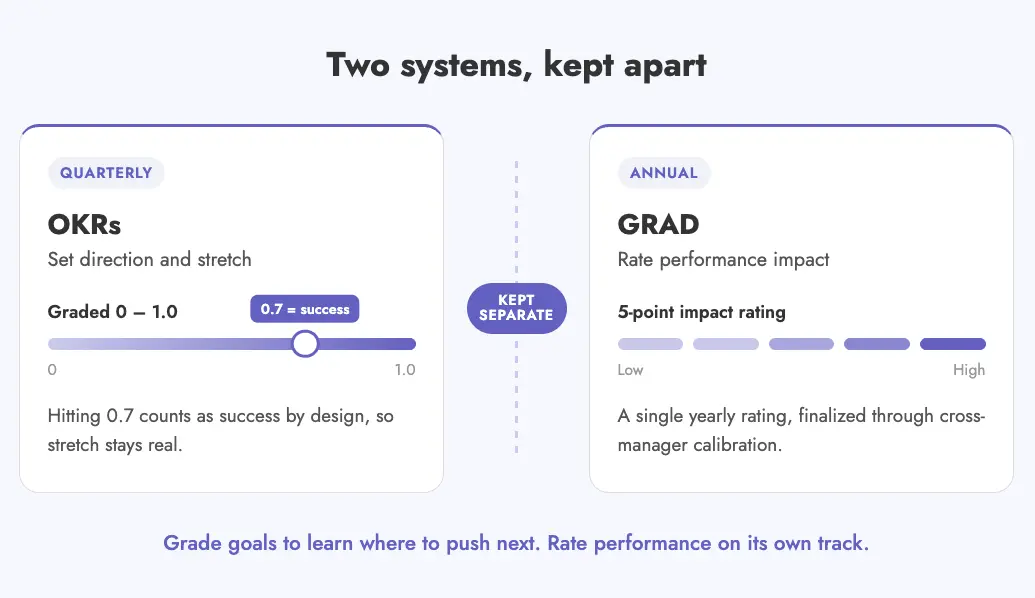
Google runs two systems that most companies mistakenly fuse into one. Quarterly OKRs set direction and stretch, graded on a 0 to 1.0 scale where hitting 0.7 counts as success by design. A separate cycle called GRAD, introduced in 2022, produces a single annual impact rating on a five-point scale, finalized through calibration. Keeping the two apart is the whole point.
That separation is what makes the stretch real. When an ambitious goal that lands at 0.6 doesn't dent your rating or your bonus, you set the target higher next time. Calibration then pulls several managers into the same room to agree on ratings, which blunts the bias of any single manager scoring their own team.
What you can borrow:
"OKRs are not synonymous with performance evaluation."
- Google's re:Work OKR guide
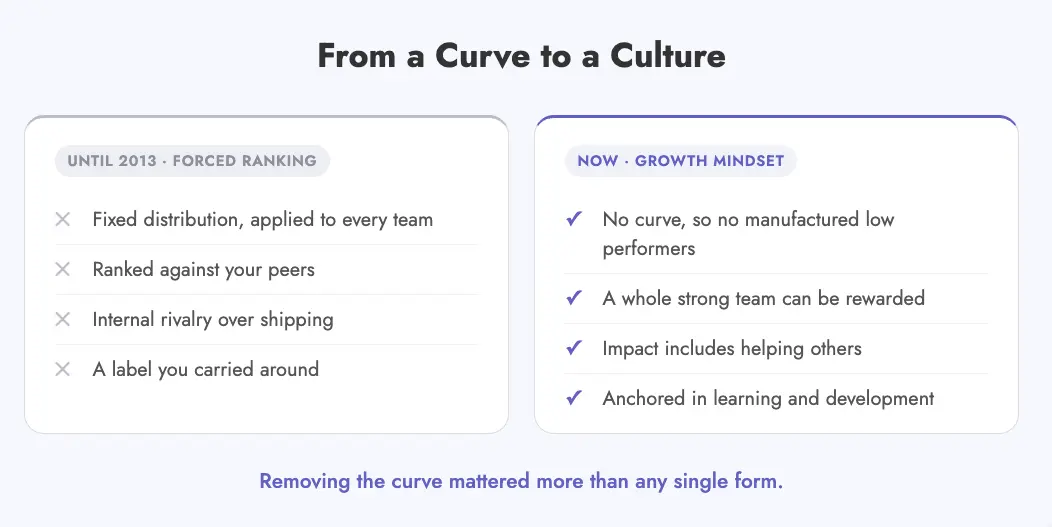
Microsoft ranked employees on a forced curve for years, a system critics blamed for the internal rivalry of its so-called lost decade, and scrapped it in 2013. What replaced it, refined under Satya Nadella, ties performance to a growth-mindset culture rather than a distribution chart. Employees prepare for periodic Connects, forward-looking conversations built around the impact they had, what they learned, and what they plan next, with impact read broadly to include how they helped others and built on the work around them.
Removing the curve mattered more than any single form. A fixed distribution had manufactured low performers even inside strong teams and pushed people to compete internally instead of shipping. Dropping it freed managers to reward a whole high-performing team, and the collaboration that followed tracked with Microsoft's broader turnaround.
What you can borrow:
"The learn-it-all does better than the know-it-all."
-Satya Nadella, CEO, Microsoft
The FAANG playbook can look out of reach for a company without a Silicon Valley budget. Securitas Europe shows it isn't. The global security firm runs continuous performance management for roughly 120,000 employees across 20 countries and 16 languages, all inside Microsoft Teams with Teamflect. Employees set specific, measurable goals at the start of each year and are reviewed against them, supported by systematic reviews, regular check-ins, and development programs in the same place they already work.
What makes it stick is where it lives. The process is accessible on mobile for a largely deskless, frontline workforce, and adoption stayed high across that scale, the practical test most marquee case studies never face. "Empowering people" is a core leadership behavior that managers themselves are assessed on, so development reads as part of the job rather than a favor. Digitalizing the process didn't cost Securitas its human-centered approach; it reinforced it.
What you can borrow:
"Teamflect is more than a tool. It is an enabler."
- Loredana Albenzio, Head of Talent and Learning, Securitas Europe
Netflix dropped the annual review as well, but its answer leaned on candor and a high talent bar rather than a gentler form. Feedback runs continuously and directly, through 360 input that employees signed rather than submitted anonymously, so people hear where they stand all year instead of waiting for a verdict. The Keeper Test sits alongside it: managers ask which of their people they would fight hard to keep, and those they wouldn't are offered a generous severance. Pay sits at the top of the market, and the bar to stay is high.
The payoff is clarity. When feedback is frequent, specific, and two-way, nobody is surprised at review time, because there is no single review time. The trade-off is real, and worth naming: this model assumes top-of-market pay and high-judgment roles, so the surface practices travel better than the whole system does.
What you can borrow:
"Trust people, not policies. Reward candor."
-Patty McCord, "How Netflix Reinvented HR," Harvard Business Review, 2014
Deloitte didn't just drop the annual review; it rebuilt the data underneath it. After tallying that the old process consumed close to 2 million hours a year, and finding that 58% of executives said it wasn't an effective use of time, the firm designed something faster and pointed forward. The 2015 redesign, documented in Harvard Business Review by Marcus Buckingham and Ashley Goodall, threw out the machinery most companies still run.
In its place came weekly check-ins between leader and team member, plus a short performance snapshot at the end of each project or quarter. Rather than scoring someone on abstract traits, the leader answers a few forward-looking questions about what they would actually do, such as whether they'd want this person on their team again and whether the person is ready for promotion. Aggregated over time, those answers give cleaner signal than a yearly rating, because they sidestep the well-documented tendency of ratings to reveal more about the rater than the person being rated.
What you can borrow:
Not every admired system is development-first. Meta and Amazon anchor the other end of the spectrum, where explicit expectations, calibrated ratings, and real consequences carry the load. Meta runs a Performance Summary Cycle on a seven-point scale; Amazon pairs its Forte feedback with a calibration stage called the Organizational Leadership Review and, since 2025, formally weighs its 16 Leadership Principles in evaluations.
Both lean hard on calibration to align ratings across managers, and both, inside larger orgs, carry an expected distribution that behaves like a softer form of stack ranking. The upside is real: clear standards and outsized rewards for top performers. So is the cost. Reporting on both companies describes genuine pressure and attrition, along with the risk any forced curve carries, labeling capable people as low performers because a quota needs filling. It rewards clarity and punishes ambiguity, and it isn't for every culture.
What you can borrow:
By 2026, AI has moved into the review cycle itself, and the companies getting it right treat it as a co-pilot, not an autopilot. It drafts and spots patterns. People still make the calls.
Employees are open to that split. Betterworks' own 2026 report found 89% satisfaction where the performance process uses AI, against 40% without, though it's worth reading as a vendor's own survey.
Three examples show the range:
The practical question is what you let AI touch:
If you're weighing an AI-enabled system, the fundamentals of what to look for in performance review software still apply: it should make good managers faster, not replace them.
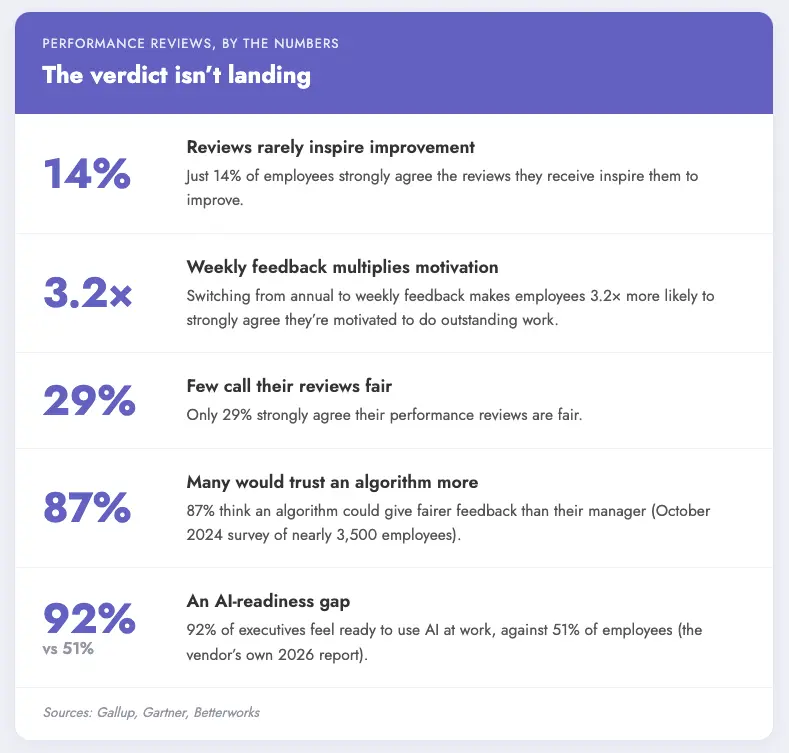
Strip away the company names and the case for change sits in the data. Five numbers worth keeping:
Sources: Gallup, Gartner, Betterworks
The through-line across every company here is copyable, even without their budgets. Here is how each principle translates to a team of any size.
None of this requires a dedicated people-science team. It requires picking a cadence and holding to it.
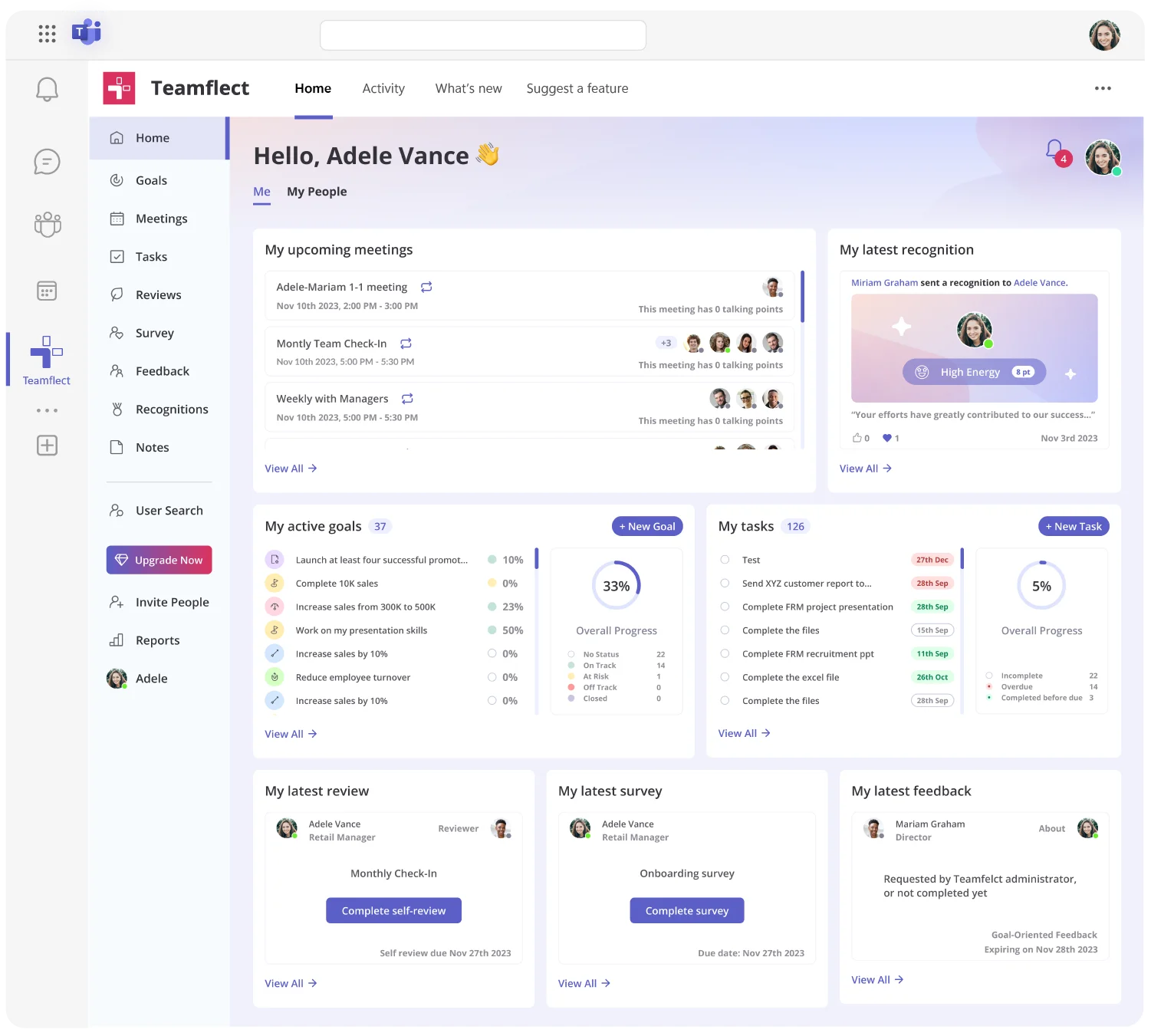
The habits that separate these companies are portable: a steady feedback cadence, goals people can see, development kept separate from the score, and AI used to assist rather than decide. The harder part is running them consistently without adding another tool your team has to be talked into opening.
If your company runs on Microsoft 365, Teamflect puts continuous reviews, goals, feedback, and AI-assisted summaries directly inside Teams, where the work already happens. It's free for up to 10 users, and you can book a demo to see it on your own setup.
There is no single best system, only the best fit for a company's goals and culture. Adobe is usually credited with starting the modern shift when it replaced annual reviews with continuous Check-ins in 2012, and development-first cultures often model themselves on Adobe, Microsoft, or Google. Companies that prize accountability lean closer to Meta or Amazon. The better question is which trade-offs you want, not which logo to copy.
The principles transfer even when the scale and budget do not. A 30-person company can run the same core moves the big names use: continuous check-ins, visible goals, a light calibration step, and development kept separate from pay. What changes is the tooling. Instead of a custom-built platform, smaller teams get there by running the process inside software they already use. The habit matters more than the headcount.
Apple does not publicly disclose the details of its performance process, which fits how secretive the company is in general. Employee accounts describe continuous feedback and evaluation across a few dimensions such as teamwork, innovation, and results, though Apple does not confirm specifics. That secrecy is the reason the transparent examples in this article, from Adobe to Deloitte, make more useful models than Apple does.
.avif)
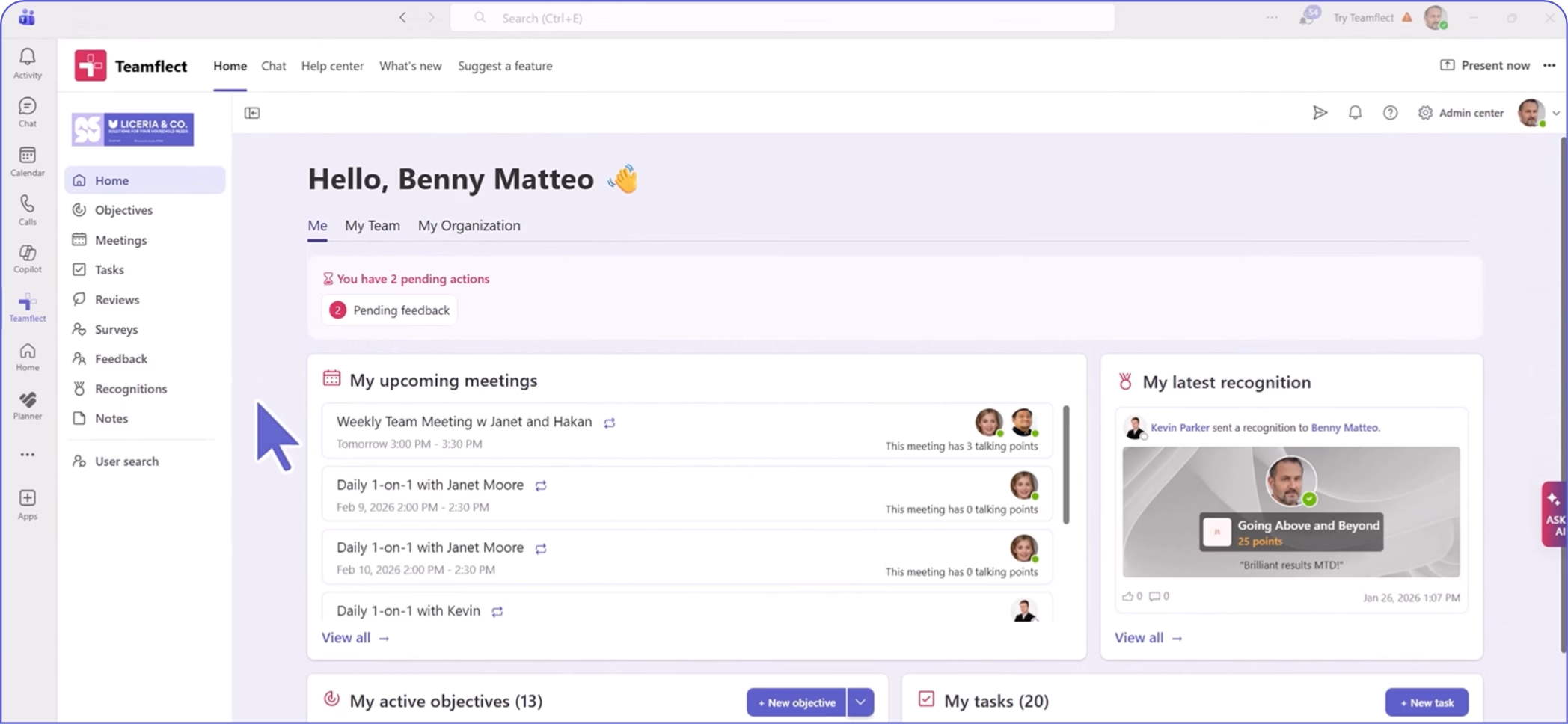
Create high-performing and engaged teams - even when people are remote - with our easy-to-use toolkit built for Microsoft Teams
.svg)

.webp)