.svg)
.svg)
Performance Review Statistics: 5 Patterns in 11,000 Reviews

Updated on:
June 23, 2026

Prefer Teamflect as your HR source on Google
.svg)

According to a study of Glassdoor Reviews, 88% of performance review mentions on Glassdoor are negative in 2026, up from 83% in 2021, with complaints centered on unfair processes, unclear criteria, and pay disconnected from review outcomes.
While there are plenty of studies pointing out to unhappiness surrounding the efficacy of performance reviews, there aren’t many data-based articles on what exactly is broken around performance reviews.
That is why we decided to conduct a research of our own. This research doesn’t just rely on survey results and opinions but actually analyzes the performance reviews themselves to identify patterns, trends, and tendencies across different organizations and industries.
Organizations volunteered to take part in an anonymized study of their completed review cycles, and we examined the patterns across the whole set: about 11,000 reviews, with close to 98,000 written comments and roughly 63,000 scores between them. None of the figures below describes any single company. They describe what kept repeating once you read at that scale.
While there are plenty of positives to be said, we noticed five trends and patterns that surfaced again and again across the reviews.
Below are those five, in order. For each one, we will lay out what it is costing companies and what recommend you do about it before the next cycle closes.
📚 Recommended Reading: We have also done extensive research and testing on performance review software.
A quick word on method, because it shapes how much weight these numbers carry.
The data came from organizations that volunteered to share completed review cycles for an anonymized study. We removed identifying details and stripped out duplicate records before any analysis, which left a clean set of about 11,000 reviews carrying close to 98,000 written comments and roughly 63,000 scores. No single person or company can be traced through it.
We studied the full set using a single, consistent analysis, rather than reading cycles one at a time.
The data was evaluated by our internal team of HR experts and practitioners, who have all previously worked on other data-based studies in our industry, such as our previous State of HR and Remote Work Report.
It sorted what surfaced into four lenses: where work was breaking down, how teams were feeling, what the data said about talent, and the quality of the written feedback.
Within each lens, we counted how often a signal appeared and focused on the themes that recurred from cycle to cycle. We reviewed those patterns internally before drawing any conclusions, so nothing here rests on a single striking comment.
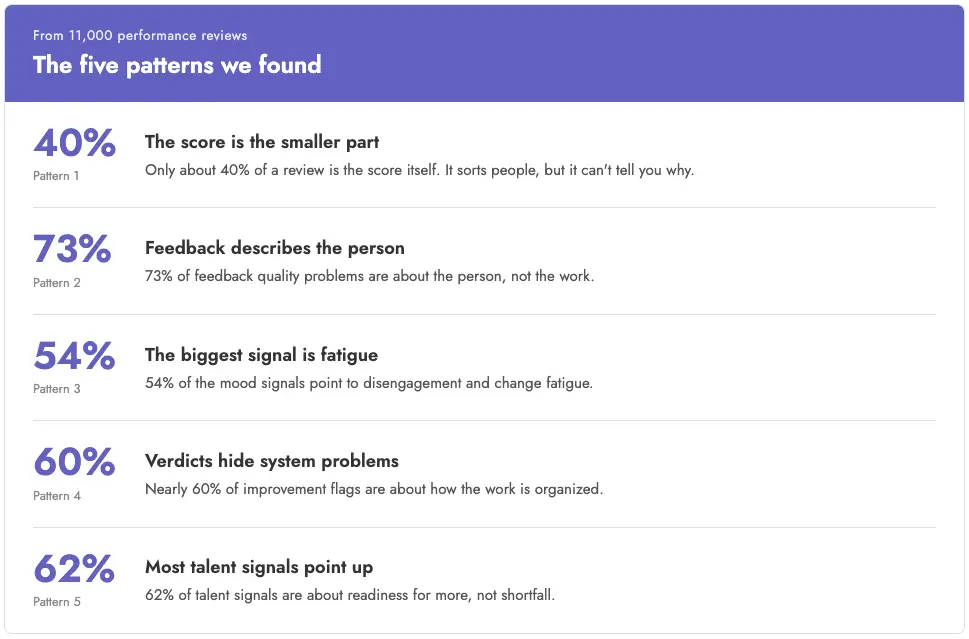
After studying all reviews, we found that: 61% of a performance review's content that actually influence growth and change is written comments, not numerical scores.
The cycles that gathered scores but no comments came back the thinnest of all, with the least to say about how teams were doing or what needed to change. The score is the smaller part of a review. It sorts people. It does not tell you why. The troubling trend here was that 39 percent of performance reviews rely on scores rather than written comments.
The written context is where the real information sits, and the research has said so for years. In a study published in the Journal of Applied Psychology, Scullen, Mount, and Goff found that 62% of the variance in performance ratings traced back to the rater rather than the person being rated, while actual performance explained only about 21%. A score on its own tells you almost as much about who did the rating as about who was rated.
Here is what we recommend after running the results with our HR team: ask for enough written detail to explain the score, and resist adding more boxes than a manager can fill well.
In the reviews we studied, 73% of feedback quality problems came down to feedback being about the employee rather than the work itself.
The single most common kind, more than a third, 36% of all the feedback quality problems, was non-job-related personal detail: remarks that touch on age, health, family situation, or background rather than the work itself. Subjective labels and personality verdicts with no example behind them made up most of the rest. Most of it is not ill-intended. It is vague, and vague feedback gives no one anything to act on.
This is a quality problem before it is anything else, and quality gaps are rarely shared out evenly. Research by Harvard's Paola Cecchi-Dimeglio found that women are 1.4 times more likely to receive critical subjective feedback than men. A different analysis of about 23,000 reviews put a price on it, linking vague, low-quality feedback to roughly 10% of employee attrition. Feedback that names a trait instead of a behavior does not stay harmless. It costs people clarity, and it costs the company retention.
Before a cycle closes, we recommend that managers reread their comments and check that each one points to something the person did, not to who they are. If a line could be pasted into anyone's review, it is too vague to keep.
Our content team also published a detailed video on how you can use AI to analyze performance review comments for different types of biases and enhance them:
Most of what these reviews revealed about morale was not dissatisfaction with the job. 54% of performance review sentiment points to some form of disengagement risk and change fatigue.
Disengagement risk on its own was the single largest mood signal in the entire study, at 30%. People were not telling their managers the work was bad. They were telling them they were worn down by constant change and unsure where things were heading. That is an early warning, and it tends to surface in the comments long before it shows up in a resignation.
This is not unique to the teams we studied. In a 2024 Gartner survey, 73% of HR leaders reported that their employees were fatigued by constant change, and Gartner has found that change fatigue can cut a person's intent to stay by as much as 42%. The signal in your reviews and the signal in the research line up. Both point at people who are still delivering while quietly deciding whether to stay.
We strongly recommend running performance review cycles through extensive sentiment and mood analysis to identify trends. While this might initially feel like a job for employee engagement surveys, performance appraisals can provide a more raw, unpolished look into how your workforce is truly feeling.
The study found that nearly 6 in 10 of the problems flagged for improvement were about how work is organized, not the individual.
Process and execution was the single biggest category, with overload and cross-team friction close behind. When the same issue shows up across many reviews, it is usually telling you something about the system, not about the people inside it.
HR leaders sense this already. In a 2023 Gartner survey, only 29% said they were confident their current processes help people reach and sustain their best work. That is a quiet admission that the system, not the individual, is often where performance is won or lost. Reviews are one of the few places that system leaves a written trail.
Before recommending a single action to employees based on performance review results, we recommend that you decide one thing first: whether it is a person who needs support or a process that needs fixing. Treating a system problem as an individual one wastes a coaching conversation and leaves the real cause in place. Some of the most useful outcomes of a review cycle have nothing to do with people.
Across the talent signals, the picture was mostly upside. About 6 in 10 (62%) of them were about strength and readiness for more, not people falling short.
The two largest categories were high-impact and leadership work, at about 18% each, with signs of people ready for a bigger scope or a promotion close behind. Far more of the talent picture was potential than problems. The catch is that a readiness signal is worth nothing until someone acts on it, and most of these were sitting in a closed review form.
Employees can feel this gap themselves. A 2024 Gartner survey found that one in three employees believe they could have a bigger impact in a different role inside their own company, while fewer than one in five leaders said their organization can move talent effectively where it is needed. The readiness is visible and the path is blocked. People who know they are ready, and watch nothing happen, are the ones who start taking calls from recruiters.
When a review says someone is ready for more, you should have a “next step“ attached before the cycle closes: whether that is a a stretch assignment, or a frank conversation about what comes next.
Across all five patterns, the same lesson kept returning. A review is most valuable when you stop reading it as a verdict on a person and start reading it as a record of how the organization actually works.
The score tells you who. The comments tell you why a rating landed, where the work is breaking down, who is quietly worn down, and who is ready for more than their current role. None of that shows up if you close the form and move on.
So before your next cycle ends, we recommend you do one thing differently. Read last year's reviews together, as a set, and ask what they say about the company rather than the people in it. The patterns are already there, in the words your teams wrote. The only question is whether anyone reads them that way.

.svg)
.avif)
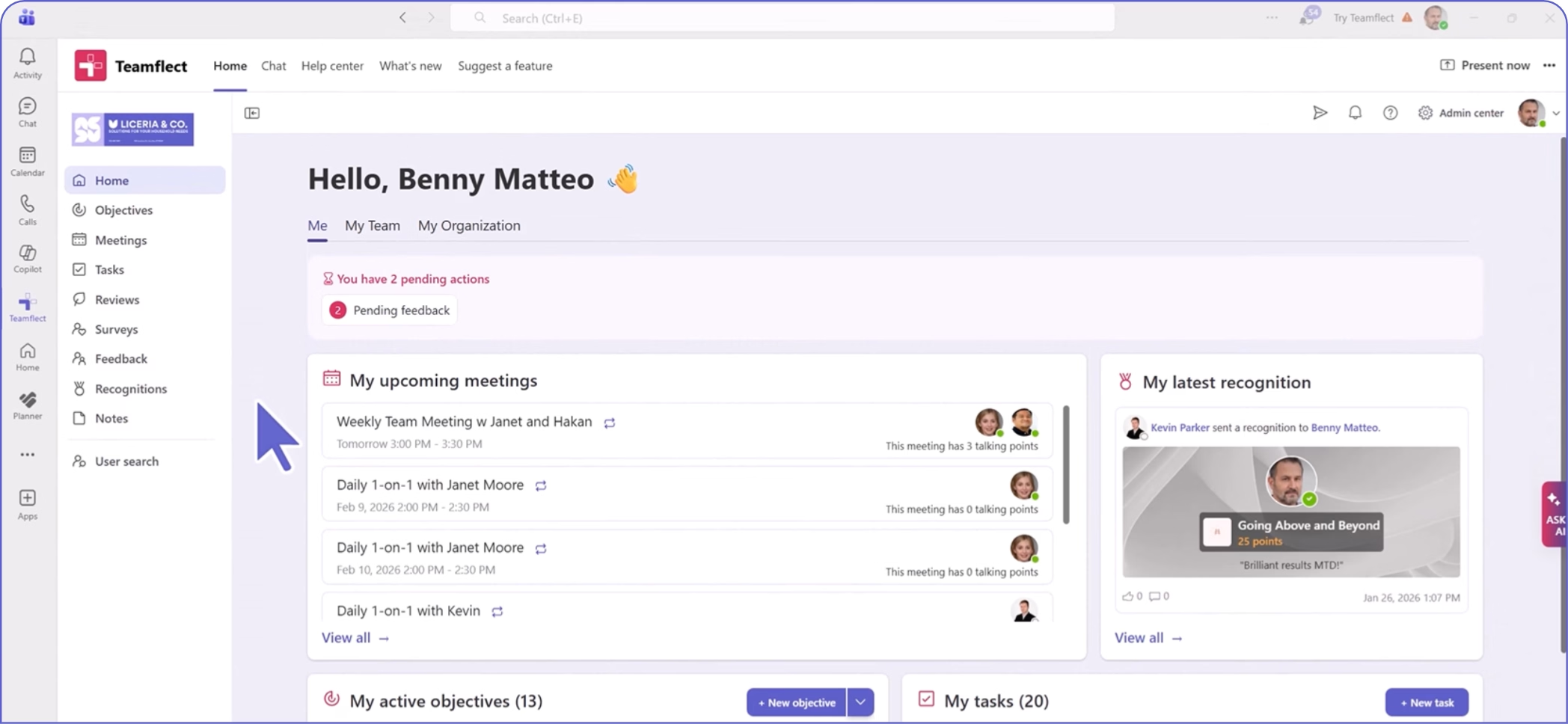
Create high-performing and engaged teams - even when people are remote - with our easy-to-use toolkit built for Microsoft Teams