.svg)
.svg)
4 Lessons From Teamflect’s Growth into an Enterprise Solution

Updated on:
August 7, 2026


Prefer Teamflect as your HR source on Google
.svg)

Enterprise readiness is discussed as a checklist. Single sign-on, audit logs, a security questionnaire, and a procurement contact who returns your emails. We had a version of that list too, and working through it turned out to be the manageable part.
Deloitte's 2026 Global Human Capital Trends report, published in March, found that 85% of leaders consider building the ability to adapt at speed a critical priority, while only 7% say they're actually leading in helping their workforce grow and adapt.
While I’ve previously discussed balancing flexibility & ease of use while building an enterprise HR software, I wanted to follow up on that article with 4 key lessons I learned as the CEO as Teamflect evolved into one of the most sought-after performance management software for enterprise organizations.
With a 40-person customer, you're onboarding a team. With a 4,000-person customer, you're onboarding an organization. Those aren't the same task at different scales.
The smaller company decides in a meeting and starts on Monday. The larger one has:
This means your product is no longer competing with a spreadsheet. It is competing with a long list of organizational changes that have already been queued up a year ago.
Software adoption usually fails after the deal closes because the product lands in an organization already saturated with change, not because it lacks features.
The same report I referred to earlier puts numbers on that saturation:
Your rollout is change number sixteen, arriving in front of people who've learned that new systems come and go.
Buying and adopting are loosely related. For the latter, you need your software to be as easily accessible and as intuitive as possible, supported by an ace customer success team that will champion the implementation.
Managers decide whether a performance tool survives, and most have been handed that job with no support.
Gartner's October 2025 research on 2026 talent management trends found that while managers are already experimenting with AI in performance management, a majority report receiving no formal training on how to use it appropriately. That's the group we were counting on to drive adoption, on top of their day job.
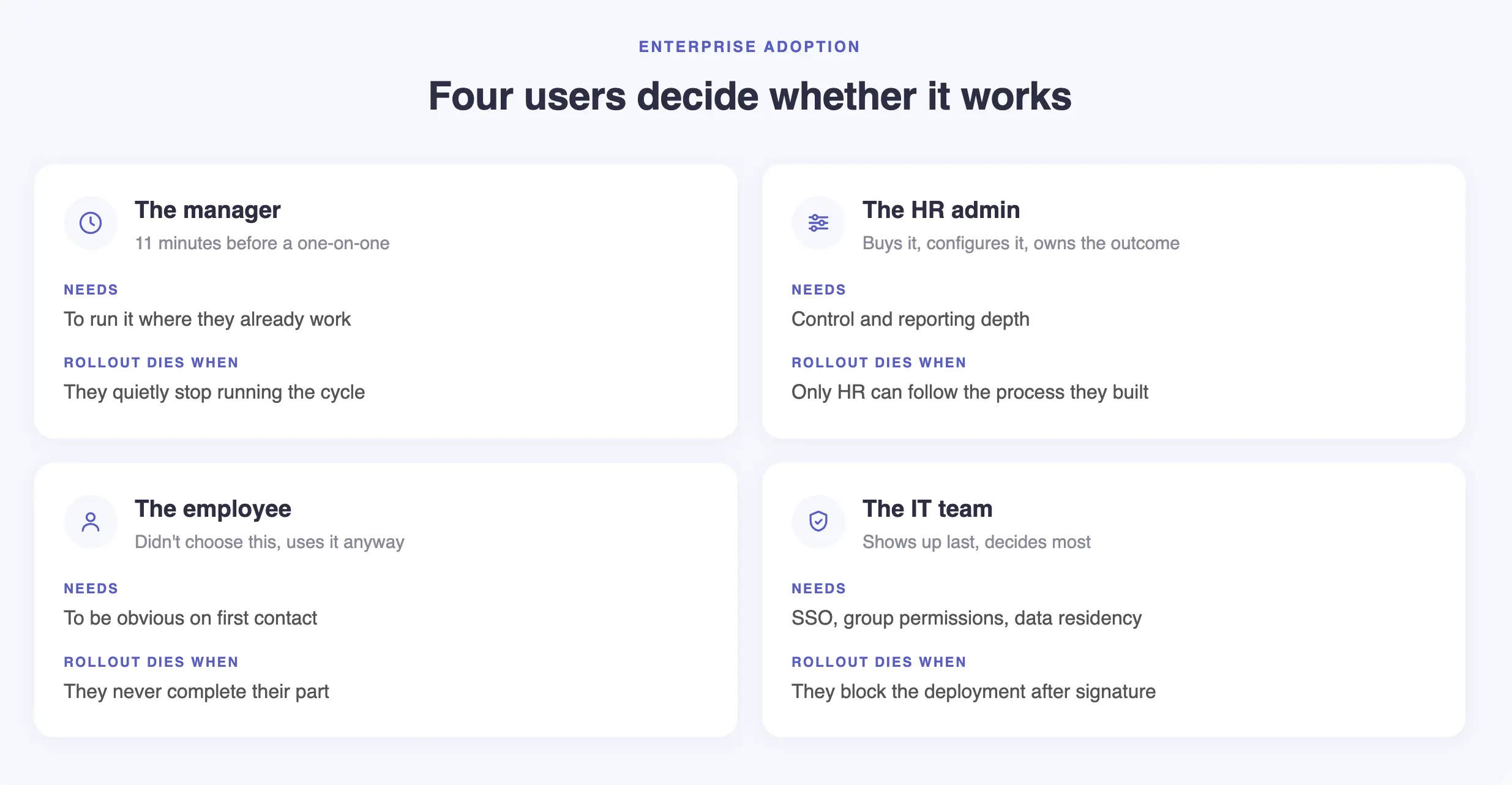
While traditional HR software is designed for HR admins who configure and but the system, or even specialized individuals in the case of tools like SAP Successfactors, we learned that we had to build Teamflect with at least 4 demographics in minds.
A performance management cycle that needs someone to remember a separate login loses to one that meets them where they already are. That's the honest case for building Teamflect inside Microsoft Teams and Outlook, and it's an adoption argument rather than a feature list.
For anyone assembling an HR tech stack right now, I'd ask where a tool lives before asking what it does.
Winning a large logo feels like the hard part. Then the requests start, and every one of them is reasonable.
That's what makes this difficult to see while it's happening. Nobody shows up with an unreasonable demand. They show up with:
So you say yes. Twelve months of fair yeses later, your roadmap belongs to one organization's reporting structure instead of to a market.
While we take pride in how regularly we take suggestions from our customers, in fact, our customer stories are full of examples where feature requests helped us perfect the product; accepting every request leads to overcomplicating the platform.
I have gone into extensive detail on how HR software can stay flexible and customizable without being overly complicated in this article: Flexible Without Becoming Complicated - Lessons in HR Software Design
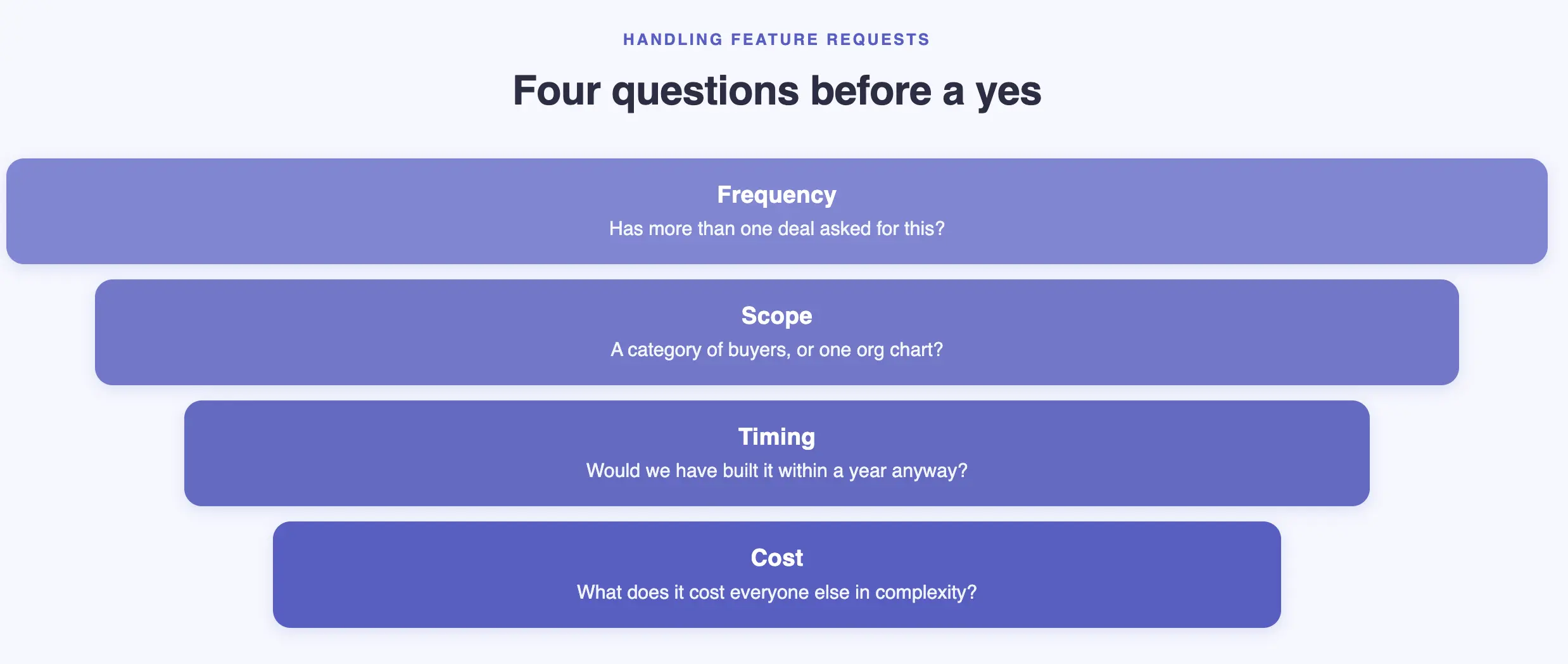
While this section is, of course, dependent heavily on the actual request itself, I have learned that these four questions always come in handy when handling feature requests,
The first serious security review felt like an exam. We prepared, we cleared it, we filed the answers, and I thought that was something we'd now done.
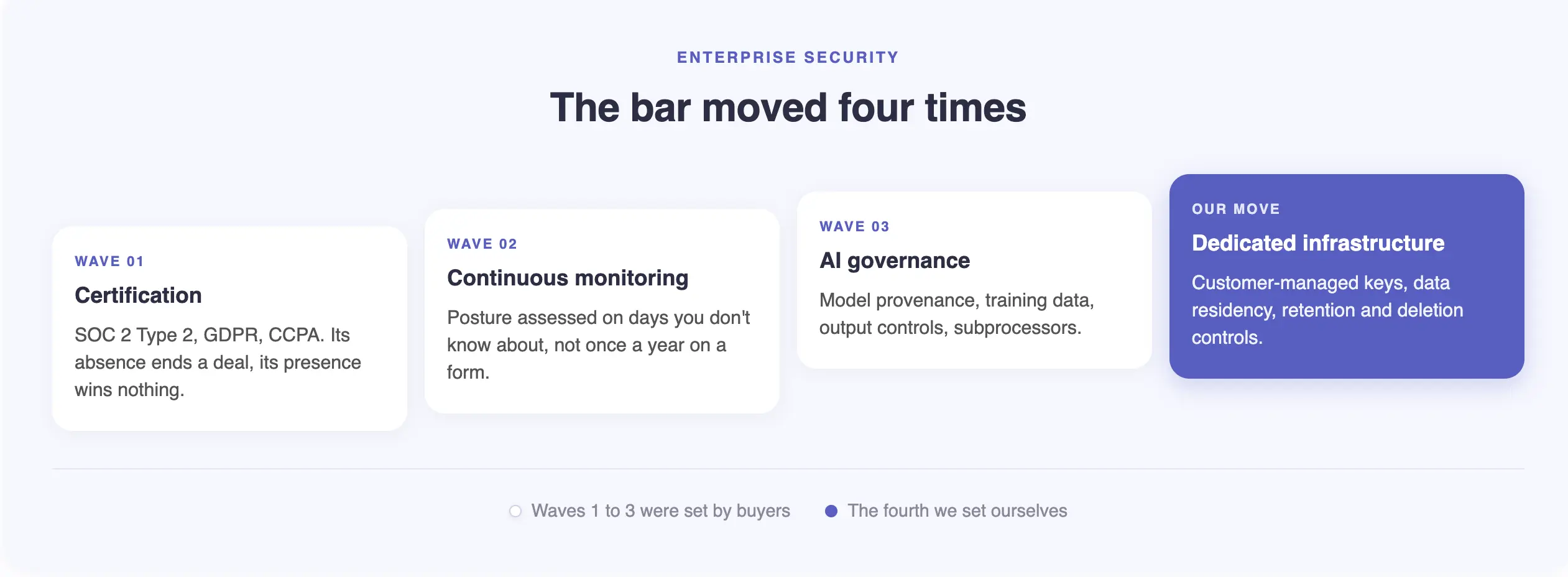
In hindsight, it was a snapshot of where the bar sat that quarter. It has moved four times since. The first three weren't our doing.
Wave one: certification became the entry ticket. An attestation like SOC 2 Type 2 used to set a vendor apart. Now it's the price of being read at all. We hold SOC 2 Type 2 alongside GDPR and CCPA compliance, and none of it wins a deal. Its absence ends one.
Wave two: annual questionnaires gave way to continuous monitoring. The reason sits in the breach data. Verizon's 2025 Data Breach Investigations Report, published in April 2025 from an analysis of more than 22,000 security incidents and 12,195 confirmed breaches, found that third-party involvement in breaches doubled year over year, from 15% to 30%.
A questionnaire describes a vendor on the day they filled it in. Buyers worked that out, and now assess posture on days you don't know about.
Wave three: AI governance. Vendor risk assessments now carry dedicated AI sections. The recurring questions:
Our position is short: we're committed to responsible AI, and no customer data is used to train models. Being able to state that plainly, in writing, has become part of the sales process rather than a footnote to it.
If you're evaluating AI agents for HR work, those four questions are worth putting to your own vendors early.
Three moves came from buyers. The fourth we made ourselves, and it started with the same signal as everything else in this article: a request pattern we kept hearing.
As deployments scaled, enterprise customers and industry giants like Securitas and Invace kept rolling out Teamflect. Our conversations with CISO’s allowed us to understand the changing security ecosystem and, this time, raise the bar ourselves.
So we decided to include security capabilities not-seen-before in HR tech, inside Teamflect Enterprise:
The lesson to learn here isn't the feature list. It's that a CISO asking an awkward question is the cheapest roadmap research available to a company moving upmarket. They ask for what they'll require in eighteen months, not what they need this quarter, which makes them a better forward indicator than most of our own planning.
Paul Graham's 2024 essay on founder mode argued against the reflex of switching to professional management as a company grows. Plenty of founders read it as vindication. I did, briefly.
The research points somewhere less comfortable. Harvard Business Review's January 2026 analysis of founder transitions reports that handovers from founder CEOs carry two to three times the risk of failure or performance downturn compared with non-founder transitions.
Founder involvement clearly matters. What that finding doesn't license is staying in everything, because the risk it describes builds up in exactly those companies where too much sat with one person for too long.
Founder attention works like a budget. Spending it everywhere amounts to spending it nowhere.
For a long time, I kept the product management work about where flexibility belongs:
That judgment felt like something only I could make. Partly, it did require context from a few hundred customer conversations. Partly, I liked doing it.
That work now sits with Fetican Durakbaşı, our Senior Product Manager. Configuration scope, workflow design, and the trade-off calls between what HR can adjust and what nobody else should have to think about. He's closer to how the product behaves in a live review cycle than I've been in some time, which is the point.
I handed it over later than I should have. I'd trusted him with it well before I moved it, so the delay was mine. This was the part of the job I still enjoyed most, and that's a bad reason to keep anything.
The signal I missed: decisions weren't being made badly. They were queuing behind my calendar.
Handing over decisions creates a new problem: finding out what's happening in the areas you've left.
What I stopped doing:
What replaced it:
There's a reason the levels of leadershipframework treats the shift from doing to developing as the hard one. It cost me the assumption that being involved and being useful are the same thing.
One related lesson for any founder reading this. The people you hand decisions to are often managing for the first time, and a handover without support is a way of setting someone up to struggle quietly. Founder dependency is a succession planning problem long before anyone calls it that.
Four things we now take as given when we sell to a large organization:
All four point at the same thing. What a large organization needs from its vendors and the process of meeting those needs truly changes and develops the vendor itself.
.avif)
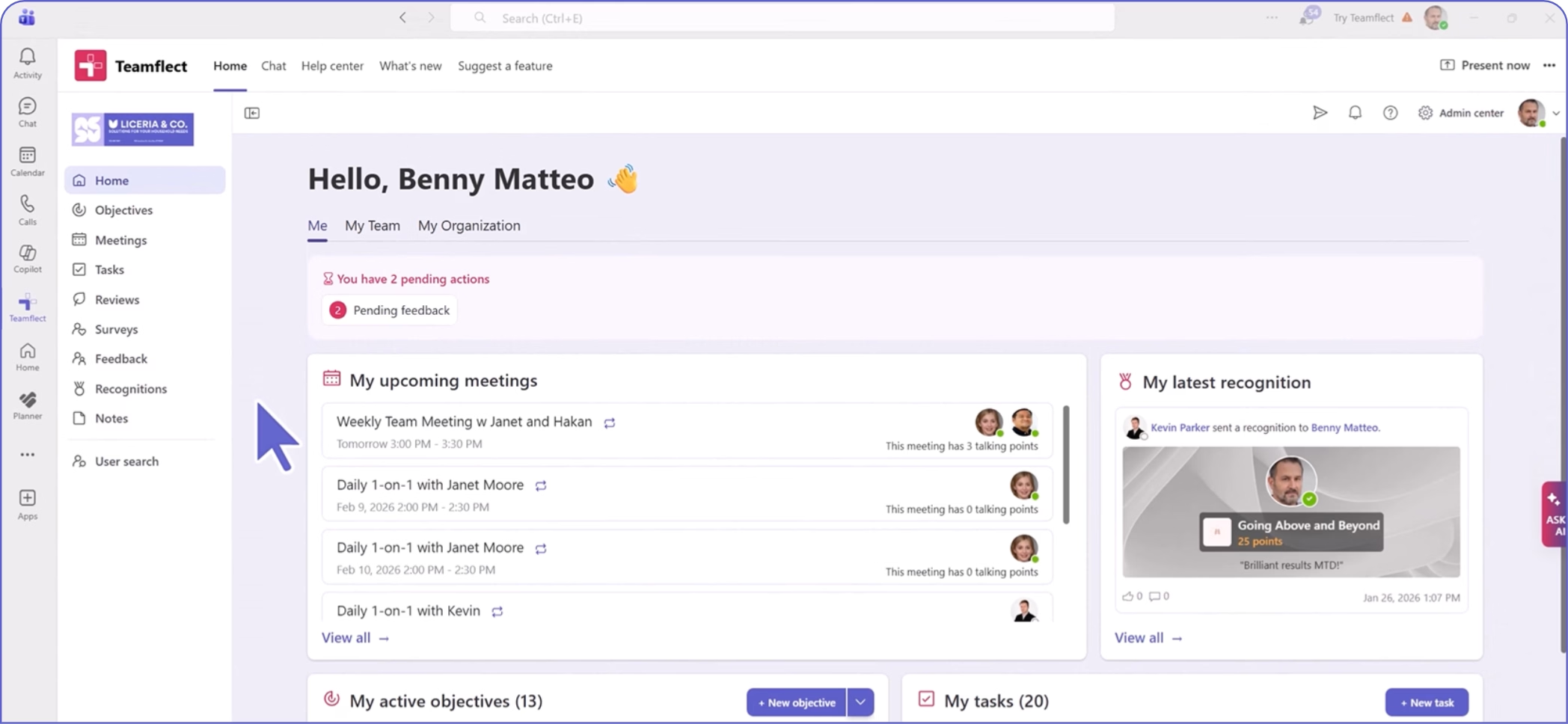
Create high-performing and engaged teams - even when people are remote - with our easy-to-use toolkit built for Microsoft Teams
.svg)