.svg)
.svg)
Flexible Without Becoming Complicated: What I Learned While Building Teamflect

Updated on:
June 18, 2026


Prefer Teamflect as your HR source on Google
.svg)

One thing we learned early while building Teamflect is that almost every company says "performance management," but they do not always mean the same thing. For one it means annual reviews, calibration, and formal scoring. For another, OKRs and weekly progress conversations.
Another cares most about competencies, development plans, recognition, or manager 1-on-1s. We expected variation, but not this much: even similar-looking companies, from the same region and with almost the same number of employees, wanted completely different things from reviews, goals, feedback, and manager ownership.
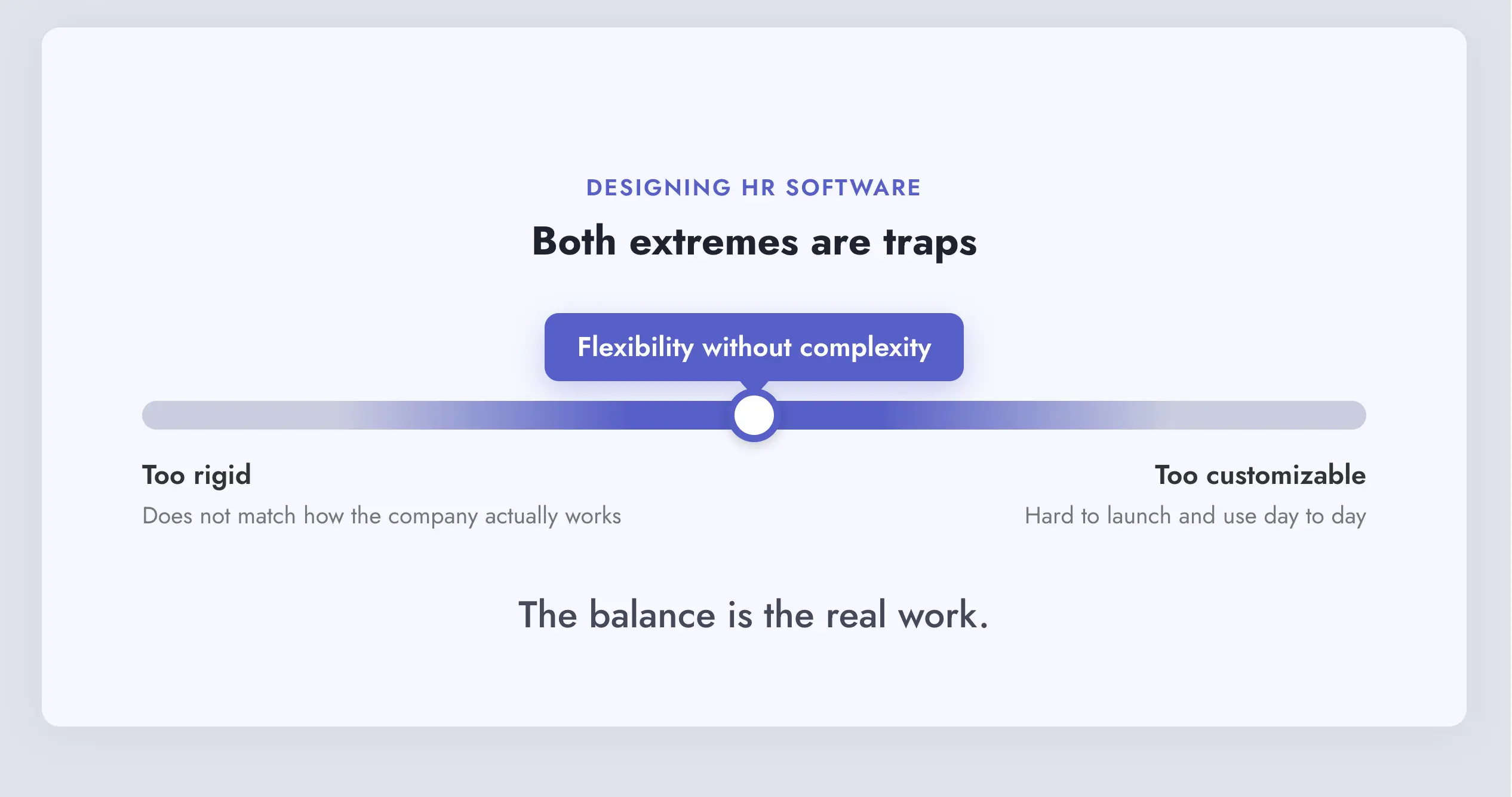
At first, this sounds like a product scope problem: keep adding settings, templates, and permissions until every customer can make the product fit. But if HR software is too rigid, it does not match how the company actually works, and if it is too customizable, it becomes hard to launch, hard to explain, and hard for employees and managers to use.
The goal is not customization for its own sake. The goal is flexibility without complexity. What follows are the lessons building Teamflect taught us about getting there.
Performance management is not a neutral administrative process. It reflects how a company thinks about goals, feedback, accountability, development, recognition, fairness, and leadership. That's why two companies can buy the same platform and need very different things from it.
What they want from it varies widely:
None of these is automatically right or wrong. They come from a company's size, culture, maturity, industry, leadership style, and past experience with HR systems. So building HR software is different from building a task management tool. The workflow is not just a workflow. It carries the company's management philosophy.
Performance review flows are a good example. Companies split on questions like:
On the surface these look like small workflow differences. In reality they reflect deeper decisions: fairness, trust, manager autonomy, HR control, legal sensitivity, and how performance decisions get made.
That's why flexibility matters. A product that supports only one review model feels wrong for many companies. A product that turns every variation into a visible setting becomes too complicated to use.
When customers ask for flexibility, the easy answer is to add another option: another setting, another field, another permission, another template, another workflow variation.
Sometimes that's the right call. But when every request becomes its own configuration, the product slowly gets harder for everyone:
We could expose every review-flow option directly: calibration rules, approval chains, anonymity settings, manager and HR initiation, visibility rules, reminders, and exceptions. But then launching a review cycle would feel like configuring an ERP module. The flexibility would be there, the confidence to use it would be gone.
HR teams may learn a complex system if it gives them control. Managers and employees usually will not. They want to give feedback, prepare for a review, update a goal, join a 1-on-1, or recognize a teammate without thinking about the software.
So the question is not whether something can be made configurable. The better one is: what should be configurable, and what should stay simple? That question has shaped a lot of our product decisions.
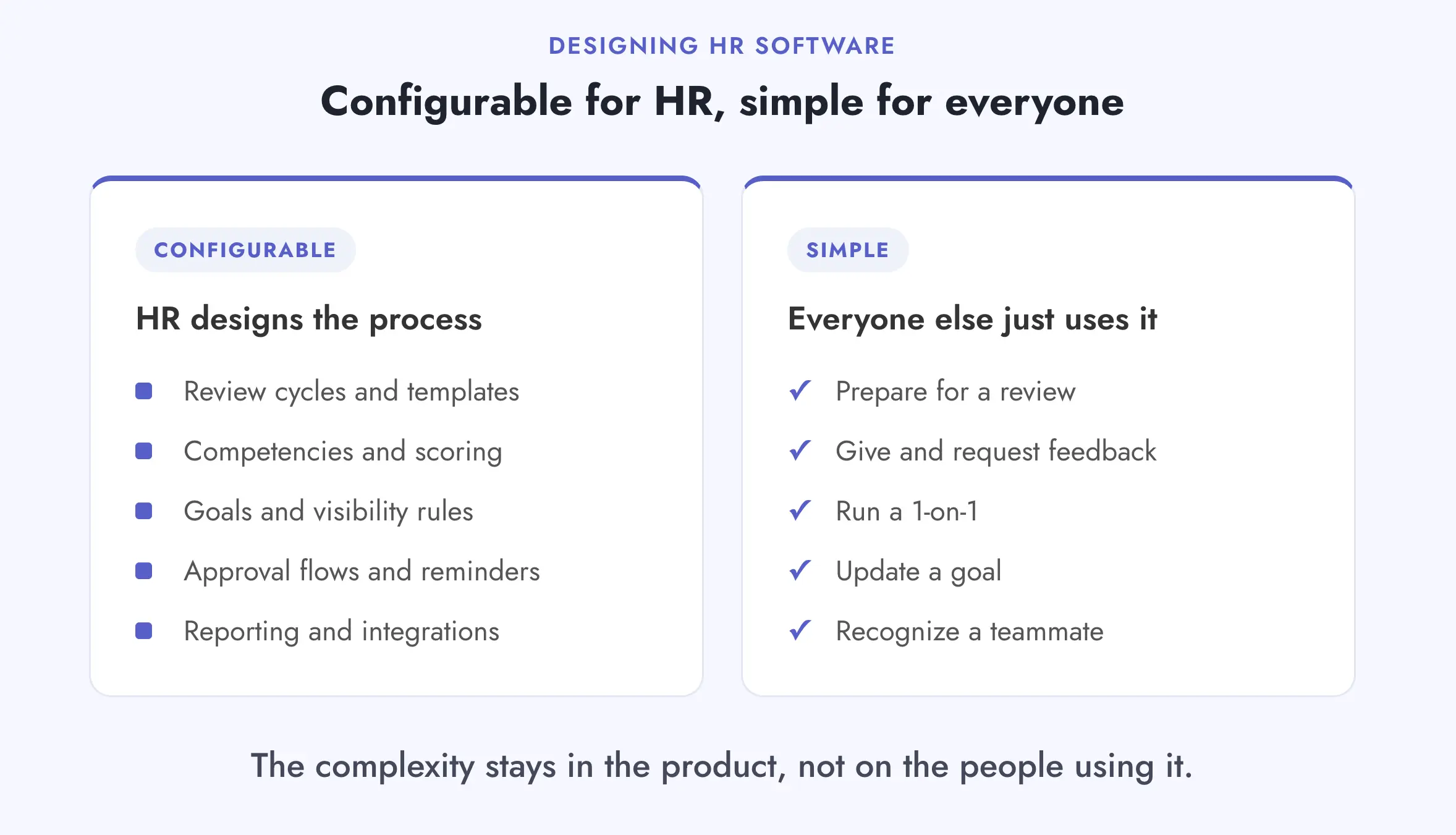
Over time, we've learned the answer isn't unlimited customization. It's to separate process design from everyday execution. HR designs the process. Managers and employees just live inside it.
HR needs room to configure:
These are real process differences. If the product can't adapt to them, it forces the customer into a way of working that doesn't fit.
The everyday experience needs the opposite:
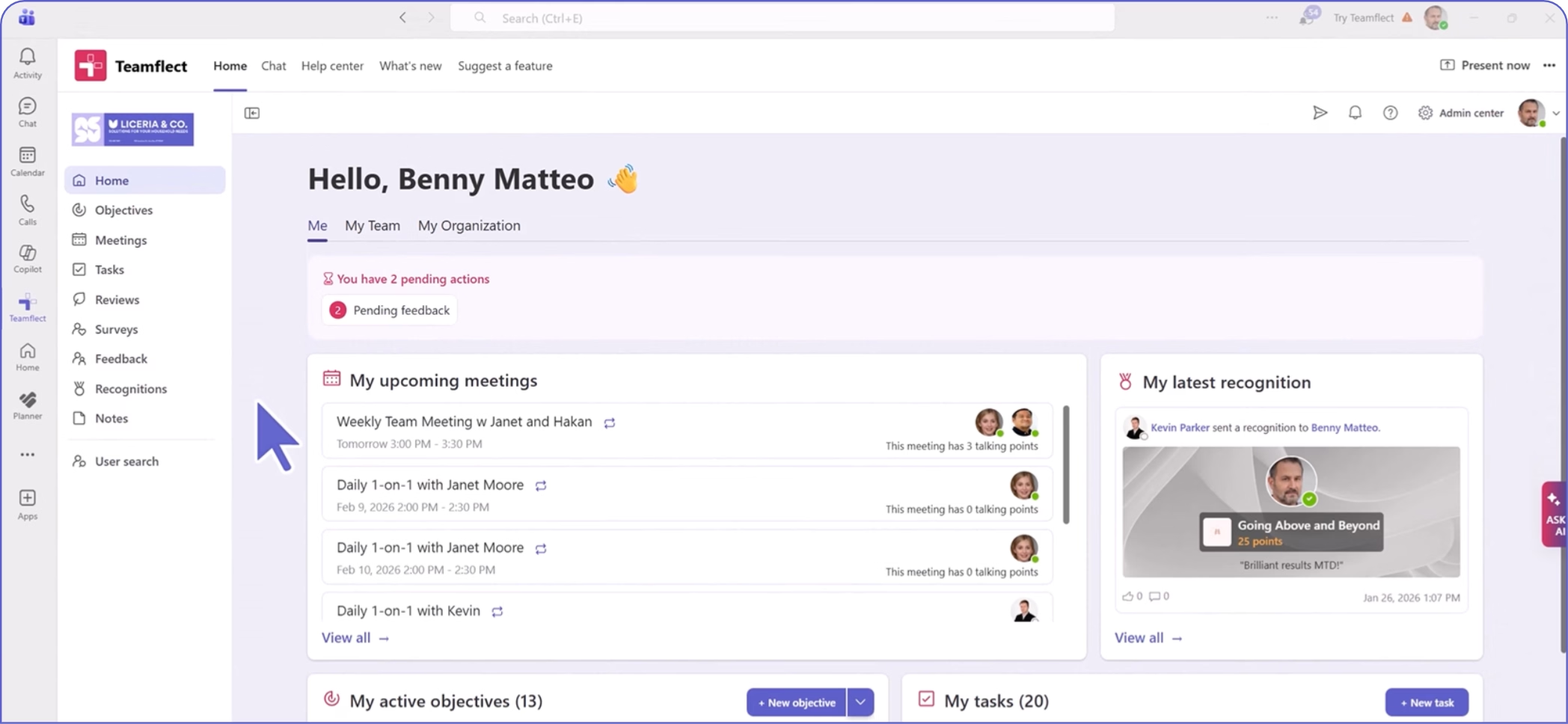
This is why our performance management tool, Teamflect is built so deeply around Microsoft Teams and Microsoft 365. A lot of performance workflows fail because they live outside the flow of work, so people forget to update goals, miss review tasks, or delay feedback. Bringing reviews, goals, feedback, recognition, surveys, and 1-on-1s to where people already work lets us support flexible HR processes without asking everyone to adopt a separate work habit.
That's the balance Teamflect is built for: a configurable platform for HR, delivered as clear, in-the-flow workflows for managers and employees. The complexity stays in the product, not on the people using it.
In HR technology, a feature does not matter very much if people do not use it.
A company can design the perfect performance review process on paper. It can have the right competencies, the right rating scale, the right templates, and the right reminders.
But if managers do not prepare well, if employees do not give honest input, or if feedback is disconnected from actual work, the process will not create much value.
That is why I think about adoption as a product requirement, not just a customer success metric.
This is also where configurability can become dangerous.
A simple example is goal updates.
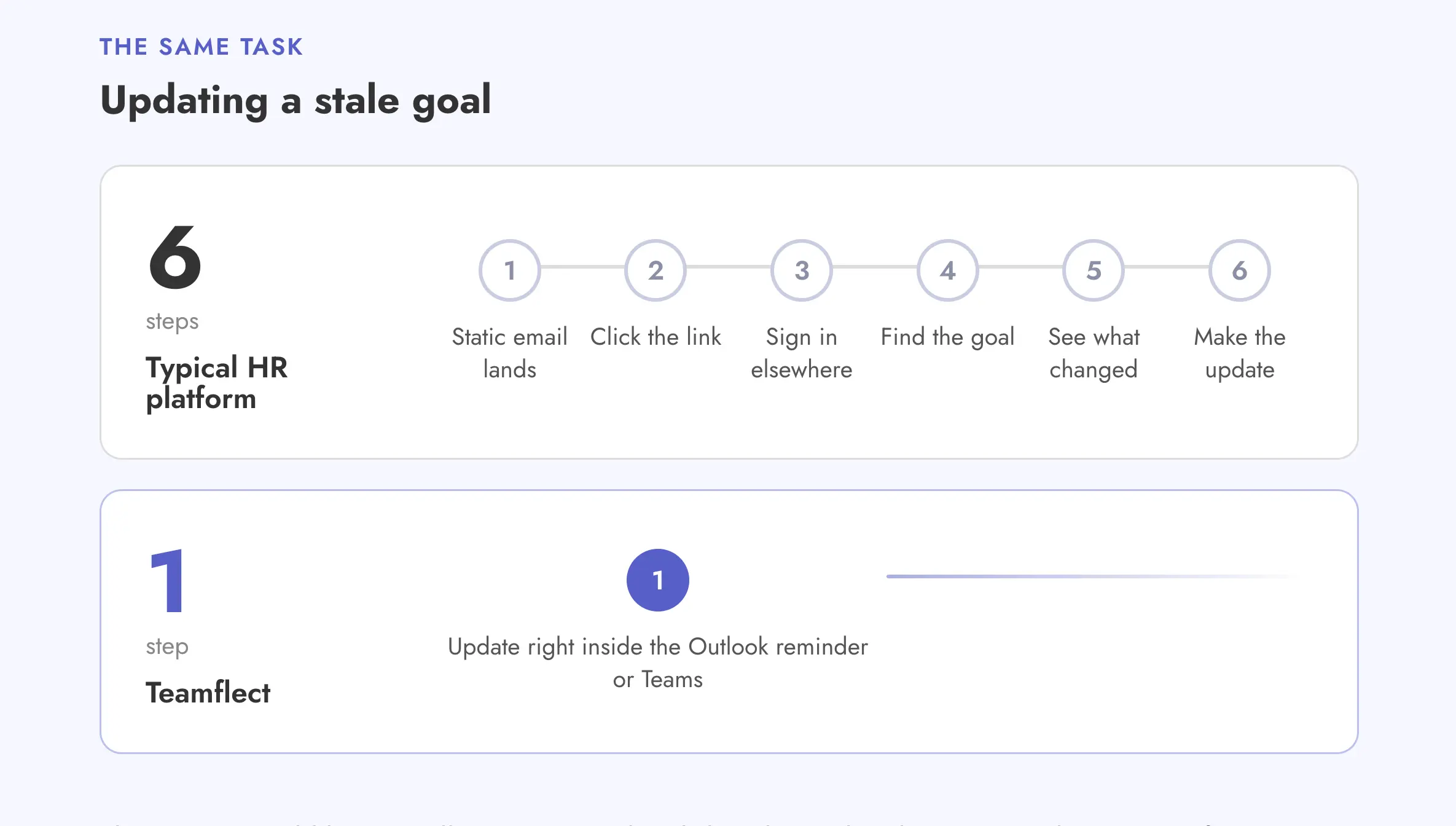
In many OKR software, an employee receives a static email saying their goals are stale and need to be updated. They click the link, sign in to another system, find the right goal, understand what changed, and then make the update.
Every extra step creates friction. If they are busy, or if they do not remember the password, or if the process feels disconnected from the rest of their work, the update is easy to postpone.
Adoption is often won or lost in the moments where a user decides whether to complete the task now or leave it for later.
As Teamflect has grown, we have also learned that enterprise readiness is not one big feature. It is many small, serious details handled consistently.
Larger organizations care about permissions, identity, security, data access, integrations, auditability, reporting, implementation support, and how the product fits with their existing systems of record. They also need confidence that the platform can support different teams, countries, departments, and workflows without becoming a custom services project.
This is where flexibility and enterprise readiness come together.
The product needs to adapt to different company structures and HR processes. But it also needs to stay maintainable, secure, understandable, and scalable. A platform that becomes different for every customer is not really a platform anymore. A platform that refuses to adapt will not survive real enterprise use.
Our goal has been to build Teamflect as a shared product that can support many different performance cultures while keeping the core experience coherent.
If I were to summarize the lesson, it would be this:
Do not confuse flexibility with a longer feature list.
Real flexibility is not about saying yes to every possible variation. It is about understanding where customers are genuinely different, then designing the product, so those differences can be supported without making the whole system harder to use.
For HR software, that means two things at once:
The best HR products:
That is the balance I am still working on every day at Teamflect. I am not trying to build a product that tells every company how performance management should work. I am trying to build a product that helps each company run performance management better, while keeping the experience simple enough that people actually use it.
That is a harder product problem than it may look from the outside. But it is also what makes the work interesting.
We still have to make these decisions carefully. Every new configuration option has a cost. Sometimes the cost is technical complexity. Sometimes it is an onboarding effort. Sometimes it is simply one more decision an HR admin has to make before launching a process. The work is to keep adding flexibility where it truly helps, while protecting the simplicity that makes adoption possible.
.avif)
Create high-performing and engaged teams - even when people are remote - with our easy-to-use toolkit built for Microsoft Teams
.svg)