.svg)
.svg)
How to Handle Employee Performance Issues: An HR Guide

Updated on:
October 9, 2026


Prefer Teamflect as your HR source on Google
.svg)

An employee performance issue is a persistent gap between actual work and documented standards, objectives, or quality requirements. HR should first be sure about the expectations, tools, authority and scope of role before treating it as an individual problem. HR owns process design, documentation standards, review cadence, escalation paths, and consistency across managers.
A performance issue is a continuing gap between an employee's actual performance and the documented expectations. Examples include missing deadlines, repeating mistakes, poor quality work, or failing to complete important tasks to the standard needed. It is not about whether the manager likes the way the employee works. The important question is whether the employee is failing to meet a reasonable, established standard.
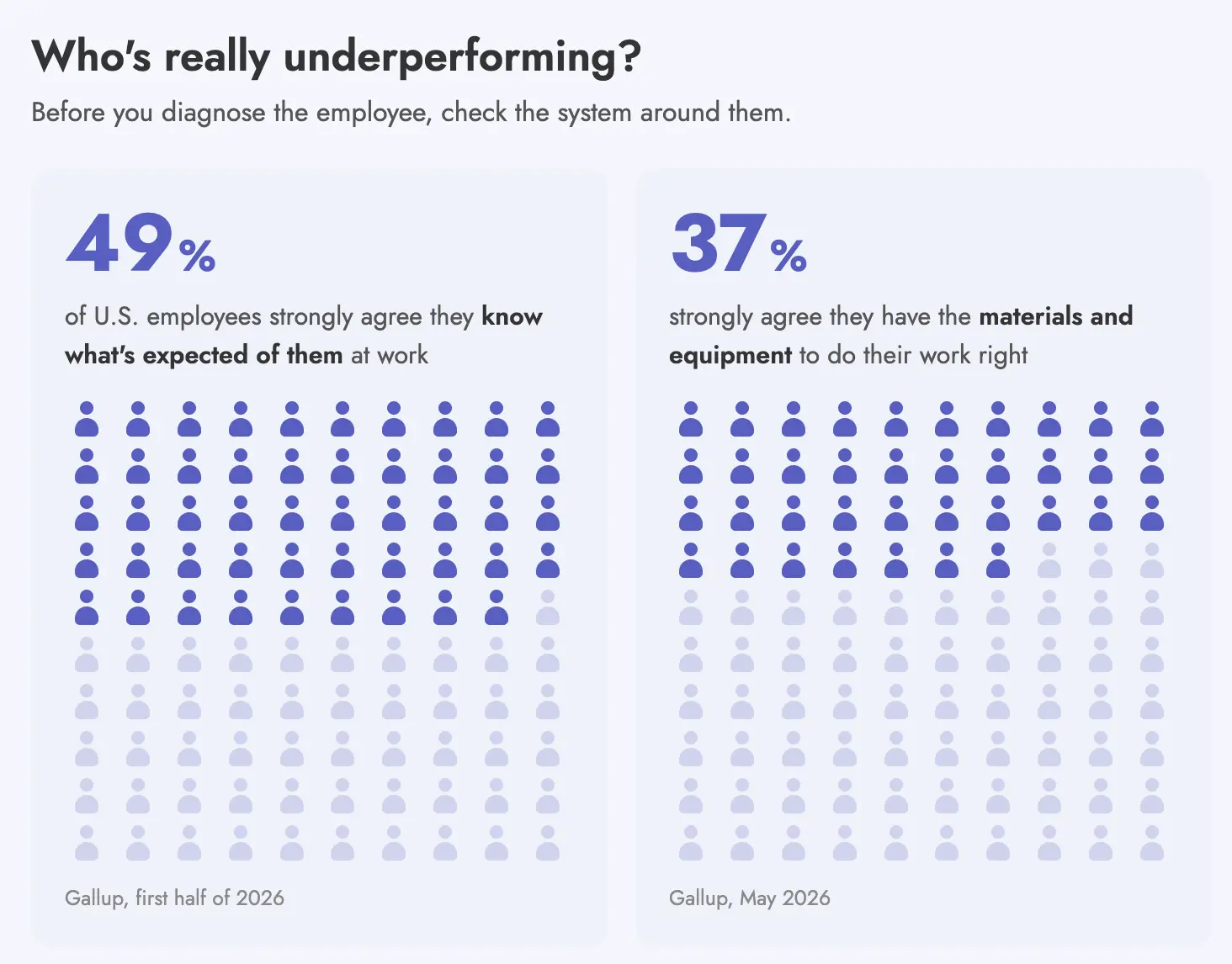
Gallup's latest U.S. data shows why the standard must exist before performance can be assessed: in the first half of 2026, only 49% of employees strongly agreed that they knew what was expected of them at work.
Before starting an underperformance process, HR should determine whether the gap belongs to the system rather than the employee. Check these eight conditions:
For the standard itself, see performance expectations.
A performance issue is a capability or output gap measured against a work standard. A conduct issue is behavior that breaches a workplace rule or policy. Keeping the distinction clear determines what evidence HR collects, who leads the first conversation, and what process follows.
A missed sales target and a policy violation should not be handled through the same evidence or conversation. The former asks whether the employee can meet an established performance standard; the latter asks whether the employee followed an established rule.
Scope Boundary: This guide covers the people process, internal workflow and management enablement. It does not deal with employment law, jurisdiction specific requirements or dismissal procedure. The organization should seek the advice of qualified counsel when legal requirements or possible termination become an issue.
Poor performance has different causes, so HR should not give managers one generic response. Classifying the gap first makes the intervention more specific and easier to measure. Use performance gaps as a reference for measuring the distance between expected and actual performance.
The classification should guide the intervention, not become a permanent label. If evidence shows that the original diagnosis was wrong, HR should adjust the process.
Managers handle performance consistently when HR provides the infrastructure. This means defining criteria for what needs to be in place before a conversation, setting standards for documentation, establishing cadences for review, and determining when an issue is outside of the manager’s scope.
According to CIPD, performance management is a mix of objective setting, feedback, performance improvement, and ongoing review supported by fit-for-purpose HR processes for managers.
HR should verify three preconditions:
This is a consistency requirement, not an exercise in building a case.
Documentation should capture observable facts, dates, business impact, and relevant history. It should not rely on labels such as "lazy," "unmotivated," or "poor attitude."
Consider a project lead who submits a client deck four hours late and includes incorrect financial figures.
"Alex has a poor work ethic, seems unmotivated, and failed to submit the pitch deck on time due to bad time management."
Why it doesn’t work: It labels the employee, assumes intent, and has no date, no evidence, and no measurable impact.
"Alex missed the deadline for the Client X presentation on Tuesday. The presentation was late and needed formatting corrections before sending."
Why it is incomplete: It names the incident but leaves out the exact delay, the exact errors, the business impact and the history.
"On Tuesday, September 15, Alex submitted the Client X pitch deck at 4:00 PM, four hours after the agreed 12:00 PM deadline. The account team therefore could not review the slides before the client meeting. Three financial projections also contained calculation errors and required manager revision. Similar deadline delays were discussed during one-on-one check-ins on August 12 and August 28."
Why it works: It records dates, measurable facts, business impact, and previous feedback without adding a judgment about intent or character.
Follow-up intervals should reflect the type of issue rather than a generic "check in regularly" instruction. See effective one-on-one meetings for guidance on structuring these check-ins.
Gallup research also shows the cost of waiting for formal reviews: employees receiving weekly rather than annual feedback were 5.2 times more likely to strongly agree that they received meaningful feedback, 3.2 times more likely to say they were motivated to do outstanding work, and 2.7 times more likely to be engaged.
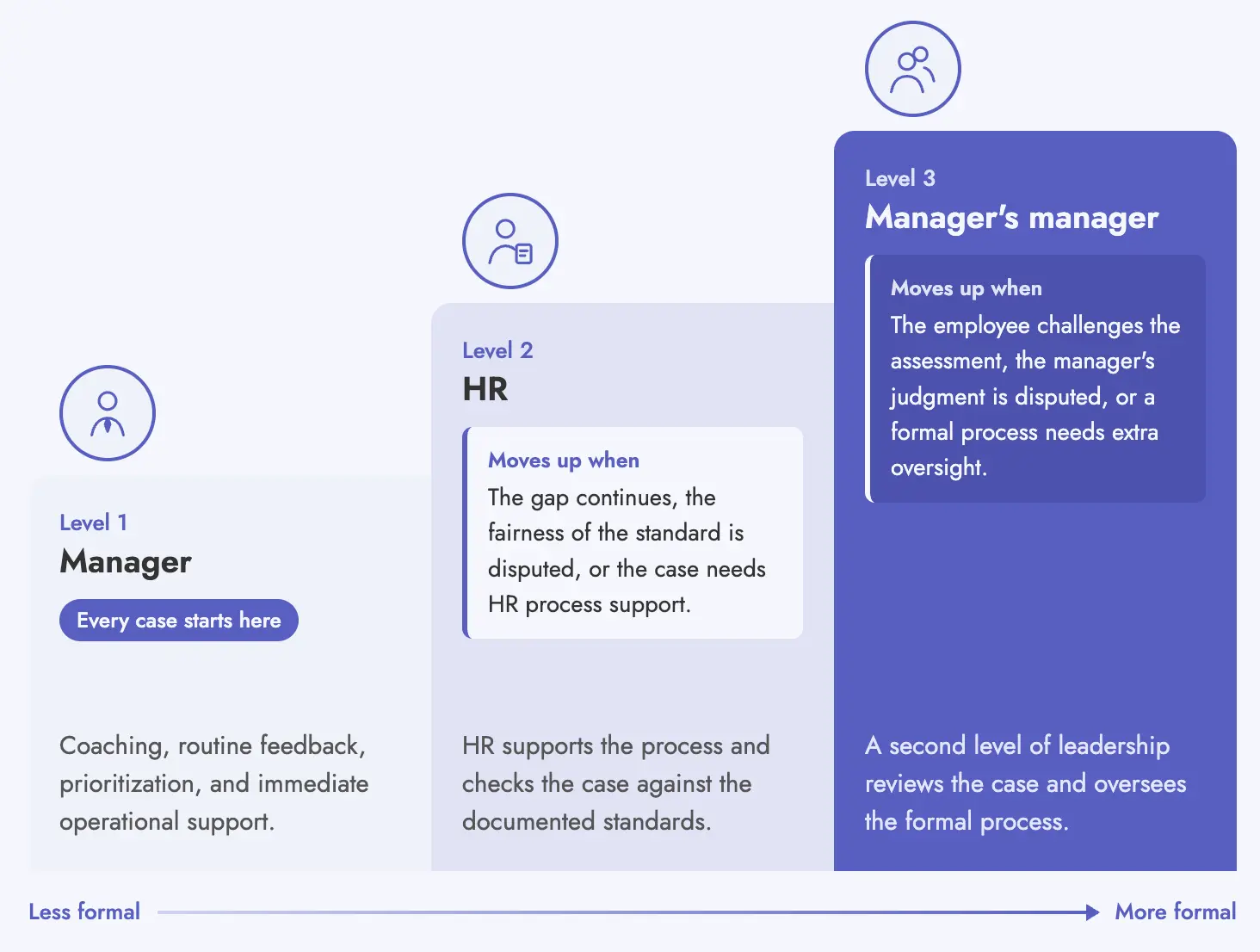
HR should define where each level of the process fits:
HR should view the manager section as a toolkit it provides to managers, not general advice for managers. The toolkit should cover manager avoidance, conversation structure, language for each situation, and post-meeting documentation.
This matters because performance conversations are often delayed. SHRM reported that 61% of HR professionals said fewer than half of managers in their organizations effectively address underperformance or improvement areas among direct reports.
When managers bring an underperformance issue to HR, the problem may already have existed for months. HR's first task is often to help the manager act rather than attempting to solve the employee's performance directly.
Before the meeting, HR should help the manager:
A useful external reference is Harvard Business Review's discussion of why managers often avoid corrective conversations because they anticipate defensiveness or relationship strain.
Give managers a simple three-part structure:
For opening questions and meeting structure, see one-on-one meeting questions and how to run effective one-on-one meetings.
HR expert Christopher D. Lee argues that traditional appraisals focus on past paperwork instead of forward-looking coaching conversations.
Managers need language matched to the problem rather than a generic list of phrases.
See negative feedback examples for additional wording guidance.
After the meeting, the manager should send a structured summary to the employee and HR containing:
This record supports consistency between managers and gives HR a clear basis for the next review.
The standard process becomes less useful when the employee disputes the assessment, a former high performer suddenly drops off, or the rest of the team starts absorbing the performance gap. HR should adapt the process to each situation instead of treating every underperformer as the same case.
Employees can challenge the examples, argue the target was unrealistic, cite a change in scope or question the manager’s interpretation.
HR should double-check the pushback before automatically supporting the original assessment:
If the employee raises concerns about manager bias, HR can involve the manager's manager or use a structured review.
The important distinction is between disagreement that reveals a genuine process problem and disagreement that does not change the evidence. If the employee is correct about the underlying standard or circumstances, fix the process before continuing the performance intervention.
A sudden dip from a strong performer needs to be diagnosed before escalation. The question is what changed, not whether the current output is below standard.
HR should examine changes in role, workload, priorities, team structure, or engagement. Where appropriate, investigate signs of employee burnout or employee disengagement.
The former high performer is still held accountable to current expectations, but the diagnosis may help clarify whether the first intervention should be workload adjustment, clearer priorities, role alignment or performance management.
Colleagues often notice when they are absorbing unfinished work. HR should protect the employee's confidentiality while making sure the team's workload remains manageable.
Managers should not disclose performance details, PIP terms, or disciplinary information. They can acknowledge operational changes without discussing the individual's case. For example:
"We're adjusting resource allocation and workflow capacity so the team can continue meeting its milestones."
Where work is being redistributed, managers should make the new ownership clear rather than leaving high performers to absorb the gap indefinitely.
There is no single improvement period for every role. HR should set a range based on the issue, the role's natural work cycle, and what has already been tried. The process should have a defined endpoint rather than continuing indefinitely.
These are working ranges, not automatic deadlines. A role with a two-week production cycle should not be assessed like one with a quarterly delivery cycle.
Consider extending the window when:
A shorter review cycle may be appropriate when:
These decisions should remain tied to documented performance evidence rather than assumptions about attitude or intent.
Where there is a significant performance gap after the setting of clear expectations, feedback, support and documented review, a Performance Improvement Plan is appropriate. HR should only approve the move if the organization can demonstrate that the employee understood the standard, had the resources to meet the standard, received meaningful feedback and was given a reasonable opportunity to improve.
Before moving to a PIP, HR should check the following:
This article does not explain how to write a PIP or provide a template. For that separate process, see how to write performance improvement plans and PIP examples.
A performance problem is a deviation of actual work from established job standards. If someone regularly misses deadlines, makes avoidable mistakes, delivers substandard quality or fails to meet specified output requirements, and has the necessary tools and authority to succeed, then they have a performance issue.
Performance concerns relate to capability and output against work standards. Conduct concerns relate to behavior against organizational policies or rules. They require different evidence and processes, so HR should not automatically treat conduct as a type of performance problem.
The manager is responsible for day-to-day feedback, expectations, coaching and performance monitoring. HR owns the process framework and documentation standards, consistency across managers and formal escalation support. Instead of just stepping in and taking over the conversation, HR should prepare the manager.
State purpose clearly, use 2-3 specific examples, explain the gap against the documented standard, and set dated next steps. Don’t judge attitude or personality. End by stating a clear expectation, what support is available and when the next review will be.
The appropriate window depends on the role and issue. A practical starting range is 14–30 days for operational roles, 30–60 days for specialist roles, and 60–90 days for senior or strategic roles, with the review cadence matched to the work cycle.
No. HR should first check the standard, tools, authority, prior feedback, and improvement opportunities. A PIP is a formal next step for persistent gaps that have not been addressed with clear expectations, feedback, support, and documented review.
.avif)
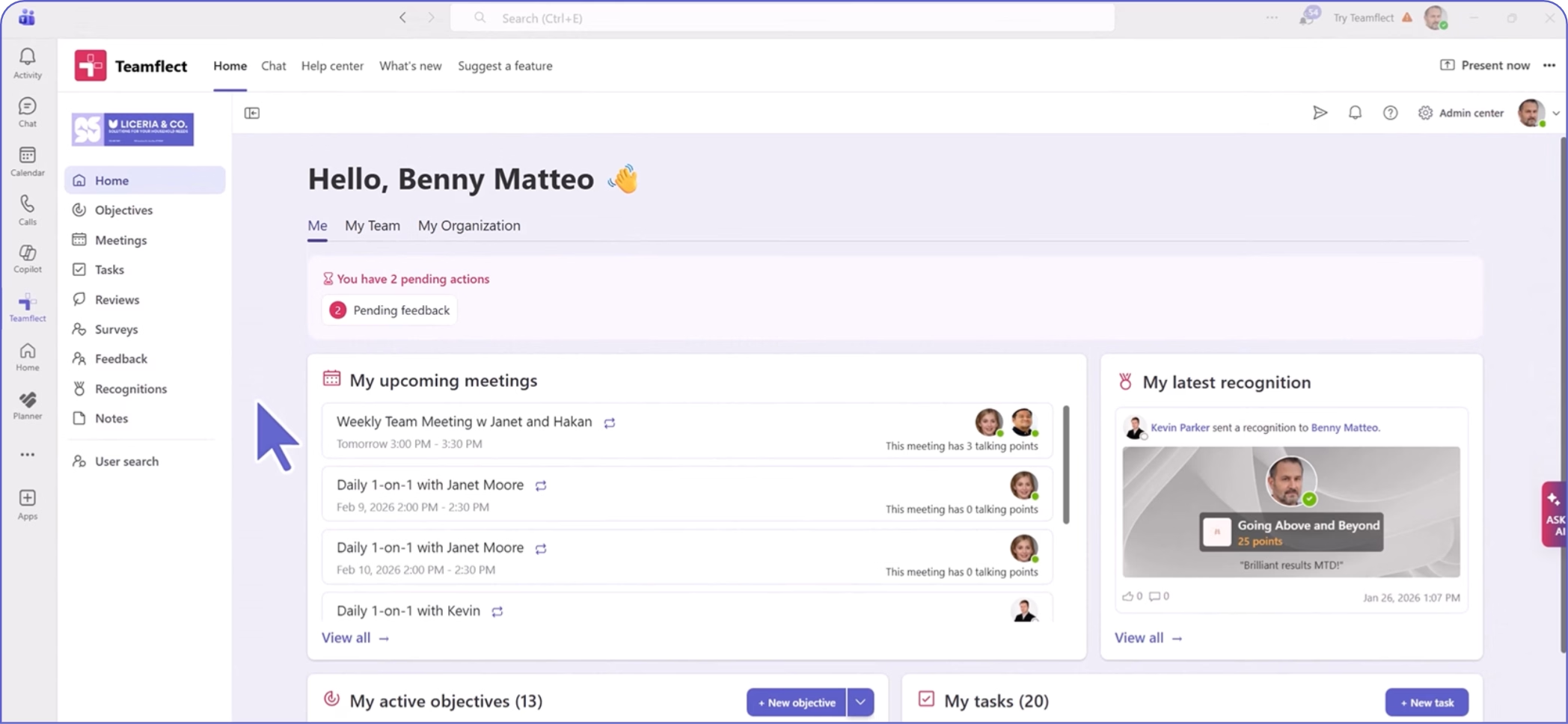
Create high-performing and engaged teams - even when people are remote - with our easy-to-use toolkit built for Microsoft Teams
.svg)


.webp)
