.svg)
.svg)
How Governmental Departments Measure and Improve Performance

Updated on:
February 20, 2026

Prefer Teamflect as your HR source on Google
.svg)

Effective performance management in government and public sector organizations directly influences public service quality, taxpayer value, and institutional trust. Unlike private sector performance systems that track profit margins, public agencies must balance accountability to citizens, regulatory compliance, and mission-driven outcomes while operating under intense budget scrutiny and political oversight.
When integrated properly, performance systems become tools that enable civil servants, agency directors, and administrators to serve the public effectively.
In this article, we examine how government organizations can transition from rigid annual reviews and paper-based systems toward continuous, outcome-focused performance management that addresses workforce challenges and drives operational excellence.
Public sector organizations operate under unique constraints that make structured performance management essential rather than optional. Taxpayer accountability, regulatory requirements, and diverse stakeholder expectations create an environment where systematic performance tracking becomes a foundation for effective governance.
Government employees with clearly defined performance objectives deliver services more efficiently. Clear expectations reduce time spent navigating unclear procedures, allowing more focus on constituent needs. Research shows that agencies with structured performance frameworks improve service delivery times by measurable margins.
The median age of US public servants is 45.6, higher than nearly every other sector. Government agencies with strategic performance approaches retain specialized talent more effectively, reducing turnover costs and institutional knowledge loss. Structured performance systems create clear career paths that attract younger workers to public service careers.
Documented performance objectives establish transparent standards for public service delivery. Performance data allows citizens to evaluate whether tax dollars are being used effectively. This transparency is fundamental to maintaining public trust in government institutions.
Connecting individual employee targets to agency-wide initiatives ensures coordinated progress toward policy goals. When performance objectives cascade from strategic priorities, entire departments move in alignment rather than working in silos.
Systematic performance reviews identify skill gaps early, enabling targeted training in new technologies, policy changes, or specialized service delivery techniques. This continuous development approach keeps government workforce capabilities current.
📚 Recommended Reading: How to Build Competency Frameworks?
Government agencies face distinct obstacles that differentiate public sector performance management from corporate approaches. Recognizing these challenges is the first step toward building more effective evaluation systems.
Budget constraints and staffing shortages leave managers with minimal time for regular performance conversations. Many supervisors oversee large teams with limited administrative support, making continuous feedback systems difficult to maintain without technological assistance.
Government organizations typically operate with complex hierarchies and matrix reporting relationships. Performance information must flow through multiple approval levels, creating delays between performance issues and corrective action. This structural complexity makes real-time performance management challenging.
Federal and state governments often require standardized evaluation frameworks that apply across all departments. These uniform systems struggle to account for the vastly different responsibilities between roles, from social workers to IT specialists to permit processors. Generic metrics fail to capture the unique contributions of specialized positions.
Many government employees work under collective bargaining agreements or civil service rules that establish specific performance evaluation procedures. These protections, while important for employee rights, can create rigid timelines and documentation requirements that limit managerial flexibility in addressing performance issues.
Performance management in government occurs under public observation and political pressure that private companies rarely face. Performance data may become politicized, and managers must balance honest evaluation with awareness that performance information might be subject to public records requests or legislative inquiry.
Modern performance management approaches allow government leaders to shift from compliance-focused evaluation to development-oriented coaching. These practices ensure performance systems support the unique requirements of public service.
Establish clear, quantifiable objectives tied to agency missions. Use 90-day goal cycles rather than annual targets to maintain agility as priorities shift with policy changes or budget adjustments. Short-term objectives allow course correction without waiting for year-end reviews.
Move beyond annual performance reviews to quarterly or monthly touchpoints. Brief, structured conversations allow managers to address service delivery challenges, workload concerns, and resource needs in real-time. Regular check-ins prevent surprises during formal evaluations.
Performance management software that works within existing communication tools reduces the technology adoption barrier. Platforms with Microsoft Teams integration allow government employees to access performance information where they already work, eliminating system-switching inefficiency. Performance management software should centralize goal tracking, feedback documentation, and review completion.
Create distinct pathways for performance improvement versus misconduct issues. When skill development conversations are separated from disciplinary procedures, employees engage more honestly about challenges without fear of immediate consequences. This separation encourages growth-focused dialogue.
Government work requires cross-departmental collaboration. Gather input from colleagues, other agencies, and service recipients to provide comprehensive performance perspectives. Multi-source feedback reveals collaborative effectiveness that direct supervisors might not observe.
📚 Recommended Reading: Everything you need to implement multi-source feedback!
Government teams need to prove public value while maintaining operational efficiency. The right KPIs provide that evidence, connecting daily work to accountability requirements and strategic priorities.
A government performance review should prioritize service delivery, compliance standards, and public accountability. This structured approach provides clarity while allowing meaningful dialogue about professional development.
Role: Social Services Program Manager
Core Skill Areas:
Development Plan Components:
📚 Recommended Reading: Looking for further performance review examples?
Well-intentioned performance systems can fail when agencies repeat common mistakes. Avoiding these errors creates more effective evaluation processes.
Many government agencies still conduct performance evaluations once annually. This approach creates long gaps between performance events and feedback, making course correction difficult. Annual cycles also create administrative bottlenecks as hundreds of reviews come due simultaneously.
Applying identical KPIs to administrative staff, field workers, and technical specialists produces meaningless data. A social worker's performance cannot be measured with the same metrics as an IT systems administrator. Effective performance management requires role-specific metrics that reflect actual job responsibilities.
Managers who don't maintain ongoing performance notes rely on recent memory during formal reviews. This recency bias means that work from early in the performance period gets overlooked. Continuous documentation creates fair, comprehensive evaluations.
When individual objectives have no clear connection to organizational goals, employees work hard without advancing agency priorities. Performance management must explicitly link daily work to strategic initiatives for meaningful contribution.
When evaluation becomes a bureaucratic checkbox exercise, both managers and employees disengage. The process must yield actionable insights that improve public service delivery, not just satisfy administrative requirements.
Performance management in government is shifting toward technology-enabled, data-driven approaches that address workforce challenges and service delivery demands. These trends reflect the unique pressures facing public sector organizations.
AI is transforming public sector performance management by shifting from reactive tracking to proactive development. Through predictive analytics and pattern recognition, these tools identify performance trends and flag potential issues before they escalate, helping agencies optimize staff deployment.
A key example is the 2024 Australian Public Service (APS) Copilot trial, involving 7,600 staff across 60+ agencies. The trial saved participants an average of one hour per day on administrative tasks, with 40% of that time redirected into high-value activities like mentoring and team building. This shift demonstrates how AI can move government focus away from paperwork and toward meaningful engagement and improved work quality.
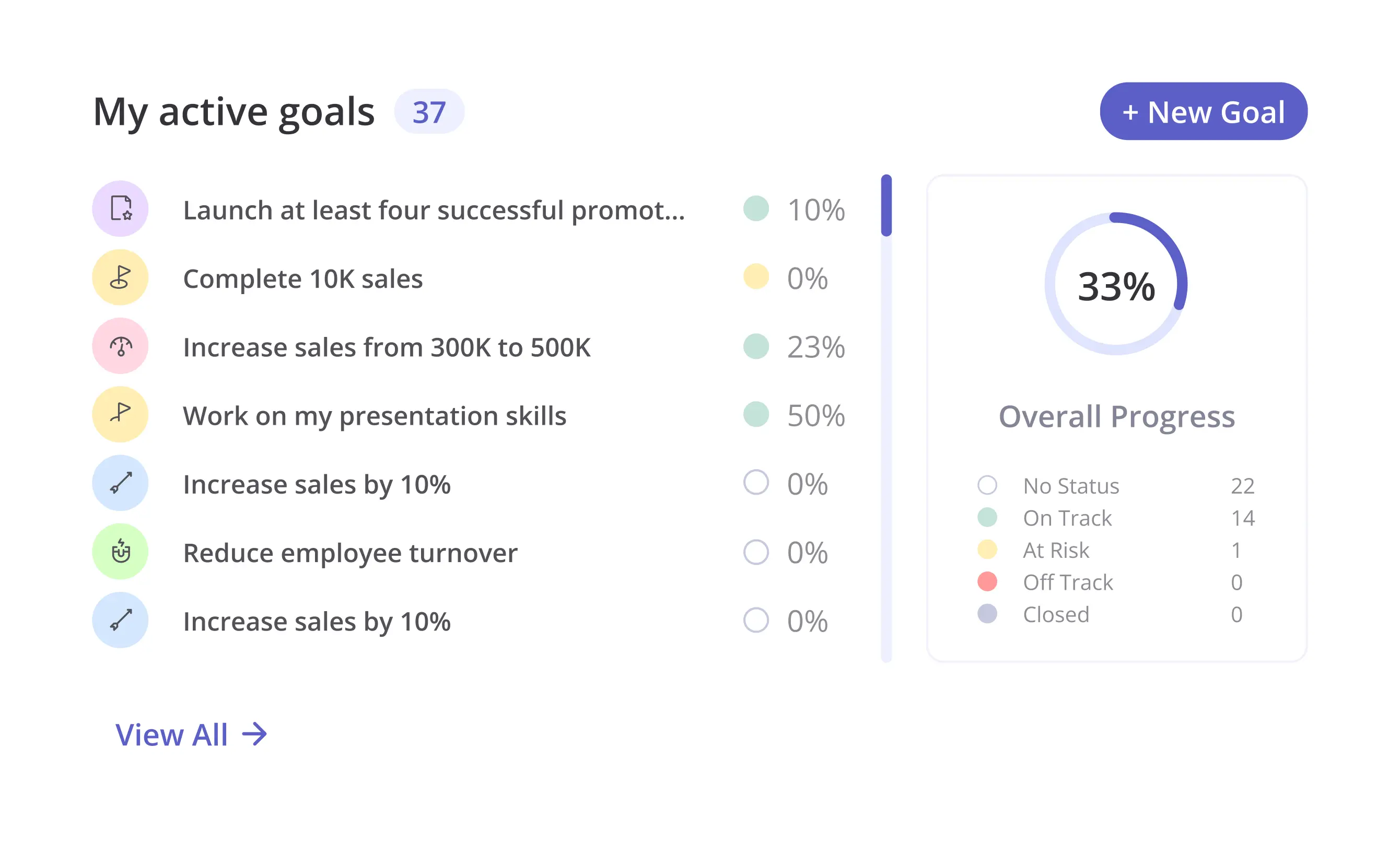
Government agencies are adopting Objectives and Key Results frameworks to replace rigid annual goal-setting. An OKR softwarelike Teamflect enables quarterly goal cycles that adapt to changing policy priorities and budget realities. These platforms provide real-time progress visibility that traditional performance systems cannot match.
Continuous feedback mechanisms integrated into daily workflows reduce the administrative burden of formal reviews. Instead of lengthy annual evaluations, managers conduct brief check-ins that document progress incrementally. This approach distributes performance management throughout the year rather than concentrating it in evaluation season.
Government leadership increasingly ties funding to data-driven outcomes, prioritizing agencies with clear results while subjecting underperformers to scrutiny. This shift makes transparent reporting essential for budget justification.
In fact, to ensure data integrity, 80% of OECD-surveyed nations hold regular discussions between finance and line ministries. Additionally, 46% require senior official sign-offs, and 32% impose corrective measures if performance targets are missed.
Field-based government employees, such as inspectors and social workers, need performance tools that work beyond the office. Mobile-first, cloud-based platforms allow real-time documentation and feedback, which is vital as agencies adopt hybrid models and expand geographic reach.
Closing the digital gap is a priority; a Deloitte survey found that government service satisfaction lags the private sector by over 20 percentage points (56% vs. 77%). Consequently, over 70% of government CIOs plan to increase investments by 2026 to better measure and improve these experiences.
Successful performance management platforms integrate with the technology government agencies already use. Microsoft integrationis particularly valuable because many government organizations have standardized on Microsoft 365 for communication and collaboration.
Performance management software that works within Teams eliminates the need for separate system logins and reduces training requirements. Employees can access goals, submit feedback, and complete reviews without leaving their primary work environment. This integration dramatically improves adoption rates and reduces IT complexity.
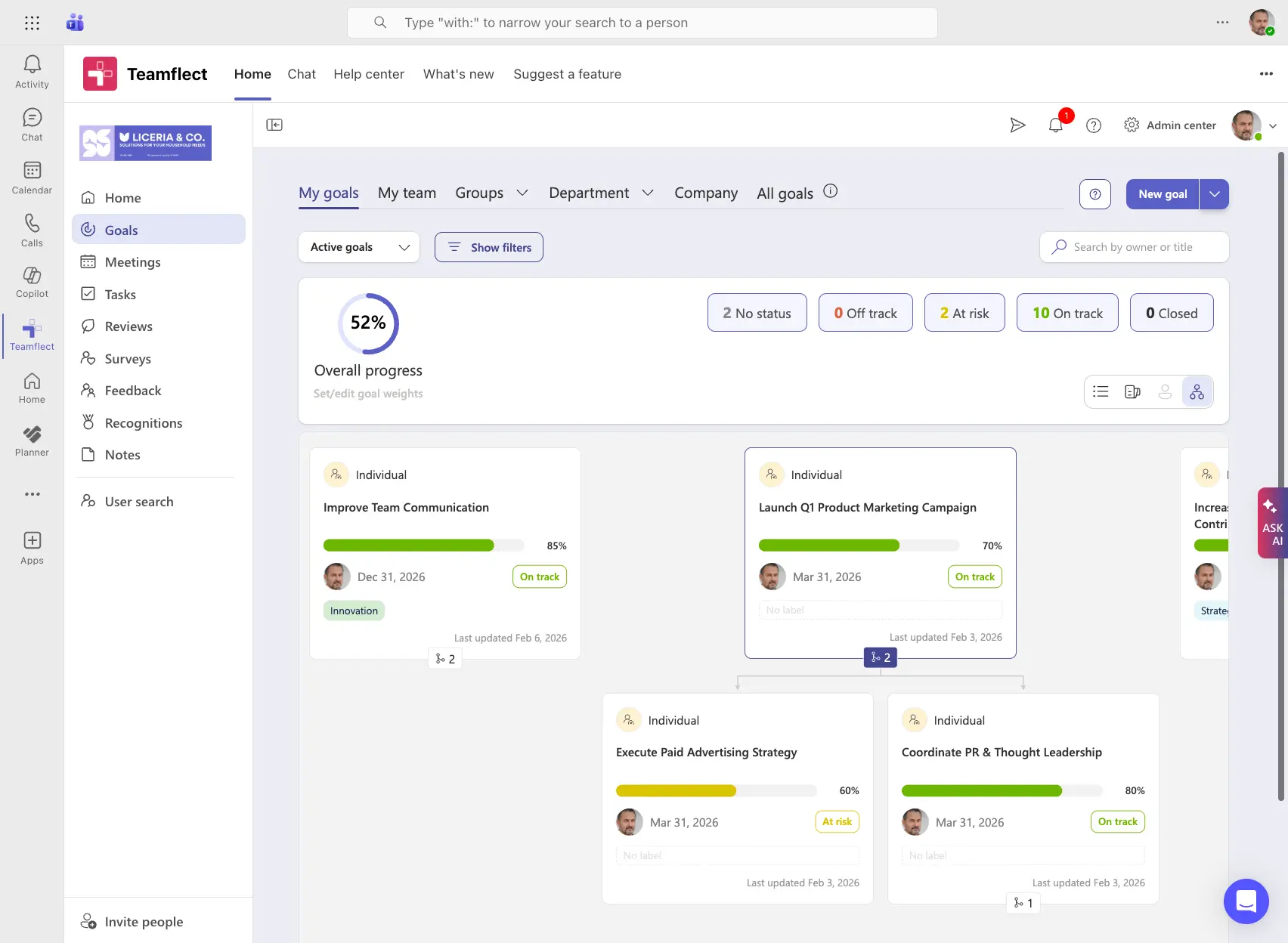
Teamflect provides a performance management software designed for the unique requirements of government and public sector organizations. The platform integrates directly into Microsoft Teams to reduce technology friction and administrative burden.
Public sector organizations require performance systems that ensure transparency, regulatory compliance, and clear accountability across large, complex hierarchies. Teamflect provides structured tools that support measurable outcomes and audit readiness.

Nevada County's Information and General Services Agency, serving a diverse rural community in California, replaced outdated, static goal-setting tools with Teamflect to improve transparency and collaboration across departments.

Illinois Heartland Library Systems (IHLS), a governmental agency supporting over 500 libraries, transitioned from a rigid, manual spreadsheet process to a tailored digital workflow.
Base evaluations on documented outcomes and specific service delivery metrics rather than subjective impressions. Use multi-source feedback from colleagues, supervisors, and stakeholders to capture comprehensive performance perspectives. Maintain detailed records throughout the evaluation period to prevent recency bias and ensure consistent standards across all departments and shifts.
Keep dated notes from regular check-ins, documenting specific examples of goal progress, service delivery outcomes, and development activities. Record both exemplary performance and areas needing improvement as they occur. Include objective data such as service delivery metrics, compliance records, and completed training. This continuous documentation provides context during formal evaluations and supports personnel decisions.
Conduct calibration sessions at least quarterly to ensure rating consistency across departments and supervisors. Because government service standards must be uniform, managers should review ratings together to verify that a "meets expectations" rating in one department carries the same meaning as the same rating in another. Regular calibration prevents rating inflation and maintains evaluation integrity.
Address performance gaps immediately through structured conversations that identify root causes. Distinguish between skill deficits, resource limitations, and behavioral issues. Create focused improvement plans with specific, measurable milestones and provide necessary training or support. Document all interventions thoroughly. Follow civil service or union procedures precisely while maintaining focus on helping employees succeed rather than pursuing disciplinary action as a first response.
The primary challenge is time scarcity. Government managers often oversee large teams while handling significant operational responsibilities, leaving limited time for performance conversations. Other challenges include navigating complex civil service regulations, managing union requirements, maintaining documentation standards, and balancing developmental feedback with accountability expectations. Technology platforms that automate administrative tasks and integrate with existing tools help address these constraints.

.svg)
.avif)
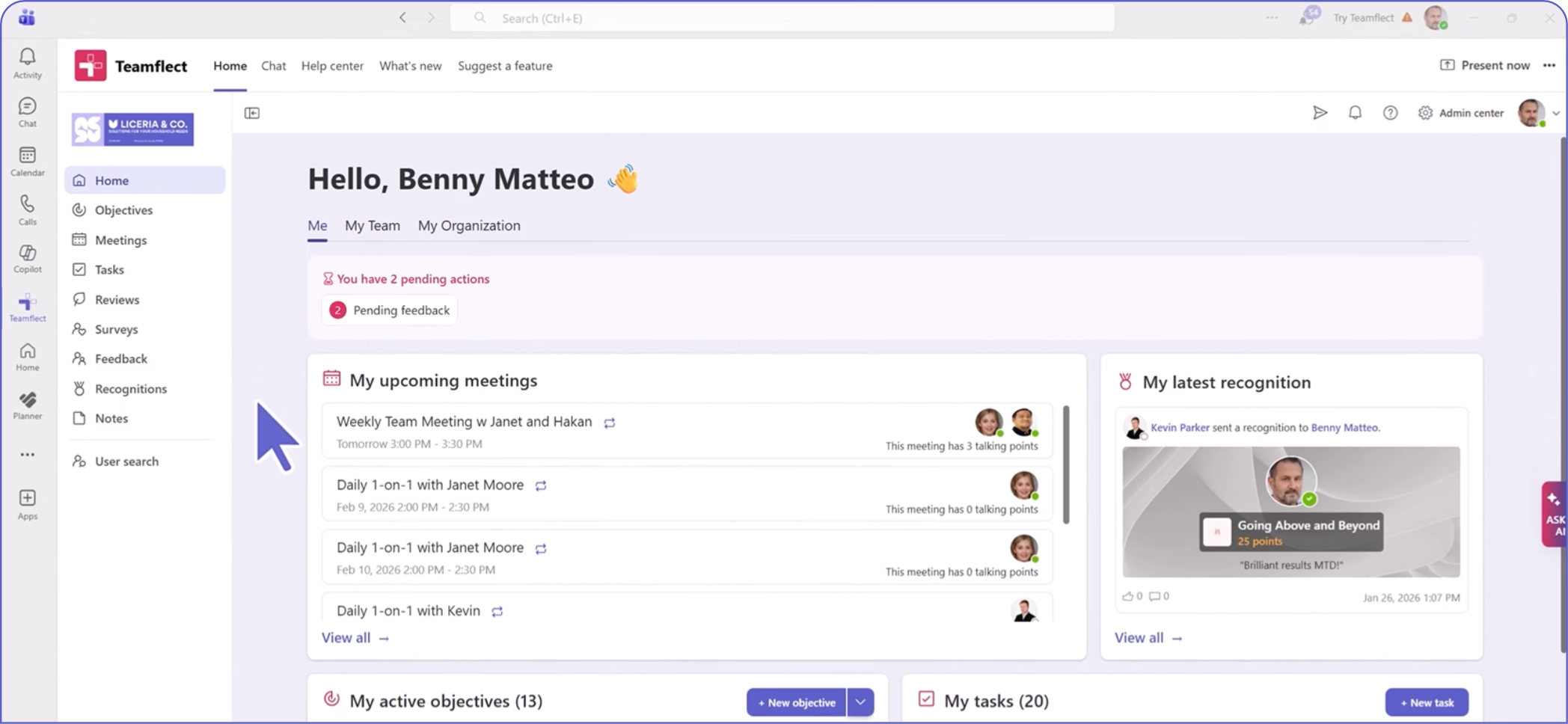
Create high-performing and engaged teams - even when people are remote - with our easy-to-use toolkit built for Microsoft Teams