.svg)
.svg)
How to Evaluate OKR Software: A 10-Criterion Framework

Updated on:
July 21, 2026


Prefer Teamflect as your HR source on Google
.svg)

An HR Tech founder's rubric for evaluating OKR platforms: the ten weighted criteria that predict whether a goal program survives its first few quarters, the reasoning behind each weight, and the hands-on tests worth running before you commit.
My team and I have spent more than ten years building OKR software, and in that time we've watched goal programs launch inside organizations of every size and stack.
Earlier this year, our Senior Product Manager Fetican Durakbaşı and I published two evaluation frameworks in this series, one for our top performance review software research and one for 11 best 360-degree feedback software list, each with its own weighted rubric and a free scorecard. When we tested OKR platforms for our latest research, we built a third rubric from the ground up, because the way an OKR program fails looks nothing like the way a review or a feedback program fails. You will find a detailed explanation of that rubric in this article.
For each criterion you'll find what it measures, why we weighted it where we did, what good looks like, the questions to put to a vendor during a demo, and a test you can run yourself inside a trial. By the end, you should be able to score any OKR platform against the same rubric we used, or download the workbook and set the weights to match your own situation.
— Bora Ünlü, Co-Founder and CEO, Teamflect
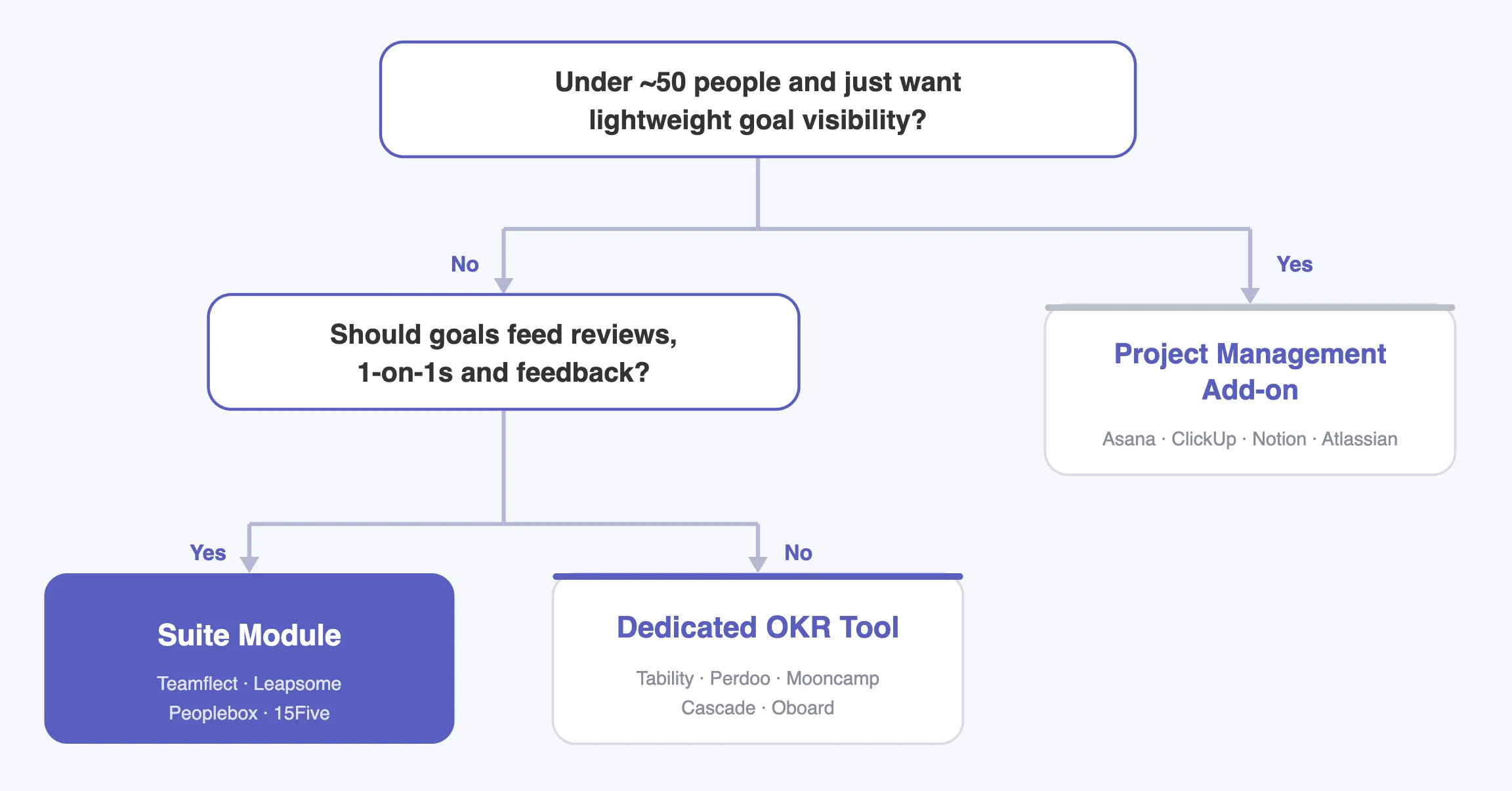
Before you touch a single weight, settle the question the rubric can't settle for you: what kind of tool is your OKR program actually asking for? The market splits three ways, and where a platform sits shapes what it's good at long before you compare feature lists.
Dedicated OKR Tool Tability · Perdoo · Mooncamp · Cascade · Oboard
Goals are the whole product, so the cadence engine, the cascade, and the customization tend to run deeper than anything a bolt-on module reaches. This is the shape for a program where OKRs are the main event and you want the mechanics done properly.
Fits standalone goal programs, methodology-strict teams, and companies putting OKRs on a firmer footing.
Suite Module Teamflect · Leapsome · Peoplebox · 15Five
OKRs arrive as one module wired into reviews, one-on-ones, and feedback, so goal progress lands next to the rest of the performance record instead of in its own silo. The connection is the value, and it's why goal completion can feed a review cycle without anyone exporting a thing.
Fits programs where OKRs feed the year-round performance system, and Microsoft 365 or chat-native teams that want a simple access point.
Project Management Add-on Asana Goals · ClickUp Goals · Notion · Atlassian Goals
Goals live inside the software your team already runs its work in, so objectives sit beside the tasks and projects that drive them and progress can roll up as that work completes. That closeness is the appeal, and it's also the ceiling: each one stores OKRs rather than running the OKR process, with no real check-in cadence and no company-to-individual alignment tree, so all of them start to strain past roughly fifty people.
Fits small teams that want lightweight goal visibility without adding a second tool, at least until the program outgrows it.
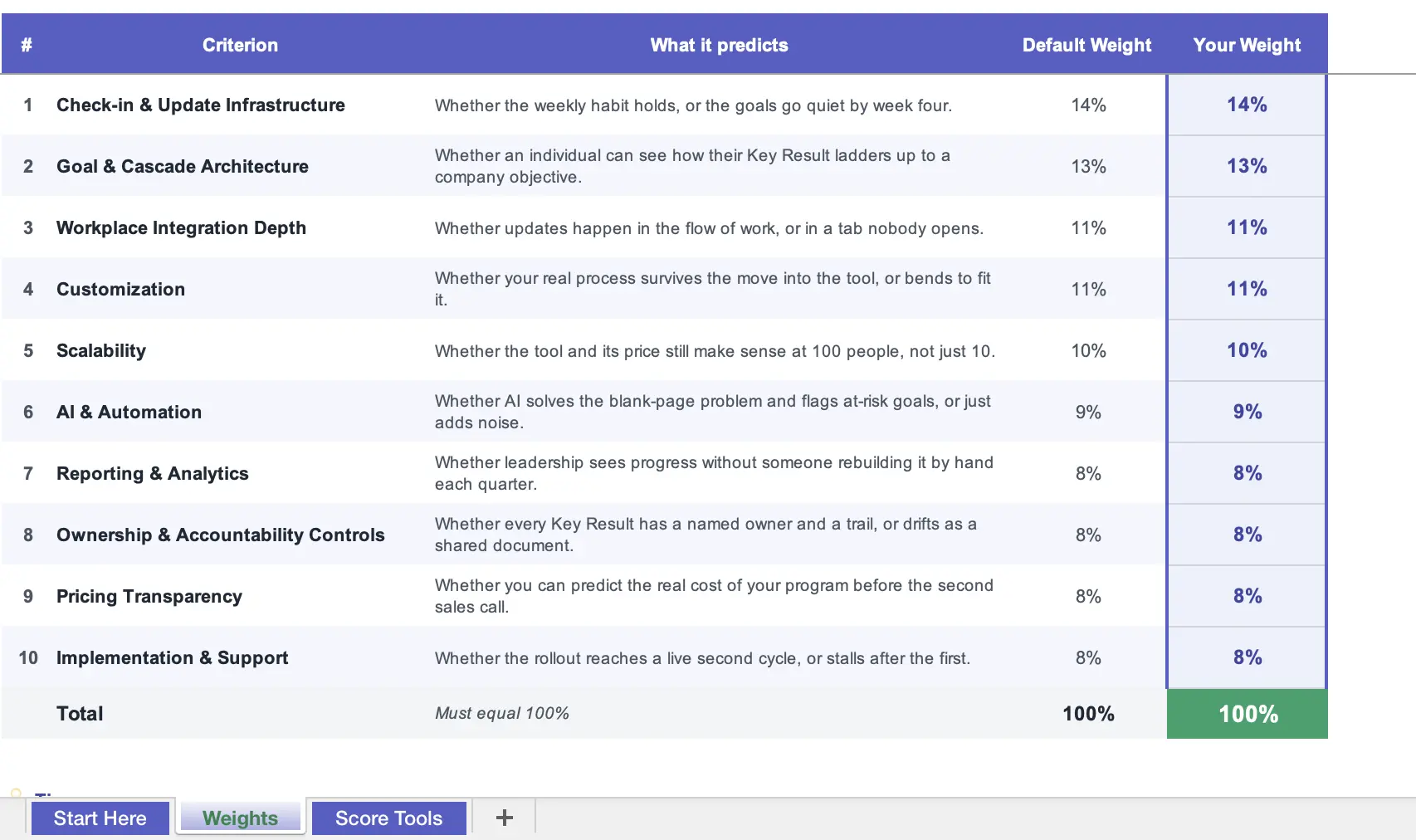
Before the deep dive, here's the full rubric in one view.
Weights are our recommendation, the same ones we used in the 2026 evaluation. We show you how to adjust them for your situation further down.
The weights total 100%, so raising one means lowering another. Keep that trade-off in mind when you reach the adjustment section. And notice where the weight sits: OKR check-in infrastructure and goal cascade carry more than a quarter of the score between them, because those two are what separate an OKR program that's still running next quarter from one that quietly became a spreadsheet nobody updates.
You can download the rubric for absolutely free and adjust the weights any way you see fit:
You can also read how we evaluated the other two categories in this series, and download those rubrics too:
The single strongest predictor of whether an OKR program is still alive in week four, or quietly abandoned. This is where the habit either becomes structural or falls to willpower.
This criterion measures the machinery that keeps goals current between the day you set them and the day the quarter closes: automated reminders, how few steps a Key Result update actually takes, and whether the cadence runs on its own or leans on someone chasing people every Monday. We weighted it heaviest, at 14%, because a stalled check-in is the most common way an OKR program dies. The objectives don't get deleted. They just stop moving, and once they've gone stale for three weeks running, no one trusts the numbers enough to bother.
What "good" looks like
Questions to ask the vendor
How to test it yourself
Set up one Key Result in your trial and run a full check-in on it. Count the clicks from the moment the reminder reaches you to the moment the update is saved. Then wait for the next scheduled reminder and confirm it actually fires without you prompting it. The click count is the number that predicts your participation rate at scale, which is exactly why we published it on every card in the evaluation and neither competing list does.
When an individual can't see how their Key Result connects to a company objective, OKRs turn into a compliance exercise. Cascade is what makes the goal feel like it belongs to something.
This criterion measures how the platform builds and connects goals across levels: multi-level goal cascades from company to department to team to individual, the Key Result metric types on offer, weighting, and whether the alignment map actually shows a person the line from their work up to the top. We weighted it at 13%, second only to check-ins, because cascade is what gives the weekly habit something worth maintaining. A goal an owner can trace upward feels earned. A goal floating on its own gets updated once and forgotten.
What "good" looks like
Questions to ask the vendor
How to test it yourself
Build a full cascade in your trial: one company objective, two team objectives beneath it, and three Key Results under each with named owners. Then log in as an individual contributor and try to trace one of your Key Results all the way up to the company objective. If you can see that line without leaving your own view or pulling in an admin, the architecture works. If the connection only exists in the admin's head or a separate report, it doesn't.
Gallup Research supports the importance of this criterion, emphasizing that only 45% of employees strongly agree they know what's expected of them, making top to bottom alignment a must-have for OKR tools.
OKRs stay current when the update happens inside the tools your team already lives in. Every integration that only sends a notification, rather than doing the work, is a tab waiting to be ignored.
This criterion measures two layers. The first is where the check-in lands and what an owner can do from there: can they update a Key Result inside Teams or Slack, or does the notification just hand them a link out to somewhere else? The second is the data plumbing underneath, meaning two-way syncs with Jira and your work tools, HRIS feeds for org structure, and single sign-on. We weighted it at 11% because integration is what decides whether updates are a byproduct of work already happening or a separate chore bolted onto the week. The strongest tools here don't just notify. They let progress flow in from the work itself.
What "good" looks like
Questions to ask the vendor
How to test it yourself
Send yourself a check-in reminder and count the hops from the notification to a saved update, every window and every login along the way. Then link one Key Result to a real work item in a tool you already use, close that work, and watch whether the number moves on its own. The category leaders keep the update to a single window and let at least some Key Results track themselves.
No OKR tool matches your process out of the box. What matters is whether your real terminology, goal types, and cadence survive the move in, or get quietly sanded down to fit the tool's defaults.
This criterion measures how much of your program design makes it into the platform intact: custom terminology, the goal and Key Result types you use, custom fields, configurable cadences, and framework flexibility for teams that don't run textbook OKRs. It also measures the reverse, whether you can switch off the parts you don't want. We weighted it at 11% because OKR programs live or die on fitting how an organization already works. When a tool forces its own vocabulary and structure on a team that had a working process, adoption pays the price, and the workarounds start piling up by the second cycle.
What "good" looks like
Questions to ask the vendor
How to test it yourself
Take your real OKR program into the trial and rebuild it exactly as you run it today, your terminology, your goal types, your cadence. Keep a running tally of every compromise the tool forces on you, from a term you couldn't rename to a section you couldn't remove. That tally is the honest measure of fit. A short list means the tool bends to you. A long one means you'll be bending to it every cycle from here on.
Per-user pricing that looks cheap at ten people becomes a growth tax at a hundred, and governance that works for one team breaks across twenty. The tool has to fit the company you're becoming, not just the one signing up today.
This is the criterion buyers most often postpone until it's expensive to reconsider. It measures two things that move together as headcount climbs: the cost curve, meaning what per-seat pricing actually totals as you grow and whether there are minimums or tier jumps waiting, and the governance ceiling, meaning whether the structure that runs cleanly for one team still holds across twenty, along with the security and admin controls larger organizations require. We weighted it at 10% because the tool you outgrow in a year is a migration you'll pay for twice, once in the switch and once in the lost cadence while everyone relearns a new system.
What "good" looks like
Questions to ask the vendor
AI earns its weight on two specific jobs: getting a first-cycle team past the blank page, and catching a goal that's slipping before the quarter ends. Everything past that is a demo flourish until proven otherwise.
This criterion measures how useful the platform's AI actually is inside an OKR workflow, not how much of it there is. The jobs that matter are goal drafting, which solves the blank-page problem that stalls teams writing their first real OKRs, and at-risk detection, which flags an objective drifting off track while there's still time to act. Automation of the check-in chase belongs here too. We weighted it at 9% because execution quality varies wildly across the category, so this is scored on whether the AI saves real work rather than on whether the feature exists. We expect this weight to climb in future evaluations as the good implementations pull away from the gimmicks.
What "good" looks like
Questions to ask the vendor
How to test it yourself
Give the AI the same real objective you'd hand a team lead and let it draft the Key Results. Read them as an owner would and ask the honest question: would I run with these after a light edit, or rewrite them from zero? If it's the latter, the AI isn't saving you the work it claims to. Then run a check-in cycle with one goal deliberately behind pace and see whether the at-risk flag actually catches it.
Leadership renews the program when a dashboard shows progress at a glance. If someone has to rebuild that picture in a spreadsheet every quarter, the renewal conversation gets harder each time.
This criterion measures whether the platform turns goal and check-in data into something HR and leadership can act on without manual assembly. Two things carry it: the dashboards themselves, meaning completion rates, goal health, and at-risk surfacing that are ready without custom configuration, and export completeness, meaning whether the data leaves the tool clean enough to use in Power BI or a board deck. We weighted it at 8% because most tools clear a baseline here, so the gap between the best and the average is narrower than it is on cadence or cascade. It still matters, though, because reporting is what makes the case to keep paying for the program.
What "good" looks like
Questions to ask the vendor
How to test it yourself
Run a small mock cycle in your trial, then try to answer one question straight from the default dashboard without help: which objectives are at risk right now, and who owns them? If you can answer it in under a minute, the reporting works. Then export the same data and open it in whatever your team actually uses. The gap between a clean export and one you have to reformat is a job someone inherits every quarter.
Named accountability, edit permissions, and an audit trail are what separate a goal system from a shared document everyone can quietly edit and no one is answerable for.
This criterion measures the controls that make a Key Result someone's actual responsibility: named ownership on every KR, whether that ownership is enforced or merely optional, who can edit whose goals, visibility rules, and whether changes leave an audit trail. We weighted it at 8% because these controls are what hold a program honest as it grows. Early on, a small team can run on trust and a shared view. Once enough people can change enough numbers without a record, the goals drift, and no one can say when a target moved or who moved it.
What "good" looks like
Questions to ask the vendor
How to test it yourself
In your sandbox, create a Key Result and check whether the tool lets you save it with no owner assigned. Then log in as a second, lower-permission user and see what you're able to edit on a goal you don't own. Finally, change a target and go looking for a record of that change. What the tool lets an unauthorized user alter, and what it fails to log, is exactly what will drift once real headcount is in the system.
This criterion has appeared in every framework in this series, and it will almost certainly appear in the next one, because hidden pricing outlasts every other complaint we read.
This is the simplest criterion to evaluate and the one buyers most often underweight until the contract is in front of them. It measures whether you can predict the real cost of your program before the sales process predicts it for you: public per-seat rates rather than quote-only, honest trial terms, and disclosed minimums. We weighted it at 8%, high enough to matter, low enough to acknowledge that some genuinely strong platforms in this category run on custom quotes, especially at the enterprise end where that's standard practice.
The value comes from the tool being used, not bought. Onboarding speed and support quality are what decide whether you reach a live second cycle or stall out after the first.
This is the last criterion in the rubric, and like the one before it, it's weighted modestly because most vendors at this scale are roughly comparable. It measures the road from signed contract to a running OKR program, and the quality of help available once cycles are live. That road matters more for OKRs than for a one-off software rollout, because the whole point is a habit that repeats. A rollout that limps through its first quarter rarely builds the momentum to reach a fourth, and the team running the program is often small, sometimes a single person, which makes the vendor's onboarding and response time part of the product you're buying.
Our weights reflect what predicts survival for a general OKR program, the kind of tool most buyers shortlist, run at mid-market scale. But "most buyers" isn't you. The right way to use this rubric is to start with our defaults, then move the weights to match the specific shape of your organization. You settled the biggest adjustment already, back at the top, when you decided whether you're buying a dedicated OKR tool, a suite module, or a project management add-on. The scenarios below handle the rest.
Every point you add has to come from somewhere, so each scenario names both the raise and the likeliest place to fund it. The total returns to 100% before you score anything.
If you run on Microsoft 365, or you were on Viva Goals before Microsoft retired it → raise Workplace Integration Depth from 11% to 15-16%.
For a Teams-native organization, the integration is most of the product. A tool that's merely good at Teams, rather than native to it, will shed check-ins no matter how strong the rest of the feature set looks, and that's the exact drop-off that kills the cadence. This is also the most direct landing spot for the many teams that lost Viva Goals when Microsoft retired it on December 31, 2025. Fund this increase from the Customization criterion if your process is fairly standard.
If your team lives in Jira or the wider Atlassian stack → raise Workplace Integration Depth to 15% and lean on two-way sync inside it.
The value here isn't notifications, it's Key Results that update themselves as engineers close the work. Weight integration heavily and treat a real two-way Jira sync as the thing that separates a live goal system from a parallel chore. Pull the points from Implementation, since a team already fluent in Atlassian needs less onboarding.
If OKRs are new to your team and you want the simplest possible start → raise Check-in & Update Infrastructure from 14% to 17-18% and lower Customization and Scalability.
For a first program, the entire battle is building the weekly habit before the quarter drifts. Deep customization and enterprise scale are problems you don't have yet, and chasing them now buys complexity that works against adoption. Keep the first cycle small and weight the cadence engine above everything else.
If you're rolling OKRs out at enterprise scale → raise Scalability from 10% to 13-14% and Goal & Cascade Architecture from 13% to 15%.
Above a few hundred people, the cost curve and the governance ceiling stop being footnotes, and a cascade that stayed legible for one team has to hold across twenty. Add the security and admin controls large buyers require to your Scalability read specifically. Fund it from AI and Reporting, which most enterprise buyers can treat as baseline rather than differentiators.
If you want OKRs and performance reviews in one system → raise Workplace Integration Depth and treat the performance layer as part of the fit, not a separate purchase.
The value of a suite module is that goal progress feeds the review record without an export, so weight how cleanly the two connect. This is where the suite platforms earn their place over a dedicated tool, and where a Microsoft 365 team should start from the first scenario rather than this one, since that covers both jobs inside Teams.
If your program is methodology-strict, or your OKR model matches nobody's defaults → raise Customization from 11% to 14-15%.
If you run a specific framework, a non-standard cadence, or your own vocabulary, the tool has to bend to you or you'll be building workarounds by the second cycle. Weight configuration depth heavily, and accept the trade-off that the most configurable tools usually carry the steepest learning curve. Fund the raise from AI or Reporting.
A note for the smallest and most price-sensitive teams: if you don't have a dedicated admin, raise Implementation & Support and Pricing Transparency together, and pull the points from Scalability and Ownership. A lean team pays twice for opaque pricing and weak onboarding, once in money and once in the time nobody has to spare. Weight the things that get you live and keep you there.
If you've read this far, you know the failure mode this whole rubric is built around: an OKR program doesn't usually die from a missing feature, it goes quiet when the check-in habit slips. Everything above is a way to test for that before you sign, instead of discovering it in week four.
Here's what to do from here:
The clearest thing our testing surfaced is that cadence beats feature count. The platforms that make the weekly check-in almost frictionless are the ones where teams are still updating goals a month in, and that's the lens I'd keep in front of you the whole way through. Pick the tool your managers will actually open on a Monday, and the rest of the program has a chance to work.
.avif)
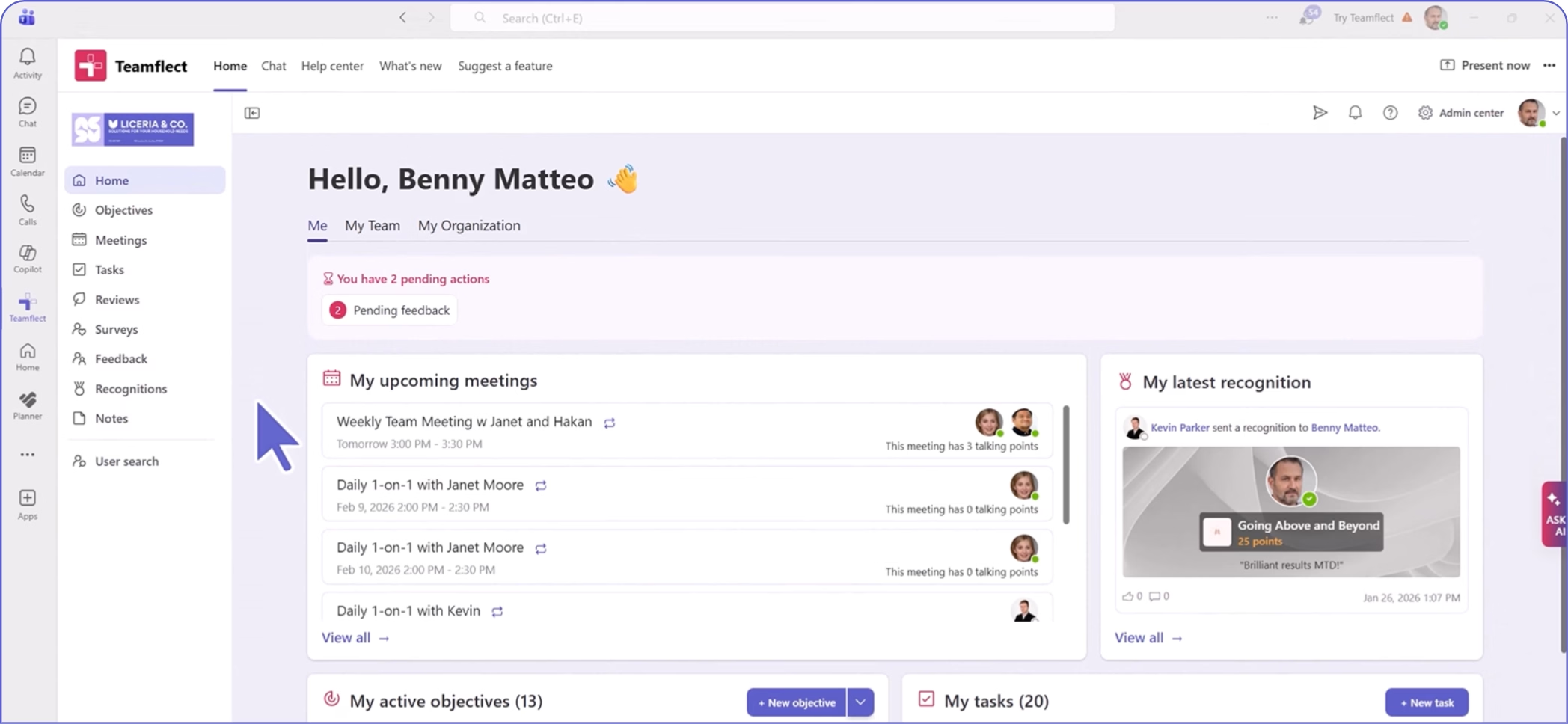
Create high-performing and engaged teams - even when people are remote - with our easy-to-use toolkit built for Microsoft Teams
.svg)