.svg)
.svg)
HCM vs Standalone Performance Management Software: What’s the Difference?

Updated on:
August 14, 2026


Prefer Teamflect as your HR source on Google
.svg)

In this article, we break down exactly how a standalone performance platform differs from your existing HCM suite, and whether adding a dedicated performance layer is worth the investment.
Research from Gallup shows that only 2 out of 10 employees strongly agree their performance is managed in a way that motivates them, which is why relying solely on a bundled HR module often falls short.
Why this matters now: Mid-market and enterprise teams no longer view this as an either/or choice. Modern HR leaders keep their core HCM for data management while adding a focused performance tool to drive daily engagement.
To see where each system fits, the table below outlines the key differences between an HCM suite and dedicated performance management software at a glance:
An HCM suite is designed to serve as your organization’s single system of record, centralizing core employee data, payroll, reporting lines, and compliance in one place. Platforms like Workday, SAP SuccessFactors, Oracle HCM, and UKG all exist to maintain an accurate, auditable single source of truth for your entire workforce.
Performance management sits inside that architecture as just one module among dozens. While this broad scope is a genuine strength for administrative HR, studies by Gartner show that the vast majority of managers find these bundled performance modules burdensome, which is why actual adoption rates remain so low.
If you want the acronyms untangled before we go any further, we covered that separately in our HRIS vs HRMS vs HCM guide.
Here is what your HCM does best:
A standalone performance platform focuses entirely on how performance happens day to day, rather than acting as a static database. It is designed to sit right on top of your existing HRIS or HCM, not replace it. As highlighted by Harvard Business Review, real-time feedback and short-cycle check-ins significantly reduce recency bias and keep development aligned with actual daily work.
This category includes tools like Teamflect, Betterworks, Lattice, Leapsome, and Performyard.
While each tool has its own focus, they all share one core philosophy: performance management deserves to be its own dedicated experience, not just a hidden tab inside a massive HR portal.
Here is what a standalone performance platform is built to own:
There's one common misconception here that's worth clearing up: "standalone" refers to scope, not isolation. These platforms pull employee data, org structure, and reporting lines straight from your central system of record and stay in sync as people join, move, or leave; meaning zero duplicate admin work for HR!
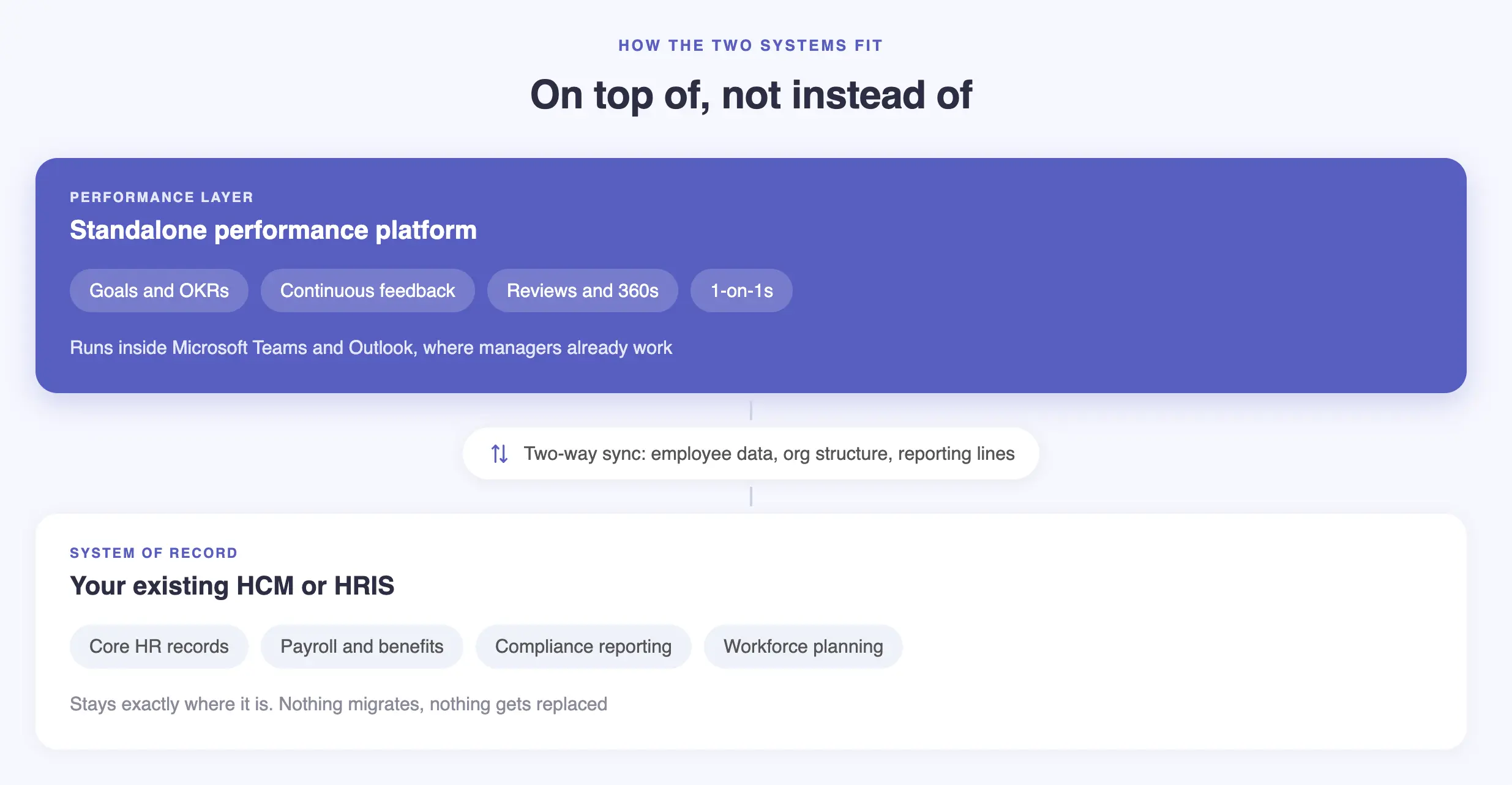
The honest difference between the two is not a feature count, because on paper the feature lists look pretty similar. What actually separates them is what each system is optimized to be good at, and that optimization shows up in almost every design decision underneath.
In most organizations, the HCM performance module technically works just fine. The problem is that hardly anyone actually uses it. The gap between what the tool can do and what people do with it is where things get costly - and it usually plays out in four ways:
Take a typical scenario from a mid-market manufacturing company with roughly two thousand employees: the HR team spends six weeks chasing overdue reviews by email, one manager at a time. Their HCM has a capable performance module sitting right there, yet most managers haven't opened it since their onboarding day.
Let’s be honest about what waiting costs. Doing nothing right now is still a decision. It means another year of reviews based on vague memories, another calibration round that leadership secretly takes with a grain of salt, and another group of managers who internalize that performance management is just HR paperwork rather than actual leadership.
For most organizations reading this, the answer is yes, and it is simpler than the procurement process tends to make it look! You keep the HCM, and you add a performance layer on top of it. Two objections come up in nearly every one of these conversations, so let me take them in the order they usually arrive.
Duplicate data. Employee records, organization structure and reporting lines sync automatically from the HRIS or HCM you’re already using. That means no separate databases to manage and no manual double entry to clean up at the end of the quarter. Teamflect integrates with over 200 HR platforms, including whichever one you’re running right now.
IT burden. Once it’s set up, your HR or People team manages the platform, not IT. You’re looking at a light setup that takes a few days, not a massive IT deployment that drags on for months, and that’s really the whole point.
Checking this against SAP? Take a look at our SAP SuccessFactors alternative page for a closer look.
This isn’t just theory or something we pulled from analyst reports, it’s simply what our own customer base looks like every day. More than a thousand organizations use Teamflect, from Fortune 500 enterprises to fast-growing startups. Most of them kept the HRIS or HCM they already owned when they brought us in.
We built Teamflect to work alongside your core HR tech, not fight against it. We sync with more than 200 HR platforms like Workday, SAP SuccessFactors, BambooHR, and HiBob; so employee data updates seamlessly without creating duplicate records or extra admin work.
The second half of the picture comes down to where people actually work. Because Teamflect runs directly inside Microsoft Teams and Outlook, managers can update goals, run 1-on-1s, and share feedback without ever opening a separate web portal. That simple choice is why our adoption rates consistently beat standard benchmarks, and it’s something an HCM module structurally can’t replicate.
It’s one thing to talk about data trends, but it’s much easier to see how this works through a real example. Here is how one enterprise team kept their existing HR setup exactly as it was and layered Teamflect on top.
Invacare is a global manufacturer in the life sciences and health industries, and it needed to digitize performance reviews across global teams. Instead of replacing their central system of record, they added Teamflect right on top of it.
Lenar Asanov, Senior Global Reward Analyst at Invacare, described the setup as "really, really easy" and gave it five stars. What made it so smooth was the scope: there was no massive system migration, no payroll data to move, and no compliance workflows to rebuild from scratch.
Employees found the tools intuitive from day one, giving Invacare a streamlined global workflow for goals, reviews, and feedback with zero downtime. Asanov described the shift in employee adoption as transformational.
If you’re trying to figure out which direction makes sense for your team, here are six practical questions to ask before committing to a contract:
There’s nothing wrong with your HCM. It does exactly what it was designed to do: maintain accurate workforce records. The gap is that HCMs were never built to drive daily managerial habits, and trying to stretch them into performance tools rarely works.
That’s where Teamflect comes in. Built natively for Microsoft 365, it runs inside Teams and Outlook, so managers actually use it, all while keeping your core HR database in sync behind the scenes. Want to see how this works with your current setup? Explore Teamflect for Enterprise or schedule a quick demo, you can even start for free while you evaluate!
Most HR software implementations fail before they ever take off, and Barry Flack knows exactly why. If you want an honest breakdown of where digital transformations go wrong, tune into this on your next drive.
Most companies will run a standard security review, and rightfully so, since any software handling employee data needs to be vetted. What it doesn't require is a massive IT implementation. Because you’re deploying a single app that connects directly to your existing HRIS, IT’s role is usually limited to an initial review and approval, rather than months of hands-on setup or ongoing maintenance.
In most cases: yes, though how smooth that transition is depends on what your current HCM lets you export. Overall rating history, goal records, and completed review forms usually transfer over cleanly. Free-text notes or custom fields might need a bit of manual mapping. A lot of teams choose to migrate just the last two review cycles for continuity and keep older records archived in their HCM for compliance, which saves time and effort.
This is actually one of the biggest hidden benefits of keeping the two systems separate. When your performance records live in a dedicated platform, switching your core HCM just means updating the data source behind it: your review history, past goals, and feedback logs remain completely untouched. Teams that rely solely on an HCM module often find their historical review data frozen or lost whenever they switch platforms, which is a massive headache that rarely gets factored into software budgets.
.avif)
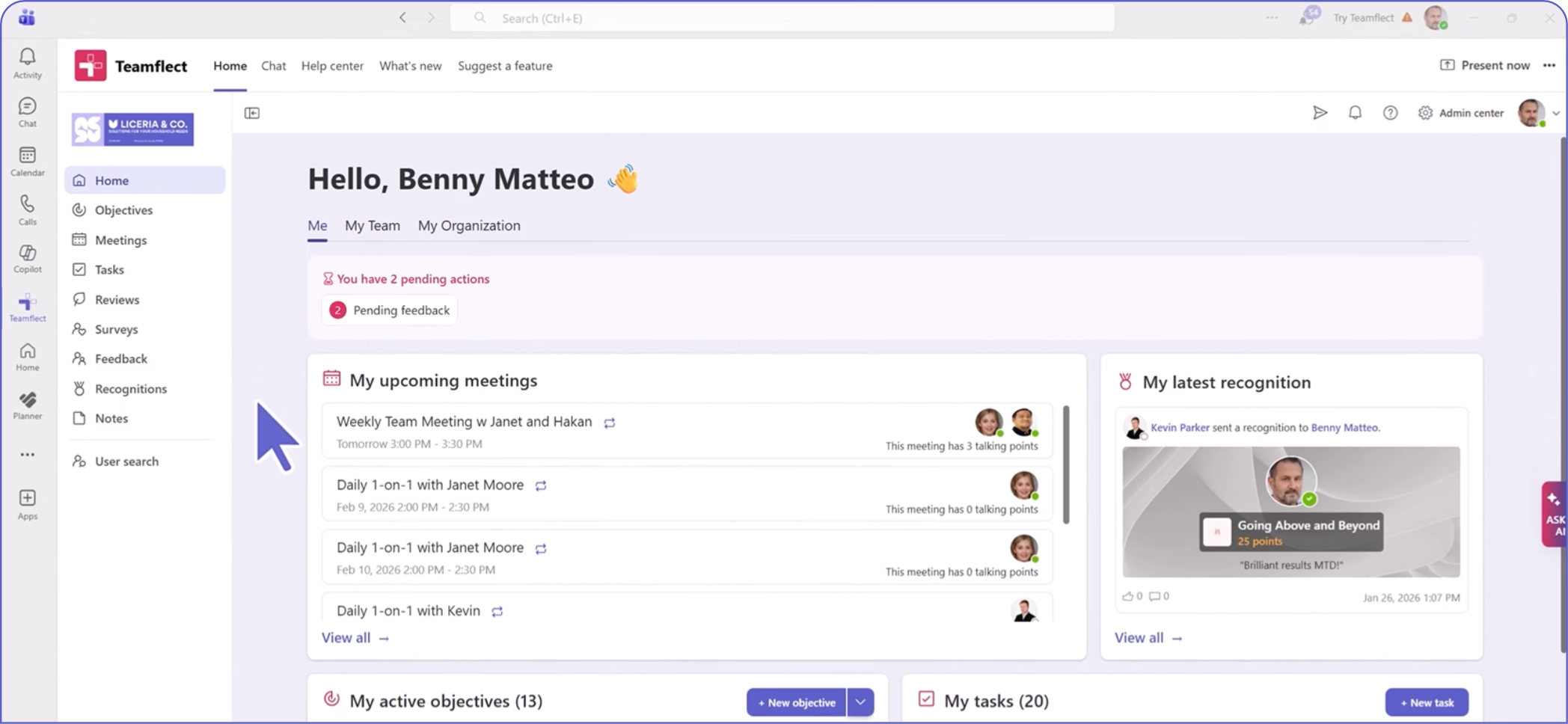
Create high-performing and engaged teams - even when people are remote - with our easy-to-use toolkit built for Microsoft Teams
.svg)