.svg)
.svg)
Best Practices in Education Performance Management

Updated on:
March 11, 2026

Prefer Teamflect as your HR source on Google
.svg)

Effective performance management in education connects individual teaching practices with broader institutional goals like improving student outcomes, maintaining accreditation standards, and supporting faculty development. Unlike traditional corporate settings, educational performance directly shapes the learning experiences of students and the professional growth of educators.
In this article, we'll examine how educational institutions can move from outdated annual review systems toward continuous, data-driven performance evaluation that addresses faculty needs and drives academic excellence.
Educational institutions face unique pressures that make structured performance management essential for institutional success. Student outcomes, accreditation requirements, and faculty development needs create an environment where systematic evaluation becomes the foundation for academic quality.
Faculty with clearly defined performance objectives deliver more effective instruction. Clear expectations about teaching standards, curriculum development, and student engagement allow educators to focus their efforts on what matters most. Research shows that institutions with structured faculty evaluation systems see measurable improvements in student satisfaction and learning outcomes.
Higher education faces significant retention challenges, particularly among early-career faculty. Institutions with strategic performance approaches retain talented educators more effectively, reducing turnover costs and preserving institutional knowledge. Structured performance systems create visible advancement pathways that help attract and keep quality faculty.
Documented performance objectives establish transparent standards for meeting accreditation requirements. Performance data demonstrates to accrediting bodies that the institution maintains consistent academic quality. This documentation is fundamental to maintaining institutional credibility and program approval.
Connecting individual faculty goals to institutional priorities ensures coordinated progress toward academic objectives. When performance evaluation cascades from strategic plans, entire departments move in alignment rather than working independently. This coordination becomes particularly important during curriculum redesign or program development initiatives.
Systematic performance reviews identify skill gaps early, enabling targeted professional development in new teaching methodologies, technology integration, or specialized subject areas. This continuous development approach keeps teaching practices current with educational research and student needs.
Educational institutions face distinct obstacles that differentiate academic performance management from other sectors. Understanding these challenges is the first step toward building more effective evaluation systems.
The semester system creates rigid timelines for performance evaluation. Many institutions compress reviews into narrow windows between terms, creating administrative bottlenecks. This cyclical pressure makes continuous feedback difficult to maintain, particularly when faculty are focused on course preparation or grading periods.
Faculty autonomy in teaching methods and research direction is a cornerstone of higher education. Performance systems must measure effectiveness without constraining the intellectual independence that drives academic innovation. Finding metrics that respect pedagogical diversity while maintaining quality standards remains a persistent challenge.
Educational institutions employ full-time tenure-track faculty, tenured professors, adjunct instructors, and administrative staff with vastly different responsibilities and evaluation needs. A one-size-fits-all performance system fails to capture the unique contributions of each group. Part-time and adjunct faculty often lack access to development resources despite representing a significant portion of instruction.
Student evaluations remain a primary assessment tool despite documented biases related to gender, race, and course difficulty. Traditional evaluation methods struggle to distinguish between popularity and pedagogical effectiveness. Institutions need multiple assessment sources to form accurate performance pictures.
Budget constraints leave many institutions with minimal funding for faculty development programs. Administrators lack time and resources to provide meaningful coaching alongside their other responsibilities. This resource scarcity makes implementing comprehensive performance management systems challenging without efficient technology solutions.
Modern performance approaches allow educational leaders to shift from administrative compliance toward developmental coaching. These practices ensure evaluation systems support the unique requirements of academic environments.
Move beyond annual performance reviews to semester-based touchpoints. You can read more about how often to conduct performance reviews to find a cadence that fits your institution. Brief, structured conversations at mid-semester and end-of-term allow department chairs to address teaching challenges, discuss student feedback, and adjust course approaches in real-time. This cadence aligns with the natural rhythm of academic work while preventing the administrative crush of year-end evaluations.
Design distinct performance criteria for tenure-track faculty, adjuncts, and administrative staff. A research-focused professor requires different metrics than an adjunct teaching multiple introductory courses. Role-specific frameworks respect the varied contributions across your institution while maintaining fair standards within each category.
Gather performance data from student evaluations, peer observations, administrative reviews, and self-assessments. Much like how an employee review with 360-degree feedback works in corporate environments, this comprehensive approach reduces individual biases and provides a fuller picture of faculty effectiveness. For a deeper look at how this method works, see our guide on the pros and limitations of 360-degree feedback. Peer observations offer particularly valuable insights into teaching practices that student surveys miss.
Align faculty objectives with departmental and institutional strategic plans. Knowing how to set effective performance goals is the foundation for this alignment. When professors understand how their course development or research activities support broader academic goals, their work gains purpose beyond individual achievement. This alignment ensures that performance management drives institutional progress rather than existing as an isolated administrative requirement.
Adopt performance management software that works within existing communication tools. Platforms with such capabilities allow faculty and administrators to access goals, feedback, and reviews without switching systems. This integration dramatically reduces the technology adoption barrier and administrative time burden.
Educational institutions need metrics that demonstrate teaching effectiveness and institutional quality. These key performance indicators provide evidence-based assessment while supporting accreditation requirements.
Track the percentage of students who complete courses with passing grades. This metric directly measures teaching effectiveness and course design quality. Analyzing completion rates across multiple sections identifies instructors who may need additional support or those with exemplary practices worth sharing.
Monitor the percentage of students meeting established learning objectives for courses and programs. This competency-based evaluation demonstrates whether instruction effectively transfers knowledge and skills. Outcome achievement rates provide concrete evidence for accreditation reviews and program improvement decisions.
Measure faculty engagement with training opportunities, conferences, workshops, and certification programs. This metric indicates institutional investment in teaching quality and individual commitment to professional growth. High participation rates correlate with teaching innovation and student satisfaction.
Track faculty involvement in course redesign, program development, and curriculum innovation. This metric recognizes work that falls outside traditional teaching responsibilities but significantly impacts institutional quality. Documenting these contributions ensures they receive appropriate recognition during performance reviews.
Monitor aggregated student evaluation data while accounting for known biases. Rather than relying on raw scores, track trends over time and compare within similar course types. This contextualized approach provides meaningful insights while reducing the impact of factors beyond instructor control.
Measure participation in departmental committees, cross-functional initiatives, and institutional service. Collaborative work strengthens academic programs and builds institutional culture. Tracking this contribution ensures that faculty who invest in community-building receive appropriate recognition.
For research-focused positions, monitor publication frequency, grant applications, and scholarly contributions. These metrics must align with institutional expectations and faculty appointments. Different institutions weigh research differently, so performance systems should reflect your specific mission.
Track the number of students advised, mentorship relationships with junior faculty, and participation in student success initiatives. Understanding individual development plans can help formalize these mentorship goals and make them measurable. Quality advice directly impacts student retention and graduation rates.
Well-intentioned evaluation systems can fail when institutions repeat common errors. Avoiding these mistakes creates more effective performance processes.
Many institutions weigh student feedback too heavily despite documented biases. Research shows that student evaluations correlate with instructor gender, race, and course difficulty more than teaching effectiveness. Effective performance systems balance student input with peer observations, learning outcome data, and other objective measures.
Using the same evaluation criteria for tenure-track researchers, adjunct instructors, and administrative faculty produces meaningless data. An adjunct teaching four sections of introductory courses cannot be fairly assessed using research publication metrics. Performance systems must reflect actual job responsibilities and institutional expectations for each role.
Waiting until end-of-year reviews to address performance concerns prevents timely course correction. Faculty deserve ongoing feedback that allows them to improve teaching practices during the semester. Regular check-ins distribute coaching throughout the year rather than creating high-stakes annual events.
Performance systems that focus exclusively on classroom instruction miss significant faculty contributions. Curriculum development, student advice, departmental service, and mentorship activities strengthen institutions but often go unrecognized. Comprehensive evaluation frameworks acknowledge all forms of academic work.
When performance management becomes a bureaucratic checkbox exercise, both faculty and administrators disengage. The process must yield actionable insights that improve teaching effectiveness and support professional growth, not just satisfy accreditation requirements.
Performance management in education is shifting toward competency-based, technology-enabled approaches that address changing student needs and institutional challenges. These trends reflect the unique pressures facing academic institutions. For a comparison of how these approaches differ from more traditional models, see our overview of performance management models.
Higher education is shifting from time-based metrics to competency-based assessments. Instead of counting years of service, institutions now evaluate faculty through demonstrated teaching skills and student outcomes. This approach prioritizes classroom performance over the number of courses taught, providing a clearer picture of actual effectiveness.
Currently, 80% of faculty include career readiness into their lessons, aligning assignments with specific professional competencies to help students identify the exact skills they are gaining.
Artificial intelligence transforms faculty evaluation by enabling predictive insights into teaching effectiveness. An AI agent can analyze student performance data, identify patterns in learning outcomes, and suggest targeted professional development. These tools help department chairs spot potential challenges before they impact student success.
The 2025 UPCEA-EDDY AI Readiness Report indicates that 70% of higher education institutionsplan to implement AI-powered analytics for faculty support within two years. These systems can flag courses with declining completion rates or identify instructors who would benefit from specific pedagogical training.
Universities are adopting Objectives and Key Results frameworks to replace rigid annual goal-setting processes. OKR software enables semester-based goal cycles that adapt to curriculum changes, enrollment shifts, and evolving institutional priorities. These platforms provide real-time OKR trackingcapabilities that traditional systems cannot match.
Faculty increasingly work in hybrid environments, teaching both in-person and online courses. Mobile-first platforms allow performance documentation and feedback from any location. Mobile-first platforms enable performance documentation and feedback from any location, providing essential flexibility as institutions expand distance education. This shift mirrors student behavior: 67% of students now use smartphones and tablets for academic purposes, a rate that has nearly doubled in a single year.
Performance management platforms are beginning to integrate directly with learning management systems like Canvas, Blackboard, and Moodle. With this integration, department chairs can now review actual classroom performance data such as student engagement metrics and learning outcome achievement, rather than relying solely on self-reported information.
Moreover, the trend toward integrated systems reduces duplicate data entry and provides more accurate performance pictures. Faculty appreciate systems that pull information automatically rather than requiring manual reporting of teaching activities.
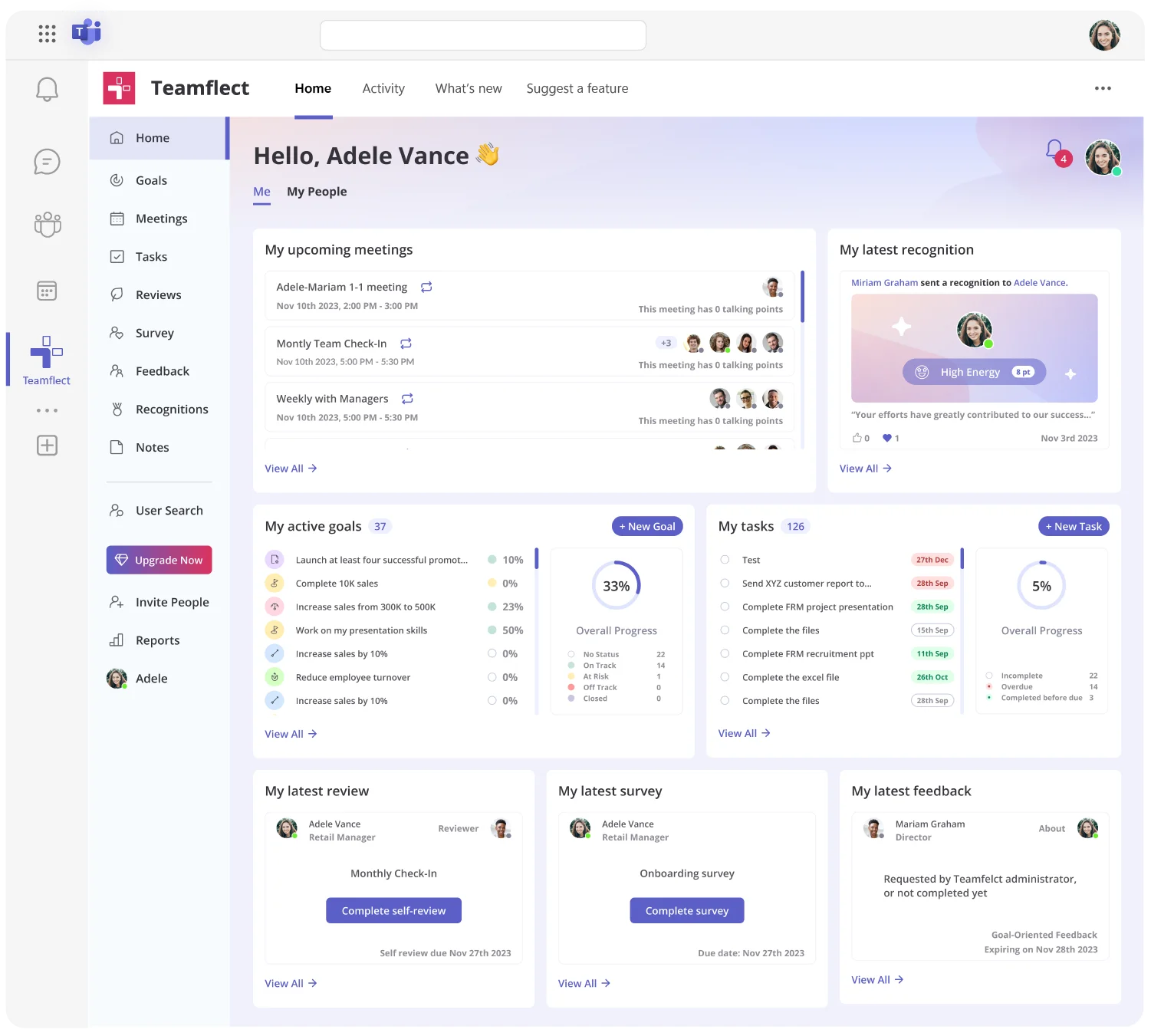
Teamflect provides performance management solutions designed for the unique requirements of educational institutions. The platform integrates directly into Microsoft Teams to reduce technology friction and administrative burden. For a look at how similar challenges are addressed in another regulated sector, see our guide to performance management in healthcare.
Educational institutions must balance teaching quality, research expectations, and faculty development within rigid academic calendars. Teamflect helps academic leaders create structured growth environments while minimizing administrative friction.
"We've accomplished more than 50% of our strategic plan within one year. That's pretty crazy. We were able to facilitate that because we were using a tool like Teamflect."
Ian Brown - Director of Campus Recreation & Wellness, Furman University
Furman University, a private liberal arts institution in Greenville, South Carolina, transformed departmental performance using Teamflect. The Department of Campus Recreation and Wellness needed better ways to track strategic objectives, conduct one-on-one meetings, and manage faculty development.
Read the full customer story →
"I would highly recommend Teamflect. It's refreshing, easy to use, and flexible enough to support everything from goals and recognition to reporting and evaluations."
Stacy Ybarra - Director of Teaching Excellence, OLLU
Our Lady of the Lake University (OLLU), a Hispanic-serving institution in San Antonio, Texas, needed better ways to recognize faculty contributions and connect individual work to larger institutional goals. Before Teamflect, the university lacked tools for consistent recognition and meaningful performance feedback.
Read the full customer story →
"Day or night, for whatever I need, I've always been able to reach somebody, and not just somebody who can listen but somebody who can help. Customer support has been excellent."
Casey Cox - Vice President of People Operations, Mansfield Hall
Mansfield Hallsupports neurodiverse learners across three states. They needed to maintain a supportive culture during a shift from Google to Microsoft.
Read the full customer story →
Base evaluations on multiple data sources rather than student feedback alone. Combine peer observations, learning outcome achievement, curriculum contributions, and self-assessments to capture comprehensive performance pictures. Maintain detailed documentation throughout the semester to prevent recency bias and ensure reviews reflect consistent work quality across the entire evaluation period.
Keep dated notes from regular check-ins documenting specific examples of teaching effectiveness, curriculum contributions, and professional development activities. Record both exemplary teaching practices and areas needing improvement as they occur. Include objective data such as student learning outcomes, course completion rates, and peer observation feedback. This continuous documentation provides context during formal evaluations and supports personnel decisions.
Conduct calibration sessions at least once per semester to ensure rating consistency across departments and evaluators. Because academic standards must be uniform, department chairs should review ratings together to verify that a "meets expectations" rating in one department carries the same meaning as in another. Regular calibration prevents rating inflation and maintains evaluation integrity across the institution.
Address performance gaps immediately through structured conversations that identify root causes. Distinguish between skill deficits (requiring professional development), resource limitations (needing institutional support), and behavioral issues (requiring corrective action). Create focused improvement plans with specific, measurable milestones tied to teaching effectiveness or service contributions. Provide necessary training, mentorship, or resources before moving to formal disciplinary processes.
The primary challenge is time scarcity during academic calendar pressure points. Department chairs often oversee large faculty groups while handling significant teaching and research responsibilities themselves. Other challenges include balancing academic freedom with accountability, managing diverse faculty employment types, addressing biases in student evaluations, and maintaining documentation standards. Performance management software that automates administrative tasks and integrates with existing tools helps address these constraints.

.svg)
.avif)
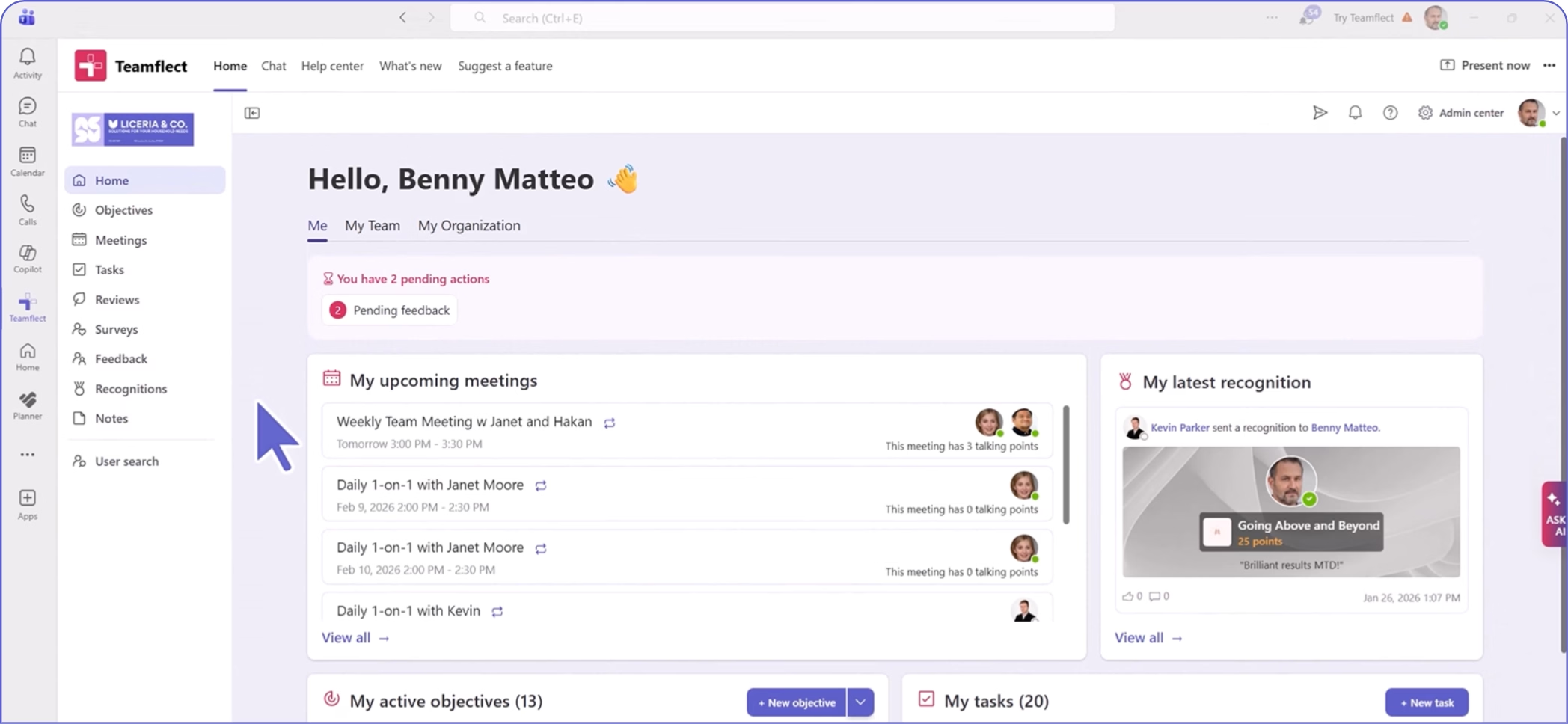
Create high-performing and engaged teams - even when people are remote - with our easy-to-use toolkit built for Microsoft Teams