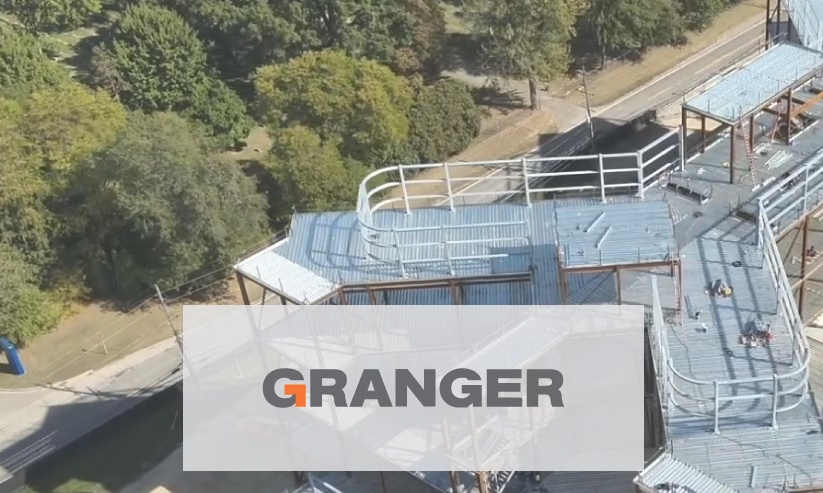
Granger Construction is a Michigan-based construction firm specializing in large-scale projects across K–12 education and healthcare. Headquartered in Lansing, the company operates from offices on the west side of Michigan, in Detroit, and in the Columbus, Ohio area, with a workforce that spans superintendents, project managers, and project engineers in the field alongside robust office teams at each of its four locations.
In February 2026, Granger launched its first organization-wide performance management process — powered by Teamflect.
We interviewed Melissa Lagodzinski, People Development Specialist at Granger Construction, who shared how her team designed a connected performance workflow on Teamflect — and how the platform now keeps Granger's people development process organized, structured, and easy to track.
A Five-Step Workflow for Performance Conversations
“I love the feature that when we generate reviews for a certain role, our team members get a ping from Teamflect indicating that their skills assessment is available.”
Melissa Lagodzinski — People Development Specialist
Melissa and her team built Granger's performance management process around a clear, repeatable flow — one that starts with self-reflection, builds in leader perspective, and lands in a structured manager–employee conversation.
Step one: team members receive an automated ping from Teamflect when a skills assessment is generated for their role. They open it, reflect on the skills they currently demonstrate, and submit their self-assessment in about 20 minutes.
“Once they've completed that, it pings their leadership, and then their leader can hop on and complete a review that indicates how that particular leader feels the individual is doing or demonstrating the skills.”
With both perspectives captured — the team member's self-assessment and the leader's review — Granger then encourages the pair to hold a check-in meeting. These conversations typically run anywhere from 30 minutes to an hour and a half, and cover the skills assessment as well as the team member's goals for the year.
To close the loop, the manager and team member log the check-in in Teamflect's surveys module — recording the date, capturing key discussion points, and noting any action steps.
“It's been a handy tool for us in terms of tracking — yes, individuals are having these check-ins, and they're having them fairly regularly.”
The result is a performance management process that doesn't live in scattered emails or one-off forms. From skills assessment to check-in survey, every step lives in the same place.
Goals That Stay Alive Across the Year — and a Clear View of Engagement
“Once they enter those goals, their leadership is able to hop on to Teamflect and take a look at them. It just generates more discussion.”
Melissa Lagodzinski — People Development Specialist
Alongside the skills-assessment workflow, Granger's team uses Teamflect's goals module to keep development conversations active throughout the year. Each team member is asked to set at least one goal, with five to seven goals as the general target. Some have set as many as twenty.
Once entered, goals don't sit dormant. Leaders have visibility into their team members' goals, which gives them a starting point for ongoing conversations. Granger also encourages multiple check-ins across the calendar year — each logged via the surveys module so progress is captured, not just discussed. For Melissa, that visibility extends to the HR view as well.
“The reporting functionality is something I go to almost on a weekly basis to see where we're at. It allows me to know — okay, individuals are engaging with the process and they're entering their information into Teamflect.”
Knowing who's completed what, when, and how often is exactly the kind of operational intelligence Granger needed when launching its first organization-wide performance process.
“It has been an A-plus from the Teamflect staff. Their availability, their ability to respond and answer questions in a way I can really understand — having them there to help me navigate Teamflect has been really nice.”
Melissa Lagodzinski — People Development Specialist
Melissa, who has previously delivered customer service training herself, doesn't give A-plus ratings lightly. But she gives one to Teamflect's customer service team — and especially to her Customer Success Manager, Sue.
During Granger's launch in early 2026, Melissa sent a steady stream of questions to her Teamflect reps.
“I can't think of a single time where I had to wait more than maybe an hour or two to get a response from my Teamflect representative.”
Sue regularly hopped on Teams calls to share screens and walk Melissa through features, and the team sent screenshots via email when that was the fastest path to a clear answer. On the rare occasion Sue was unavailable, someone else was reaching out within minutes to make sure Melissa wasn't stuck.
For an HR leader launching an organization-wide performance process for the first time, that level of responsiveness made the difference.
A Recommendation Anchored in Microsoft Teams
I would definitely recommend Teamflect to other organizations that use Microsoft Teams.
Melissa Lagodzinski — People Development Specialist
Asked whether she'd recommend Teamflect to peer organizations, Melissa's answer pointed to the same alignment that's made it work at Granger: Teamflect lives where Microsoft Teams shops already work. For Granger's office teams — who use Teams every day as second nature — that's been a natural fit.
“There's a lot of other functionality that, when we signed up with Teamflect, we didn't even think about. Teamflect could be sending pulse surveys or reviews — there's more we could be taking advantage of.”
Melissa is also clear-eyed about where Teamflect could grow with Granger over time. Beyond the performance management use case the team has built around, she sees real potential to use Teamflect for pulse surveys, onboarding check-ins at 30 and 60 days, and other HR workflows that the platform supports.
Three months into running Granger's first organization-wide performance management process on Teamflect, the foundation is in place — and the platform has plenty of room to grow alongside the company's people strategy.

.svg)