.svg)
.svg)
Lawyer Performance Reviews: A Practical Guide for Law Firms (with a Filled-In Attorney Review Form)

Updated on:
October 16, 2026


Prefer Teamflect as your HR source on Google
.svg)

A lawyer performance review is a firm's internal evaluation of an attorney's legal work, economic contribution and professional growth over a defined period. This guide is for the people who run that process inside a firm: criteria by role, the behaviours behind the billable hour, a review form you can copy, and where the data has to live.
This is not about writing a public review of a lawyer you hired; if that is what you came for, this guide will not help.
As of September 2026, the practical problem for larger firms is not whether performance reviews should happen. It is how to make the process consistent enough to mean something across practice groups, offices and levels of seniority.
A partner, a junior associate and a member of the firm's IT team should not walk into the same review process with the same definition of good performance. The criteria need to reflect the work. The evidence needs to be available when the review happens. And the conversation needs to lead somewhere beyond a rating that gets filed away until next year.
Most firms run an annual cycle built from four inputs: a self-assessment, supervising partner input, peer or 360 feedback, and matter and billing data pulled from the practice management system.
The annual review is the formal point in the process, but the useful information should be collected throughout the year. A review assembled entirely from memory will naturally overemphasize recent matters, recent mistakes and whichever projects happen to be easiest to remember.
A workable law firm performance review process looks like this:
The documentation also matters beyond the mechanics of the review itself. This is where legal requirements for documenting performance evaluations come in.
A partner, a fifth-year associate and a paralegal are not measured on the same things, and using one form for all three is the most common reason review scores stop meaning anything.
The firm needs a consistent review structure, but consistency does not mean identical criteria. A good process gives every role a clear definition of what matters while keeping the underlying review format comparable.
The distinction between a role and a seniority level matters here. Two associates may have the same title but very different expectations depending on their level of independence, client exposure and responsibility for other people.
For example, a senior associate who is still producing technically strong work but requires a partner to repeatedly rework the same matter has a different development issue from a junior associate who is making the same drafting error for the first time. A useful review makes that distinction visible.
The same principle applies outside the legal track. Marketing, finance and IT should not be forced into attorney-specific criteria simply because they are part of the same firm. Their performance measures should reflect the service they provide to the business.
This is also where a skills matrix for legal teams can help when a firm needs to map expectations across different levels and functions.
Publish this table to the firm at the start of the review period; the criteria do the work only if people see them before they are measured against them.
Billable hours, realization and collections tell you what already happened; they do not tell an associate what to do differently next quarter.
That does not make billable hours unimportant. A law firm still needs to understand the economic contribution of its matters, and billing data is one of the clearest sources of that information.
The problem starts when a lagging metric becomes the only thing a manager can coach.
If an associate records fewer billable hours than expected, the number itself does not explain why. Was work unavailable? Were hours entered late? Was time written off because the matter was poorly scoped? Did the attorney absorb work that should have been delegated? Did the client relationship create a realization problem?
Those are different management questions, and they require different responses.
The better approach is to keep the economic metric while pairing it with a leading behaviour that can still be changed during the review period.
The right-hand column is what a manager can coach on mid-cycle; the left-hand column is what the compensation committee reads at the end of it.
The form below is a mid-level associate review, filled in, so you can see what a usable entry looks like before you adapt the categories to your own practice groups.
The filled example shows why specificity matters. "Strong associate" tells the attorney very little. A record of how much partner editing was required, what responsibility the associate took on, and how clients responded gives the next review something concrete to compare against.
It also creates continuity. When the next review comes around, the reviewer can ask whether the associate actually moved into first-chair responsibility, whether the negotiation programme was completed, and whether the expected improvement appeared in the work.
Change the criteria per role using the table above; keep the structure, because a form that changes shape every year cannot be compared year over year.
For firms that want more examples of evidence-based wording, these attorney performance review examples can be used alongside the form. If the firm needs a broader reference point, the filled-in attorney review form can also be adapted to the firm's own review structure.
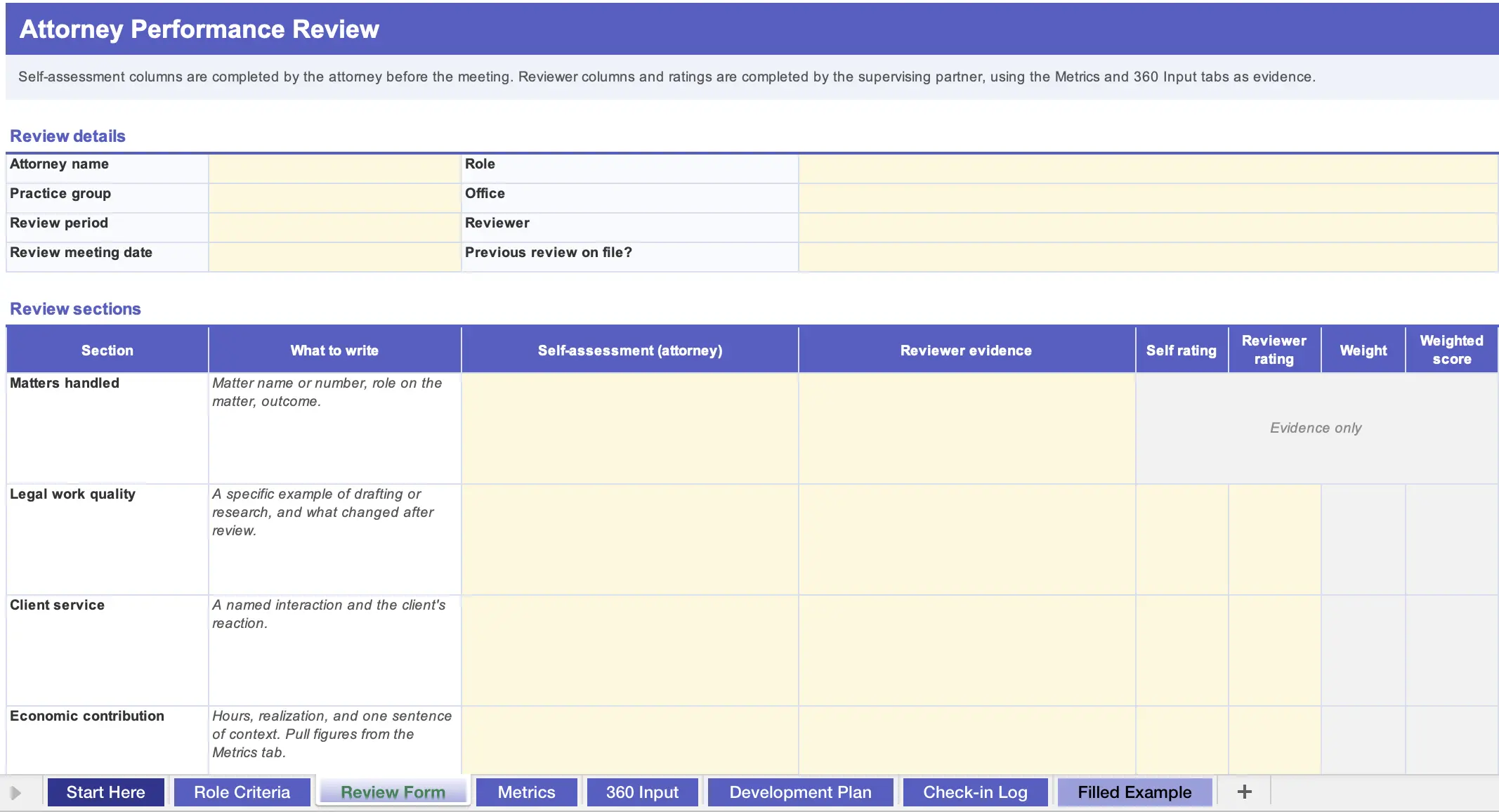
We put together a detailed performance review template tailored specifically for lawyers. It includes all the different sections mentioned above and is fully customizable.
The conversation fails in three predictable places: the feedback is a surprise, it is about the person rather than the work, and it ends without a plan.
That is why the quality of the meeting depends heavily on what happens between formal review cycles. A well-written form cannot rescue a process in which the attorney has spent the entire year without knowing what the supervising partner expected.
Short check-ins are what keep that plan alive. They also give HR and practice group leaders a record of what was discussed rather than forcing everyone to reconstruct a year's worth of conversations from memory. For firms looking to make those conversations consistent, documented 1-on-1s between cycles can provide a shared place for agendas, notes and follow-up actions.
For larger firms, this is particularly useful when people work across offices or practice groups. The review should be the formal summary of the performance record, not the only place where that record exists.
Before a firm rolls out any review system, three questions have to be answered: who can read an evaluation, where the data is stored, and whether every access leaves a trace.
Performance review data is not ordinary employee survey data. An evaluation may contain matter references, client names, performance concerns, compensation-related information and comments about an attorney's development. In a large firm, the access model matters as much as the review workflow.
The exact requirements will depend on the firm's policies, client obligations and regulatory environment, but these are the questions an IT or risk team is likely to put to a vendor.
These should not be treated as questions to answer after the software has already been selected. They belong in the evaluation process before the pilot begins.
For enterprise deployments, Teamflect documents dedicated infrastructure, customer-managed encryption keys, data residency controls, IP allowlisting, role-based permissions and audit logs that can be streamed to SIEM platforms as part of its Enterprise offering.
Those controls are part of the Enterprise offering rather than general product capabilities, so firms should evaluate them against their own IT, security and client requirements. More detail is available under enterprise security and data residency controls.

Most firms live in Outlook, Word and Teams; a review tool that needs a separate login is a tool that gets used once a year.
This is where performance review software that works inside the Microsoft ecosystem can remove some of the friction from the process. Teamflect is built natively for Microsoft Teams and Outlook, and its performance review workflow can connect reviews with goals, competencies and 360-degree feedback.
Associates, partners and business services do not review on the same clock.
A firm may have different expectations around the timing and evidence used for different populations. The software should support that organizational reality rather than forcing everyone into one generic process.
360 requests go out and come back inside the same tool, not by email.
For example, Teamflect's 360-degree feedback functionality supports input from peers, managers, direct reports and external parties, with configurable feedback providers and visibility settings.
So the annual review is assembled from notes, not memory.
That record is especially useful when the person writing the annual review is not present for every matter or every conversation. It creates continuity between the formal cycle and the day-to-day management of performance. Teamflect's 1-on-1 functionality supports shared and private notes and keeps meeting information available across recurring conversations.
The table above is the checklist; ask for it in writing before the pilot.
A vendor that cannot clearly explain permissions, infrastructure, data residency, encryption, logging and authentication before implementation is likely to create more work for the firm's IT and risk teams later.

Law firms typically conduct performance reviews by combining self-assessments, supervising partner input, peer or 360 feedback, and matter and billing data, followed by a review conversation and development plan.
The exact cycle varies by firm, but the strongest processes connect the formal annual review with shorter check-ins throughout the year. That gives the reviewer evidence from multiple sources rather than relying on memory at year-end.
Most law firms can use an annual formal review supported by shorter check-ins throughout the year.
The annual review provides the formal record for performance, development and compensation-related decisions where applicable. Shorter check-ins allow managers to address performance issues, recognize progress and update goals before the next annual cycle.
The right cadence can differ by role and practice group. What matters most is that the firm's criteria and expectations are clear before the employee is evaluated against them.
An attorney performance review should include matters handled, legal work quality, client service, economic contribution, supervision and teamwork, and development goals.
The weighting should change by role. For example, an equity partner may need substantial attention on book of business, client retention and developing others, while a first-year associate may be evaluated more heavily on research quality, writing clarity, responsiveness and learning speed.
Evaluate a lawyer beyond billable hours by pairing economic outcomes with observable behaviours such as drafting quality, client responsiveness, deadline reliability, matter ownership, supervision and business development activity.
Billable hours, realization and collections remain useful lagging measures of economic contribution. They simply work better when the review also captures the behaviours that influence those results and can still be coached during the review period.
Law firms can use 360-degree feedback when the people contributing feedback have direct knowledge of the attorney's work and the questions are relevant to the role.
A supervising partner may see matter ownership, while a junior associate may see supervision quality and a client may see responsiveness. Bringing those perspectives together can provide a fuller picture than relying on one reviewer alone.
It should not mean sending a long questionnaire to everyone who has interacted with an attorney. A short, role-relevant set of questions is more useful, particularly when the firm already has other sources of performance data.
Yes, a law firm using Microsoft 365 can run performance reviews inside its existing Microsoft environment if it selects a platform that supports that deployment model.
Teamflect, for example, is built for Microsoft Teams and Outlook and supports performance reviews, goals, 360-degree feedback and 1-on-1s within the Microsoft ecosystem. Its Enterprise offering adds controls such as dedicated infrastructure, customer-managed encryption keys, data residency controls and advanced security logging for organizations with those requirements.
The more important question is not simply whether the software can run inside Microsoft 365. It is whether the review process, permissions, data governance and evidence trail fit the firm's actual operating model.
.avif)
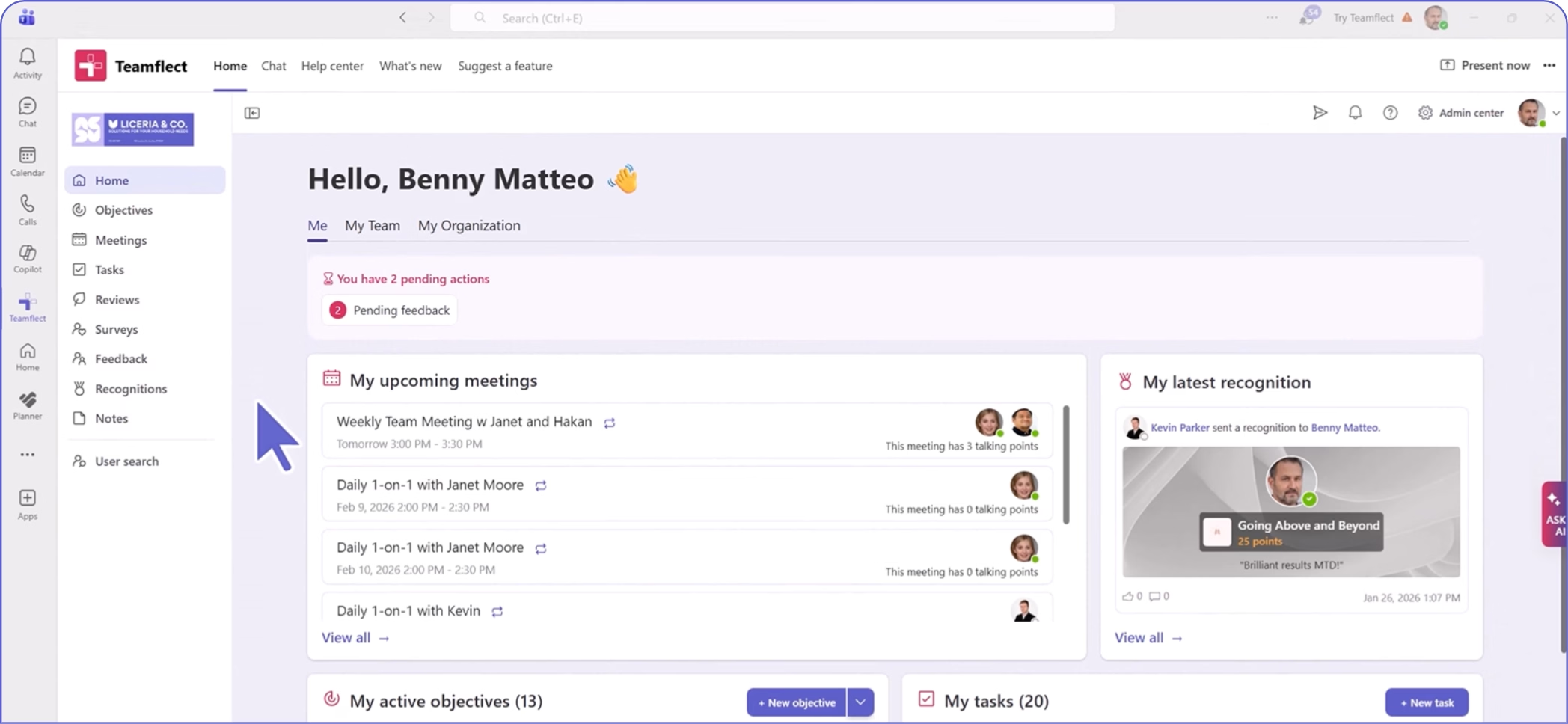
Create high-performing and engaged teams - even when people are remote - with our easy-to-use toolkit built for Microsoft Teams
.svg)


.webp)
