How to Build a Coaching Culture: A Manager-Led Plan With 1:1s, Feedback and AI Coaching

Updated on:
November 5, 2026


Prefer Teamflect as your HR source on Google


To build a coaching culture, make coaching the normal way managers lead: they ask questions, give regular feedback and agree on development actions in every 1:1. This guide gives you six steps, a four-stage maturity model and a GROW question guide. It also covers the metrics to track and where AI coaching helps.
A coaching culture is a workplace where managers and colleagues regularly help each other think through problems, build skills and take ownership, instead of only giving instructions or judging results.
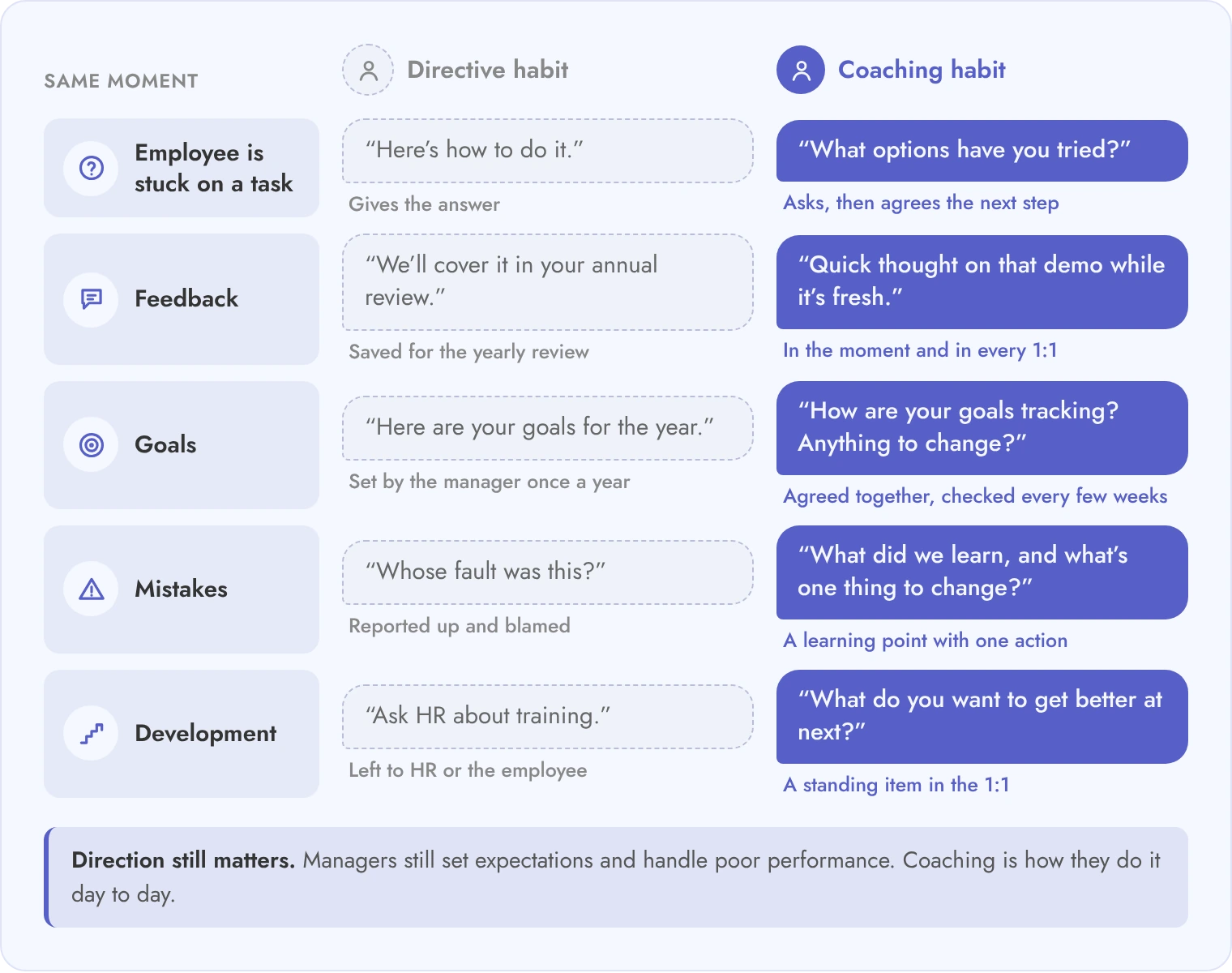
| Situation | Directive habit | Coaching habit |
|---|---|---|
| An employee is stuck on a task | The manager gives the answer. | The manager asks “What options have you tried?” and agrees on the next step. |
| Feedback | Given mainly in the annual review. | Given in the moment and in every 1:1. |
| Goals | Set by the manager once a year. | Agreed together and checked every few weeks. |
| Mistakes | Reported up and blamed. | Discussed as a learning point with one action. |
| Development | Left to HR or the employee. | A standing item in the 1:1. |
Coaching doesn't replace direction: managers still set expectations and handle poor performance, and coaching is how they do it day to day.
Build a coaching culture in six steps. Get leaders to model it, define three manager habits and train with a simple model. Then put coaching into the 1:1, connect it to goals and feedback, and measure it.
With Teamflect, the 1:1 agenda, the notes and the goals that you coach on all sit in Microsoft Teams, where managers already work.
A coaching culture grows in four stages, from a few managers coaching on their own to coaching that every team does without being told.
| Stage | What it looks like | Signal you can see | Next move |
|---|---|---|---|
| 1. Ad hoc | A few managers coach, most don't. | 1:1s happen when people have time. | Define the three manager habits and train one pilot group. |
| 2. Trained | Managers know the model but use it unevenly. | Training is done, 1:1 notes are thin. | Give every 1:1 a fixed agenda and a development action. |
| 3. Embedded | Coaching is part of 1:1s, goal reviews and feedback. | Most 1:1s end with an agreed action. | Start peer coaching groups for managers. |
| 4. Self-sustaining | Employees ask for coaching and coach each other. | Teams raise their own development goals. | Review the model every year and share examples across teams. |
Use the model to pick one stage to move up this quarter instead of fixing everything at once.
The GROW model gives managers four questions to use in any coaching conversation: what's the Goal, what's the Reality, what Options exist, and what Will the person do.
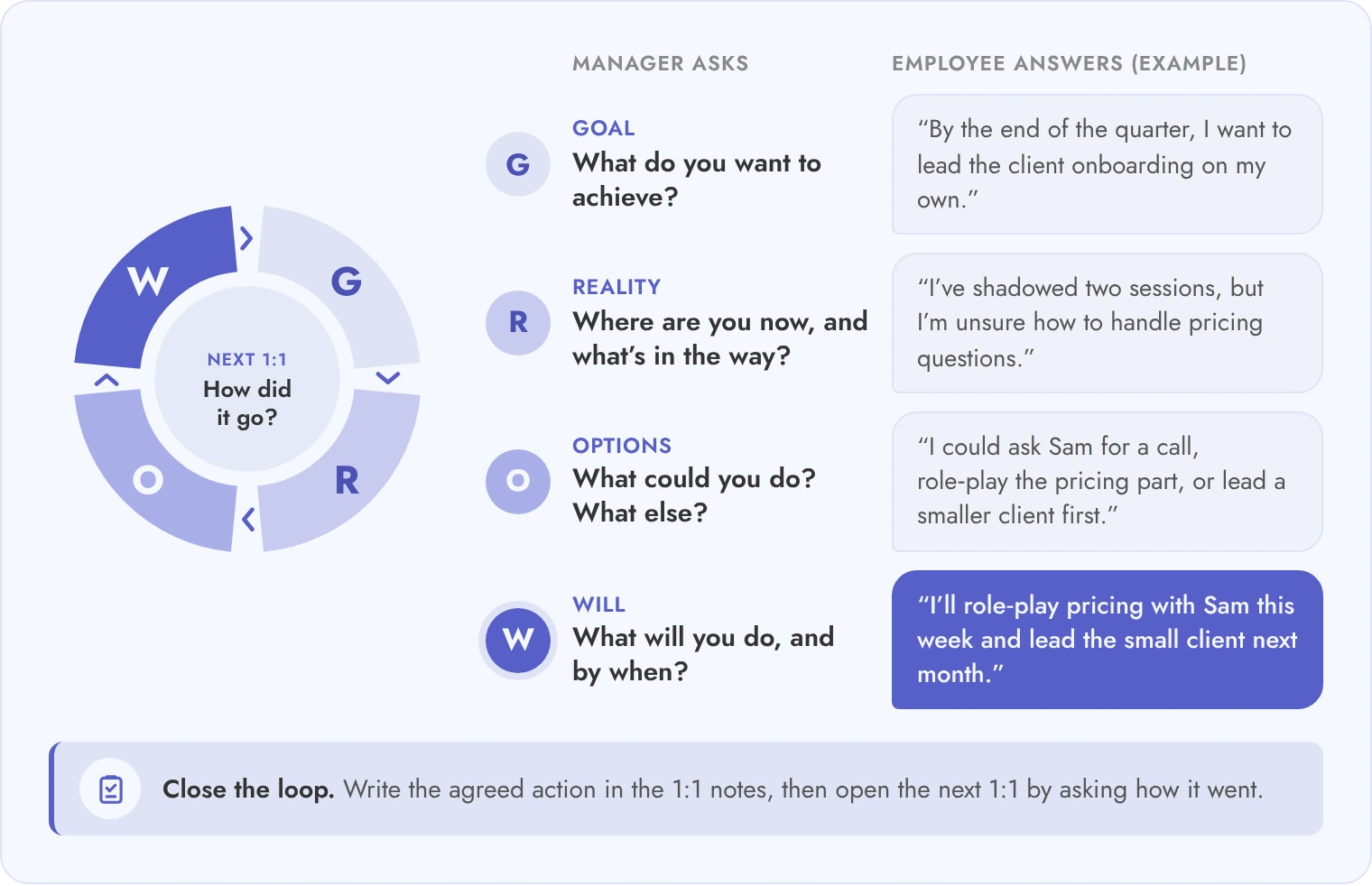
| Step | Question to ask | Example in a 1:1 |
|---|---|---|
| Goal | What do you want to achieve? | “By the end of the quarter, I want to lead the client onboarding on my own.” |
| Reality | Where are you now, and what's in the way? | “I've shadowed two sessions, but I'm unsure how to handle pricing questions.” |
| Options | What could you do? What else? | “I could ask Sam for a call, role-play the pricing part, or lead a smaller client first.” |
| Will | What will you do, and by when? | “I'll role-play pricing with Sam this week and lead the small client next month.” |
Write the agreed action in the 1:1 notes and open the next 1:1 by asking how it went.
Measure a coaching culture with a few habit metrics, such as how many 1:1s end with an agreed action, and a short employee survey on how coaching feels.
| Metric | Where to find it | What it tells you |
|---|---|---|
| Share of managers who hold a regular 1:1 with each report | 1:1 records | Whether the basic habit exists |
| Share of 1:1s that end with an agreed action | 1:1 notes | Whether conversations lead to development |
| Progress on development goals | Goal check-ins | Whether coaching changes results |
| Peer feedback given per team | Feedback records | Whether coaching spreads beyond managers |
| Employee survey score on the five statements below | Pulse survey | How coaching feels to the employee |
Send these five statements every quarter, ask people to rate each from 1 (strongly disagree) to 5 (strongly agree), and compare the results by team.
Run this survey inside Microsoft Teams with Teamflect and compare coaching scores between teams on one dashboard. Learn more about Teamflect pulse surveys.
AI coaching uses AI tools to give employees and managers on-demand development support, such as goal setting, skills practice and preparing for hard conversations.
| Need | AI coaching can help | A human manager or coach is needed |
|---|---|---|
| Everyday career and skills questions | Yes, on demand and at low cost | For a deeper career plan |
| Practicing a hard conversation | Yes, as a rehearsal before the real talk | To give feedback on the real conversation |
| Preparing a 1:1 or a feedback note | Yes, as a first draft that the manager edits | To decide what to say and to own the message |
| Emotionally charged, political or values-based topics | Limited | Yes |
| Privacy of coaching notes | A risk to check with IT and Legal | A manager follows existing HR confidentiality rules |
A Conference Board report, covered by HR Dive in October 2025, found that AI can handle most everyday career coaching. It's weaker on emotionally charged or values-based topics and carries privacy risks. The report recommends a blended model, in which managers use AI insights to improve their own coaching conversations and escalate to a human coach when needed. Gartner published research in March 2026 on when and how to use AI coaching, which says it can raise development across a large workforce at relatively low cost.
Treat AI as a preparation and practice tool for managers, and keep the coaching conversation itself human.
Coaching efforts stall when managers lack time, leaders don't model the habit, training is a one-off, or nobody checks whether coaching happens.
| Barrier | Sign | Fix |
|---|---|---|
| Managers say they have no time | 1:1s are skipped or shortened | Keep the 1:1 to a fixed length with a fixed agenda, and remove one other recurring meeting |
| Leaders don't model coaching | Executives give orders in meetings | Ask executives to run one coaching 1:1 and share what they learned |
| Training is a one-off | Skills fade within weeks | Add short monthly peer sessions with real cases |
| Nobody measures it | No data on 1:1s or actions | Track the habit metrics and share them with managers every quarter |
| Remote and hybrid teams | Fewer chances to coach informally | Schedule the 1:1 and send reminders, so it doesn't depend on bumping into each other |
Fix the barrier that shows in your data first, and expect the culture to change over several quarters, not weeks.
A coaching culture is a workplace where managers and colleagues regularly ask questions, give feedback and agree on development actions. People grow through everyday conversations, not only through training courses or reviews.
Get leaders to model coaching, define three manager habits, train managers with a simple model such as GROW, put coaching into the regular 1:1, connect it to goals and feedback, and measure the results.
Managers coach in their 1:1s. They ask open questions, give specific feedback, agree on development actions and follow up on them, while HR supports them with training, tools and data.
Track three habits: how many managers hold regular 1:1s, how many 1:1s end with an agreed action and how development goals progress. Then add a short quarterly survey on how coaching feels to employees.
GROW is a four-step coaching model: Goal, Reality, Options and Will. A manager asks what the person wants, where they are now, what they could do and what they'll do by when.
AI can support everyday development questions, practice for hard conversations and 1:1 preparation. It's weaker on emotionally charged or values-based topics and raises privacy questions. Most guidance suggests a blended model with a human manager or coach.

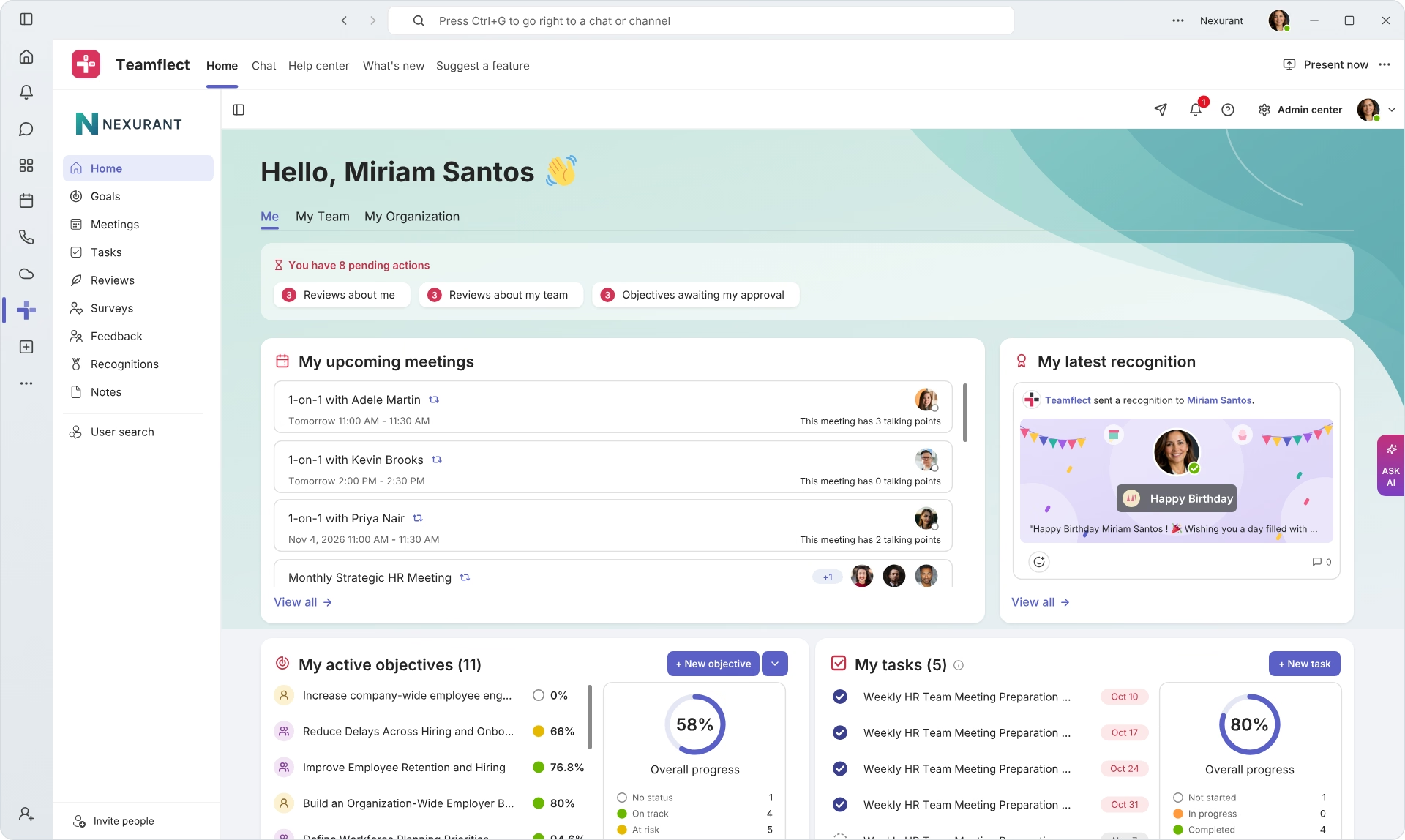
Create high-performing and engaged teams - even when people are remote - with our easy-to-use toolkit built for Microsoft Teams