.svg)
.svg)
Disgruntled Employees: How to Identify, Address, and Prevent Them

Updated on:
September 18, 2026
%20(100%20x%20100%20px)%20(2).webp)

Prefer Teamflect as your HR source on Google
.svg)

A disgruntled employee has an active grievance about their job, pay, leadership, or working conditions that they have not addressed through the proper channels. Addressing a disgruntled employee requires three steps: identifying the source of the complaint, speaking with the employee using factual behavioral observations, and setting clear boundaries or escalation paths.
A disgruntled employee is an employee with a specific, unresolved grievance against their employer who actively expresses that grievance through their behavior, communication, or work performance. Disgruntlement is not the same as passive disengagement. It’s a response to perceived unfairness: promises not kept, a spike in workload not addressed, and a promotion not given.
The meta-analytic work on organizational justice by Colquitt et al. (2001) in the Journal of Applied Psychology shows that perceived unfairness leads to active commitment decline and retaliatory behaviors, not just passive withdrawal. Disengaged employees don't go the extra mile, don't speak up in meetings, and don't leave work early. Gallup’s State of the Global Workplace report found that 16% of employees worldwide were actively disengaged in 2025.
The term can also refer to an insider security threat involving data theft or sabotage. This article focuses on the HR meaning of a disgruntled employee.
Understanding this distinction alters how a manager responds:
To learn more about the structural motivation loss in teams, see our guide to employee disengagement.
Employees become disgruntled when expectations and reality don't align for a long time, especially around fairness, recognition, or career progression. These root causes are of three types: problems a manager can solve, organizational constraints a manager can only escalate, and external personal pressures.
Many grievances develop in the day-to-day working relationship. Resentment builds when managers fail to execute basic leadership responsibilities, such as:
When these issues persist, the direct cause might be a bad manager.
Other sources of disgruntlement originate above the direct manager’s authority. These include broader organizational constraints such as:
You cannot change these decisions directly. Instead, your job shifts to being a transparent context provider, an employee advocate, and an honest expectations manager. When the environment turns hostile due to broader cultural shifts, refer to our toxic workplace checklist.
External stressors, such as a major health event, financial hardship, or family crisis, can trigger negative behavior. It is not the manager’s job to figure out personal problems. The best approach is to focus on observable workplace behaviors and provide accessible organizational support resources, such as an Employee Assistance Program.
If an employee is disgruntled, the main clues are long-term changes in behavior across three areas: day-to-day behavior, quality of work, and communication style. Any one of these behaviors can have an innocent explanation; the pattern over time is the signal to examine.
Organizational researcher Dr. Elizabeth Morrison discusses employee voice and silence in her peer-reviewed article “Employee Voice and Silence,” published in the Annual Review of Organizational Psychology and Organizational Behavior in 2014. In her own words, “employees often choose silence when they believe speaking up is futile or risky,” a mindset that quickly fuels indirect complaints, disengagement, and behavioral resistance.
When talking to a disgruntled employee, it is important to have a clear, organized framework that is broken down into three stages: pre-meeting planning, actual dialogue, and follow-up. Each stage helps you address the grievance directly while keeping the conversation focused on observable behavior, specific concerns, and clear next steps.
Before you arrange the meeting, ask yourself one basic question: Is this company trying to keep this employee?
More than 70% of managers and employees and report avoiding tough workplace conversations.
As HR leader Paula Heller notes, “It’s natural and human to feel hesitation or awkwardness to have difficult conversations.”
Preparation Steps:
Start by stating facts without introducing emotion or judgment:
Thanks for your time today. I’ve seen that your activity in product reviews has slowed down in the last three weeks and that you have missed two project deadlines. I wanted to reach out to you directly to see what's going on with you.”
When faced directly, an employee may respond with a blunt, “Nothing is wrong; everything is fine.” Stay on topic. You don't get them to confess. Let's come back to what we can see:
“I know you may feel everything is okay, but I'm bringing this up because the pattern is different from your normal standard levels. Deadlines are missed without warning, and the team has to pick up the slack. What can we look at together to get things back on track?”
If the pain point was a mistake made by a manager, like a missed communication or unfulfilled promise, take ownership of it right away and transparently:
"Thanks for raising this. I didn’t review the project scope when I said I would last month. A few other things came up, and I kept putting it off. I should have dealt with it sooner. I know that doesn’t change the time we’ve already lost, but let’s review it today and decide what we need to do next."
For more phrasing ideas on delivering difficult input cleanly, see our guide on negative feedback examples.
A conversation without clear follow-through often worsens disgruntlement.
“I just wanted to follow up on your request for an outside-cycle compensation review. I cannot approve a pay rise today because of corporate policy that limits off-cycle adjustments to structural role changes. What we can do is agree on clear performance milestones to be considered in our scheduled November review cycle.”
You should escalate a disgruntled employee situation whenever the behavior violates company policy, involves legal protections, or falls outside the manager’s authority. The goal is to distinguish routine management issues from situations that require HR, legal, security, or safety involvement. Depending on the severity, 4 escalation levels exist.
“Employers expect supervisors to resolve some issues on their own and to report other things to human resources, or possibly to in-house counsel, rather than to resolve them independently,”
This can be anything from a heavy workload or a minor disagreement about a task to confusion around performance feedback or some temporary tension between colleagues.
Human Resources must be brought into the loop when:
For detailed steps on resolving peer conflict with HR support, see our article on conflict resolution strategies. If the behavioral issue transitions into a formal performance issue, review our PIP examples.
When to reach out to corporate legal counsel (usually via HR):
When an unhappy employee departs, whether by resignation or termination, your challenge is to keep the team together, protect the company’s assets, comply with legal requirements, and clear the administrative deck. The steps you take should cover both the employee’s departure and the impact on the remaining team.
Maintain a comprehensive and balanced permanent record on the employee, such as performance appraisals, documented check-in notes, written warnings, and letters of resignation or termination. Don’t include casual and subjective comments in the formal record.
When announcing the departure to the rest of the team, keep the message professional, brief and forward-looking:
Manage IT access offboarding systematically. On termination (or the end of the final day in voluntary resignations), immediately terminate access to company networks, remote databases, and internal communication tools to prevent security breaches or data loss. See our employee offboarding checklist for typical steps.
When the employee is leaving angry, the exit conversation should not become a second grievance hearing. Let the employee explain their concerns, document any formal allegations, and avoid debating the history of the dispute. If the employee is leaving with an unresolved grievance, then the exit interview should be conducted by a neutral HR rep rather than the direct manager. Use the structured, standard questions in our guide to exit interview questions.
If they raise concerns about discrimination, harassment, retaliation, policy violations, or safety, follow the appropriate HR or legal process. If an employer asks for employment references, provide only information that can be verified, such as dates of employment, job titles held, and rehire eligibility.
Former employees often turn to public employer review sites to air their grievances.
Establish reliable feedback channels at both the manager and organizational levels to prevent disgruntlement and identify and address grievances before they become chronic resentment. You should create regular opportunities for employees to raise concerns, and organizations should provide channels for issues that teams cannot resolve.
Gallup research suggests that direct managers account for up to 70% of the variance in team engagement scores. Gallup has also found that employees supervised by highly engaged managers are 59% more likely to be engaged than employees supervised by actively disengaged managers.
You can implement three core practices immediately:
To optimize these weekly touchpoints, use our guide on running effective one-on-one meetings.
Leadership must provide systemic communication channels to capture issues employees may feel uncomfortable sharing directly with line managers:
A disgruntled employee is someone who has an active grievance that is unresolved regarding their employment, pay, management, or working conditions and who expresses their frustration in the form of reduced effort or hidden friction rather than through formal means.
Watch for warning signs like repeated sarcasm, pulling away from team conversations, a sudden drop in work performance, missed deadlines, backchannel complaining to coworkers, and resistance to new projects.
A disengaged employee quietly withdraws effort and does the bare minimum. A disgruntled employee has a specific grievance and expresses resentment through pushback, friction, or negative influence.
Bring specific examples of behavior based on facts. In your opening, stay objective and non-accusatory, and listen to what they have to say. Address the real issues directly and clearly communicate your expectations. Follow through in writing.
HR should get involved when grievances involve protected characteristics, include allegations of harassment or discrimination, involve policy violations, or when manager conversations fail to produce behavioral improvements.
An employer may be able to terminate an unhappy employee if their conduct, performance, or behavior violates company policies or does not meet established standards. Employers must support terminations with documentation, fair procedures, and compliance with employment law.
Disclaimer: This article is for educational purposes only. It is not legal advice. If you are experiencing a specific employment law issue, contract dispute, or possible termination, you should talk to a competent employment lawyer.
.avif)
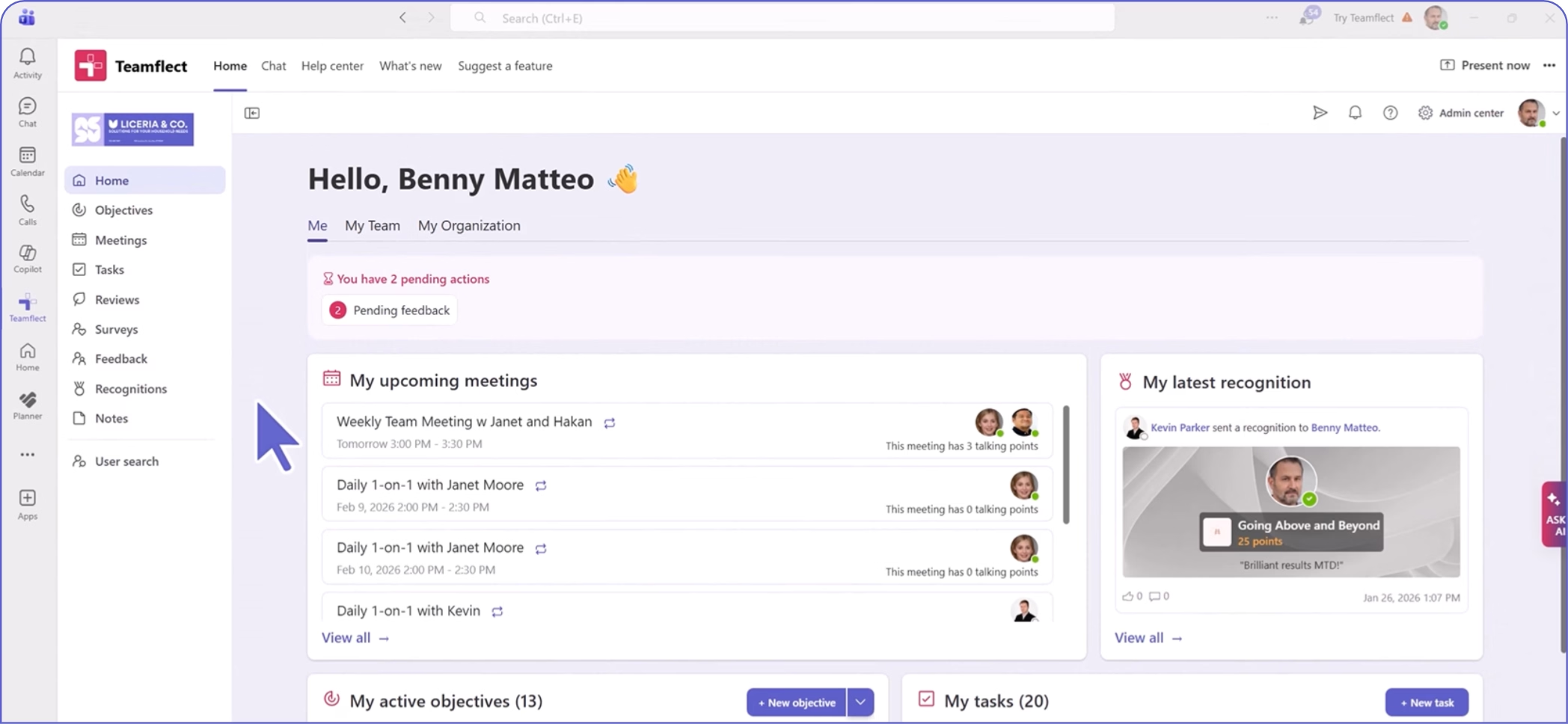
Create high-performing and engaged teams - even when people are remote - with our easy-to-use toolkit built for Microsoft Teams
.svg)