HR Software Pricing in 2026: What It Costs, What Drives a Quote, and When You Shouldn’t Need One

Updated on:
November 19, 2026


Prefer Teamflect as your HR source on Google

 Request a Demo
HR software is priced per employee per month in most cases, and the published number is rarely the number you pay in year one. This guide shows what the main platforms charge, which of them publish a price at all, the six things that move a custom quote, and the numbers to have ready before you ask for one.
Core HR usually costs $5 to $20 per employee per month, and suites with performance and engagement run $10 to $39, so a mid-market buyer should also budget for implementation in year one.
Buyers' own budgets land in the same place. Capterra's 2026 benchmark for small and midsize businesses found that businesses across its top five industries allocate $10 to $39 per employee per month for HR software, with an overall average of $17. The table below breaks that range down by company size.
| Company size | Typical PEPM range | What that usually includes | What pushes it higher |
|---|---|---|---|
| 1-50 employees | $5-$12 PEPM for core HR; more with payroll, often with a monthly base fee | Employee records, time off, basic onboarding | Adding payroll and benefits administration |
| 51-500 employees | $8-$39 PEPM for a suite | Core HR plus performance, engagement and reporting | Modules bought separately, and per-module minimums |
| 500+ employees | Custom quote | Full HCM with workforce planning and analytics | Multi-entity structures, data residency and security requirements |
The ranges move with what is bundled, so compare what is inside the price before you compare the price.
Each band below is backed by the sources listed with it:
The spread inside each band is the point. Two sources can both be accurate and still sit $20 apart, because one counts payroll and benefits administration and the other doesn't.
Before you compare any of these numbers with a vendor's, decide which modules you actually need. Our guide on how to choose HR software walks through that step.
Four models cover almost every quote you will receive, and the model matters more than the headline number because it decides what happens when you grow.
You pay a rate for every active employee, every month. It turns against you at scale, and again if the vendor counts inactive records.
A base fee covers a set number of employees, then a per-head charge starts. The step between tiers is where budgets break.
Core HR is the entry point and each capability is priced separately. The first quote looks cheap and the second one, after you add two modules, does not.
No published price; the number comes after a discovery call. Legitimate for complex enterprise deployments, and a delay tactic everywhere else.
Most vendors in the price table below mix two models. Gusto charges a monthly base fee plus a per-person rate, so its effective PEPM falls as headcount grows. BambooHR bills a flat monthly rate up to 25 employees and switches to PEPM above that. Lattice and 15Five publish module pricing, with a separate list price for each product. When you compare quotes, write down which model each one uses before you compare the totals.
Some vendors put the number on the page; others put a form there instead, and that difference tells you how long your buying process will take.
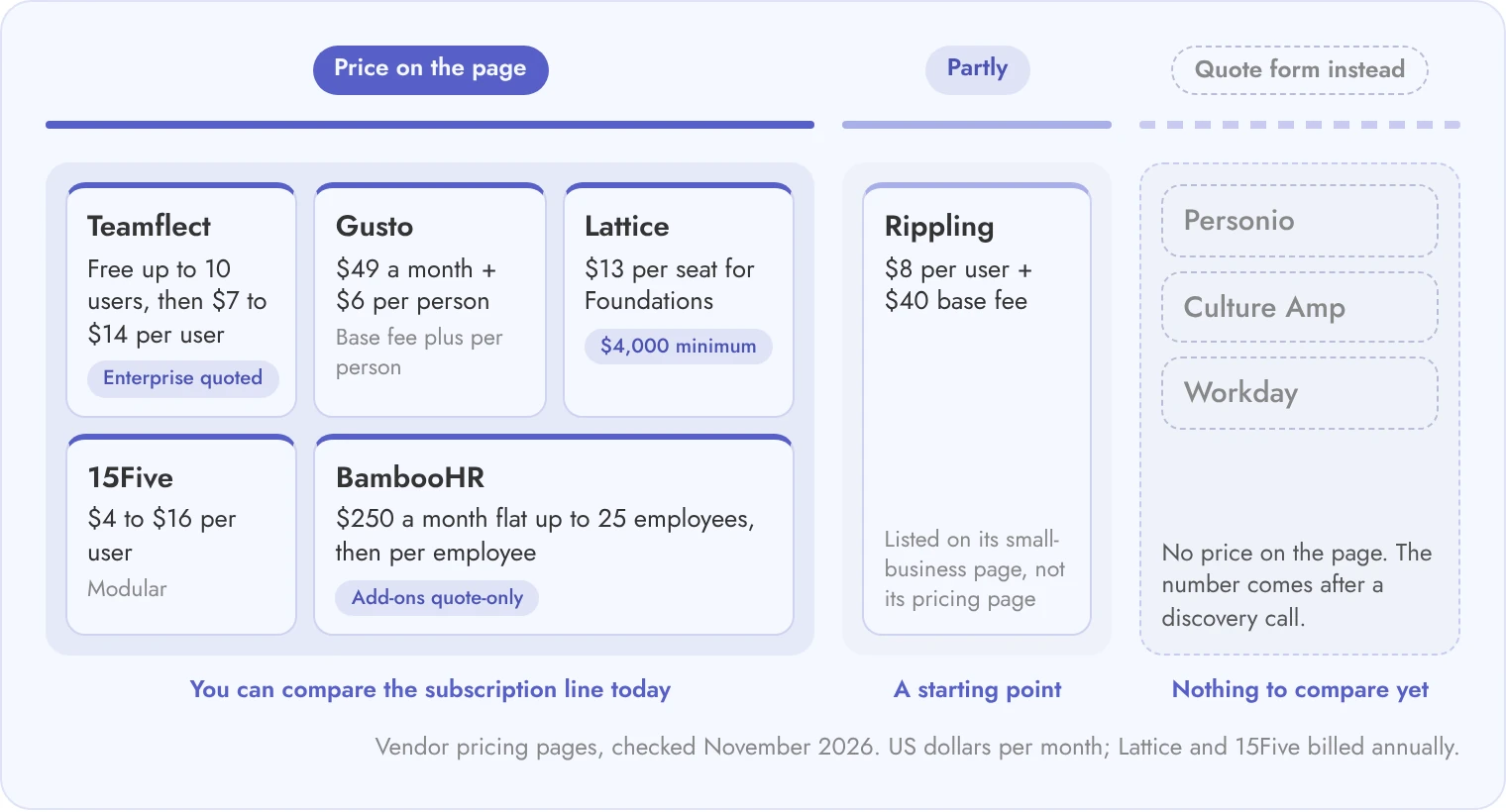
| Platform | Published price | Pricing model | Minimum seats | Published or quote-only |
|---|---|---|---|---|
| Teamflect | Starter $0 (up to 10 users); Essential $9 per user per month, or $7 billed annually; Professional $14 per user per month, or $11 billed annually; Enterprise on request | PEPM | Not stated | Published (Enterprise quote-only) |
| BambooHR | 25 or fewer employees: flat $250 (Core), $425 (Pro) or $650 (Elite) a month. Above 25: $10 (Core), $17 (Pro) or $25 (Elite) per employee per month on the plan cards; the pricing FAQ gives $10.25 and $17.50 for Core and Pro. Payroll and other add-ons are quote-only | Flat rate, then PEPM | 25 or fewer billed as a flat rate | Published (add-ons quote-only) |
| Gusto | Simple $49 a month plus $6 per person; Plus $80 plus $12 per person; Premium $180 plus $22 per person | Base fee plus per person | Not stated | Published |
| Lattice | Foundations (Performance plus Goals & OKRs) $13 per seat per month; Performance $10, Goals & OKRs $8 and Engagement $4 when bought alone; billed annually | Modular | $4,000 minimum annual commitment | Published |
| 15Five | Engage $4, Perform $11 and Total Platform $16 per user per month, billed annually | Modular | Not stated | Published |
| Rippling | No price on the pricing page, which shows a quote form; Rippling's small-business page lists $8 per user per month plus a $40 monthly base fee | Modular, PEPM | Not stated | Partly published |
| Personio | No price on the page | Quote-only | Not stated | Quote-only |
| Culture Amp | No price on the page | Quote-only | Not stated | Quote-only |
| Workday | No price on the page | Quote-only | Not stated | Quote-only |
Prices checked November 2026, in US dollars.
Every price in this table comes from the vendor's own website, checked in November 2026. Where a vendor publishes nothing, the row says so rather than guessing.
Teamflect's published per-user pricing shows the monthly and annual rate for each plan.
A published price is not automatically the cheaper one, but it is always the faster one to evaluate.
Three details in the table are easy to miss. BambooHR's pricing page shows two sets of per-employee rates for the same plans, so ask which one your quote uses. Lattice requires a $4,000 minimum annual commitment whatever the seat count, which matters more to a 30-person company than to a 300-person one. And Rippling's starting price appears on its small-business page but not on its pricing page, which leads to a quote form.
Six variables move a custom quote, and five of them are things you decide rather than things the vendor decides.
| Factor | Why it moves the price | What to decide before the call |
|---|---|---|
| Modules | Each capability is often a separate line item, such as performance review software bought on top of core HR | Write down which modules you will use in year one, and which can wait |
| Headcount tier | Price per employee usually drops at set thresholds | Know your headcount now and your realistic headcount in twelve months |
| Support level | Named support and training are frequently a paid tier | Decide whether you need an assigned contact or can work from documentation |
| Integrations | HRIS, SSO and payroll connections can be priced per connector | List the systems that must connect on day one |
| Contract length | Multi-year terms buy a discount and cost you flexibility | Decide the longest term you would sign if the discount is good enough |
| Data migration | Historical record import is usually project work, not subscription | Decide how many years of history actually have to come across |
Answer these six before the first call and the quote arrives in one round instead of three.
The published prices above show two of these factors at work. Module pricing is visible on Lattice's page, where buying Performance and Goals & OKRs together as Foundations costs $13 per seat instead of $18 for the two bought separately. The headcount tier is visible on BambooHR's page, where the price changes from a flat monthly fee to a per-employee rate above 25 employees. The other four (support level, integrations, contract term and data migration) rarely appear on a pricing page, which is why they belong in the quote request.
The subscription is one of six cost lines, and the other five are where first-year budgets are missed.
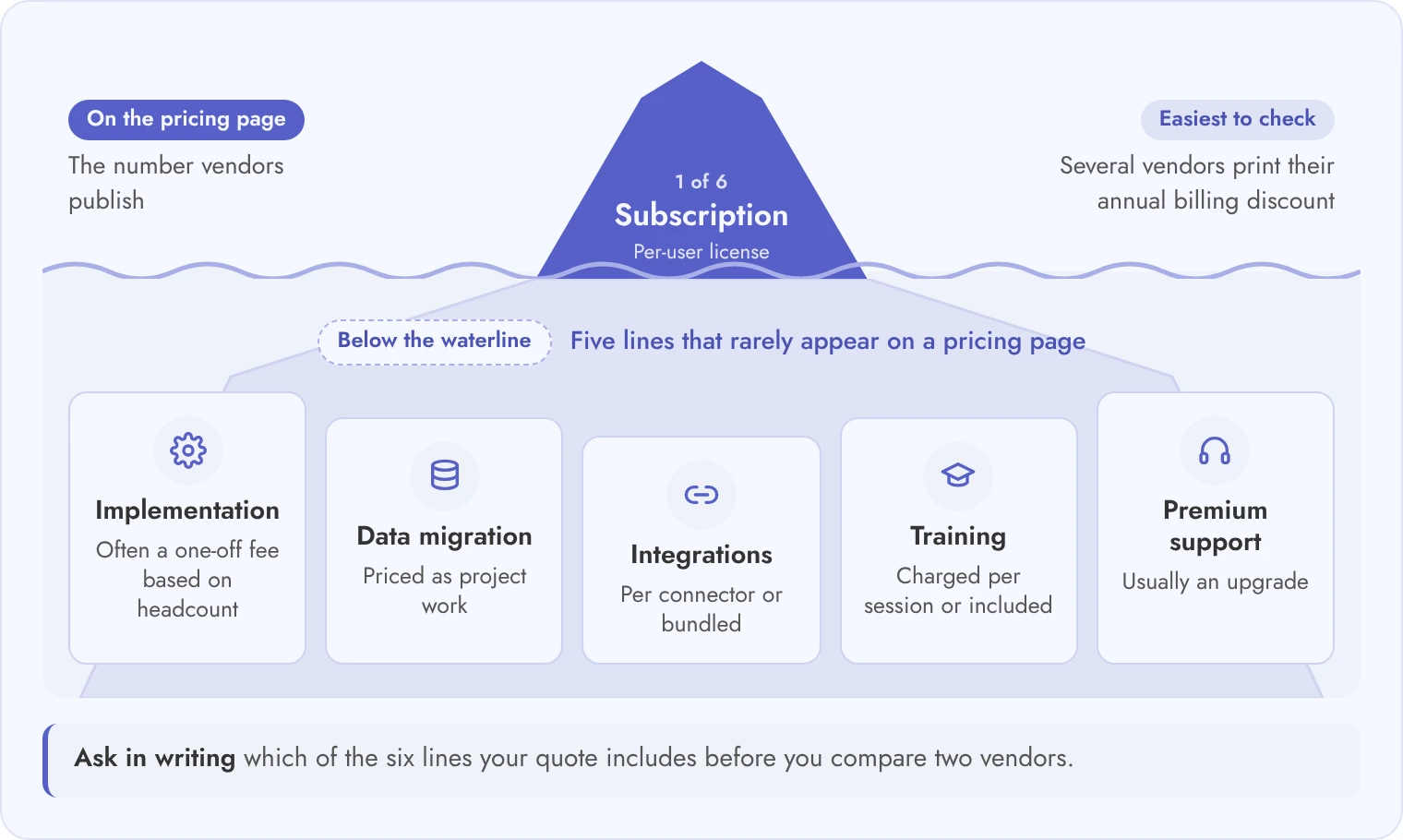
| Cost line | What it covers | Typical treatment | How to remove or reduce it |
|---|---|---|---|
| Subscription | Per-user license for the year | Billed monthly or annually | Annual billing, where the vendor discounts it |
| Implementation | Configuration and go-live support | Often a one-off fee based on headcount | Choose a vendor that includes implementation support in the paid plan |
| Data migration | Importing historical employee and review records | Priced as project work | Migrate only the history you will actually query |
| Integrations | HRIS, SSO, payroll connectors | Per connector or bundled | Buy inside a stack you already license, so identity is not a new connector |
| Training | Admin and end-user enablement | Charged per session or included | Confirm in writing whether admin and end-user training are included |
| Premium support | Named contact, faster response times | Usually an upgrade | Check what the entry paid plan already includes before paying for a tier |
Ask which of these six are included in the number you were quoted, in writing, before you compare two vendors. Then run the numbers on your own headcount to see how the six lines add up for your company.
The annual billing discount is the easiest of the six to check, because several vendors print it. Teamflect's Essential plan is $9 per user per month billed monthly and $7 billed annually, and Lattice bills its published prices annually. Implementation and support are harder: some vendors include them in every paid plan and others sell them as a tier, so the same subscription price can hide very different first-year totals. Put each vendor's six lines side by side, and the total cost of ownership comparison does itself.
Have six numbers ready, send them to every vendor in the same message, and ask each one to price the same twelve months.
Active employees who will have a login, not total records in the system.
The number that decides which tier you land in.
Some vendors charge for them, some do not, and the answer changes the total.
Written as a list, so every vendor prices the same scope.
HRIS, identity provider, payroll.
The single biggest driver of implementation cost.
Hello,
We are evaluating performance and HR software for a twelve-month term starting [month]. So that we can compare vendors on the same basis, please quote against the following:
Please break the quote into: annual subscription, implementation, data migration, integrations, training, and support tier. Confirm which of these are included in the subscription and which are billed separately, and state any minimum seat count or minimum contract term.
Thank you,
[name], [title]
Sending the same six inputs to every vendor is what makes two quotes comparable; without them you are comparing two different scopes.
Some vendors, including Teamflect, publish their per-user prices, so this step is optional below enterprise scale: the price table above already answers the subscription line. A quote-only process is legitimate where enterprise deployment and security requirements change the scope, such as dedicated infrastructure, data residency or customer-managed encryption keys, and that's where Teamflect quotes too.
Core HR usually costs $5 to $20 per employee per month, and suites with performance and engagement run $10 to $39. Payroll usually adds to the price, and enterprise platforms are quoted. This page compares prices rather than ranking tools, so build your shortlist first and come back here to price it.
Yes, some vendors offer a free plan for small teams. Teamflect's Starter plan, for example, is free for up to 10 users. Free plans usually cap the number of users or leave out paid modules, so check what you'd pay once you grow past the cap.
Some vendors price every deal individually, based on headcount, modules and contract term. That's legitimate for complex enterprise deployments with custom security or data residency requirements. Below that scale, a missing price mostly means a discovery call before you can compare anything.
It can take anywhere from a few minutes to several rounds of calls. A vendor that publishes its price answers the subscription question on the page. A quote-only vendor usually needs a discovery call first, and the six numbers in this guide cut the rounds down.
A quote should list the annual subscription, implementation, data migration, integrations, training and the support tier as separate lines. It should also say which of these are included in the subscription, and state any minimum seat count or minimum contract term.

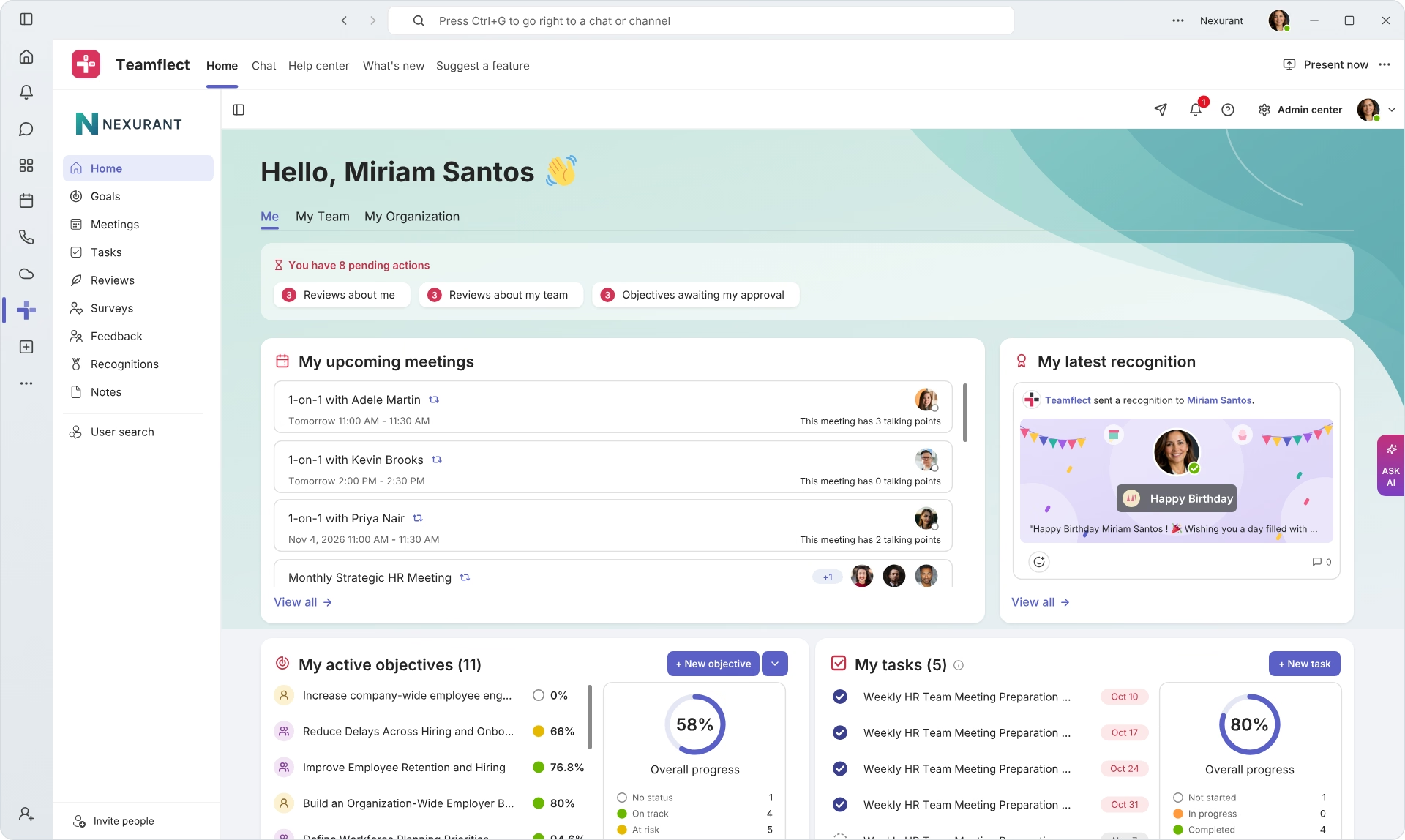
Create high-performing and engaged teams - even when people are remote - with our easy-to-use toolkit built for Microsoft Teams