Teamflect Q3 2026 Updates: Meeting Intelligence, Teamflect MCP, Bulk Calibration, and More!

0
min. read

Updated on:
October 16, 2026

Prefer Teamflect as your HR source on Google


October is when review season stops being a calendar entry and starts being a workload. Q4 is underway, and calibration meetings are starting to fill calendars.
That makes it a good moment to look back at Q3, which turned out to be one of our biggest quarters yet. We have plenty of ground to cover here but we can quite comfortably tell you that the new additions we've made to Teamflect such as the MCP, bulk calibration, and meeting intelligence are gamechanging improvements for enterprises using our product.
If you'd rather watch than read, our quarterly walkthrough covers every feature below. There are timestamps in the description if you want to jump straight to one.
With that said, here is what the product team built in Q3.
Meeting Intelligence is now available on every meeting page in Teamflect. Once you enable it, it reads the meeting transcript and hands back a summary, the key discussion points, suggested talking points for next time and suggested action items.
The action cards are what take it past a standard meeting summary. Anything that came up in the conversation can become a task or a talking point for the next meeting, right from the page. If someone did work worth calling out, it can become a recognition too.
For recurring meetings, you also get a recap of the previous meeting in the series. Walk into a 1-on-1 and you already know what was agreed last time and what's been done since.
Most people keep an AI assistant open for a good part of the working day. Until now, their performance data wasn't in it.
Teamflect MCP connects your Teamflect data to the LLM of your choice, whether that's Claude, ChatGPT, Copilot or something else entirely.
Here's what that looks like in practice. During review season, you can ask Claude to help write your self-review, starting from your actual goals and feedback. A manager whose engagement survey just closed can ask ChatGPT to break down the team's results and pull out the themes worth acting on, without exporting a single spreadsheet. And if you need a presentation on where everyone stands with their goals, Copilot can look into Teamflect and map one out.
Access follows the permissions you'd expect. Employees reach their own data and managers reach their direct reports' data, while admins get the broader organizational view. Nobody sees anything they shouldn't.
Teamflect MCP launches with 20 tools covering goals, reviews, surveys and more. That number will grow significantly over the coming months.
The new Cycle Detail page brings everything you need to manage your review cycles under one roof, organized across three tabs.
The Reviews tab is where you manage reviews in bulk. Score distributions before and after calibration sit side by side, along with your 9-box distributions. Select the reviews you want to calibrate and calibrate them together, right from the same page. Bulk calibration is an enterprise-grade capability we've had our eye on for some time. For organizations calibrating hundreds of reviews, it'll save hours this season.
The Results tab is a full analytics view of the cycle, with custom evaluations, heatmaps, breakdowns and filters. Managers can filter by manager, direct report, department, country and more. Both managers and admins can compare results across individuals or across whole teams, so working out how engineering performed against sales takes a couple of clicks instead of a spreadsheet.
The third tab, AI Analysis, is coming soon. Where Results handles the scores, AI Analysis will handle the written feedback: the hundreds of comment fields that rarely get read in full. It'll bring sentiment analysis, theme-based analytics, talent signals and improvement areas, plus a space to ask Teamflect Agent your own questions about the results.
A review cycle that spans several countries rarely runs in one language. Employees write their best answers in the language they think in, and a manager reviewing a cross-border team shouldn't need a translator to read them.
We know how much customization and language support matter to companies running reviews across multiple countries, so we took it a step further. Teamflect now translates performance reviews automatically. Everything from the review questions to the answers employees give can be translated into each user's own language.
One global review process, read by everyone in the language that suits them.
Last quarter, we rebuilt the 360-degree feedback page from the ground up. This quarter, we added advanced AI analysis on top of it.
"AI analysis" gets used loosely, so here's exactly what you get. There's an honest summary of the results and a set of actionable insights drawn from them. From those insights, Teamflect suggests objectives and tasks, and a Teamflect Agent window lets you keep digging into the results with your own questions.
A 360 cycle has always produced a lot of rich information. This update makes sure it turns into something someone acts on.
However customizable a template gets, some question in it won't fit someone's role. Until now, that employee had to pick a rating anyway.
Rating questions across reviews, feedback and surveys now include a "Not applicable" option. When a question is out of context for an employee, they can mark it N/A instead of guessing at an answer that doesn't apply to them.
You get cleaner data. They get one less frustrating question.
Over the past year, the Recognitions module has picked up new badge designs, interface updates and monetary rewards. Leaderboards were next in line.
They've now had a long-overdue redesign. If your organization uses leaderboards, you'll get a clearer view of who's being recognized and a smoother experience all around.
Scoped admin access used to be defined by office location, department or country. That covers a lot of ground, but large organizations rarely draw their admin boundaries along those lines alone.
Admins can now use their own custom tenant attributes to set scoped admin access types. Combined with the "AND" conditions that shipped in August, a scoped admin rule can match the actual remit of the person it's for. As organizations scale, the roles inside them get more complex, and the clearance those roles need should be tailored rather than approximated.
We're heading into the final stretch of 2026 with plenty already in the pipeline. Module-based admin access is on its way, and so is Compensation. Teamflect Agent is also getting a new assistant skill for meetings and reviews, and the AI Analysis tab on the Cycle Detail page isn't far behind.
That's only part of the list. We'll share the rest as it lands.
None of this happens without your feedback, so thank you for that. Whether you've been with us from the very beginning or joined the Teamflect family this quarter, thank you for choosing Teamflect.
If you want to see any of this in action, the Teamflect YouTube channel is where the short product walkthroughs and Microsoft Teams how-tos live. For something longer, The Team Check-In podcast sits down with HR and workplace leaders on where work is heading.
New to Teamflect? What you have read here barely scratches the surface of what the platform does inside Microsoft Teams and Outlook. Book a quick call and we will walk through what would make the biggest difference for your team.



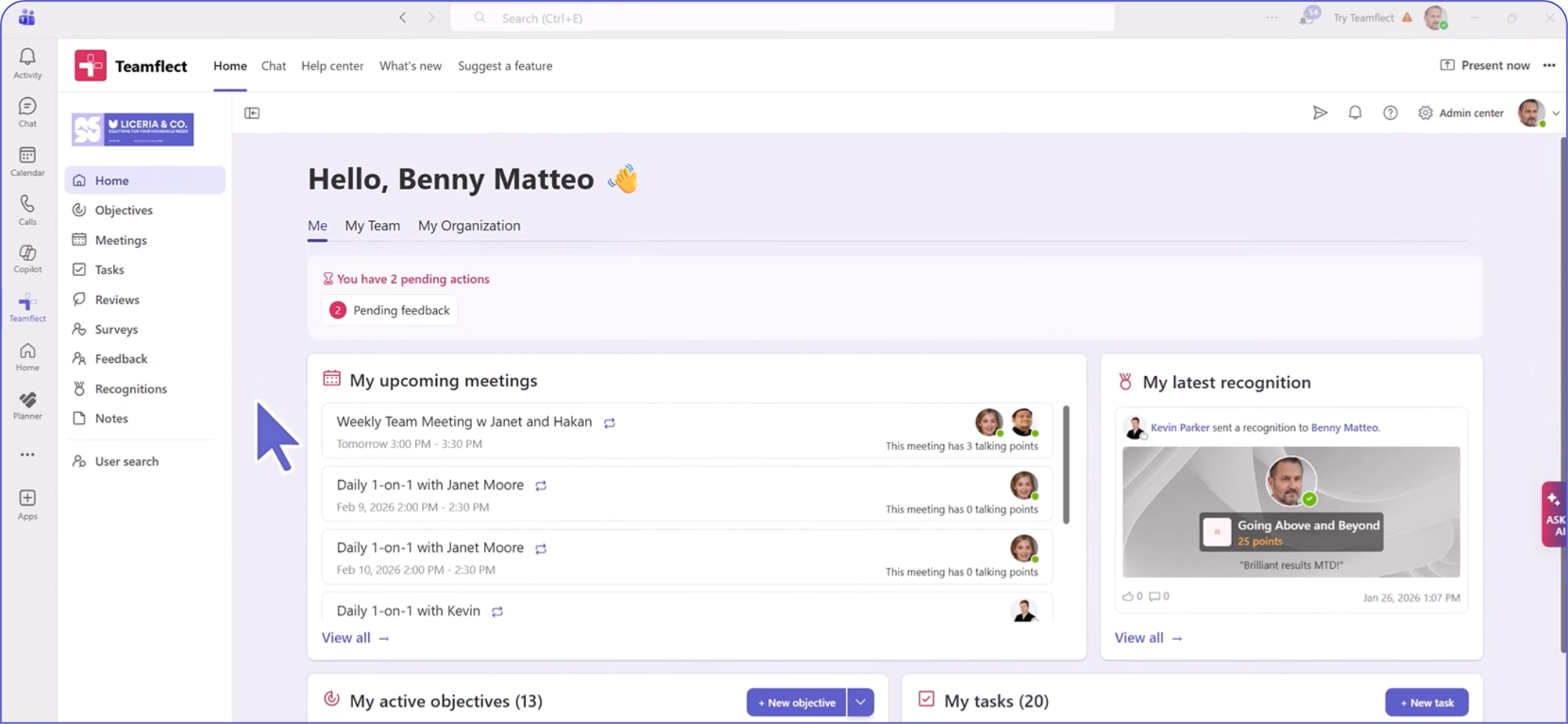
Create high-performing and engaged teams - even when people are remote - with our easy-to-use toolkit built for Microsoft Teams