

Enterprise Employee Recognition Software Buyer's Guide (2027)

Updated on:
November 13, 2026

Prefer Teamflect as your HR source on Google


Enterprise employee recognition software has to pass a different test than a small-team tool. This guide covers what HR, IT security, procurement and finance should prove before signing: security and identity, global rewards and tax questions, privacy, integrations, three-year cost, RFP questions and reference checks.
Enterprise recognition software is a financial system as much as an HR tool, because points, budgets and rewards move money across countries, payroll and audit.
A company with 100 people can run recognition as a culture program: one budget, one gift card vendor, one country. A company with thousands of employees in several countries runs the same program as a ledger. Points are owed to employees. Rewards are taxed in different ways by country. Hundreds of managers spend from budgets. A public feed shows names and achievements to a large audience.
That changes who sits on the buying team. HR owns the program. Finance owns budgets and the liability for unredeemed points. IT security owns sign-in and access. Procurement owns the contract. Tax advisers review rewards by country. This guide lists what each of them should make a vendor prove before signing.
| Decision area | Typical 50- to 500-person purchase | Enterprise purchase |
|---|---|---|
| Budgets | One program budget, often held by HR | Central pool plus budgets held by managers, with approval thresholds, cost centers and accruals |
| Rewards | One catalog, usually gift cards, in one currency | Catalog coverage in every country, local currency, delivery partners and local redemption rules |
| Sign-in and access | Email invitations or a single SSO setup | SSO with automatic provisioning and removal tied to the HR system of record |
| Data and privacy | Standard vendor terms | Residency, retention, consent for public posts and sub-processor review for reward partners |
| Reporting | Participation counts | Spend, liability and audit trail by cost center, country and legal entity |
| Rollout | One launch announcement | Waves by country and business unit, with frontline access and local-language communication |
| Contract | Annual, per-seat | Multi-year terms with renewal caps, an SLA and exit rights for recognition history and points |
Write down who signs off each area before the first RFP goes out, because finance and tax reviewers usually join late and ask the most questions.
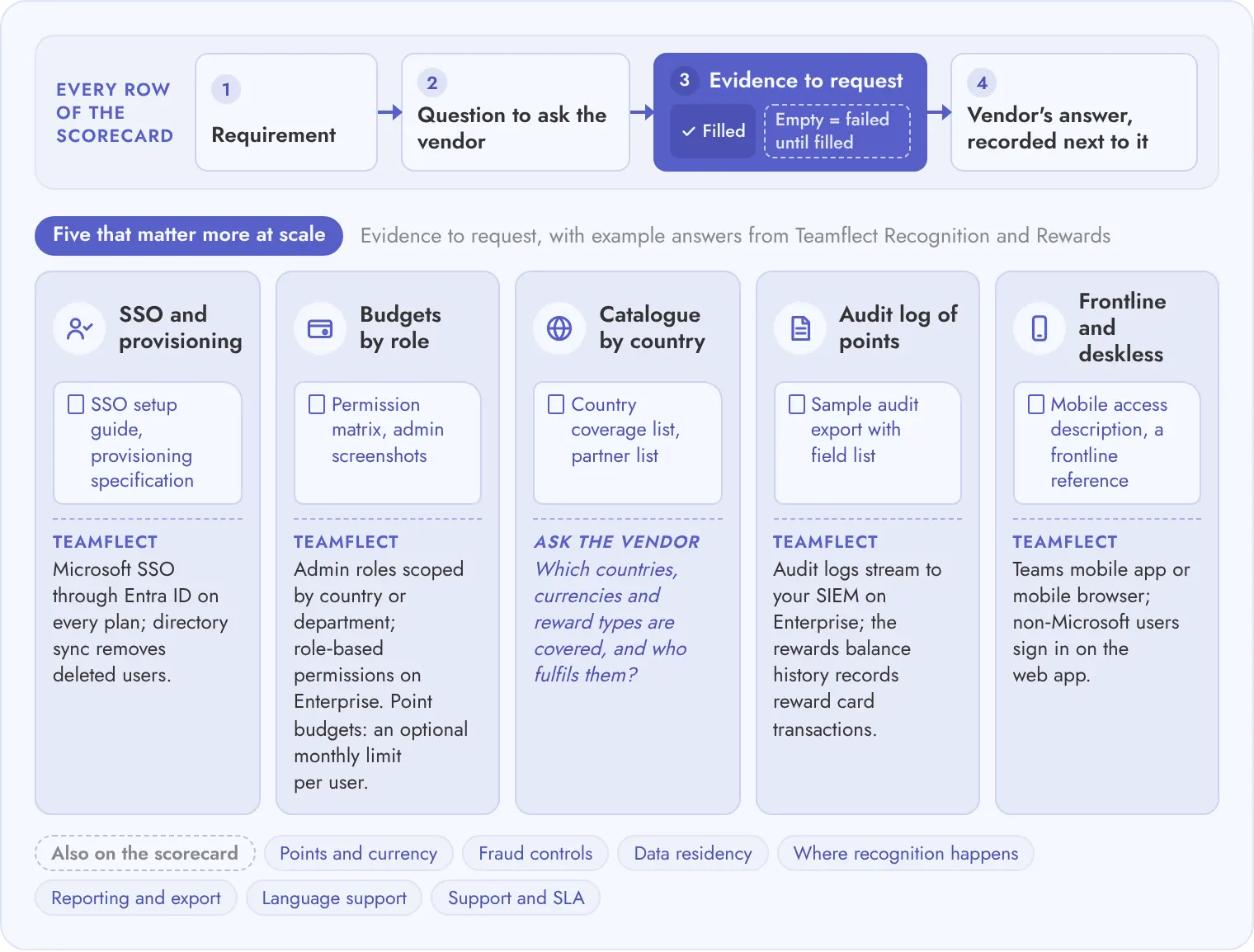
An enterprise scorecard asks for evidence on identity, budget control, global rewards, audit trail and reach, and it records the vendor's answer next to each requirement.
Start with the requirements below and add your own. Five capabilities matter more at scale than in a small rollout. They are provisioning that follows the HR system, budget permissions by role, a rewards catalog for every country, an audit log of points, and access for employees who do not sit at a desk.
The last column shows one example answer. Teamflect Recognition and Rewards gives badges, points and rewards inside Microsoft Teams chats, meetings and channels.
| Requirement | Question to ask the vendor | Evidence to request | How Teamflect answers it |
|---|---|---|---|
| SSO and provisioning | Which SSO protocols and which automatic user provisioning do you support, and on which plan? | SSO setup guide, provisioning specification | Microsoft SSO through Entra ID (formerly Azure AD) on every plan; directory sync updates users and removes deleted ones. |
| Role-based budget permissions | Can budgets and approval rights be set by role, country and cost center? | Permission matrix, admin screenshots | Admin roles can be scoped by country or department, and Enterprise lists role-based permissions under advanced security. Point budgets are an optional monthly limit per user. |
| Rewards catalog by country | Which countries, currencies and reward types are covered, and who fulfills them? | Country coverage list, partner list | Reward cards through Tango Card (Professional plan and above), with rewards shown by country. |
| Points and currency handling | How are points valued, converted and displayed for employees paid in different currencies? | Currency and conversion policy | Funded in USD and shown in local currency at checkout, with a transaction fee. |
| Fraud controls | Can you block self-recognition, repeat awards between the same two people and unusual award patterns? | Admin settings list, sample fraud report | Admins approve every reward request, and an optional monthly point limit applies. Blocks on self-recognition and repeat awards are not documented; test them in the demo. |
| Audit log | Does every point issued, adjusted and redeemed create a log entry, and can we export it? | Sample audit export with field list | Audit logs can be streamed to your SIEM on the Enterprise plan. The activity log records recognitions sent (last 90 days), and the rewards balance history records reward card transactions. |
| Data residency | Can recognition data be stored in a chosen region? | Residency documentation, hosting list | Five Azure regions as standard; any Azure datacenter region on Enterprise. |
| Where recognition happens | Do employees recognize each other inside the tools they already use? | Live demo in your own tenant | Badges, points and rewards appear inside Microsoft Teams chats, meetings and channels. |
| Frontline and deskless access | How does a nurse, driver or store employee give and receive recognition without a laptop? | Mobile access description, a frontline reference | Teams mobile app or mobile browser; non-Microsoft users sign in on the web app. |
| Reporting and export | Can finance and HR pull spend, participation and liability data into our reporting tools? | Report catalog, sample export | Native Power BI integration (report creation from Professional); managed Power BI dashboards are Enterprise only. |
| Language support | Which interface and reward languages are available? | Language list | Multi-language support exists in 13 app languages. |
| Support and SLA | Who supports admins, and what uptime does the contract commit to? | SLA document, support hours | An assigned Customer Success Manager, implementation support and training come with every paid plan, plus 24/5 support. The standard SLA sets a 99% monthly availability target (commercially reasonable measures); Enterprise contracts can carry custom SLAs. |
Send the scorecard to every vendor in the same format, and treat an empty evidence cell as a failed requirement until it is filled.
Check how people sign in, who can spend company money, how fraud is limited, and whether every point issued and redeemed leaves an audit record.
Recognition data looks harmless, but it holds employee names, the reasons for awards and sometimes a monetary value. Four checks matter most. First, sign-in and provisioning: when an employee leaves the HR system, access and award rights should end the same day, and you should know what happens to points they still hold. Second, role-based budget permissions: a manager should spend only from an assigned budget, and a regional admin should see only their region. Third, fraud controls: ask how the product handles self-recognition, repeat awards between the same two people and collusion limits. Fourth, the audit log of points issued and redeemed, with the approver for each award above a threshold.
Microsoft describes automatic provisioning in Entra ID as creating accounts and also maintaining and removing them when someone's status or role changes. Test exactly that with a few real leavers before you sign.
Teamflect is SOC 2 Type I and Type II certified and GDPR and CCPA compliant. Its Enterprise plan adds customer-managed encryption keys, IP allowlisting and audit logs streamed to your SIEM. Read each vendor's security documentation first, starting with Teamflect's security page, then request the report itself. Our guide to the SOC 2 report explains what to look for in it.
Under the AICPA's SOC suite of services, a SOC 2 examination is performed by a CPA firm, so note the auditor's name and the period the report covers.
A vendor that cannot produce a sample audit export for points issued and redeemed has not shown that it can control spend.
Ask who can see each recognition post, how long awards are kept, which partners handle reward fulfillment, and whether AI writes or reads recognition messages.
Recognition is social by design, so the privacy questions are about audience and history. A post that thanks an employee for covering a night shift may be fine inside a team and unwelcome on a company-wide feed. Reward fulfillment adds outside companies that receive a name, an address or an email, and each one is a sub-processor your privacy team will want to review. Ask your privacy counsel which of these questions need a works council or employee representative conversation in your countries.
Under Article 28 of the GDPR, a processor needs the controller's written authorization before it engages another processor. That is why the fulfillment partner list belongs in the contract, not only in a sales deck.
The Teamflect Enterprise plan includes custom retention and deletion policies and data residency controls. Do not accept a verbal answer on any row of the table below.
| Question | Good answer looks like | Red flag |
|---|---|---|
| Who can see a recognition post: the recipient, the team or the whole company? | Admins set the default audience, and the poster can choose a narrower one | Every post is public to everyone and cannot be changed |
| Can employees opt out of public feeds or of being named in a post? | A documented setting with a clear employee-facing explanation | No opt-out, or the answer is that you should ask HR |
| How long is recognition history kept, and can we set our own period? | Retention is configurable and deletion is verifiable on request | Fixed retention with no deletion route |
| Where is recognition and points data stored? | A named region, chosen by you, with a written commitment | A global setup with no stated location |
| Which reward fulfillment partners receive employee data? | A list with country, data fields shared and a data processing agreement for each | The vendor says partners are confidential |
| What happens to a leaver's recognition history and unredeemed points? | A documented process that your HR and finance teams approve | Data stays indefinitely and points vanish without notice |
| Does AI write or suggest recognition messages, and what data does it use? | Opt-in feature, named model provider, no customer data used for training, admin switch to turn it off | No answer on model provider or training use |
| Can recognition and spend data be exported on request? | Full export in a standard format within a stated time | Export only through a paid service request |
Treat each reward fulfillment partner as part of the vendor's data chain, and get its name and country in writing.
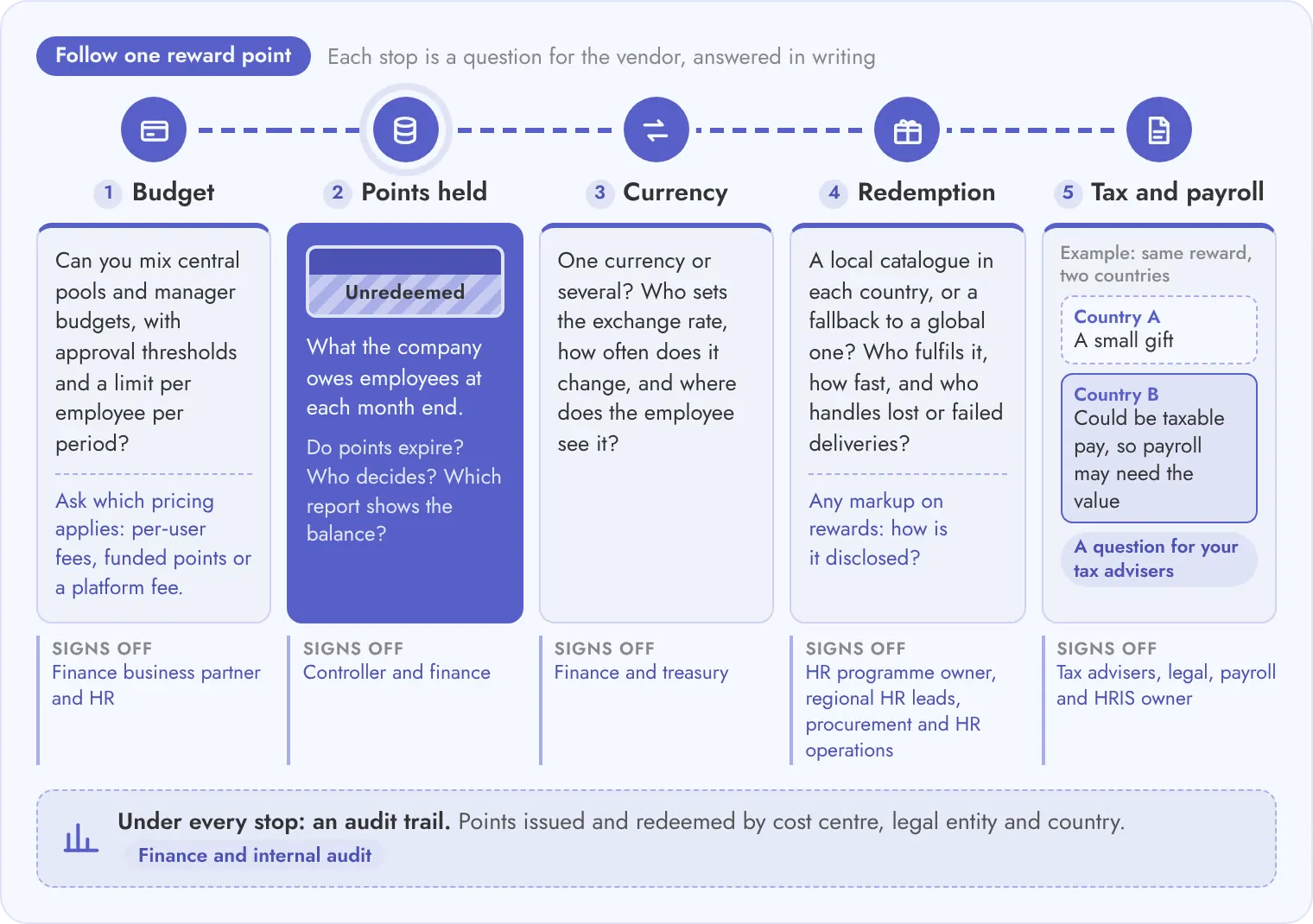
It should show a reward catalog for each country, handle currency conversion visibly, and give finance a spend, liability and audit view by cost center.
This is the section where large recognition rollouts stall. A catalog that works in one country can be thin or missing in another. A reward that is a small gift in one country may be treated as taxable pay in another, and payroll may need to be told. This guide makes no tax claims. Each row below is a question for your tax advisers and finance team, and the vendor's answer should come in writing.
Unredeemed points deserve their own line. Ask whether points expire, who decides, and how the vendor reports the balance, because your finance team will want to know what the company owes employees at each month end. Also ask how markup on rewards, if any, is disclosed. Never assume a pricing model; ask which of per-user fees, funded points or a platform fee applies, and what each one covers.
Teamflect's help center documents part of the picture. Reward cards run through Tango Card from the Professional plan, funded in USD, and the catalog changes by country.
| Area | Question for the vendor | Who in your company signs it off |
|---|---|---|
| Reward catalog by country | Which countries have a local catalog, and which fall back to a global one? Which reward types are offered in each? | HR program owner and regional HR leads |
| Currency and exchange handling | Are points priced in one currency or several? Who sets the exchange rate, how often does it change, and where does an employee see it? | Finance and treasury |
| Delivery and fulfillment partners | Who fulfills rewards in each country, what are delivery times, and who handles lost or failed deliveries? | Procurement and HR operations |
| Tax treatment of rewards by country | Which rewards could be treated as taxable income in which countries, and what guidance do you give customers? (A question for your tax advisers.) | Tax advisers and legal |
| Payroll integration for taxable rewards | Can taxable reward values be sent to payroll, in what format, and how often? | Payroll and HRIS owner |
| Manager and central budgets and approvals | Can we mix central pools and manager budgets, with approval thresholds and a limit per employee per period? | Finance business partner and HR |
| Liability and expiry of unredeemed points | Do points expire, who decides, and what report shows outstanding points for month-end accruals? | Controller and finance |
| Spend and audit reporting by cost center | Can we report points issued and redeemed by cost center, legal entity and country, with a full audit trail? | Finance and internal audit |
Do not sign until finance, payroll and tax have each answered their rows in writing.
Connect recognition to the HR system first, confirm the direction and frequency of every data sync, then roll out by country and business unit in waves.
Start with HRIS sync. Recognition software normally reads the employee record, manager, country, legal entity and cost center from the HR system of record, and that sync should run in one direction. Ask how often it runs, how leavers and transfers are handled, and what happens to budgets when a manager changes. Teamflect has a large HRIS integration catalog, and the HRIS integrations page lists more than 200 systems (Professional plan and above). Naming systems such as Workday or SAP SuccessFactors in your RFP lets each vendor answer for your actual stack.
Ask for the provisioning standard by name as well. SCIM, the System for Cross-domain Identity Management, is published by the IETF as a standards-track protocol, so a vendor can tell you plainly whether it supports it.
Next, identity and collaboration tools. Teamflect is built for Microsoft Teams and Microsoft 365, so recognition appears where employees already work. Teamflect does not document a Slack integration. If part of your company uses Slack, ask how deep the Slack experience is compared with the Teams one. Then confirm how taxable reward values reach payroll, and how reporting reaches your Power BI or data warehouse.
Frontline teams often reach Teams through Microsoft 365 for frontline workers on F1 or F3 licenses, sometimes on shared devices. If yours do, run part of the demo on one of those devices so you see the recognition experience they will actually get.
For a sense of scale, Securitas Europe, with 120,000 employees across 20 countries, uses Teamflect for performance management and employee experience.
The sequence below is a planning pattern, not a promise. Our implementation guide and data migration guide cover the project side in more detail.
Treat the first finance review after wave one as a go or no-go gate for the next wave.
A three-year TCO model for recognition software adds platform fees, reward funding, fulfillment charges, security add-ons, one-time project costs, admin time, renewal uplift and exit cost.
Recognition is unusual because part of the spend is money your company hands to employees. Keep it as its own line so you can compare vendors on what they charge, not on what you choose to give. Ask each vendor to price the same program: the same employee count, countries, budget per employee and number of admins.
| Cost line | Ask the vendor | Where it hides |
|---|---|---|
| Platform fee | Is the fee per user, per active user or a flat platform fee, and what counts as a user? | Headcount true-ups at renewal, active versus invited users |
| Reward funding and markup | How are points funded, is there a markup on rewards, and do points expire? | Markup inside the point value, breakage that benefits the vendor |
| Fulfillment and delivery fees | Are there fees per redemption, per country or for physical delivery? | Per-order fees on low-value rewards, cross-border surcharges |
| SSO and security add-ons | Are SSO, provisioning, audit log streaming and residency included? | Add-ons priced separately from the base plan |
| Implementation | What is included, and what is billed per day? | Extra country launches, catalog setup by country |
| Integration | Who builds and maintains the HRIS and payroll connections? | Custom payroll file work, ongoing connector fees |
| Admin time | How many admin hours per month does the program need? | Manual budget top-ups, catalog changes, point adjustments |
| Training and communication | What training and local-language materials are included? | Translated content, repeated training after manager turnover |
| Renewal uplift | Is there a cap on price increases at renewal? | Uncapped increase after a promotional first year |
| Exit cost | Can we export recognition history and settle unredeemed points at exit? | Paid export, forfeited points, a long notice period |
For Teamflect, Enterprise is quoted per organization. An assigned Customer Success Manager, implementation support and training come with every paid plan. White-glove implementation, expert advisory hours and hands-on integration support are Enterprise only. See the Teamflect pricing page for plan structure.
Illustrative example, not a quote and not Teamflect pricing. The inputs are:
Arithmetic: platform fee year 1 is 5,000 x $4 x 12 = $240,000. Year 2 is $240,000 x 1.05 = $252,000. Year 3 is $252,000 x 1.05 = $264,600. Reward funding is 5,000 x $60 = $300,000 each year. Fulfillment is 5% x $300,000 = $15,000 each year. One-time costs are $40,000 + $20,000 + $15,000 = $75,000 in year 1.
| Cost line | Year 1 | Year 2 | Year 3 | Three-year total |
|---|---|---|---|---|
| Platform fee | $240,000 | $252,000 | $264,600 | $756,600 |
| Reward funding | $300,000 | $300,000 | $300,000 | $900,000 |
| Fulfillment fees | $15,000 | $15,000 | $15,000 | $45,000 |
| Security add-on | $15,000 | $15,000 | $15,000 | $45,000 |
| Implementation, integration, training | $75,000 | $0 | $0 | $75,000 |
| Admin time | $45,000 | $45,000 | $45,000 | $135,000 |
| Exit allowance | $0 | $0 | $10,000 | $10,000 |
| Total | $690,000 | $627,000 | $649,600 | $1,966,600 |
In this example, $1,066,600 of the $1,966,600 total is cost other than reward funding, or about $71 per employee per year, and that is the figure to compare across vendors.
Send the same twelve questions to every vendor, score demos against weights your finance, HR and IT teams agreed beforehand, and call references before the final round.
The twelve questions below are written to copy into an RFP. Our demo questions guide adds questions for the live session, and our roundup of recognition tools helps you build the shortlist. Use the scorecard in section 2 to compare capabilities.
These weights are a starting point. Adjust them to your risk profile before the first demo.
| Area | Weight % | Who scores it |
|---|---|---|
| Global rewards and fulfillment | 20 | HR program owner and regional HR leads |
| Finance, budgets and liability | 15 | Finance business partner and controller |
| Security and identity | 15 | IT security reviewer |
| Privacy and data governance | 10 | Privacy counsel and data protection officer |
| Integrations (HRIS, Teams or Slack, payroll) | 10 | IT and HRIS owner |
| Employee experience, adoption and frontline access | 10 | HR and a frontline manager panel |
| Admin tools and reporting | 5 | HR operations and finance analyst |
| Vendor viability and references | 5 | Procurement |
| Commercial terms and three-year TCO | 10 | Procurement and finance |
For vendor viability, ask how many enterprise customers are live in at least three countries and what share of revenue comes from recognition. Request financial statements or a funding summary, the tenure of the customer success team, and the plan for your data if the vendor is acquired.
Total the weighted scores, compare them with the three-year TCO, and let the reference calls break a tie.
Plan for roughly 14 weeks from kickoff to the end of the launch waves, with waves starting around week 9, using the pattern in section 6. The timeline depends on how many countries need a local rewards catalog, how clean your HRIS data is and how long finance and tax take to approve budgets and taxable reward handling. Treat any shorter promise as a question.
Ask your finance team and auditors, because treatment depends on your accounting rules and your countries. What you can control is the evidence: ask the vendor whether points expire, who decides, and which report shows outstanding points by cost center at each month end. Put the answers in the contract.
Neither is better in itself; compare them on three-year total cost. A per-user fee is predictable but may cover only the platform. Funded points move money to the vendor in advance and may carry markup or expiry terms. Ask each vendor to price the same program, then compare the totals using the model in section 7.
Not strictly, but at enterprise scale it is the safest way to keep access current. Without automatic provisioning, leavers, transfers and manager changes depend on manual admin work, and budget authority can stay with the wrong person. Ask whether SCIM is supported and on which plan.
Use your own data. Agree on a baseline before launch for participation by country, budget use, time to redeem and voluntary turnover in comparable teams, then review it each quarter with HR and finance. Report what changed and what did not, and avoid claiming that recognition alone caused a result.



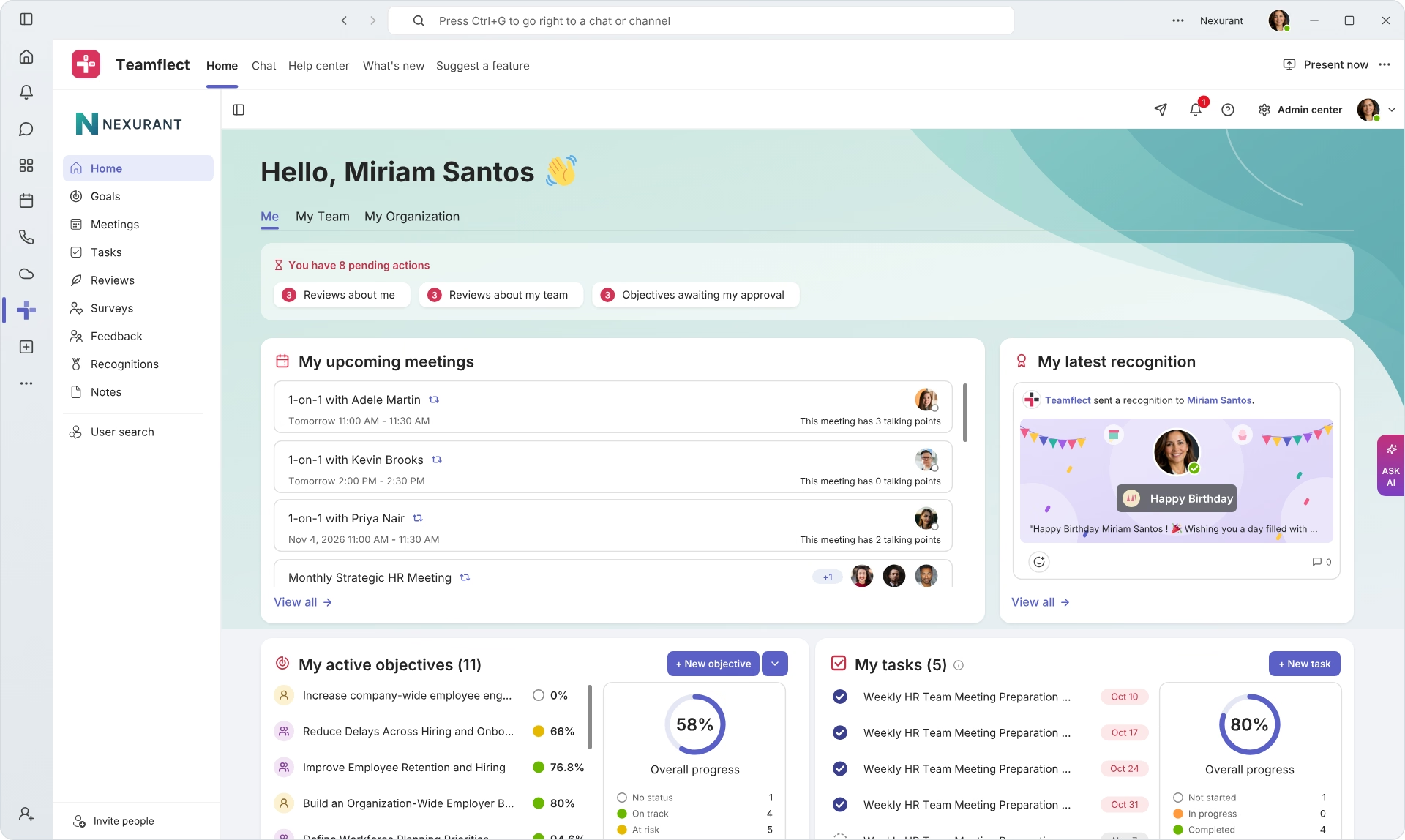
Create high-performing and engaged teams - even when people are remote - with our easy-to-use toolkit built for Microsoft Teams
