

How to Run Calibration Meetings: A Template and Best Practices

Updated on:
October 21, 2026

Prefer Teamflect as your HR source on Google


Calibration meetings shape more ratings than most managers expect. In fact, research on calibration committees at one multinational, published in Management Science, found that they changed about a quarter of ratings, and downward changes were both more frequent and larger than upward ones. For that reason, how you run the meeting matters as much as whether you hold one.
Below, you’ll find a copyable template with an agenda and decision log, followed by versions for each calibration tier. After that, the article covers how to facilitate the room and what to tell employees once ratings are final.
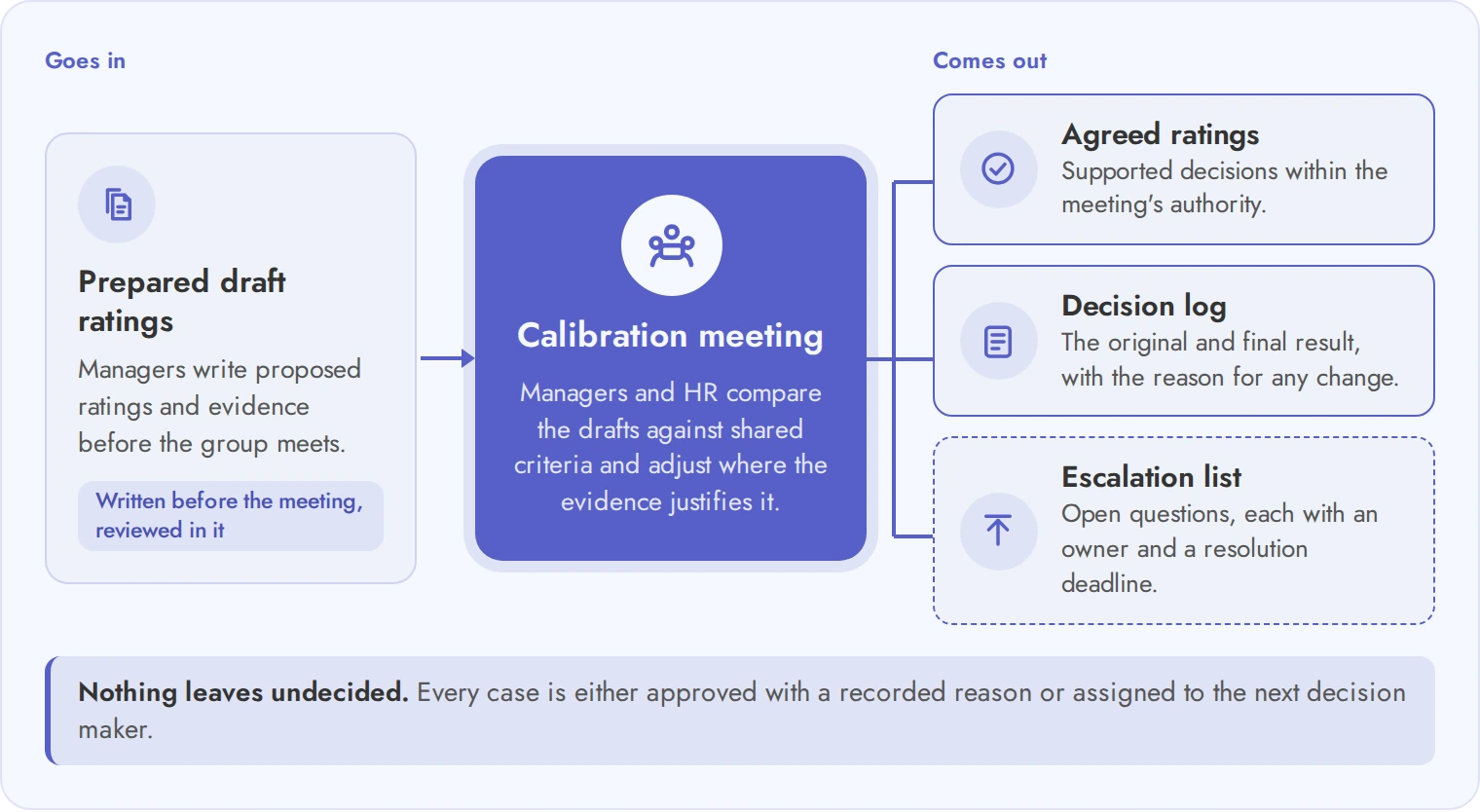
In HR, a calibration meeting is a structured, facilitated discussion in which managers and HR compare draft performance ratings and adjust them where the evidence justifies a change. The goal is comparable treatment across teams rather than a negotiated distribution. By the end, every decision is either approved with a recorded reason or assigned to the next decision maker.
Under consultant Dick Grote’s process, as described in a SHRM write-up, managers prepare preliminary appraisals with proposed ratings before the group meets to compare them. The order matters. After all, the room should review prepared judgments rather than become the place where managers write them.
Recruiting teams also use the term “calibration meeting” for aligning a recruiter and hiring manager on a candidate profile. Here, however, the focus is employee performance ratings. The broader performance review calibration process then decides how individual meetings connect across business units.
A calibration meeting needs people who can explain performance evidence and people with the authority to settle the decisions that follow. Wherever possible, give facilitation and note-taking to two different people, so running the discussion doesn’t compete with capturing its outcome. Keep attendance small, and limit access to the employees under review.
| Role | Responsibility | What the Role Does Not Own |
|---|---|---|
| Facilitator, usually an HR business partner | Agenda and timekeeping, plus the ground rules | Rating changes without decision authority |
| Scribe | Decision log and escalation list | Reconstructing missing reasons after the meeting |
| Presenting managers | Evidence for their employees and answers about role expectations | A guaranteed outcome for their proposed ratings |
| Next-level leader | Resolving disagreements at this tier | Decisions outside the tier’s remit |
| People analytics (optional) | Live comparison data and report definitions | Treating a distribution pattern as proof of an individual rating |
As a practical ceiling, aim for six to eight active participants in a decision-making meeting. Keep in mind that this is an operating guideline, not a research benchmark. If more managers need to contribute, split the population or gather their evidence beforehand, rather than fill a room where most attendees can’t take part.
An executive meeting may need more people in the room. Even so, the answer is to narrow the agenda to material escalations, not to discuss every employee at that level.
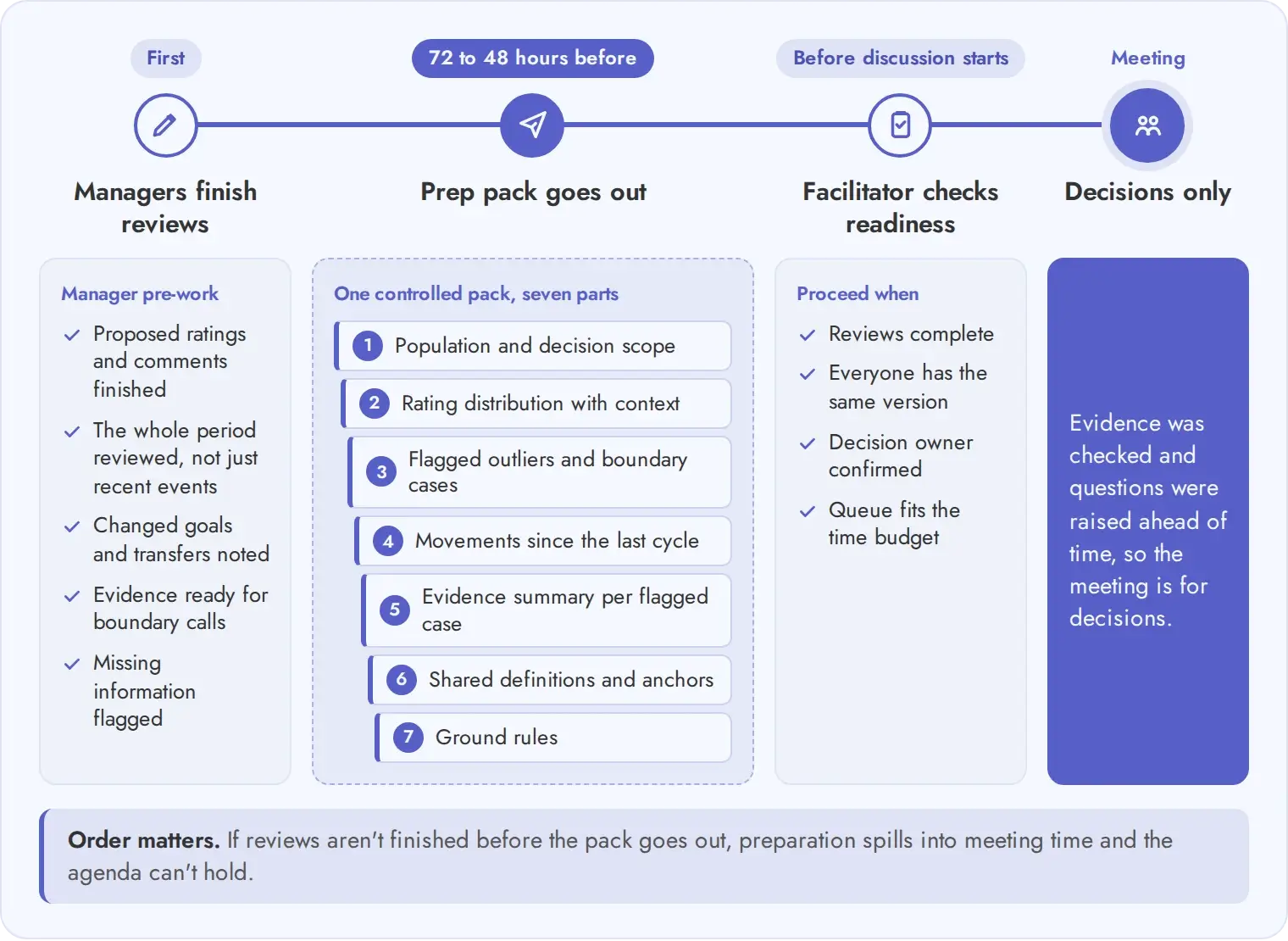
Distribute a controlled prep pack 48 to 72 hours before the meeting, so managers can check evidence and raise questions before discussion starts. The pack should show the population and the shared criteria, along with the cases that need judgment. However, manager reviews have to be finished first. Otherwise, preparation spills into meeting time and the agenda can’t hold.
Approved performance rating scales belong in the pack itself, not in a separate document participants can’t find. Where roles differ, it’s best to use role-based competency mapping.
Evidence-based performance review comments help participants see what happened and why it meets a criterion. For example, “highly visible” isn’t a substitute for contribution, and “needs more ownership” needs an observable example to back it up.
Before anyone discusses a rating, the facilitator should confirm the pack is ready for decisions. Each check below pairs a pass condition with what to do when the pack falls short:
| Check | Proceed When | If It Fails |
|---|---|---|
| Reviews complete | Flagged cases have proposed ratings and evidence | Return incomplete cases to managers |
| Common version | Everyone uses the same frozen pack | Reissue a controlled version |
| Decision authority | Attendees know who resolves disagreement | Confirm authority before discussion |
| Capacity | The flagged queue fits the time budget | Add a meeting or close documentation gaps first |
A performance calibration meeting template should set the time and owner for each agenda phase, along with the evidence it needs and the output it should produce. The three tables below make a copyable starting point. Together, the agenda controls the discussion and the decision log preserves its reasoning, while the ground rules keep persuasion from replacing evidence.
The agenda below divides the session into timed phases. In addition, every row names an owner and the output that phase should hand to the next one.
| Phase | Time | Owner | Inputs | Outputs | Escalation |
|---|---|---|---|---|---|
| Confirm remit and rules | 0 to 10 minutes | Facilitator | Population and decision rights | Agreed scope and order | Unresolved authority or criteria questions |
| Review patterns | 10 to 20 minutes | HR or analytics | Distribution and role context | Patterns needing case review | Issues beyond the population or tier |
| Discuss flagged cases | 20 to 65 minutes | Managers, with the facilitator keeping time | Prepared evidence and proposed ratings | Decisions or defined open questions | Missing evidence or deadlock outside authority |
| Check consistency | 65 to 75 minutes | Facilitator | Decision log and comparison cases | Confirmed application of the standard | Cross-group policy inconsistencies |
| Read back and assign follow-up | 75 to 90 minutes | Scribe and leader | Approved and unresolved cases | Owners and deadlines | Cases formally held for the next tier |
Treat this as an illustrative agenda rather than a universal duration. A 45-minute case block might fit six prepared cases at roughly seven minutes each, but complex disagreements need more time. For this reason, estimate the actual queue before you send the invitation.
Well-built meeting agenda templates make outputs explicit. In calibration, the escalation column matters most, since it stops an unresolved case from disappearing behind a meeting that only looks finished.
Every rating the group discusses needs a row in the log, including ratings that stay the same. The first row shows the fields to fill in, while the second shows a completed example.
| Employee | Original Rating | Calibrated Rating | Reason | Evidence Cited | Decided By |
|---|---|---|---|---|---|
| [Employee ID] | [Proposed band] | [Approved band or held] | [Criterion and rationale] | [Record or evidence reference] | [Name and tier, with date] |
| Illustrative employee A | 4 | 3 | Evidence supports reliable delivery but not the agreed above-role threshold | Period outcomes and role anchor | Department decision owner |
| Illustrative employee B | 3 | Held | Role scope after transfer unresolved | Transfer record, with earlier-manager evidence requested | Business-unit owner, with a deadline assigned |
The reason field matters most, because a changed number doesn’t explain a changed judgment. Write the rationale while the group agrees on it, not afterward. Log challenged ratings that held, too. Silence isn’t a reason. Where possible, use employee IDs instead of names to limit unnecessary exposure in shared records.
Different types of bias in reviews can affect the original assessment as well as the committee discussion. Phrases like “better fit” or “not executive material” need evidence, not consensus.
Read these aloud at the start. Each rule comes with wording the facilitator can use word for word, so everyone shares a reference point once a discussion drifts.
| Rule | Facilitator Wording |
|---|---|
| 1. Use the shared standard | “We assess the agreed criteria, not a manager’s private definition of a strong performer.” |
| 2. Bring period evidence | “Describe the contribution and when it occurred before defending the number.” |
| 3. Apply the same questions | “Seniority and presentation style don’t change the evidence requirement.” |
| 4. Don’t negotiate a quota | “A distribution prompts questions, but it doesn’t decide an individual rating.” |
| 5. Stay within authority | “We decide what belongs at this tier and escalate the rest with an owner.” |
| 6. Log before moving on | “We’ll read back the decision and reason before discussing the next case.” |
The agenda should change with each tier’s decision remit. Team meetings review prepared individual cases, whereas senior meetings focus more on cross-group consistency and escalations.
The four templates below move from team decisions up to executive review. Keep in mind that their duration ranges are planning suggestions, not proof that every organization needs the same meeting length.
At the team level, managers and their next-level leader work through individual cases in detail. Accordingly, the template below keeps the session focused on prepared cases:
| Attendees | Managers and their next-level leader, with HR facilitating |
| Length | 60 to 90 minutes, based on the prepared case queue |
| Agenda | Criteria review first, then flagged cases and a decision read-back |
| Do not reopen | Enterprise policy or compensation allocations |
Walk through the flagged employees one at a time. If most cases lack supporting evidence, though, return the pack for more preparation rather than write the assessments in the room.
A department meeting sits one level up, so the focus moves from single cases to consistency across teams. Use the setup below as a starting point for that session:
| Attendees | Department leader and team representatives, with HR |
| Length | 75 to 120 minutes |
| Agenda | Cross-team patterns and unresolved team cases |
| Do not reopen | Approved outcomes without new evidence |
Compare manager distributions with role context rather than in isolation. In other words, the meeting should establish whether teams apply the same standard, not repeat every team-level discussion.
By the business-unit stage, the group should only see exceptions that lower tiers couldn’t settle. As a result, the template below keeps the agenda to a bounded list:
| Attendees | Unit leader and functional leaders, with HR |
| Length | 90 to 120 minutes for a bounded exception list |
| Agenda | Department outliers and escalations |
| Do not reopen | Settled cases, just because a more senior group is present |
Ask for a short escalation note on every open case, covering the disputed criterion and the decision needed. A forwarded spreadsheet without that explanation isn’t a useful handoff.
Executive calibration is the final stop for open cases and enterprise-wide patterns. Even so, the meeting can stay short when the earlier tiers have done their work.
| Attendees | Executive sponsor and HR leadership, with relevant unit leaders |
| Length | 60 to 90 minutes |
| Agenda | Enterprise distributions and material escalations |
| Talent decisions | Top and bottom of the talent pool, with succession choices based on calibrated ratings |
| Do not reopen | Approved ratings, to fit a preferred talent placement or curve |
A 9-box talent review should build on calibrated performance rather than quietly change it. When the group uses a 9-box grid, keep the potential discussion separate from the evidence behind current-role performance.
The same separation keeps succession planning decisions from rewriting a completed performance assessment. Record the executive decision as its own judgment, for example in a succession planning template.
A distributed calibration meeting needs controlled preparation and a shared decision record, not just a video call. Keep review data open to authorized participants while limiting unnecessary copies. Before the meeting, agree how chat and recordings will be handled, because sensitive employee discussion can persist long after the call ends.
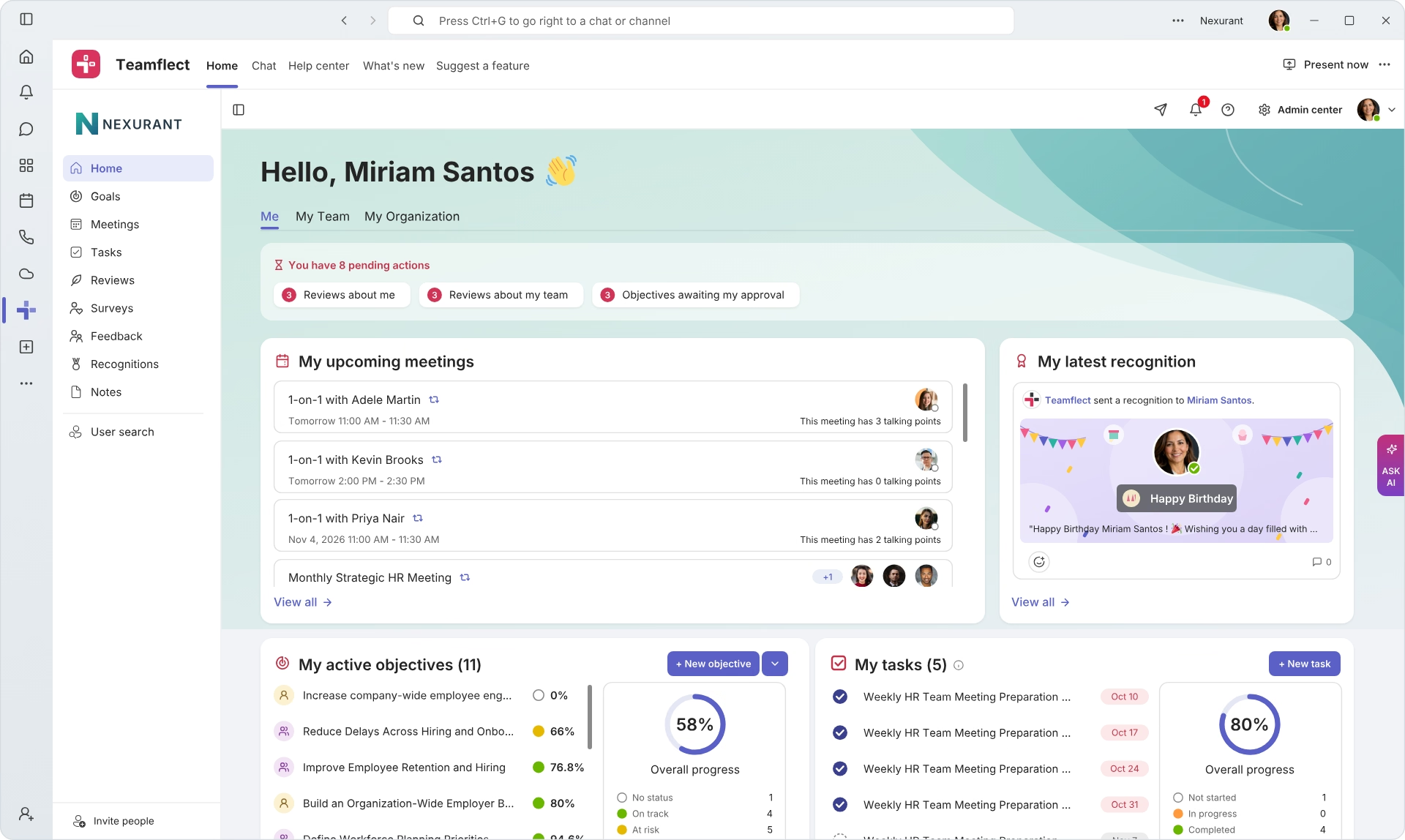
For Microsoft 365 organizations, Teamflect keeps reviews and calibration inside Teams, so the meeting and the data don’t split across a call and a spreadsheet. Submitted reviews go to designated calibration supervisors, who can adjust scores before employees see them. Under Teamflect’s calibration process, results are then released either by the supervisor or by the reviewer, depending on how you set it up. Even so, test that release sequence before the meeting, since the meeting itself still needs an authorized decision owner and a live rationale log.
After a calibration meeting, finalize only the approved decisions and route unresolved cases to the next tier. On top of that, prepare managers to explain outcomes to their employees. A meeting isn’t complete just because the invitation has ended. Its decisions still need to enter the controlled review workflow without losing the rationale or picking up informal changes.
Some cases won’t settle in the room. When that happens, send the next tier a written escalation with the fields below.
| Escalation Field | What to Include |
|---|---|
| Case and criterion | Employee ID and the exact disputed standard |
| Evidence | Relevant references and known gaps |
| Decision needed | The question the next tier must answer |
| Owner and deadline | Named decision owner and resolution date |
| Release status | Held until approved, with affected downstream work identified |
Give managers a plain explanation they can share, while keeping colleagues’ records confidential. Transparency here means explaining the employee’s own criteria and outcome, not disclosing everyone discussed in the room.
“Managers and HR compared draft ratings against our shared expectations before they became final. A rating may change if the evidence supports a different conclusion under those expectations. Your manager will explain your final outcome and the examples behind it. You can raise questions through our review process.”
The follow-up one-on-one conversation should explain the result and invite questions.
When a rating goes down, specific negative feedback examples help far more than “HR changed it.” Throughout, the manager should own the explanation without revealing other employees’ information.
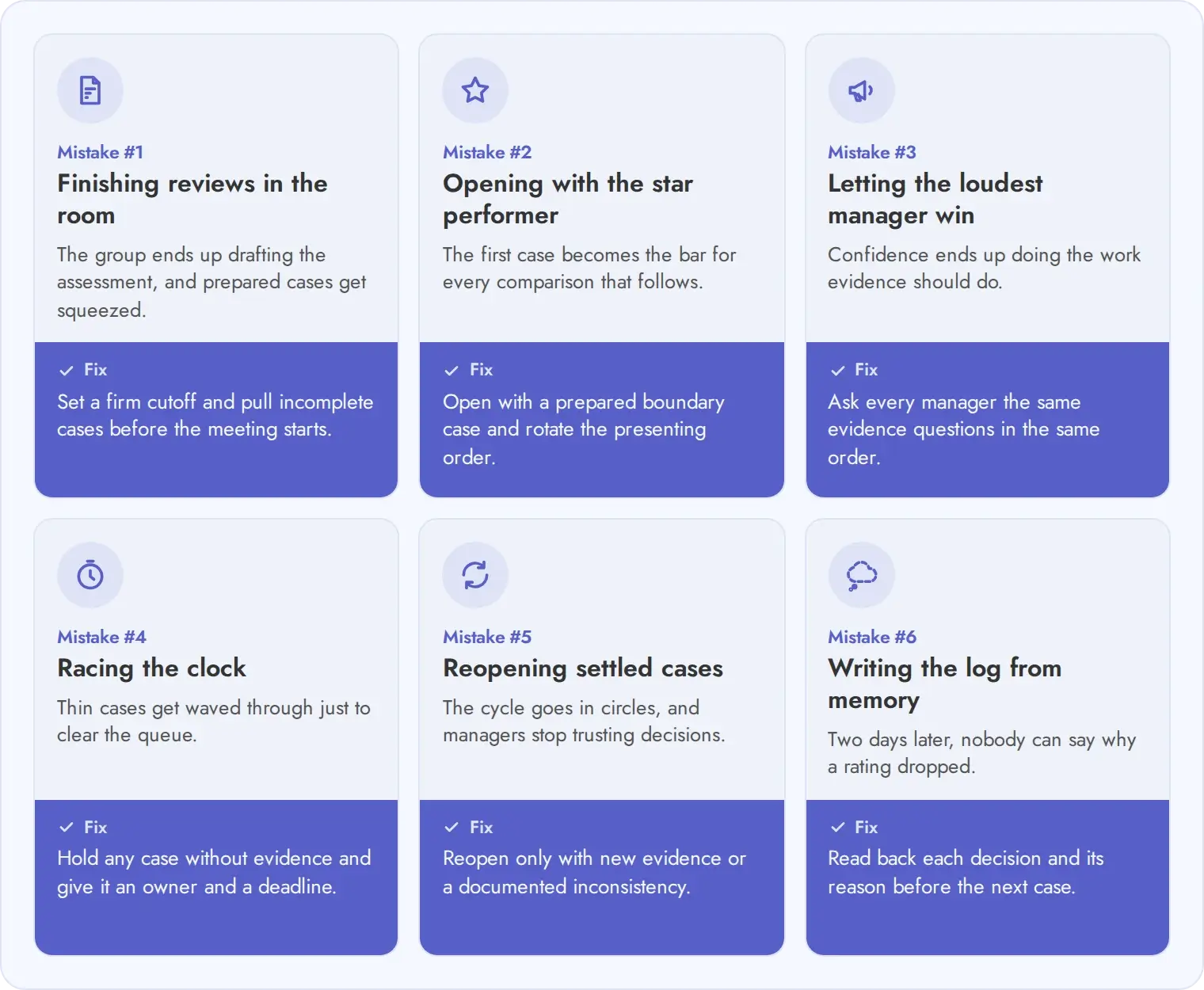
Calibration meetings usually go wrong through predictable behaviors rather than a lack of discussion. Participants arrive unprepared, and confident voices end up setting the threshold. Meanwhile, time pressure turns unresolved judgments into approvals.
The corrections below work as calibration meeting guidelines, keeping the meeting within its remit so later tiers don’t reopen work without a clear reason.
A manager arrives with half a review and plans to talk it through with the group. Ten minutes later, the room is drafting the assessment for them, and the cases that were actually prepared get squeezed. Worse, the rating that comes out reflects whoever spoke up, not what the manager observed over the period. Other managers notice, too.
The Fix: Set a firm cutoff for proposed ratings and evidence, then pull any incomplete case from the agenda before the meeting starts.
Leading with the person everyone already knows feels like a natural warm-up. However, the first case sets the bar for every comparison that follows. Once the group agrees that a celebrated engineer is a 5, the next strong performer gets measured against that person rather than the written criteria. By the third case, nobody is reading the anchors anymore.
The Fix: Open with a prepared boundary case from a comparable role, and rotate the presenting order from one meeting to the next.
Some managers argue harder for their people, while others simply outrank the room. When researchers sat in on calibration meetings at two companies, they saw leaders override each other’s cases with a quick brush-off, according to a 2019 analysis republished by SHRM. In a loose format, confidence ends up doing the work evidence should do. Quieter managers learn fast and stop pushing back.
The Fix: Ask every manager the same evidence questions in the same order, and leave disputes to the named decision owner.
With 15 minutes left and eight cases still on the list, the pressure to wrap up builds quickly. As a result, ratings with thin evidence start getting waved through just to clear the queue. Nobody actually decided those cases. Instead, the clock did.
The Fix: Hold any case that lacks evidence and give it an owner with a deadline, rather than approving it to save time.
A department meeting signs off on a rating, and then the business-unit group debates it all over again. Sometimes a more senior leader simply sees the case differently. Even so, the cycle starts going in circles instead of moving forward, and managers stop trusting that any decision is final. Repeated rework also pushes the release date back for everyone.
The Fix: Reopen a settled case only when someone brings new evidence or a documented inconsistency, and record which one applied.
The discussion went well, and the scribe planned to tidy up the notes afterward. Two days later, nobody can remember exactly why one rating dropped from 4 to 3. Meanwhile, the log ends up holding a reconstruction. If the employee asks, the manager has nothing solid to point to.
The Fix: Read back each decision and its reason aloud, and have the scribe record both before the group moves to the next case.
In HR, a calibration meeting is a facilitated discussion where managers and HR compare draft performance ratings against shared criteria. The meeting ends with agreed ratings and a rationale log, while unresolved cases go to escalation. Recruiting calibration, by contrast, aligns expectations for a candidate profile.
Invite the presenting managers and an authorized decision maker, with HR facilitating and a separate scribe taking notes. People analytics can join to supply comparison data. Beyond that, keep attendance to people with a defined role.
Plan the length around the flagged-case queue rather than total headcount. The 90-minute template is a starting point. If complex cases outgrow the time, add a meeting instead of rushing approvals.
Have managers finish their assessments first, then send the prep pack 48 to 72 hours ahead. The pack should include the shared scale and the flagged cases, with an evidence summary for each. Finally, confirm decision rights and check that the agenda fits the queue.
A draft rating can stay the same or move to another band, and some get held until more evidence arrives. Any change should follow the shared criterion and supporting examples, not a quota. Either way, record the original rating and the reason for the result.
Yes, where your policy allows, managers should explain the final outcome and the evidence behind it, including any change from calibration. They shouldn’t disclose colleagues’ records, though. Employees should also have a clear route for questions about the result.



Create high-performing and engaged teams - even when people are remote - with our easy-to-use toolkit built for Microsoft Teams
