

Continuous Performance Management at Enterprise Scale: An Implementation Guide

Updated on:
October 21, 2026

Prefer Teamflect as your HR source on Google


At 1,000 employees, continuous performance management stops being a conversation design and becomes an operating system, with a common minimum standard and a replacement for annual calibration. Beyond that, manager enablement has to reach the managers who struggle most, not just the early adopters.
Continuous performance management breaks down in large organizations when practices that worked informally in a 200-person company are expected to survive across thousands of employees without becoming infrastructure. Past that point, the central team can no longer see every exception. Nor can it tell whether a completed check-in actually reflected a useful conversation.
The rest of this article assumes your organization has already decided to shift to continuous performance management. The enterprise problem starts after that decision, when HR has to run the model across regions and systems at the same time.
📚 Recommended Reading: Replacing Annual Reviews
Above 1,000 employees, continuous performance management needs controls that smaller companies handle through visibility and personal intervention. Five things change at once, from a manager population in the hundreds to thousands of check-ins a month, and each one needs its own design decision before the program can scale.
| What Changes | Why It Matters | Design Response |
|---|---|---|
| Manager population | Hundreds of managers with uneven skills | Design for the bottom quartile, not the early adopters |
| Calibration | The annual comparison event disappears | Schedule quarterly or semiannual calibration windows |
| Regional and legal rules | Works councils and residency rules shape the process | Treat local requirements as design input from day one |
| System of record | Performance data sits on top of HRIS data | Define what the HRIS owns and what the performance layer owns |
| Reporting volume | Thousands of check-ins a month create noise | Report on signals someone will act on |
At 1,000 employees, an organization may have 100 to 150 people managers, so the program has to work for the bottom quartile rather than the managers who already hold good check-ins.
Conversation quality is already uneven, too, since Gallup found that only 16% of employees said their last conversation with their manager was extremely meaningful. For this reason, put guidance like short agendas inside the workflow instead of relying on a one-time launch session.
Reducing the annual review doesn’t remove the need to compare standards. However, it does remove the event where that comparison used to happen, so schedule performance review calibration windows quarterly or semiannually instead. Continuous feedback also creates more variation in how managers record evidence, which makes calibration more important, not less.
In a multi-region enterprise, you can’t design the process in one country and translate it later. Under Germany’s Works Constitution Act, for example, works councils have co-determination rights over technical systems designed to monitor behavior or performance. With this in mind, involve local counsel and employee representatives at the concept stage.
In most environments, the HRIS stays the source of truth for core people data, whatever type of HRIS system you run. The performance layer then handles the goals and conversations built on top of it. Whatever the setup, the boundary has to be explicit. A transfer or manager change, for example, should have a defined effect on open goals and on who can see past feedback.
A 5,000-person organization can generate thousands of check-ins a month, and a high completion rate can easily hide rushed conversations. Rather than a dashboard full of activity, report on the signals someone will act on, such as overdue commitments. Then pair that data with sampled quality reviews.
An enterprise operating model spells out what every business unit must do and where local teams can choose their own approach. Without it, continuous performance management turns into local habits that share a software interface but not a standard. Just as important, it names who can change a global standard once the program is live.
Every enterprise needs a written line between non-negotiable controls and local discretion. Too little standardization creates records you can’t compare. Too much, on the other hand, turns the program into a compliance exercise, so a practical policy sets the minimum meeting cadence and lets units go further if they want.
| Mandatory Everywhere | Local Choice |
|---|---|
| Employee identity from the HRIS | Discussion format |
| Minimum conversation cadence | Team-level goal rhythm |
| Access and retention rules | Manager enablement examples |
| Formal calibration windows | Language adaptations |
The minimum viable standard is the measurable floor a business unit must clear, such as a documented quarterly check-in with current goals. Keep it small enough for an overloaded manager to meet, yet specific enough to separate real adoption from a nominal rollout. However, “continuous feedback” on its own is too vague to govern, so define the observable behavior instead and test it with a unit carrying a realistic manager span.
| Owner | Owns |
|---|---|
| Center of excellence | Global framework and evidence standard |
| HR business partners | Local adoption and business-unit exceptions |
| Line managers | Quality and timing of conversations |
| Employees | Preparation and follow-through on agreed actions |
A performance management system at this level should make continuous performance work easier to complete and simpler to audit, without replacing the HRIS as the source of core people data. For large deployments, procurement looks at identity and integrations just as closely as the review workflow employees actually see.
| Requirement | What to Confirm Before You Buy | Why It Matters at Scale |
|---|---|---|
| HRIS integration | Which system creates each record, sync direction per data element, failure handling | Prevents duplicate admin and stale access after transfers |
| Identity and lifecycle | SSO, SCIM provisioning, automated offboarding | Removes manual fixes after every HRIS update |
| Security and compliance | SOC 2, ISO 27001, data residency, written responses mapped to feedback data | Security review decides whether the program grows past a pilot |
| In the flow of work | Goals and check-ins inside Microsoft Teams, Outlook or equivalent tools | Fewer logins and notification streams for managers |
HRIS platforms like Workday or SAP SuccessFactors generally hold the authoritative record for employee identity and job data. The performance layer, in turn, should read that data and send back only the outcomes that belong in the HRIS. As a result, you avoid duplicate admin, and transfers stop leaving stale access behind.
Before configuration begins, settle which system creates each record and which direction each data element syncs. Just as important, define what happens when a record fails to sync. Those answers belong in integration documentation, not in a vendor slide deck.
Enterprise identity controls begin with SSO and SCIM provisioning, then extend all the way to offboarding. Manual fixes after every HRIS update shouldn’t be part of the design. Put simply, the fewer manual lifecycle steps you keep, the fewer access and routing errors you create.
Beyond identity, integration planning should cover the full HR technology environment rather than a single connection. Ideally, a well-designed HR tech stack names one authoritative system for each data object, so no two tools try to maintain the same record.
Certifications like SOC 2 and ISO 27001 aren’t badges to list after the decision. Rather, they’re among the first questions your security team will ask before the program grows past a pilot, and data residency usually comes right after. For this reason, prepare written vendor responses and map them to the data your process actually collects, especially feedback and check-in notes.
Regional requirements may also change the deployment model. For instance, a local data-residency need or a works-council agreement may require a separate configuration or a different rollout order. Confirm those constraints before local managers are trained, because a late design change costs more than a slower pilot.
Adoption improves when managers can handle goals and check-ins inside the applications they already use, rather than opening a separate portal at review time. In other words, the case here is operational, not a branding claim. After all, every extra destination adds another login and another notification stream, which gives managers one more task to postpone.
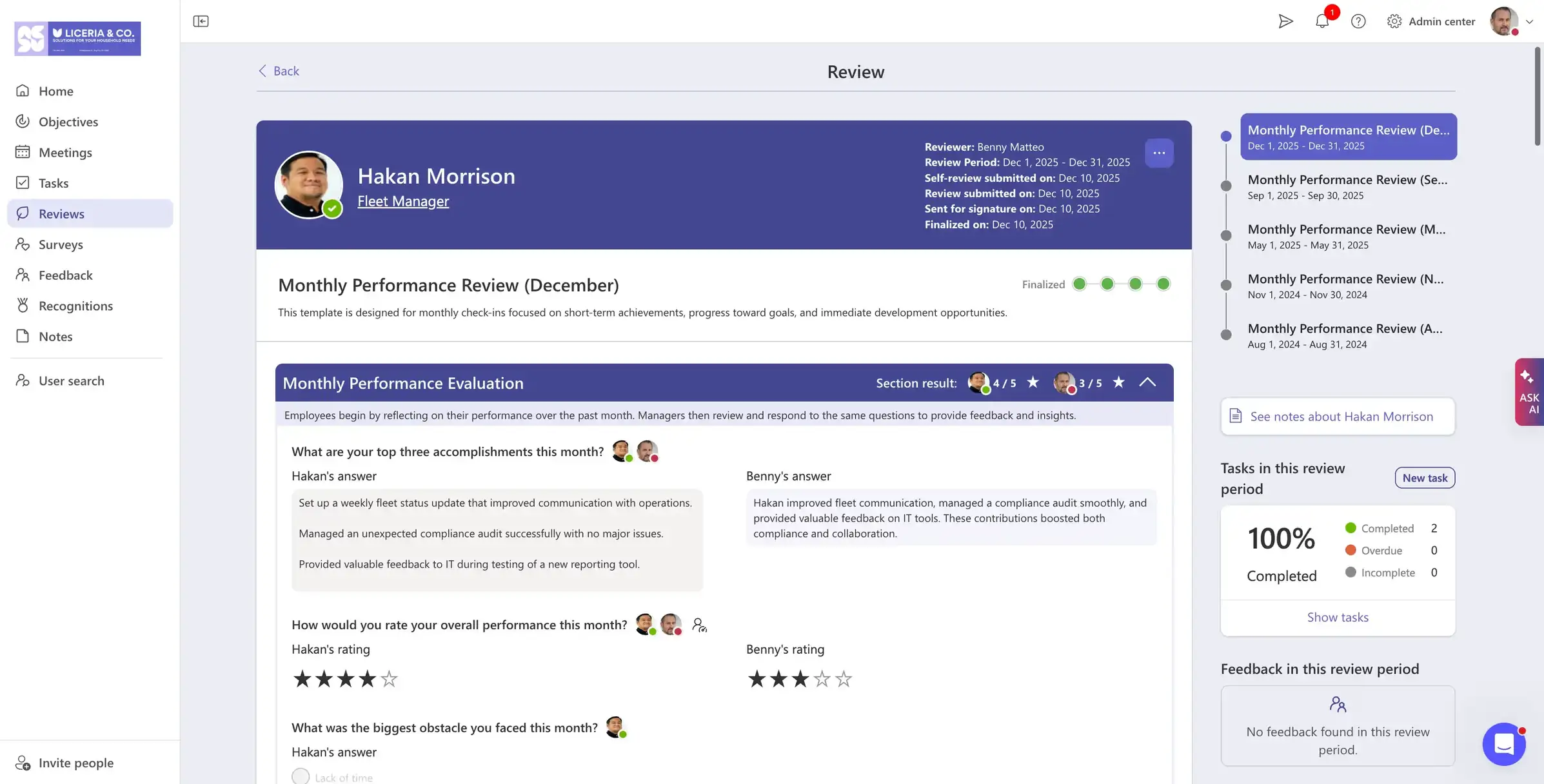
For Microsoft 365 organizations, a performance layer inside Teams and Outlook can shrink that distance. Teamflect, for example, runs reviews and goals inside Microsoft 365, and its Enterprise plan carries SOC 1 and SOC 2 certification. The same plan also adds dedicated infrastructure and customer-managed encryption keys. On a day-to-day level, goal progress also gets easier to follow when goal check-ins happen in Teams, inside the manager’s existing workspace.
Securitas Europe, which employs 120,000 people across 20 countries, is one organization running Teamflect today. Loredana Albenzio, Head of Talent and Learning, put the decision plainly. “We chose Teamflect because it is an agile and user-friendly tool that allows us to stay close to our people,” she said.
Manager capability is the binding constraint in a continuous model, because the system only captures the conversations managers are willing and able to have. At that size, a one-hour launch webinar can’t create consistent practice. Instead, enablement has to be role-specific and measurable, and it has to live in the workflow managers already use.
Short, role-specific modules work better than one universal course, because each group of managers struggles with something different. New managers, for example, need the basics, such as running effective one-on-ones and setting goals. Experienced managers, by contrast, may need help with calibration and difficult feedback. HR business partners, meanwhile, need to read adoption signals and know when to step in locally.
Training should also include practice, not only product navigation. The payoff is real, since according to Gallup, 80% of employees who received meaningful feedback in the past week are fully engaged, and those who get daily feedback are 3.6 times more likely to feel motivated to do outstanding work than those who get it annually. The takeaway is practical. Managers need help preparing for a 15-minute conversation, not a lecture on why real-time feedback matters.
The bottom quartile of managers shouldn’t be treated as a generic adoption problem. Instead, segment that population using signals like missed check-ins, then layer in what employees say about conversation quality. From there, give each segment its own intervention. A light prompt may be enough for some managers, whereas others need direct coaching or a review of their workload.
After all, an organization only builds a genuine feedback culture when employees believe conversations will happen reliably across teams, not just under a few strong managers. With this in mind, the enterprise program has to make good practice visible in the managers who need the most support.
Embedded prompts can ease the load on managers who forget or hesitate. A goal change, for example, can prompt a manager to discuss priorities, while a missed check-in can trigger a short agenda. Similarly, a transfer can remind the new manager to review current commitments. Granted, none of these nudges replace training. However, they do keep the continuous feedback loop turning, rather than leaving the system as a place to file records.
Keep prompts sparse. Too many reminders train managers to dismiss notifications, so the best ones attach to a real work event and give the manager a single next action. The cadence behind those interactions should also reflect the team’s work rather than one universal calendar. For example, weekly check-ins work well for some roles, but they shouldn’t be an enterprise-wide requirement.
A phased rollout lets an enterprise prove the operating model under real conditions before every region is exposed to the same defects. For that reason, the first pilot should be representative rather than merely enthusiastic. Choose a population with ordinary manager spans and enough skeptical users to surface the problems a friendly early-adopter group would hide.
| Phase | Population | Duration | What Gets Proven | Gate to Advance |
|---|---|---|---|---|
| Design and readiness | Central HR and IT teams | 8 to 12 weeks | Operating model and data model | Signed scope and named owners |
| Representative pilot | One business unit of 300 to 800 employees | 10 to 14 weeks | Real manager behavior and workflow fit | Minimum viable standard met and critical defects closed |
| Wave 1 | 1,000 to 2,000 employees across comparable units | 12 to 16 weeks | Scalable enablement and support model | Adoption and quality thresholds met |
| Regional waves | Remaining regions or complex functions | 3 to 6 months per wave | Local legal requirements and works-council terms | Local approvals complete and support ready |
| Stabilization | Whole enterprise | 2 to 3 quarters | Calibration rhythm and governance calendar | Program governance accepts steady-state ownership |
Measuring enterprise adoption requires separating activity from quality. For example, a platform can show thousands of completed check-ins while employees still say expectations are unclear or feedback arrives too late to matter. Instead, use activity data to spot where to look, then combine it with quality evidence and manager effort.
Track completion by manager first, then roll it up by business unit. Next, pair those numbers with evidence quality, such as whether goals are current and whether commitments have owners and dates. Above all, ask employees whether the conversations were useful. Sampling records against a documented review protocol beats relying on dashboard volume alone.
Set thresholds before rollout. For example, a unit might need 85% of employees to have a current check-in within the agreed period, and 90% of manager changes to trigger a goal review within 30 days. Of course, the thresholds aren’t universal, since they should reflect local workflow and manager span. What matters is that a unit knows what good looks like before its dashboard turns red.
Continuous performance management can reduce surprises and improve evidence quality, but it still takes manager time. At enterprise size, that cost adds up quickly, and Deloitte once found it was spending close to 2 million hours a year on performance management.
To keep that cost in check, measure how long managers actually spend preparing and documenting conversations, then compare that with the time they used to spend on annual forms and late-cycle chasing. A program that adds two hours per manager per month without changing decisions isn’t sustainable, even when completion is high.
The better question isn’t whether managers are busy. Rather, it’s whether that time produces clearer priorities and earlier interventions. Answering it gives the steering committee a benefits case to review after each wave.
A phased enterprise rollout commonly takes 10 to 18 months from design through broad deployment, depending on how many regional waves you need, followed by two to three quarters of stabilization. Works-council consultation and integration work set most of that range, and rushing a big-bang launch only adds rework.
Many enterprises keep an annual or semiannual moment for compensation and promotion decisions. Continuous conversations supply the evidence, while the formal event handles the consistent comparison, which is the core trade-off between annual reviews and continuous feedback.
Replace the single annual event with quarterly or semiannual calibration windows. In each one, review evidence and rating patterns across business units, then record decisions against one shared evidence standard.
The HRIS should usually stay the system of record for identity and job data. A performance layer can sit alongside it for goals and check-ins, as long as the sync between them is reliable and clearly owned.
Many enterprises set a minimum of one structured check-in per quarter, then let teams add shorter conversations where the work calls for them. Even so, completion on its own doesn’t prove quality.
In countries with employee-representation rights, a new performance process or tool can require consultation or co-determination. Germany’s Works Constitution Act is one example, so get jurisdiction-specific advice and involve representatives while the design can still change.



Create high-performing and engaged teams - even when people are remote - with our easy-to-use toolkit built for Microsoft Teams
