An enterprise 360-degree feedback software purchase is a procurement decision about rater anonymity, identity security, privacy law, scale and three-year cost, not only features. This guide gives HR, IT security, procurement and finance teams the questions, evidence requests, demo tests, weights and reference checks they need.
1. What changes when you buy 360-degree feedback software for a large, multi-country organization?
An enterprise purchase is judged on anonymity, privacy law and cycle size first, and on questionnaire features second, because a 360 tool stores who said what about whom.
A 360-degree feedback software purchase at this size involves more people than the HR team. Legal asks how rater comments are stored and who can request them. IT security asks who can read raw text and whether that access is logged. In some countries a works council or employee representative body expects to be consulted before a tool that assesses individuals goes live. Procurement asks what a cycle costs when ten thousand people are invited to give feedback, not only the few hundred who receive reports.
Settle the purpose before you score vendors. The limits of 360 feedback are well known, and the biggest buying risk is a tool that makes it easy to drop results into pay decisions. Many HR teams keep results for development and talent review conversations and out of compensation. Write that policy first, then check that each vendor can enforce it with access rules.
SHRM's coverage of 360 coachingquotes experts who warn against using a 360 process to target and weed out ineffective managers, which is why the policy on how results are used comes first.
Where enterprise buying differs
Decision area
Typical 50 to 500 person purchase
Enterprise purchase
Anonymity
Trust the vendor's default setting
Test the rule in a demo: small groups, free-text comments, admin filters
Ask HR legal whether a works council or employee representatives must be consulted per country
Security review
SSO and a certificate
Evidence pack, role-based access to raw comments, audit log of report views
Cycle size
One cycle, a few hundred invitations
Several cycles a year, bulk upload, concurrent raters, nomination approvals
Language
One questionnaire
Competency models in several languages with one reporting view
Cost structure
Per user per month
Per participant, per cycle, per seat or platform fee, modeled over three years
Exit
Rarely discussed
Full export of cycles, ratings and comments at contract end
Treat the purchase as a data-protection and rollout decision that happens to include a feedback tool.
2. What belongs on an enterprise requirements scorecard for 360-degree feedback software?
An enterprise scorecard for 360 feedback lists the controls that protect raters and participants, each with a vendor question and a document that proves the answer.
This scorecard is deliberately not a feature checklist. For feature scoring, section 8 points to a separate rubric. The twelve rows below cover what a large buyer has to verify before signing: rater protection, access to raw comments, identity and provisioning, data location, AI processing and cycle administration. The last column shows how the Teamflect Enterprise plan answers each row, using documented facts only.
Enterprise requirements scorecard for 360-degree feedback software
Requirement
Question to ask the vendor
Evidence to request
How Teamflect answers it
Comment protection
Can comments be reviewed, masked or summarized before the participant sees them?
Demo recording of a comment that names a project
With anonymous feedback turned on, Teamflect randomizes submission order and summarizes anonymous comments, but it does not remove identifying details that providers write into a comment.
Access to raw comments
Which roles can see who wrote which comment, if any?
Role and permission matrix
Role-based permissions are part of the Enterprise plan. Each 360 template sets whether the recipient sees feedback results and provider names, managers see results under every setting, and a separate setting can hide provider names from managers and admins too.
Export controls
What can an admin export, and do exports include rater identity or raw text?
Sample export file, admin permission list
Admins with report access (Global Administrator, Scoped Administrator or Report Reader) can export 360 results, including written comments, to Excel.
Report access log
Is every view of an individual report logged and available to us?
Sample audit log extract
Audit logs can be streamed to your SIEM on the Enterprise plan.
SSO and provisioning
Which SSO protocols and provisioning methods are supported?
SSO setup guide, identity provider test results
SSO capabilities with Microsoft 365 and Entra ID (formerly Azure AD) are listed on the enterprise page.
Data residency
Can we choose the region where feedback data is stored?
Hosting and sub-processor list
Data residency controls are available for any region where Microsoft Azure operates a datacenter.
Tenant isolation and keys
Is our data in a separate database, and who holds the encryption keys?
Architecture summary
Teamflect’s Enterprise plan has dedicated infrastructure (separate database and application layer) and customer-managed encryption keys.
AI summaries of comments
Where is comment text processed, and is it used to train any model?
AI data-flow description, model provider terms
An AI summary of 360 feedback and an AI analysis of 360 results are documented. Teamflect’s AI runs inside Microsoft's Azure environment on OpenAI services and that customer inputs are not used to train or fine-tune models, and admins can turn the AI summary off for each 360 template.
Participant and rater upload
Can we load thousands of participants and raters in one file?
Template file, error report sample
Bulk upload of 360 participants and providers is documented.
Language coverage
Can the same competency model run in several languages?
Demo in two non-English languages
Multi-language support exists.
Use inside reviews and talent review
Can 360 results sit next to review data without a second system?
Demo of results inside a review
360 results can be viewed inside reviews, and 360 can run in reviews with the Feedback module turned on but limited to official templates and no free-form feedback.
Send the scorecard to every vendor in the same file, and score only the answers that arrive with a document attached.
3. How should you run the security and identity review for 360-degree feedback software?
Review 360 software as a system that holds the most identity-sensitive HR data you own, where anonymity is a security property that must be tested, not promised.
A breach of salary data is serious. A breach of 360 data is personal in a different way: it can show which colleague wrote a harsh comment about a named manager. Standard questionnaire items (encryption, hosting, penetration testing) still apply. Add four checks specific to 360. Who holds role-based access to raw comments and rater names? Can an administrator impersonate a user, and is that action logged? Is every view of an individual report recorded in an audit log you can read? Can exports bypass the anonymity rules?
Teamflect states SOC 2 certification (Type I and Type II, plus SOC 1) and is hosted in Microsoft Azure data centers. Ask for the report itself, not the badge. Read the scope, the audit period and the exceptions. The guide to the SOC 2 Type 2 report explains what to look for, and the security page lists the controls Teamflect publishes.
The NCSC's 14 cloud security principles help you choose a cloud provider that meets your security needs, including separation between customers and secure service administration, plus audit information and alerting for customers.
Evidence pack to request from every 360 feedback vendor
Current SOC 2 report (with scope, audit period and listed exceptions) and the date of the last independent penetration test summary.
Hosting description: cloud provider, regions available, and the full sub-processor list with the country of each.
Role and permission matrix showing which roles can see raw comments, rater names, individual reports and exports.
Description of the anonymity rules: minimum raters per group, behavior when a group is too small, and who can change the setting.
Sample audit log extract that shows report views, exports, admin impersonation and permission changes.
Identity documentation: supported SSO protocols, provisioning method, session timeout settings and what happens to open cycles when a user is deprovisioned.
Encryption description: in transit, at rest, key ownership and whether customer-managed keys are offered.
Incident response summary: notification time commitment to customers and the last post-incident report format.
Data retention and deletion description for raw comments, closed cycles and backups, with the deletion time after contract end.
AI data-flow document: which provider processes comment text, where, and whether any customer data trains a model.
A vendor that cannot produce the audit log sample and the permission matrix has not finished building the product you are buying.
4. What data, privacy and AI governance questions should you ask about 360 feedback?
Bring your legal and privacy teams in before the demo stage, with a short list of questions that the vendor's answers must support.
These are questions for your legal team, not legal advice. Privacy rules differ by country and by employment contract, and the vendor cannot answer them for you. What the vendor can do is provide the facts your counsel needs: where data sits, who processes it, how long comments stay and what the AI features send out. Teamflect states GDPR and CCPA compliance on its site. Treat that as a starting point for your own review, not a conclusion.
Two topics deserve extra time. First, subject access requests: if an employee asks for all personal data held about them, comments written about them may be included, and the tool must be able to show them without revealing the author. Second, AI summaries: a summary that quotes distinctive phrases can reveal a writer as easily as the raw comment.
The EDPB's guidelines on the right of access use annual performance reviews as an example, saying the identity of an employee whose testimony appears in a review may be withheld under Article 15(4), while the request itself should not be refused altogether. For UK employers, the ICO's guidance on third-party information in subject access requests says to balance the third party's confidentiality against the requester's right of access.
Privacy and AI governance questions for 360 feedback vendors
Question
Good answer looks like
Red flag
What lawful basis and consent wording does the tool support for raters and participants?
Configurable notice text per country, and a record of who saw which notice
One fixed notice, no record of acknowledgment
Does the vendor support an impact assessment (DPIA) for our rollout?
A completed template and a named privacy contact who answers follow-ups
Only a generic whitepaper
How do you handle a subject access request that covers comments about the employee?
A documented export that shows comment text without rater identity
Raw database export with names, or no process
How long are raw comments kept, and can we set different periods by country?
Configurable retention per tenant, with proof of deletion
Comments kept indefinitely with no deletion tool
Which sub-processors touch rater data, and where are they located?
A current list, notice before changes, and our right to object
List available only on request after signing
What do AI summaries send out, and is any comment text used to train models?
Written statement that customer text is not used for training, with the provider named
No written answer, or an answer that changes by who is asked
Can the summary expose identity through quoted phrases or small groups?
Summaries respect the same minimum group rules and avoid verbatim quotes
Summary is built from comments before anonymity rules apply
What do we need to ask HR legal about employee consultation per country?
Vendor provides a plain description of what data is collected and who sees it, for use in consultation
Vendor will not share product detail until a contract exists
Keep the written answers in the project file, because they become the evidence for your own impact assessment.
5. How should 360-degree feedback software protect rater anonymity and run very large cycles?
It should enforce the anonymity rule in the product, for small groups, free text, filters and exports, and still run cycles for thousands of participants without spreadsheet work.
A vendor's statement that feedback is anonymous means little until you try to break it. Ask for a demo tenant, or run the tests below live in the demo and watch what happens. Scale is the second half. Teamflect documents bulk upload of 360 participants and providers, filtering users by attributes in 360 cycles (including 9-box placement) and letting users start their own 360 cycles. Securitas Europe, with 120,000 employees across 20 countries, is the scale reference to ask about in your own reference call.
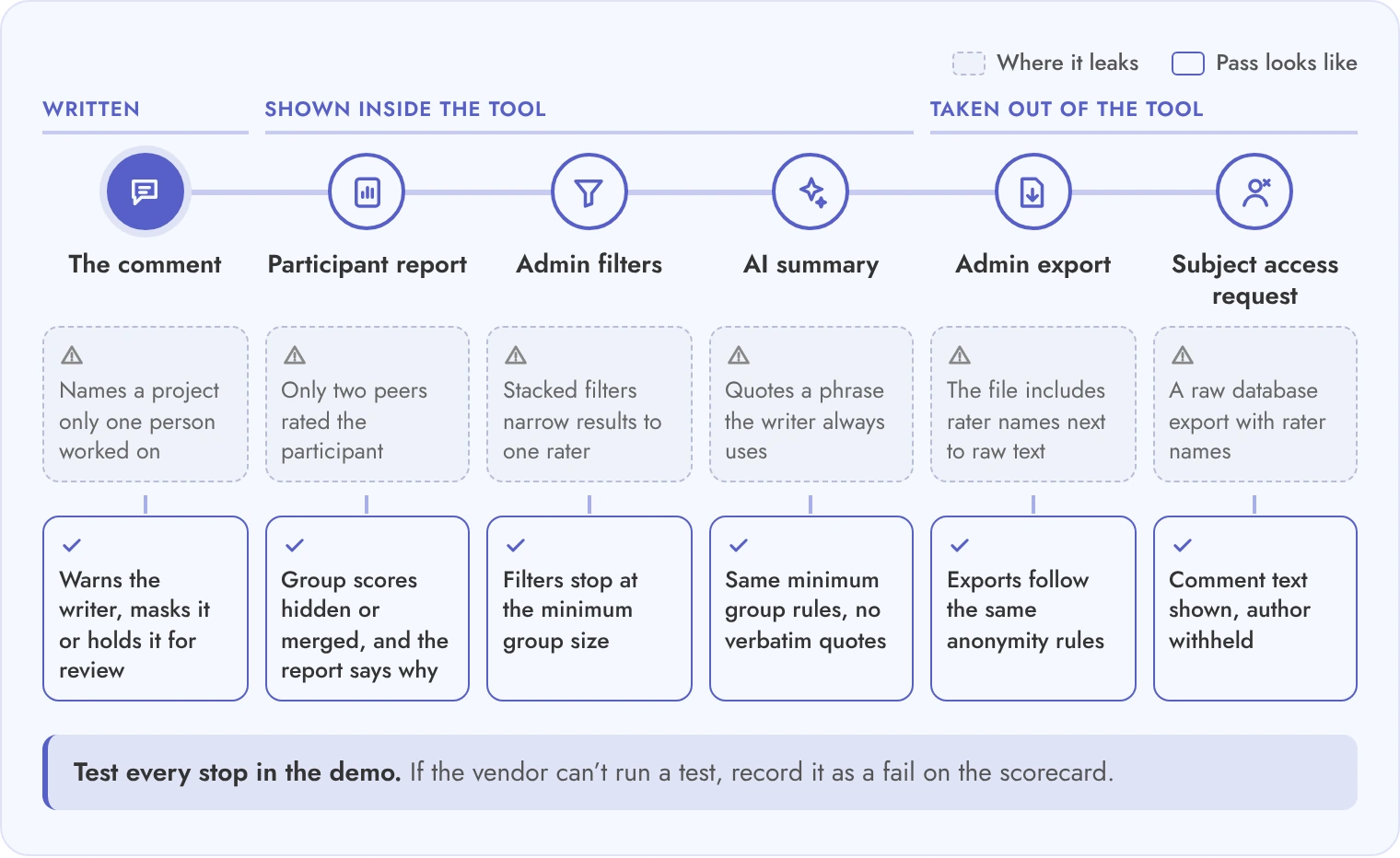
Each test has a clear pass condition. If the vendor cannot run a test, record that as a fail on the scorecard. Pair this list with the demo questions you already use so the two sessions are not repeated.
Anonymity and scale tests to run in the demo
Test
What to do
Pass looks like
Two-person rater group
Invite two peers to rate one participant and open the report
The group's scores are hidden or merged, and the report says why
Identifying free-text comment
Write a comment that names a project only one person worked on
The tool warns the writer, masks the comment or lets the participant see it only after review
Admin filters to one rater
As admin, filter results by department, location and grade until one rater remains
Filters stop at the minimum group size, or results are suppressed
5,000-row participant upload
Upload a file of 5,000 participants and raters with 200 deliberate errors
Valid rows load, and a downloadable error report names each bad row and reason
Nomination approval
Run one cycle where the manager approves raters and one where HR approves
Both routes work, approvers see only their own reports, and changes are logged
Three-language competency model
Run the same model in three languages and open one combined report
Questions display in each rater's language, and results combine in one view
Rater deprovisioned mid-cycle
Disable an account while the rater has an open request
The open request is reassigned or closed by policy, and existing responses stay anonymous
Contract-end export
Request all cycles, scores and comments for the whole tenant
A complete file arrives in an open format, with a written date for deletion of the original
Record the result of each test as pass, partial or fail, and attach the screen recording to the scorecard.
6. How do integrations and rollout work for 360 feedback across a large organization?
A 360 rollout depends on clean HRIS data, because reporting lines and org units decide who rates whom, so confirm sync direction and frequency before any other integration.
Ask which fields the HRIS sync reads: manager, department, location, grade, hire date and employment status. A wrong manager field produces wrong rater lists and wrong reports. Ask how often the sync runs and what happens when a user is terminated mid-cycle. Teamflect is built for Microsoft Teams and Microsoft 365 (Outlook too), and Power BI integration is native, with managed Power BI dashboards on the Enterprise plan. Review the HRIS integration catalog for your system, such as Workday or SAP SuccessFactors. The catalog lists 200+ systems.
Plan the rollout in waves. A pilot with one business unit exposes problems with rater lists and language before ten thousand people see them. The sequence below is a planning pattern, not a promise: your timeline depends on HRIS data quality, consultation requirements in each country and how many languages the questionnaire needs. The implementation guide and the data migration guide cover the general project steps.
Example rollout sequence for a large 360 program
Weeks 1 to 2: confirm policy (development use only or also talent review), the consultation checklist per country and the project owners from HR, IT security and legal.
Weeks 2 to 4: connect identity and HRIS, test the sync with a small export and fix manager and org-unit errors.
Weeks 3 to 6: build the competency model and questionnaire, translate it and review it with local HR.
Weeks 6 to 8: pilot with one business unit, including a deliberately small rater group to confirm the anonymity rule.
Weeks 8 to 10: train managers, admins and nominators, and publish the employee notice in each language.
Weeks 10 to 14: launch wave one, then review completion rates and support tickets before inviting the next unit.
Weeks 14 to 20: launch the remaining waves, with report release dates staggered so the HR team can support questions.
After the first full cycle: review the audit log, retention settings and export test, then decide on the next cycle.
Run the pilot with the hardest country and language first, not the easiest.
7. How do you build a three-year total cost of ownership (TCO) model for 360 feedback software?
A three-year TCO model adds licence fees, security add-ons, implementation, integration, admin time, training, renewal uplift and exit cost, and divides the total by participant-cycles to compare vendors fairly.
360 pricing is hard to compare because vendors charge on different bases: per participant, per cycle, per seat or as a platform fee plus a volume tier. The first step is to convert every quote into one unit, cost per participant per cycle. For Teamflect, the Enterprise plan is quoted per organization, so use the quote you receive, not a list price. An assigned Customer Success Manager, implementation support and training come with every paid plan. White-glove implementation, expert advisory hours and hands-on integration support are Enterprise only. Ask each vendor for written confirmation of what is and is not in the quote. The pricing page explains the plans.
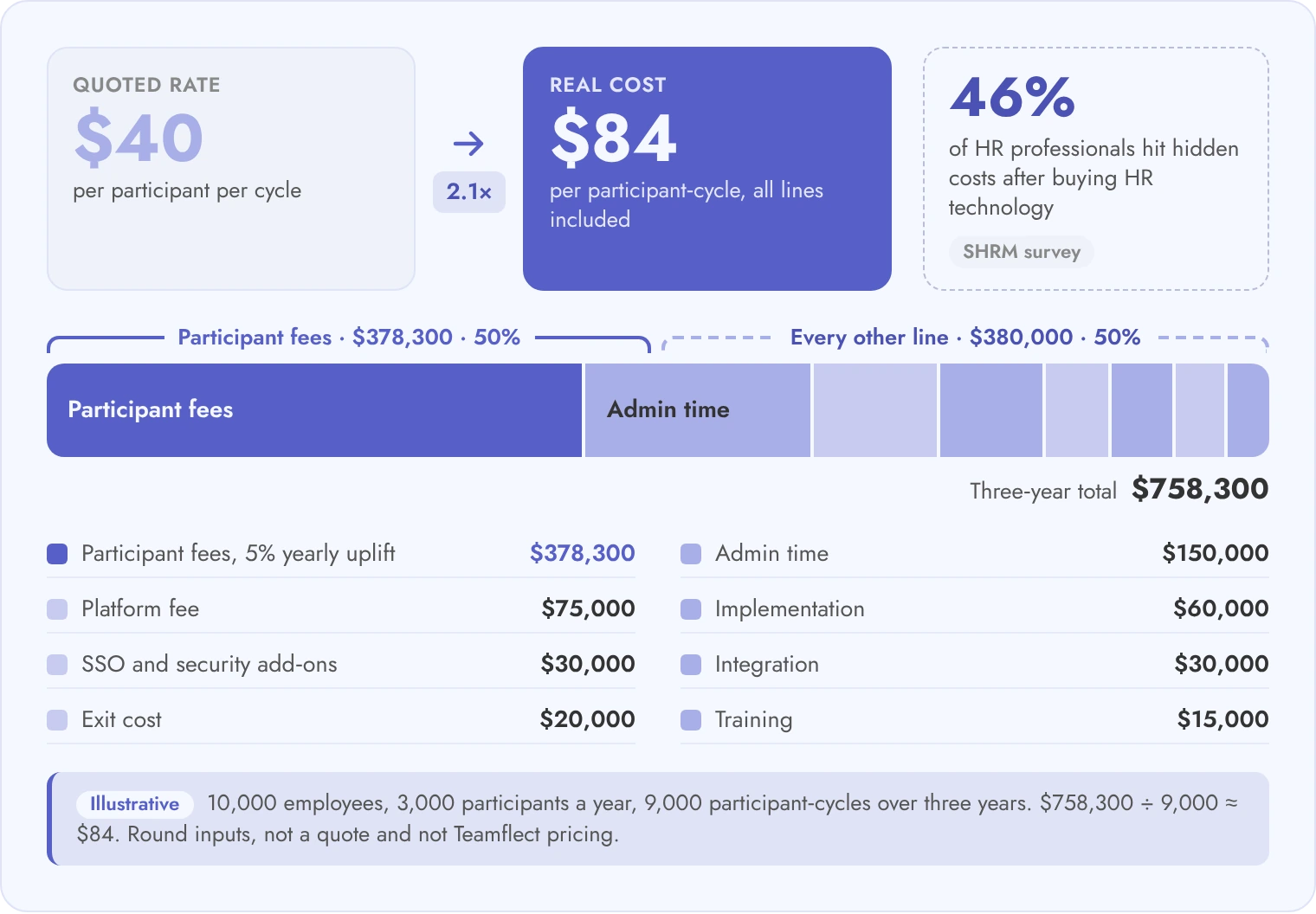
SHRM's survey of HR professionals found that 46% encountered hidden costs after buying HR technology, which is why the model below prices admin time and exit as well as licence fees.
Three-year cost lines for 360 feedback software
Ask each vendor to fill this table, then compare three-year totals, not headline rates. A vendor that quotes only the participant fee is leaving the largest costs off the page.
Cost line
Ask the vendor
Where it hides
Seat, participant or module fees
Is the fee per participant, per cycle, per seat or a platform fee? Are raters free?
Rater volume tiers, extra cycle charges, a separate fee for a second business unit
SSO and security add-ons
Which identity, key and logging features cost extra?
Audit log streaming, custom retention or data residency listed as add-ons
Implementation
What is included and what is billed by day?
Questionnaire design, translation and pilot support
Integration
Who builds and maintains the HRIS sync?
Custom field mapping, change requests, re-testing after HRIS upgrades
Admin time
How many hours does one cycle take for an HR admin?
Rater list corrections, reminders, reopening cycles and report release
Training
Are manager and nominator sessions included?
Per-language sessions and repeat sessions for each wave
Renewal uplift
What is the cap on renewal increases?
Uncapped renewal clause or price tied to headcount growth
Exit cost
What does a full export and deletion certificate cost?
Export fees, data format conversion, archive storage
Use the table to fill the worked example below. Every number is illustrative: round inputs chosen to show the arithmetic, not a quote and not Teamflect pricing. The company has 10,000 employees and 3,000 of them (managers and leaders) take part in one 360 cycle each year, so three years contain 9,000 participant-cycles.
Illustrative three-year TCO for 3,000 participants a year (all figures illustrative)
Cost line
Illustrative input
Three-year arithmetic
Total (USD)
Participant fees with 5 percent yearly uplift
$40 per participant per cycle, 3,000 participants
Year 1: 3,000 x 40 = 120,000. Year 2: 120,000 x 1.05 = 126,000. Year 3: 126,000 x 1.05 = 132,300
Divide 758,300 by 9,000 participant-cycles and the illustrative cost is about $84 per participant per cycle, a number you can set beside every vendor's quote.
8. How do you run the RFP, demo scoring and reference checks for 360 feedback software?
Send every vendor the same twelve written questions, score the demo with a weighted scorecard, and finish with reference calls to customers of similar size.
The questions below are grouped by area and can be copied into an RFP as they are. They cover the procurement risks in this guide. For scoring product features such as question types, templates and report design, use the feature rubric, which has its own scoring workbook.
Twelve RFP questions for 360 feedback vendors
Ask for written answers, with documents attached where evidence is listed. Unsigned answers to security questions are verbal promises, not evidence.
Anonymity: What is the minimum number of raters per group before scores are shown, and who can change it?
Anonymity: What does the participant see when a rater group is below the threshold?
Comments: Who can see rater names or raw comments, and is every view logged?
Comments: How do you prevent identification through free-text comments, filters and exports?
Security: Provide your current SOC 2 report, the sub-processor list and the date of your last penetration test summary.
Identity: Which SSO and provisioning methods do you support, and what happens to an open request when a rater is deprovisioned?
Privacy: How do you support subject access requests for comments about an employee, and how long are raw comments retained?
AI: Where is comment text processed for summaries, and is customer text used to train any model?
Scale: What is the largest participant upload you have run in one file, and how are errors reported?
Integration: Which HRIS fields do you read, how often, and in which direction?
Cost: Provide a three-year price for 3,000 participants and 10,000 raters per cycle, including all add-ons and the renewal cap.
Exit: Describe the full export of cycles, scores and comments at contract end and the date original data is deleted.
Weights are a starting point. Adjust them to your policy, for example by raising Privacy and AI governance if your legal team expects a heavier review.
Starting weights for an enterprise 360 feedback scorecard
Area
Weight (%)
Who scores it
Anonymity and comment protection
20
HR lead and HR legal
Security and identity
15
IT security reviewer
Privacy and AI governance
15
Privacy officer and HR legal
Scale and cycle administration
15
HR operations
Integrations and rollout
10
IT and HR operations
Reporting and talent review use
10
CHRO team
Three-year cost
10
Procurement and finance
Vendor viability and references
5
Procurement
Reference-call script and vendor viability checks
Ask for two references of similar size and with a similar country mix. Use these six questions on each call.
How many participants and raters did your largest cycle include, and in how many languages?
Did anyone ever identify a rater from a report or an export, and how was it handled?
How accurate was the HRIS sync, and who fixed errors?
What did the first cycle cost in admin hours compared with the quote?
What did the vendor do when a problem appeared mid-cycle?
What would you change in the contract if you signed again?
Add four viability checks: audited financials or funding status, customer retention if the vendor will share it, the vendor's support hours across your regions and a named executive sponsor for your account. Teamflect offers 24/5 support across the US and Europe, with an assigned Customer Success Manager on every paid plan.
Total the weighted scores only after the evidence pack, the demo tests and both reference calls are complete.
Enterprise 360 Feedback Software FAQ
How many raters are needed before a 360 report shows group scores?
There is no universal number, so set the threshold in your own policy and test that the tool enforces it. Ask each vendor for its default, who can change it and what appears when a group is too small.
Should 360 feedback results feed pay decisions?
Many HR teams keep 360 results out of pay decisions and use them for development and talent review instead, because raters write more candidly when pay is not at stake. Decide your policy first, then check that the software can restrict who sees individual reports and whether results can be exported to compensation tools.
Do we need works council consultation before launching 360 feedback?
Ask your HR legal team, country by country. In some countries a works council or employee representative body must be consulted before a tool that assesses employees is introduced. The vendor can supply a plain description of the data collected and who sees it, which helps the consultation move faster.
Who can see the comments that employees write about a colleague?
That depends on the tool's permission model, so request the role matrix before you buy. Check whether administrators can see rater names, whether comments are masked, whether every report view is logged and whether subject access requests reveal authors. A good answer names each role and each permission.
What does the implementation timeline for enterprise 360 feedback depend on?
It depends on HRIS data quality, how many languages the questionnaire needs, consultation requirements in each country and how many waves you run. The sequence in section 6 shows an illustrative planning pattern of about 20 weeks for a full launch, but treat it as a starting point and ask each vendor for its own plan.





 Request a Demo